Colleague and friend Brian Hollar commented yesterday concerning the possibility of a space elevator: a robotic machine that runs up and down a teather with one end anchored on earth and the other anchored to an object in orbit.
Brian thinks the idea is very promising, quoting Business 2.0's comparison of the idea: "The space elevator is where the PC was in the 1960s: The theory is solid, the materials exist, and people in garages are starting to tinker with the next step."
But the biggest hurdle to the space elevator is that NASA has latched on to it. The elevator is destined to be expensive (estimates start at about five billion USD) adding to the already high likelihood that it'll make a lot of headlines. This is more of a weakness than a boon. When NASA projects make headlines before they are complete, the project becomes a political pawn. The focus changes, the budget fluctuates, projects are added on and taken off, rivalries and infighting overcome the goals and, if you're lucky enough to finish what you started, it'll be a shadow of what it was supposed to be. The ISS is the first example that comes to mind.
Don't get me wrong; there are some things NASA's starting to do right. Following the X-Prize lead, it's offering annual prizes for those that solve certain technology obstacles the elevator faces. But the prize money is tiny ($50,000 for each of the two elevator-related prizes) and while one has thus far received an impressive following (19 teams this year for the tether prize), the other is proceeding lacklusterly (4 teams last year, only two so far this year).
NASA's core problem with its approach on this strategy is that it's missing the whole point of the prize system. The idea is to encourage novel solutions of achieving goals, not to simply outsource your R&D department. By stating how NASA would like to get into space (the elevator), that strategy is embodied in the rules and hampers engineers from using their own ideas. For example, the tether prize states all tethers must form a closed loop, weigh a maximum of 2 grams, have an inner circumference of 2m long, +/- 1cm, and can be no wider than 200mm.
The goal isn't to get into space with an elevator; the goal is to get into space cheaply.
Wednesday, March 08, 2006
Tuesday, March 07, 2006
Ah! I've Been Tagged!


Steve Horowitz just tagged me a few minutes ago and since it's more fun than studying econometrics, let's run with it.
Four jobs I’ve had
1. Dishwasher/Busboy
2. Teaching assistant (microeconomics)
3. College scene shop worker (building sets for plays)
4. "Team member" at Jo-Ann Fabrics and Crafts (a very manly job, I must add)
Four movies I can watch over and over
1. The Count of Monte Cristo
2. Snatch
3. Indiana Jones and the Last Crusade
4. Star Trek 6: The Undiscovered Country
Four places I’ve lived
1. Davenport, IA
2. Fairfax, VA
3. Beloit, WI
4. Istanbul, Turkey
Four TV shows I love
1. Firefly
2. Southpark
3. The West Wing
4. Battlestar Galactica
Four highly regarded and recommended TV shows I haven’t seen (much of)
1. Desperate Housewives
2. Grey's Anatomy
3. 24
4. House
Four places I’ve vacationed
1. Rome
2. Alaska
3. Orlando, Florida
4. Barcelona
Four of my favorite dishes
1. Spaghetti with meatballs
2. Chicken and garlic calzone
3. Fudge brownie with vanilla ice cream and hot chocolate sauce
4. Chicken Caesar salad
Four sites I visit daily
1. Wikipedia
2. Google News
3. At least one blog of a professor or peer
4. Gmail
Four places I’d rather be right now
1. An empty tropical beach, reading
2. Roaming the streets of Paris, eating crepes
3. Sitting around with old friends from Beloit, catching up
4. Sitting around with old friends from Beloit, pretending to be people far cooler than we could ever be.
Four new bloggers I’m tagging
1. Jason Briggeman
2. Capital Freedom
3. Jeremy Horpedahl
4. Michael Thomas
Friday, March 03, 2006
March's Most Random Wikipedia Page Is...
Ok I don't plan to do this every month, but List of sets of unrelated songs with identical titles should win something.
Congratulations Wikipedia!
For achieving its one millionth article on the first of March.
Not surprisingly, the landmark article--Jordanhill railway station--is probably one of the fastest growing articles about a mundane topic, achieving 31 discussion topic and citing 21 references within the first three days of its creation.
Just another example of how decentralized order can create wonders central planners could never dream of.
Wednesday, March 01, 2006
Pickpocketed At the Pump
Way back in August, I commented that the imposed price ceilings of Hawaii gas would actually cause the retail price to rise (because the law only pertains to wholesale gas prices). After checking data at Hawaiigasprices.com, it appears my logic was sound.
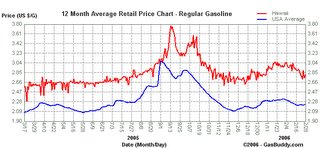
Note that before the law came into effect on September 1, Hawaii gas prices were about 38-57 cents higher than the US average. After September 1, prices were about 57-78 cents higher. (Note the two expections shortly after Katrina, where the difference goes from 95 cents to 38 cents.)
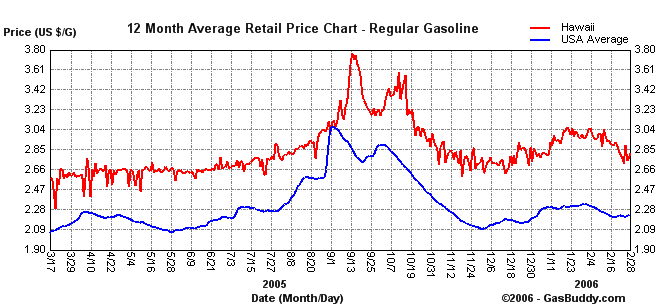
Note that before the law came into effect on September 1, Hawaii gas prices were about 38-57 cents higher than the US average. After September 1, prices were about 57-78 cents higher. (Note the two expections shortly after Katrina, where the difference goes from 95 cents to 38 cents.)
Tuesday, February 28, 2006
Give Trade a Chance
A random walk along the Internet today led me to a disdainful look at Thomas Friedman, which led me to his Wikipedia entry, which led me to a criticism piece entitled, "FLATMAN I'm sorry, but the world's still round."
I have mixed feelings about Friedman: I don't agree with him that America needs to compete to maintain it's hold on high tech sectors nor do I feel that the US needs to maintain a dominance in finance. No one thing is the key to prosperity; that's what globalization is for in the first place.
He has some interesting takes how globalization changes cultural norms, though. And while he might put too much stock in the idea of trade as a universally peaceful solution (a la the Golden Arches Theory of Conflict Prevention) it conveys a powerful point. Take this criticism of the theory, penned by Siddharth Varadarajan: "cross investment and extensive trade relations have never prevented countries from going to war against each other."
That's quite a claim, especially since he's citing historical evidence. Especially since we tend not to study times war almost broke out (and we really don't study potential wars that never had a chance to break out, like the US invading Canada anytime in the past fifty or so years). It's hard to measure trade's impact on peace and while I don't think it prevents all conflict, it's even more absurd to claim it prevents none.
Sunday, February 26, 2006
Newtonian Time
Taking a little study break, I added an article about Newtonian time to Wikipedia. Newtonian time is a facet of neo-classical economics and because of its rigidity, it assumes away endogenous change. Austrians openly reject the idea of Newtonian time and embrace real time instead, which is an article I'll write later.
Wow, this is what I do for my break? I'm going to go watch American Dad.
Wow, this is what I do for my break? I'm going to go watch American Dad.
Checking for Fallacies
Way back when, Mike and I came up with the idea of The Fallacy of the Unclaimed Dollar. I doubt this idea is new, but the fallacy goes a little something like this: If something hasn't happened yet, it's probably a bad idea. The name comes from a joke economists like to tell each other about a professor refusing to pick up a dollar bill because if it was really there, someone would have picked it up by now.
(Side Note: I actually want to change the name to Fallacy of the Unclaimed Fortune, but for consistency's sake, let's keep with the original name.)
It's recently occured to me that Austrians may be committing this fallacy despite our focus on the ongoing process of market change, that circumstances aren't predetermined. At the very least, we get dangerously close to commiting this fallacy when we dismiss a government agency as inefficent because "if it was a good idea, the private sector would have done it."
Granted, that's just the tip of the iceberg for arguments against Agency X (the government isn't spending their own money; they don't have a strong vested interest in being effective or efficent; they lack the relevant knowledge to accomplish such a task and on and on and on). And far be it from me to suggest a rationale for government agencies. But if we are to be scientists and if we are to avoid the intellectual traps of lazy or simplistic arguments, we should be prepared to move past this standard claim and acknowledge this is not a sufficient argument for everything.
Wednesday, February 22, 2006
Dirty Deeds Done With Dogs
In an attempt to stave off the apparent orgy of dog-fighting going on Scotland, new anti-animal fighting laws will be going into effect shortly. The new laws punishes anyone engaging in activities related to the fights (including distributing tapes of them) with severe penalties of up to 12,000 pounds and up to a year in prison.
I really don't have a problem with dog-fighting, and not just because I'm a cat person. My main source of skepticism comes from the supporters of bills like these who then gladly eat bacon, chicken and humanity's other "animal friends."
I don't know how a feel about animal torture in general; my heart says it's wrong but my head can't figure out a reason and having "bad feelings" isn't enough to infringe on another's liberties. I do know that with all the crazy injustices going on the world, focusing on a small part of the population watching dogs fight is an absurd waste of one's time. I guess perspective is the first thing you loose when you live in a prosperous society.
Sunday, February 19, 2006
O Brother, What Art Thou Thinking?
Last week Mike guest posted about labor laws and spawned a 10-comment (!) debate on the subject. I thought about responding to some criticisms via comment but since I don't have much of anything to write about just now, I thought I'd turn it into a post.
In the comments section, I wrote that employers should be able to fire employees for whatever reason they want. And yes, that includes for reasons of race, marriage status, religion and every other distinction you can think of. Why? Consider the reasons an employer would do this: 1) because he's a jerk in which case it's his lose and 2) because the customer wants it in which case why punish the employer? Before you argue, ask yourself if you'd like to see Denzel Washington as a Nazi or William H. Macy as Martin Luther King. It's an extreme case, but the basic ideas are constant.
My brother correctly pointed out that firms do not fire people on a whim and they have a vested interest in seeing them work out. Yet he paradoxically thinks it's a good idea to require firms to have "proof of ineptitude" before firing someone. If the firm has a vested interest in seeing the employee do well, then why do you need a law requiring the firm not fire employees that could do well? (Consider this article I wrote about Donald Trump and his hiring practices for The Apprentice.)
Labor laws like these are layered in truthiness. For example, my brother also cites that he's been in the "real world" for about nine years and implies I'm detatched from it's realities. But his experience is a weakness as much as a strength because he's only been on the labor side. Not surprisingly, he thinks labor should be protected from management citing the "human cost." Feelings as opposed to facts.
The fact of the matter is if you start favoring one group, you punish another and usually several others. I may have been in the "ivory tower" for most of my life but it's not like I've been studying English literature. Economics is the study of choice and it's chiefly concerned with creating a better world; the conclusions I have made have not been arrived at lightly. And for the record, I've worked jobs myself. I've had good employers and bad employers; I've seen good employees and bad employees. The world is not so uniform you can ethically make a law that favors one side; laws are good for issues of homogeneity, not diversity.
Friday, February 17, 2006
A Wee Bit of Culture
Prometheus is by far my favorite figure in Greek mythology. Defiant. Intelligence. A bit of a wise ass but also the patron of human civilization. Like the authors that wrote of him (notably Lord Byron and Percy Bysshe Shelly), he recognized the grand potential of free minds and free societies.
I stumbled on this poem about Prometheus, written by Lord Byron and published in 1816. Comparing Prometheus to the human spirit Byron wrote,
I stumbled on this poem about Prometheus, written by Lord Byron and published in 1816. Comparing Prometheus to the human spirit Byron wrote,
And a firm will, and a deep sense,
Which even in torture can descry
Its own concenter'd recompense,
Triumphant where it dares defy
Wednesday, February 15, 2006
Facts and Theories
At its most basic, good economics is about two things: good theory and good data. Some will say it's more about the data and some will emphasize the theory but a good economist combines both into a coherent explanation about the world around us. If your theory can't be supported by the data, you better rethink your theory. Yet if your data says one thing but you can't construct an explanation that's consistent with accepted truths, there's something probably wrong with your data.
That reality came to head Friday night when an AU student and I got into a discussion about income data. He pointed to the old claims that the rich are getting richer and the poor are getting poorer. Remembering an IHS seminiar Steve Horwitz spoke at a few years ago, I pointed to data that said the poor were getting richer, too.
He responded that the data--which tracks a family's income over time--is flawed because poor people move more than other people, so you don't count them and there's a sampling bias. He, who has been studying income data for ten years, noted stasticians have come up with a weight to adjust for this and when applied, the poor are getting poorer. (Note that according to the data 95% of the lowest quintile move up from it at least one quintile, suggesting that must have been one hell of a weight to make such a drastic change. Perhaps poor people are literal nomads...)
I've never heard of this weight, so I let it go and gave him the benefit of the doubt. "So what's your explanation, then?" I asked. His theory was quite....elaborate.
He noted that the rich are more likely to save than the poor. Seems reasonable. So, he said, the rich put their money in a bank and live off the interest and the wealth stays at the top. I insisted we follow the money beyond that. So we agreed that the bank could then take all of that money and lend it to a corporation which then could give it all to their highest paid inwhich the whole cycle could start over again.
Now to fully grasp this AU student's theory, replace every "could" with "always" because that's the only way the money could stay at the top. He insisted that all you need is that higher liklihood for savings but, as I tried to explain, that doesn't work. Money leaks out and spreads around; it moves between classes, industries and countries. It's a medium of exchange--that's why we have it.
I also wanted to point out that even if this "100% always" theory held, it still wouldn't mean the data's telling a good story. Companies don't give millions to CEOs just because they feel like--they do it as a reward for making the company more efficient which means society just got richer. I avoided that point, however, as I suspected the conversation would quickly devolve into conspiratorial claims that the rich focus on keeping the downtrodden poor.
Still, the bias claim was new to me so I e-mail Steve Horwitz about it. He responded quite quickly and suggested the burden of proof rests on the AU student. The PSID data is highly respected and widely used; what special ability allows for him to know how much to reweight the data? I'm not sure how I feel about this; it seems pretty straightforward to run surveys and ask people how many times they've moved in the past five or ten years, even if you include complications such as students moving from college to home.
But Steve offered an even better bit of evidence that the poor have gotten richer over the past thirty years: They have more stuff. Even if there's more debt, are they really "poorer" if that debt means having AC, cable and a washer and dryer? They clearly don't think so.
If your theory is sloppy, then your data probably is too, especially when your data contradicts accepted truths.
Tuesday, February 14, 2006
Labor Laws
This is Mike, Guest Posting here. More like homecoming, but I still consider myself a guest. I told the story below to David, who begged me to blog it. I am currently studying Anthropology and Buddhism in Thailand, which gives me an interesting chance to see a lot of economic questions in a slightly different setting. Depending on my reception I may blog some of those too.
A friend of mine from Germany and I had dinner the other night and discussed German labor laws. In Germany it is exceedingly difficult, or at least very costly to fire a person. A very solid foundation of evidence of incompetence and damage to the firm must be laid before even thinking about firing a person, because a lawsuit and a government intervention will speed right in to the rescue. The intent, as is the intent with so many economic policies, is to benefit the poor, oppressed working classes against the evil corporations. The actual effect I leave as an exercise to you. I would suggest as a starting point that the laws benefit the already employed at the expense of the desiring-to-be-employed and the bottom lines of the employers. However, some employers have found an ingenious (if illegal) workaround.
Say an employee is peforming at a level that ought to get him fired but in Germany would not, due to the hassle. A manager at this employee's firm will speak to his counterpart in a competing firm and ask them to hire the employee away, through a headhunter. The employee, excited about being hired away, takes the job at the competitor and begins work there. Meanwhile, the new firm gives him a slight raise, but the raise and the salary are actually paid by the original firm. Why?
Because the labor laws allow a grace period of about a month after hiring in which companies can still fire new employees freely without much difficulty. So after a few weeks feigning due diligence, the new employee is unceremoniously let go, unable to sue his old firm which he left voluntarily and unable to sue his new firm which is exempt from the ruleswas still in the grace period. Apparently entire industries will engage in this kind of trade back and forth, under the table, all to maintain some form of efficiency.
The market finds a way, albiet a little messy. But who loses? That's right, labor.
Monday, February 13, 2006
The Meaning of Collusion
Skeptics of the market love conspiracies; it's an easy way to side step the observed and provable to make outrageous claims. To no surprise of my own I came across a few conspiracy-laced theories Friday night, the most notable of which was the "implict collusion between car manufacturers."
What? I said. We see intense compeition between such firms; how can one claim they are secretly colluding?
Well, the AU student in question used to work in the industry and noticed the profit margins for car parts and vechiles was "identical." He concluded there's an acceptable level of profit and they collude to keep that profit steady.
I bypassed the obvious point that if they are setting the price they collectively could increase it easly suspecting he would respond with the standard "keeping up apppearances" defense. Instead, I pointed out that uniform prices are not evidence of collusion (though I don't doubt such prices are more or less uniform). An enforcement mechanism designed to hinder defection is evidence. What is the enforcement mechanism for car makers?
His answer was vague, claiming firms would be kept out of "special deals" if they defected. Backroom deals. Secret agreements. Implict collusion. It's not that I don't think conspiracies can't exist, it's just I'll only consider them a possibility if there lacks a better explanation.
To explain uniform prices, I noted the role of risk. Just as oil companies experience high profits and high losses (but unremarkable profits when the quarters are averaged), car companies probably demand higher mark ups because they deal in durable (and thus riskier) goods. At least one AU listener acknowledged the role of risk in determining profits but my fellow conversationalist did not seem to agree.
NOTE: My AU counterpart also cited the perfect competition model as evidence of collusion; in "perfect competition" there are no profits (which is not true; there are no windfall profts). Thus, the industry is not perfectly competitive. I told him it's distrubing when PhD econ students think a model completely describes reality. PC is useful to explain some phenomena but as Hayek noted, the model lacks all elements of actual competitiveness. He mumbled something and let the issue drop there.
Sunday, February 12, 2006
The Gravity of Incentives
There are very few wide ranging Rules of Economics, especially when you compare it to the hard sciences. Easily one of the most basic is "incentives matter." We see it everywhere: when prices increase, supply responds as fast as it can; when a grocery line is shorter, people are more likely to gravitate towards it; when wages for a job increase, more people are willing to do the work. Incentives play as vital role in economics as gravity does in physics.
So imagine my surprise when one of my first conversations with an AU econ grad student involved him saying "incentives aren't that important." I was stunned.
He stated that many people do things without monetary gain. In a way, it's true. Most of human history existed in a cooperative structure where people--in small family units--did favors for each other. But that doesn't mean incentives aren't important. Sometimes people do things for moral or social reasons. Sometimes it's as basic as simple survival. Sometimes you do something nice because it gives you a warm fuzzy feeling. All organisms are creatures of purpose and humans are no expection.
Ok, my colleague said, so why can't we use moral or social incentives do get things done? Why the emphasis of material incentives? He cited collective farms as a prime example where people pitch in out of sense of community. I have no doubt these communities exist because they emulate the social structure of hunter-gatherer societies. Large scale societies (and by "large" I talk of a hundred or more) tend not to be able to function in this way.
There are many reasons why this is but I would say enforcement is a main one. Allow me to digress into a personal example. I went to a very small school--my graduating class was ten and that was a big class. There were roughly thirty students in the high school in total. Thus we pretty much hung out with each other even if we had little in common. (In fact, of these thirty-odd people I only consider a few to be friends and I talk regularly to an even smaller number.)
Contrast this with most high schools, which are much larger. Clicks are not just common, they are a staple of growing up (and being an adult come to think of it). People gravitate towards those that are like them. In small societies, if you piss off others, you're alone. In large ones, if you piss off others, you just hang out with your friends. Typical strategies of guilt and ostracism don't work between strangers.
Not all kinds of incentives matter all the time. Social incentives work better in small groups; material incentives work better in large groups. But I'm not willing to say incentives aren't that important no more than I'm willing to point to a hot air balloon and question the significance of gravity.
Saturday, February 11, 2006
Through the Looking Glass
Last night I had a date with this girl I met online. It turned out we were both first year PhD economics students (me at Mason, she at American) and we've been talking via e-mail comparing classes.
During this date, I discovered that American University's economic department leaned left. So after dinner, we decided to go to meet up with some of her friends from the program in a bar. It was here I discovered AU's program was Very Leftist.
It's hard to overstate how different I learned our departments and student body were. When I mentioned I was from Mason, there were cringes and looks of horror. When I noted I had friends at Cato and IHS, they were visibly shaken. They talked of the Soviet Union just not having the right people in charge, of incentives not mattering that much and an "implict collusion" between car makers.
I had never fathomed an economics department could seriously embrace these ideas in this day in age, especially at a world-renown school like American. But there it was, Ying to Mason's Yang; stir to Mason's shake; Bizarro to Mason's Superman (or perhaps more appropriately, Superman to Mason's Bizarro because Superman is a socialist).
Over the next few blog posts, I plan to retell--to the best of my ability--some of the discussions I engaged in with AU's econ students. I think it's worthy to engage in such dialogues; its helpful and neccessary to do so if you want to continue to claim to be a scientist. Hopefully my retellings will demonstrate that.
The Return of Mike
My old blogging partner (and co-founder of L3) Mike will be back for a guest post. Let us all wish him the best of luck and hope he decides to stay. His articles are always insightful and thought-provoking and I'm looking forward to reading his economic commentary once again.
Friday, February 10, 2006
Quick! Someone Give Us Something To Honor!
Here's a sampling of what the House did on Legislative Day of February 8, 2006:
-H.RES.670: Congratulations to the Pittsburgh Steelers for winning the Super Bowl.
-H.R.4456: Renaming a post office in Arkansas the "Hattie W. Caraway Station."
-H.R.389: Saying how great museums are in this, the "Year of the Museum."
-H.R.660: And let's not forget this month is National Mentoring Month which stands for some pretty awesome ideas.
-H.R. 657: Catholic schools are pretty cool, too.
Each of these required 40 minutes of debate (I'm thinking debate is a requirement for all resolutions). Don't get me wrong: I'm all in favor of lawmakers wasting time; it gives them less time to do something damaging. But as long as they are not doing anything really important, they might as well be occupied doing something productive like picking up trash. Crimminals do it so it's got to be good enough for politicians, right?
Hippies Get High (But In A Way That Makes It News Worthy)
Mike sent me an e-mail containing this link with the exclamatory subject, "Malthus!"
The link led me to a page describing "Z-Axis Urban Agriculture," otherwise known as putting a bunch of plants in a skyscraper. The article warns of the growing population growth of the planet and even with improved technology, humanity may have trouble finding the land to feed itself (which may or may not be true as we don't know what this new technology will look like).
The article trumps the buildings as a way to reduce a community's "ecological footprint" and other nonsense about needing to increase the quality of urban settings. The artist's conception even sports tiny wind power plants at the top.
The strangest bit about all of this is Julian Simon had a similar idea except he was more ambitious. Using hydroponic bays, we could grow all the food for the whole world in a giant 100-story building the size of a small state (I think it was New Jersey).
Simon, however, was using it only as a hypothetical point to illustrate how humanity was in no danger of "running out of farm land" as these cranks claim we are. It's true that ideas like Z-axis farming are what ensure we don't have to worry about a food shortage and in doing so, these neo-Malthusians are proving their own scares false.
The thing I can't get past (besides the staggering but so far uncited panic number that 80% of the arable land is farmed) is the effort to make a test farm in New York from an abandoned building as part of the general strategy. If land is becoming so scarce, how come there are all these abandoned buildings in urban areas (where land is generally more valuable than its counterparts in rural areas).
If and when this becomes an important tool to feed humanity, it will happen because the rising food prices will make such an endeavor profitable. If not, then not. Either way, we don't need neo-Malthusians making test farms, spreading panic in their wake.
Wednesday, February 08, 2006
40 Acres and an iPod
Mike sent me this link. Watch it; apparently Lincoln and Washington knew the power of electronics.
Tuesday, February 07, 2006
Mixed Feelings From the House
I never thought I'd say this, but reading the daily proceedings from the House floor has actually made me more optimistic about government (though I wasn't very optimistic in the first place).
Consider their activities on the first of February, 2006. The House debated for forty minutes on H. Res. 648. An intense debate it must have been because HR 648 "eliminate floor privileges and access to Member exercise facilities for registered lobbyists who are former Members or officers of the House." (They passed it, by the way.)
At the same time, I get more concerned. They spent the same amount of time debating H.R.4659, which extends the Patriot Act (it also passed by the way and was signed by the President four days ago).
And then I get confused. For example, at 5:07 the "House agreed to Senate amendment to House amendment pursuant to H. Res. 653." which relates "to consideration of the bill (S. 1932) to provide for reconciliation pursuant to section 202(a) of the concurrent resolution on the budget for fiscal year 2006 (H. Con. Res. 95)."
But the most damning thing of all is they took a week off, due to reconvene today at 2 PM. God only knows what they did in the meantime.
Channel 101 101
Last week I posted an article about Channel 101, praising it as an improved institution over conventional television.
My colleague, Jason Briggeman, disagrees passionately as he notes that voting in the conventional sense (the prime mechanism for which 101 uses to determine which shows to keep) is not the same as watching a show every week and "voting" that way. The former is simply "talk," putting your stamp of approval, that really doesn't bear a cost to you, on a show of which you shrug your shoulders and say, "why not?" The latter requires the voter to bear a very real cost, such as spending the time to watch the show in question. The former does not. Jeremy made a similar agrument commenting on the difference between American Idol voters and the Billboard rankings.
These are very good points, but let me take a moment to defend 101's methods. I acknowledge that imposing costs for voting is a much more accurate way to discover what people want, ceteris paribus. But it isn't completely divorced from preferences; it still has its uses. More fundamentally, expressing choice for media is not easy because one must consume the product before determining if it was a good idea to do so.
Media companies have developed a few ways of getting around this problem (creating previews, measuring returning audiences, creating advertising campaigns) but these strategies are hardly appropriate for five-minute shows that are to be judged on a episode-by-episode basis (for example, measuring returning audiences would require making two episdoes of a potentially bad concept, meaning one new show wouldn't have as much of a chance to be shown, thanks to opportunity costs). I've toyed with the idea of spliting up each episode and then measuring how many people download the second half, but downloading 2.5 minutes of video nowadays hardly imposes a cost on the consumer. Perhaps there is a good idea out there to solve the problem, but I haven't heard it yet.
It is not that voting (which by the way is approval voting) on 101 is ideal. But given the turnover, 101 does what is sets out to do; the voting system is certainly sufficent and (I'd argue) Channel 101 much more dynamic than conventional television as a result. (Jason and I did come to the agreement that if 101 became mainstream, it could just start turning out crap, depending how it was organized.)
Saturday, February 04, 2006
Welcome To the 21st Century
Today on MSNBC, a guy (the Secretary, I believe) from Veterans Affairs pronounced a revolutionary development that change everything for providing veteran's health care. After building up the advancement to suggest a medical breakthrough, he smugly announced they've switched to electronic health records.
Excuse me? Dozens of sectors started using computers decades ago to coordinate and store data. American Airlines completed an automated reservation network as early as 1964. VA finally making it to the punch isn't revolutionary; it's meeting minimal standards. You want it to be revolutionary? Try jumping back half a century.
Excuse me? Dozens of sectors started using computers decades ago to coordinate and store data. American Airlines completed an automated reservation network as early as 1964. VA finally making it to the punch isn't revolutionary; it's meeting minimal standards. You want it to be revolutionary? Try jumping back half a century.
Tuesday, January 31, 2006
What Would Hayek Watch?
Imagine a channel where anyone can submit shows and the audience votes on which to keep every month. Where creativity is your greatest asset. Where new ideas are constantly being churned in, and then out. That's Channel 101; almost a standard television station, but completely different at the same time.
The premise is based on peer production. Anyone, from artistes to epigones, can submit a five minute show to the site. People vote on which shows they like and the winners are picked up for another episode. The losers go back to the drawing board. (Nifty diagram here.)
The best part about it is that there's no resting on your laurels. Even if you get picked up, you get picked up for just one show; the second, third or even twelveth episode is treated like a pilot for voting purposes.
Sadly the show is not as rooted in peer production as I'd like to see. Submitted pilots have to go through a screening process by the "Prime Timers" and one cannot take a failed idea and try to improved on it (well, one might be able to, but Channel 101 gives all legal rights of the episode to the submitter, so it might get messy). Moreover, only five ideas are allowed to be kept, even if there are six good ideas.
A lot of this is meant to simulate the corporate world so (I'm guessing) promising filmmakers can get a harsh dose of reality. According to the site, "Channel 101 is where you learn three things: How to fail, how to succeed, and finally, how there is no difference between the two....You surrender to the audience as life-giving God and acquire total creative freedom through that surrender."
The consumer is king!
The Boys Are Back In Town
Today at noon, the House will reconvene for a new legislative day, returning from a vacation lasting since the 3rd of January.
I have no problem with Representatives taking some time off. However, one of my New Year's resolutions is to blog more about what the House passes but the media doesn't cover. Few people actually look at what the House passes. Perhaps that's for a good reason. Perhaps not. Looks like I'm going to find out either way.
I have no problem with Representatives taking some time off. However, one of my New Year's resolutions is to blog more about what the House passes but the media doesn't cover. Few people actually look at what the House passes. Perhaps that's for a good reason. Perhaps not. Looks like I'm going to find out either way.
Friday, January 27, 2006
Learn to Market "Market"
Tonight, Larry Kudlow ran an online poll for his show asking, "Which is the more reliable economic indicator? Markets or GDP?" The episode concluded with the results; 54/46, favoring of markets.
Larry seemed quite pleased with this result, but I'm just confused. Market for what? Everything? That's just a tautology. Gold? Too ambiguous. Copper? Aluminum? Sodium nitrate? Some combination? Is it a reference to the DOW or Nasdaq?
He's right to look down on GDP, and there are alternatives (copper is my favorite check, at least for short term changes), but don't load the question with the nice-sounding--but ultimately meaningless--description, "market."
WikiDistraction
Wikipedia is organized in such a way, it's very easy to get lost in it. For example, pick any date (such as your birthday) and look it up to see shared birthdays and important events (and deaths, but that's not as fun).
On my birthday, Kellogg patented corn flakes, the 17th Amendment was added to the Constitution, the Ford made the last Model T, Seinfeld premired, Union (and later Republic) of South Africa was founded and Mark Felt admited to being Deepthroat. (Not to mention the Tulsa Race Riots, the Battle of Seven Pines, the Johnstown Flood and the Ancash earthquake.)
Shared birthdays include two kings, four Nobel Prize laureates (including economist Maurice Allais), Walt Whitman and Pope Pius XI. As a juxtaposition to the last two, I also share it with Colin Farrel and Clint Eastwood. The question then becomes who do I mention first at parties?
NASA Wises Up...Sort Of
Twenty years after the Challenger explosion, NASA finally announced the space shuttle will be scraped and they will undertake a new generation of design.
The shuttle has never worked the way it was supposed to, and by that I mean be cheaper to operate than a rocket and capasule. Thus, NASA will design a new rocket and capsule.
It took two disasters, five space-worthy (relative term) shuttles and a good four decades of development to finally admit what was demonstrated with every launch; it's just not worth it.
But the most puzzling thing is the use of old capsule design for the new phase of NASA space exploration in an age when the Ansari X-Prize generated 26 teams, each with their own method of getting to space. The most notable example being the winner of the Prize: SpaceShipOne. Hell, the craft's hanging in the National Air and Space Museum. It's not like NASA officials have to go far to see it. Perhaps they don't just want to admit the private sector has a leading role in their domain.
Thursday, January 26, 2006
Paradise Still Lost
There are few events in the human imagination that are as world-changing as first contact with extra terrestrial intelligence. Its draw is so powerful we often loose perspective.
So is the case with astronomers yesterday when they announced the discovery of OGLE-2005-BLG-390Lb, to date the most Earthlike exoplanet yet discovered.
"Earthlike," however, is a relative term; there is no alien Eden here. The rock's more than five times larger than ours with an average temperature of a chilly -364 degrees F. Clearly, no life (as we know it) could exist here yet still it's lauded as progress for the search for intelligence beyond our solar system.
But even if life as we know it could exist there, I say so what? What would we do, say "Hi?" It would only take 21,000 years for the message to get there (give or take a few millennia). Normally I wouldn't be so cynical about such things but the National Science Foundation is the one that funded the research, an aimless institution that seems to spend taxpayer money finding empty planets we can't get to.
Only the government could find a pointless little planet they claim is important, but fail to name it anything remotely memorable. Must not have been in the budget.
Tuesday, January 24, 2006
Nu-Clear Perspective
"Take a nuclear chain reaction 20 times more powerful than Hiroshima. Run it through a power plant every day near families. What management would negate the risk?"
These angry words came from President Bartlet during last Sunday's episode of the West Wing. In the show, a nuclear power plant nearly exploded and one person died from radiation poisoning in preventing the meltdown. For the record, if this event was true it would constitute the highest casuality total for any nuclear accident in the US, ever.
But still, people are wary of nuclear power. Very wary of it. Critics still cite Three-Mile-Island as a reason not to use this technology even though no one died. Imagine, for a moment, that there was a nuclear disaster with a relativity new technology that killed, say, 300 people. Not just any people, but men and women and children. I would be amazed if there would be a working reactor anywhere in the US within five years of the incident.
Well, it really did happen, but it wasn't radiation or plutonium or Manhattan Project technology that caused it. It was natural gas and the incident is better known as the New London School explosion of 1937. Three hundred students and teachers died from a leaking gas line and the spark from a newly started electric sander.
Natural gas is poisonous, explosive and pumped into millions of homes--most with families--every day. Shitty stuff happens, and it's very sad when it does, but you can't negate risk, especially at large scales. It's dangerous to assume you can.
After the New London explosion, industry started adding minute amounts of odorant to aid in the detection of leaks. When disasters happen, we shouldn't run and hide, throwing the new and unknown away in the process. We learn, adapt and move forward, building a better world for the future.
Approving the Vote
Last week I encouraged the adoption of approval voting in some part of the US system because I think it's a step in the right direction and because the system is culturally connected to everyday life, thus improving its chances to become the norm.
This apparently had a strange effect on Jason Briggeman, who was apparently apathetic enough not to comment on the article but upset enough to make his first words to me since mid-December--and I'm paraphrasing here--"What the hell is wrong with you David? Voting systems don't matter." I had a wonderful break, Jason; thank you for asking.
Voting systems do matter for the simple fact that they affect the political landscape. There are no hard fast rules on this matter but safe to say that plurality systems such as the US encourage a two party system while IRV or approval voting encourage a multi-party system.
So why should libertarians (small "l") care how many parties have a shot at office(s)? Because the more parties there are, the less percentage points any one party has, thus they have to engage in more time and energy playing politics and less time passing crazy laws. Libertarians like deadlock; deadlock is our ally. Approval voting is an easy to understand and rhetorically sympathetic way to slow government down.
Monday, January 23, 2006
Soaps and Suds All Night Long
After the Liberty Fund/IHS conference this weekend, I heard the strangest ad on the radio. A local carwash is now open 24 hours a day, 7 days a week. The dialogue went a something like, "You can get food when you need it, you can get perscriptions when you want, but why can't you wash your car at your convience?"
I can understand food and drugs because there's a strong time preference (I'm hungry now, I need to take X now) but washing your car? Maybe the queue for car washing is so long, the firm thought this would be a good way to handle it. But it is yet another example of how freakishly wonderful the free market is because it allows this choice.
I can understand food and drugs because there's a strong time preference (I'm hungry now, I need to take X now) but washing your car? Maybe the queue for car washing is so long, the firm thought this would be a good way to handle it. But it is yet another example of how freakishly wonderful the free market is because it allows this choice.
Thursday, January 19, 2006
We Should Vote Like We Pick Pizza Toppings
While reading about voting systems, I wondered if we could use casual election systems to aid us in establishing a new way of voting in our political system (our current way encourages a two party system which doesn't offer as much deadlock as most libertarians would like).
For those of you that don't know, there are dozens (perhaps hundreds) of different institutional rules for voting, each yielding a different result. One of these is approval voting. Given a list of options, votes vote for which ever they approve of. They can vote for all or none or three or one. This simple method may seem strange to us who are used to one-person, one-vote but in reality, it's a method we use all the time.
Consider three friends picking pizza toppings. If two want pineapple but three want sausage, then they get sausage. Even if one really wants pineapple and is only slightly in favor of sausage, they get sausage because the third person hates pineapple. (Though they might get pineapple if the other two don't like this hypothetical third person very much.) The same sort of informal voting pops up when people choose movies, televison shows, video games, restaurants and so on. It is only when there is a tie does level of preference become an issue.
While I institutionally prefer instant runoff voting (because it includes approval and level of preference), convincing the general public of approval voting is much easier given we do it so often as it is.
Sadly, the pizza topping analogy is quickly becoming obselete as Pizza Hut and its competitors offer up solutions to choosing toppings, such as mini pizzas or Domino's bulk pizza deals. The slogan may have to be reworked.
Monday, January 16, 2006
A Pricing Lesson
Last week my brother commented about prices saying,
It makes me very concerned because it implies that suppliers set prices and we, as consumers, have to take them. The reality is much more tricky. First, there is wiggle room when it comes to prices. If you think a price is too high, you can a) wait for a sale or b) get it somewhere else. True, traditional bargaining is very rare (particularly in the US) but we negotiate--in a sense--when we refuse to pay for something we feel is priced too high. Our actions put downward pressure on prices.
It is true that any random individual has very little control over what the tag says. But that goes for both demand AND supply. No one person sets the price from on high. It is the result of the wants and needs of millions of other people. Compromise is not only possible, it is really the everyday reality prices experience.
Hayek reminds us that prices are determined by billions of seemingly disconnected circumstances from all over the economy. They draw in knowledge that's unique to time and place, knowledge that's important but difficult to convey and, most astonishing of all, only the knowledge that's important (granted the "important" part is imperfect but it's still quite the impressive filter). "Prices" forged in the government sector (such as union wages, speed limits and sugar cane) stop being useful amalgams; they don't merge demand and supply, they ignore millions of tiny adjustments, and sidestep countless and qualifiable volumes of knowledge.
My brother quoted an old adage--"an item is worth whatever the purchaser will pay for it"--but we all know it's not quite that simple. If you think it is, try buying a yatch for the same price as your microwave.
Prices, however, often give you no wiggle room. "An item is worth whatever the purchaser will pay for it." they say. I can't go into a Musicland and try to negotiate the price of a CD. I may think it's worth $5 but they want $20. No comprimise is possible.
It makes me very concerned because it implies that suppliers set prices and we, as consumers, have to take them. The reality is much more tricky. First, there is wiggle room when it comes to prices. If you think a price is too high, you can a) wait for a sale or b) get it somewhere else. True, traditional bargaining is very rare (particularly in the US) but we negotiate--in a sense--when we refuse to pay for something we feel is priced too high. Our actions put downward pressure on prices.
It is true that any random individual has very little control over what the tag says. But that goes for both demand AND supply. No one person sets the price from on high. It is the result of the wants and needs of millions of other people. Compromise is not only possible, it is really the everyday reality prices experience.
Hayek reminds us that prices are determined by billions of seemingly disconnected circumstances from all over the economy. They draw in knowledge that's unique to time and place, knowledge that's important but difficult to convey and, most astonishing of all, only the knowledge that's important (granted the "important" part is imperfect but it's still quite the impressive filter). "Prices" forged in the government sector (such as union wages, speed limits and sugar cane) stop being useful amalgams; they don't merge demand and supply, they ignore millions of tiny adjustments, and sidestep countless and qualifiable volumes of knowledge.
My brother quoted an old adage--"an item is worth whatever the purchaser will pay for it"--but we all know it's not quite that simple. If you think it is, try buying a yatch for the same price as your microwave.
Friday, January 13, 2006
Start Selling the Lobby
Mike sent me this link yesterday about the relator's association as they attempt to create barriers to entry in their area of expertise. Thankfully, they are having trouble.
This is all great stuff. Belated, but great. My only problem is that people don't seem to be getting an good overarching message from the trend. The biggest message people seem to be getting is "The industry could be more competitive" or "Finally, someone is standing up to that nasty lobby." A better lesson would be, "This is what happens when we let lobbies get out of hand. Let's try to create some overarching rules to diminish capacity." In other words, it's not just the lobby. More generally, it's whom the lobbies are lobbying. You focus so much on hamstringing one faction, another will just take it's place.
I'd like to see more talk about how to limit faction influence, like denying Congress from creating certain laws (such as those that restrict entry), but until the public grasps this big picture lesson, such a limitation is little more than a pipe dream.
The Justice Department sued the association last year, asserting that the group's rules for online property listings discriminate against Internet-based brokers. Battles have also raged in the states as realtor organizations pursued policies that opponents say would hurt discount brokers. The Consumer Federation of America is revving up to fight any such industry-sponsored legislation state by state in coming months.
This is all great stuff. Belated, but great. My only problem is that people don't seem to be getting an good overarching message from the trend. The biggest message people seem to be getting is "The industry could be more competitive" or "Finally, someone is standing up to that nasty lobby." A better lesson would be, "This is what happens when we let lobbies get out of hand. Let's try to create some overarching rules to diminish capacity." In other words, it's not just the lobby. More generally, it's whom the lobbies are lobbying. You focus so much on hamstringing one faction, another will just take it's place.
I'd like to see more talk about how to limit faction influence, like denying Congress from creating certain laws (such as those that restrict entry), but until the public grasps this big picture lesson, such a limitation is little more than a pipe dream.
Monday, January 09, 2006
Price Discrimination Lesson In Sports
I'm not a sports fan, but I overhead some of my colleagues discussing last Saturday's game between the Washington Redskins and the Tampa Bay Buccaneers. I'm told this was a very important game, thus many Redskins fans traveled all the way to Florida to see it.
Naturally, Buc fans didn't want the other guys sitting in their stadium, cheering the enemy so the ticket agents claimed to anyone with a Virginia, DC or Maryland license that they were sold out. This is where it gets funny. Less enthusiatic natives who could buy tickets did so and re-sold them to Redskins fans at a tidy profit.
While not typical price discrimination, the attempt still counts because the price to buy was deliberately increased for a certain group. But no economist should be surprised it didn't work because these tickets can be easily resold; the stadium merely created an arbitrage opportunity. A friend who was at the game tells me about half the stadium were Redskins fans (I think she's exaggerating but even half that would be impressive). Price discrimination only works with items that are hard to resell, such as education, plane tickets or the physical entering of a stadium, but not a resellable ticket that allows the ticketholder in. Economics be a harsh mistress to those that don't respect or understand her.
For the record the Redskins won 17-10.
Friday, January 06, 2006
The Roddenberry Economy
If you're a Star Trek fan, or even a person with a passing familiarity but like economics, you've probably asked yourself, how does the economy of the future work? This is a question I've taken upon myself to answer at Memory-Alpha wiki (article here).
I've already gotten flak because I've speculated and made educated guesses but only because there is so little evidence. Still, I felt that pointing out the problems with this economy would get removed rather quickly because we don't know of any critisms in the Star Trek world. So I post here.
The New World Economy, from what I can gather, is a sorts of voluntary socialism. Consider Roddenberry's comments: "Money is a terrible thing. Why do people work at jobs in Star Trek? Why does someone become a baker? Because the family is going to starve to death? No. People become bakers because certain people love the smell of things baking and certain people take pride--we all have a little pride--in something. 'Let me give this to you because it's delicious and you will love it, and I made it, and this is my recipe'. All things will be taken care of."
It would be wishful thinking to believe all things would be taken care of. Even in a world of replicators and transporters, there are thousands of needed jobs few people would do for fun. At the least, the demand would exceed the supply even in the rare case where it's known that demand exceeds supply. Building ships, fixing replicators, scrubbing plasma conduits, mining dilithium, construction, surveying, ferrying goods and people between planets, operating transporters for intraplanetary travel, maintaining the power infrastructure, etc.
Roddenberry is wrong; prices are a wonderful thing. In one stroke they provide the knowledge and incentive to get done what needs to get done. But people don't consider prices to choose a career; they do what they simply feel like doing, even if they're bad at it, even if there are brownouts. Sculptors, paintings, playwrights and actors must be a dime a dozen on Terra Prime. In this economy, Earth must be a place with lots of bad art in lots of bad lighting. But I guess that's why they call it a paradise.
Sunday, January 01, 2006
Government: Unsafe At Any Speed
Happy New Year!
Sorry it's been so long since I posted; blame the holidays. I did want to have a thematic post today, but when I was in Iowa I saw something worth mentioning.
They raised the speed limit to 70.
Considering the rhetoric surrounding speed limits, the move surprised and pleased me. Especially after being in Virginia where the top speed is a mere 55. It got me thinking, is there any way I can make the claim speed limits are unconstitutional?
Granted I am no legal scholar by any measure of the word but I know enough to know that the overarching laws and ideas trump the smaller ones. So I asked myself, is there anything in the Constitution that could be interpreted as forbidding speed limits? I think there is.
Suppose I'm driving home one night and it's rapidly approaching Southpark time. In an effort to get there in time for the opening scenes (because face it, you're lost for the whole episode without them), I exceed the speed limit by several miles per hour. In doing so, I have hurt no one but I still get pulled over for breaking the law which causes me to miss a show that gives me joy. They have denied me my pursuit of happiness.
All attempts to restrict velocity deny in fact deny the pursuit of happiness because people want to go fast for a reason. Even if that reason is work because they will surely be sad if they get fired (unless they want to get fired for some unknown reason, in which case the question becomes "Why do they want to get there on time?").
Opponents would argue that speed limits reduces crashes and deaths and that certainly makes people happier than watching TV shows. This is a sloppy argument because first, they don't know that. Second, it is dangerous because the line between acceptable and unacceptable becomes arbitary. Outlawing cars would also reduce crashes and it would do so more completely than speed limits. So why not outlaw cars? It would be smarter to advise for greater punishment if accidents occur. That way we can discourage what we don't want without denying the opportunity of satisfaction.
It's appropriate that when I was home, I discovered a friend of mine might loose his license because he got three speeding tickets in the course of a year. Two of them occured while he was working his delivery job. If his license is revoked, he will loose his job and possibly have to drop out of college. So much for his pursuit of happiness.
Thursday, December 22, 2005
Global Design and Intelligent Warming
Regular vistors of L3 would probably have noticed my reservations when it comes to accepting the theory of global warming, or more specifically, that humans are the cause. With the recent decision about intelligent design, it might seem odd that I side with the scientists on this one.
Consider the similarities. Both theories are nearly universally accepted in scientific circles. Both ideas are seeped in politics. Both relate to dynamic systems. Both have huge bodies of evidence but neither can be "proven" in the lab.
But there are solid differences.
1) Politics played against evolution when the theory first appeared. Global warming scares are modern tools of politicians. The consistency lies in disbelieving what the government tells you.
2) Evolution describes a dynamic system. GW makes causal claims of a dynamic system.
3) Evolutionary theory became more sophisticated as technology developed (using DNA to demonstrate how species are connected, for example). GW theory has certainly become more complicated as computer technology improved, but its reliance on modeling the unknown does not make it more sophisticated in any useful sense.
4) The most important difference is that evolution is the best scientific theory we have that explains the origin of life. But there are far better origins of causation for changing climate (ie that it's natural and the virtue of this theory is, like evolution, it has historic evidence).
The judge was absolutely correct when he said ID is nothing more than creationism with a scientific-sounding name. When opponents perversly argued that evolution is its own dogma, they were equally, absolutely wrong. By definition science cannot be dogma. But that doesn't mean scientists are never dogmatic.
Saturday, December 17, 2005
Thinkin' About Your Deficit
I've often mentioned that the only times I trackback to CF is when I disagree with her and today is no expection. She wrote yesterday that there's no such thing as a "trade deficit." This is wrong. The trade deficit exists; it's just a dumb name.
I'll agree that when people talk of the trade deficit, they're speaking of a vacuous concept. The trade deficit is an arbitary distinction between net exports and capital flow. It exists, however, because people make that very real distinction.
It would be (slightly) more accurate to say that there is no trade "deficit" because a deficit implies we have to pay it back. We aren't running up a debt because we import more than we export. CF is correct that we should ignore the media scares. At the same time, remember the English language is clunkly and silly and people call things stuff that doesn't make sense. I drive in a parkway but I park in a driveway and so on. Sementics. Technically true, but there are bigger battles to fight.
While the trade deficit exists, the real lesson is that it doesn't matter. Two reasons for this: CF's point (we can afford these imports; isn't that a good sign?) and the accounting identity. Dollars that go abroad have to end up in the US (okay they could end up in Palau or East Timor or whatever but they're too small to really mean anything). Now you could say that net exporters (like China) are putting those dollars back in the US buy purchasing government bonds, thus funding inefficient spending. That's true; that's a problem. But that's really a problem with the budget deficit, not the trade deficit, because that's something we really do have to pay back.
Wednesday, December 07, 2005
Smoke Freely
The Broadside had an opinion piece this week that advocated more non-smoking zones on campus. I sent the editor a reply:
Making rules about how people should live their lives a free society does not make.
Dear Editor,
I do not smoke. Like Lindsay Wolcott who wrote to you on December 5th, I find it disgusting. There is also no doubt that cigarettes are harmful to your health. Everyone knows this; most anti-smoking ads are pointless because they merely repeat this well-known fact.
Yet teens continue to smoke. Why? Imagine James Dean, the ultimate cool guy. He’s a rebel and when you’re young, being a rebel is cool. Dean smoked because authoritarian figures didn’t want him to just as such figures don’t want teenagers to smoke today. That makes smoking cool.
Not enough people understand this concept so pro-banners cite passive smoking health risks to push their cause. It would surprise few that second-hand smoking is dangerous, but there is a real difference between a child living with a pack-a-day mom and a person passing a few smokers on the street. The first could do real harm, the second likely wouldn’t do anything.
It is already shameful that we treat smokers as second-class citizens by telling them to leave large open spaces (like the JC dining area) and stand out in the cold. Pushing that boundary further so you don’t have to walk through “clouds of smoke” is inconsiderate laziness. If Ms. Wolcott is truly so concerned about her health, she can hold her breathe for the few seconds it takes to pass smokers. If, as she implies, this is truly not an option then I strongly recommend she gets her lungs checked.
Sincerely,
David Youngberg
First Year Graduate Student, Economics
Making rules about how people should live their lives a free society does not make.
The Wealth of Christmas
Economics is hard, so we shouldn't be surprised if even CF gets it wrong every once in a while.
Yesterday she posted about how Buy Nothing Day is silly and that eliminating Christmas would be irrelevant. I agree with her that BND is absurd but for a fundamentally different reason. She says that buying nothing for a day is very common. I said in an earlier post that it's actually impossible. Clearly CF does not read my blog as often as I read hers. Shame on her.
I also disagree with her on Christmas though her logic is at first sound. People have X amount of money to spend every year: eliminating Christmas won't cause people to have less money or want fewer things. But it assumes there are no benefits to crowding production. Schleifer argues that the role of implementation theory (sectors of the economy work best when they are all working together) means Christmas makes the economy more efficient. In other words by lumping our consumption and production, our efficiency is higher on average for the year than if both were smooth over the seasons.
This idea should come as no surprise to either CF or myself because we practice implementation theory as students all the time. Finals are coming up and to prepare for math, we are going through about a chapter a day. We did not study so intensely a week ago. We are crowding our production just as most students do.
If we think about it more, we can complicate it more. There are problems with Christmas. There's inefficiency with buying stuff for other people, but there's also utility asscoiated with giving and receiving. People get utility from the holiday itself while others get disutility. My gut tells me that the benefits outweigh the costs, which I think says a lot because I'm not a fan of Christmas.
But to call the holiday irrelevant based solely on an accounting identity is very incomplete.
Have A Merry Holiday
People get upset about the stupidest things. Consider the annual uproar from conservatives because Bush sends out a "holiday" card instead of a Christmas one. There is no Jesus in this card, odd for a self-proclaimed born again.
The White House reasonably responds that they send out cards to all faiths, hence they aim for a wide-appeal. That makes sense but frankly, it doesn't matter. They could send out Happy Kwanzaa cards and it wouldn't matter (but it would be funny).
This is where it gets really absurd because some find the card to be a crime against humanity. "This clearly demonstrates that the Bush administration has suffered a loss of will and that they have capitulated to the worst elements in our culture," said William Donohue, president of the Catholic League for Religious and Civil Rights.
The worst elements of our culture? That's pretty impressive for one card. One card which apparently cancels out all of Bush's references to Jesus and God, all his trips to church and all quotes from the Bible. I know if I could undo an entire culture with a folded piece of paper, I'd do it just for the thrill.
Tuesday, December 06, 2005
Cato the Unbounded
Cato recently launched its online monthly, Cato Unbound. There's some smart people at Cato and I promised Steve Slivinski my legions of....fan will check it out. Don't make a liar out of me!
Thursday, December 01, 2005
Pondering Walter Williams: The Art of the Deal
The other day in class WW tried to convince us that the phrase "bargaining power" (especially as it pertains to wages and labor) is a vacuous statement. The argument is reminiscent of economic thought's early days, when a great debate raged over if it was supply or demand that determined price.
It's both, of course, and Williams used a similar argument. While one could demand a low wage, the other could respond with a low quantity of working hours. Price and quantity go hand in hand, just like supply and demand. Thus claims of having superior bargaining power is the same as claiming superior demand. It's meaningless.
I disagree. The bargaining process is not a one-time negotiation where a wage is presented, a quantity of labor is responded with and there's nothing beyond that except agreement or rejection. Bargaining is a process of give and take where new offers are made for a single unit. It is a process that describes how supply and demand discover price and quantity.
Bargaining power is really a comment about elasticity. As different wages are offered, different hours (explicitly or implicitly) are offered to match with it. Each negotiator has a range of prices and a range of quantities they would be willing to put on the table but without the other party giving up and walking away. The wider those ranges, the greater the bargaining power.
Suppose I seek out employment at the Cato Institute. Being a first year grad student, I know I have a small range of p's and q's to offer them because my human capital is relatively low (but still pretty good). Now fast forward about five years. I've publish a few papers and got my PhD; my ranges of p's and q's has increased. I have more bargaining power. Bargaining power describes how sensitive the size of sets of p's and q's are to changes in human capital (just as elasticity describes how sensitive Q is to changes in P). Like elasticity, bargaining power is influenced by similar determinants, most notably the number of substitutes.
It's difficult to measure human capital so it's difficult to come up with an absolute value of bargaining power. We can estimate the ranks of such power, if someone has more or less or roughly equal ranges of offers. Thus we can say if someone has superior (greater) bargaining power, just as we can say if some goods are more or less elastic than others. (We can use the word "superior" because more bargaining power is always preferred by any agent while more elasticity may be preferred or not depending on if one is on the demand or supply side.)
Tuesday, November 29, 2005
Pondering Walter Williams: God's Priorities
Today I again refer to Walter Williams' list of questions for us to ponder.
Question 92. d) Why do you think that the commandments: "Thou shalt have no other Gods before me" and "Thou shalt not make unto thee any graven image...." are the two more important amoung the Ten Commandments, in the eyes of God?
There are really two different but related ways to answer this: for monopoly and for legitimacy. Monopoly power is probably the one WW is thinking of so let's start with that.
The first cited commandment is a way to clear out all existing competition. "Dump all your other objects of worship." The second is to establish a lasting monopoly, a barrier to entry. "Not only can you not keep your objects of worship, you can't make any more." Remember, "thy God am a jealous God."
Without competition, God gets final say on everything. Pretty sweet deal.
But it is also possible that God's pursuit of monopoly power wasn't power for its own sake but for legitimancy. It's hard to get everyone to follow the rules if some people think the rule-maker could be wrong. Thus we see God not only as the one true deity but as the ultimate moral authority (even though he gets jealous at times). Weird.
Monday, November 28, 2005
Clarification On MR
Tyler Cowen is having us, his students, write up our own questions for our final to post in the comments section of his blog. After contributing my question, I later scanned the other ones until I came across this one by Brad DeLong:
I thought this question was funny, not because it's a bad question (it's a good one in fact) but because a) Brad DeLong is not a student in our class and b) the nature of the question is very different from the topics we've been covering and from the other questions that were asked.
A couple of lines down I noticed the comment, "Brad DeLong is one of your students? Weird."
Naturally I thought this was very funny because I was thinking the exact same thing so I replied, "Yeah and given his question I can tell you he's been skipping class." The point of the comment was to establish what I found to be an hilarious juxtaposition between what he thought we were focusing on (projected growth calculations) and what we were doing (pretty much everything besides that).
It would appear not everyone thought this way. Robert Schwartz commented "Say something snarky about Brad Delong and your post will be taken down on this blog and his." To be sure, Prof. Schwartz, I don't mean it as "snarky," merely good humored.
The whole episode speaks to the immense confusion I feel when I think about the hierarchial nature of academia--a place where ideas are supposed to flow freely. There are things to say about that, but it's a post for another time.
The United States, with a GDP of some $12 trillion a year, currently has a current-account deficit of $750 billion a year composed of a $750 billion trade deficit and a balanced flow of factor incomes. Making your own rough back-of-the-envelope projections of U.S. GDP growth and of real interest and profit rates over the next twenty years, answer the following question: If the trade deficit stays constant as a share of GDP over the next twenty years, how large--both in 2005 real dollars and as a share of U.S. 2025 GDP--will the current-account deficit be in 2025? Why might one argue that this trade deficit is "unsustainable"?
I thought this question was funny, not because it's a bad question (it's a good one in fact) but because a) Brad DeLong is not a student in our class and b) the nature of the question is very different from the topics we've been covering and from the other questions that were asked.
A couple of lines down I noticed the comment, "Brad DeLong is one of your students? Weird."
Naturally I thought this was very funny because I was thinking the exact same thing so I replied, "Yeah and given his question I can tell you he's been skipping class." The point of the comment was to establish what I found to be an hilarious juxtaposition between what he thought we were focusing on (projected growth calculations) and what we were doing (pretty much everything besides that).
It would appear not everyone thought this way. Robert Schwartz commented "Say something snarky about Brad Delong and your post will be taken down on this blog and his." To be sure, Prof. Schwartz, I don't mean it as "snarky," merely good humored.
The whole episode speaks to the immense confusion I feel when I think about the hierarchial nature of academia--a place where ideas are supposed to flow freely. There are things to say about that, but it's a post for another time.
Sunday, November 27, 2005
Sticking It To Stigler
George Stigler wrote a piece on the economics of information sometime back inwhich he described reasons that determine the scale of cost of search (as in for the best price of a product). He listed several relevant factors: the number of buyers and sellers, the ratio of price of good to income and the geographical size of the market.
It annoys me, though, that he paid no attention to technological development as a factor, which can increase the size of the market but at the same time can increase the amount of search. Lo and behold while I was reviewing old micro final exams I stumble onto this sentence we're asked to comment on:
"According to the search model of George Stigler, the rise of the Internet should increase the amount of time that consumers spend searching for good prices."
The move is technically ambiguous because while sellers and buyers have increased (more search), the geographic area has also increased (less search). The second part isn't important, though, because the whole point of considering the geographic size is to include the cost of moving from place to place, which has actually decreased. But the author only talks about geographic change, not effective geographic change.
Seeing this question, I found myself shaking my fist at the paper loudly saying, "Damn you Stigler for not including technological change in your determining criteria for the cost and amount of search a consumer endures for the pursuit of the best price of a particular good or service."
I wonder how long I've been such a big economics dork?
Thursday, November 24, 2005
Try Buying Nothing For a Day. I Dare You.
With Thanksgiving winding down there's growing anticipation in the streets and homes of DC. I'm surrounded by an edgy silence. It's like a simmering Jamaican soup, calmly sitting on the stove but possessing enough fire and passion to melt the coldest of hearts. I can feel the energy in the air; it's absolutely palpable.
Tomorrow is one of the biggest shopping days of the year: Black Friday, so named as it tends to bring retailers into the fiscal black. It is an exciting day and while I prefer to avoid the crowds I do like to stop by the malls and breathe in the wonderful ordered chaos. It's a holy pilgrimage for economists.
And now that I live in a real city, I might get lucky and spot some "Buy Nothing Day" protesters. I doubt I'll actually see any because the Adbusters group doesn't seem to protest consumerism in the US (but they seem to be very popular in Europe in Canada). Their rather ambitious goal is to buy nothing on Black Friday to protest the evils of people purchasing gifts for their friends and family. The horror, the horror.
I really hope to see them so I could tell them they are hypocrites. They didn't “buy nothing” that day. Virtually nobody "buys nothing." Here's a list of things at least one protestor will buy tomorrow.
-Gas
-Car maintenance (depreciation)
-Electricity
-Food
-Drink/Water
-Cigarettes
-Lighters (for the cigarettes)
-Butane (for the lighters)
-Markers (they carry big signs)
-Posters (again, the signs)
-Clothes/Shoes (depreciation)
-Bus/cab/subway fares
-Cell phone minutes
-Pay toilets
No doubt people will say that they didn't buy those things today, but I argue they did otherwise their entire protest is meaningless. If we define "buying" as merely the exchange of money between hands then buying doesn't happen nearly as much. You don't buy something if you paid with a credit card (you write the check much later). Since I doubt the make the distinction between credit cards and cash, they must mean "buying" to be "engaging in an activity that promises payment." Consumption. Because of the protesters activities tomorrow, they will or did buy certain goods and services. In every relevant way, they are buying things. Ironically, you are less of a consumer if you stay at home and watch TV.
Say what you will about the mall-shoppers tomorrow. At least they are being honest.
Wednesday, November 23, 2005
A World Without Patents
This past weekend I went to the SEA conference in DC and had a wonderful discussion with economist Howard Baetjer of Towson University.
Howie wrote a wonderful article in the Review of Austrian Economics called "Capital As Embodied Knowledge" (pfd here). Capital, he says, get its value because it's infused with knowledge, thus other people can use it even if they don't understand the technology. I can use my car even though I can't even change my oil. If I had no knowledge of how computers work, I could still use one just fine.
We got to talking about patents and how screwy they are. For a long time I always figured patents as a necessary evil. Yes, they are subject to terrible abuse but I couldn't think of an alternative to protecting intellectual property. He suggested re-enginneering, say software, to encrypt it better so its patent is protected.
This is where it gets really interesting. I realized that what he's proposing is the seperation of service (what the technology does) and technology (how it works). This is what patents basically do: seperate service from technology. Patents allow people to enjoy what a technology does but disallow the replication of that technology. Firms cannot "reverse-engineer" a patented item (usually). But if there were no patents, they could (and do).
In a world without patents, the costs of reverse engineering is their grace period (not the length of the patent). Thus, I propose firms will adjust their behavior to get the most out of the technology they developed.
First, they will attempt to make it as hard as possible to reverse-engineer the product by doing extra work to seperate service from implementation. I call this practice "black-boxing" because you want to turn your product into a "black box;" all the people know is what comes from it (the service), not how it works (implementation). We can imagine firms hiding circuts, creating false relays, adding "self-destruct" programs (overheat the circuts if the case is broken) and maybe even coating the inner-casing with a tough structure that's physically hard to remove.
Second, firms will engage in multi-incremental technology growth. With patents, marketing the absolute latest makes sense because no one else can make that technology. Without patents, firms will not release a product the moment they perfect the slightest improvement because that will be easy to reverse-engineer. Instead we'll likely see new products that not only contain generations of a particular improvement, but several of them at once. With all these leaps in one product, it becomes exponentially more complex to figure out how it works. (Think of the difference of giving a six-shooter to the founding fathers and giving them a machine gun.)
Third, firms will reduce their prices faster for new technology because they want to get a bigger foot in the door. With patents, they have greater monopoly power (because they know when their power ends). Without patents, their length of their monopoly power becomes uncertain; it would be as if they are competing with a company even before they replicate the technology.
Fourth, all of these things will encourage corporate espionage, and that's just cool.
Fifth, there will be more focus on technology with greater originality and novel approaches. Reverse-engineering such technology is harder because you're less certain where to start.
All of these things would, of course, increase the costs for firms, (just like removing a licensing law increases the costs). I do not think firms will embrace this change in law. However, it is possible it could work in their favor if they black-box and spy well enough.
If You Ever Thought Your State Was Sad
At least you're not from Idaho. Earlier this month, Maddox gave a nice rant about his potato-farming neighbor. The most telling bit of evidence is the recent resolution the Idaho house passed to commend the movie, Napolean Dynamite, which was filmed in the state.
Here are some of the things they cite as why they honor the film.
"tater tots figure prominently in this film thus promoting Idaho's most famous export"
"Uncle Rico's football skills are a testament to Idaho athletics"
"Napoleon's bicycle and Kip's skateboard promote better air quality and carpooling as alternatives to fuel-dependent methods of transportation"
"Pedro's efforts to bake a cake for Summer illustrate the positive connection between culinary skills to lifelong relationships"
"Kip and LaFawnduh's wedding shows Idaho's commitment to healthy marriages"
"Napoleon's tetherball dexterity emphasizes the importance of physical education in Idaho public schools"
There are many more but the best part of the list concludes with
This is where your tax dollars are going.
Here are some of the things they cite as why they honor the film.
"tater tots figure prominently in this film thus promoting Idaho's most famous export"
"Uncle Rico's football skills are a testament to Idaho athletics"
"Napoleon's bicycle and Kip's skateboard promote better air quality and carpooling as alternatives to fuel-dependent methods of transportation"
"Pedro's efforts to bake a cake for Summer illustrate the positive connection between culinary skills to lifelong relationships"
"Kip and LaFawnduh's wedding shows Idaho's commitment to healthy marriages"
"Napoleon's tetherball dexterity emphasizes the importance of physical education in Idaho public schools"
There are many more but the best part of the list concludes with
any members of the House of Representatives or the Senate of the Legislature of the State of Idaho who choose to vote "Nay" on this concurrent resolution are "FREAKIN' IDIOTS!" and run the risk of having the "Worst Day of Their Lives!"
This is where your tax dollars are going.
Monday, November 21, 2005
Seeing the Light
Have you ever heard of Rattenberg, Austria? Yeah, neither have I. Not until today at least.
With a population of 440, it's the smallest town in Austria and exists in perpetual darkness during the winter months. With the looming shadow of the romantically named Rat Mountain blocking their sun, the people are naturally upset.
Founded in the 1300s, the town's dismal placement made sense because it helped defend them against marauders. (Though I thought the best defense would be on the mountain, not behind it, but what do I know?) Marauders aren't common anymore so naturally adjacent towns sprang up when the region stablized.
Instead of taking the cue and moving, the people of Rattenberg have decided to build an array of thirty mirrors to redirect sunlight to their town. Keep in mind, this won't be the whole town; only certain areas will be bathed in light.
Granted, that would look really cool from a distance but then you look at the $2.4 million dollar price tag. It's about $5500 per person, and that doesn't include maintainence.
The EU plans to foot half the bill meaning people smart enough to live in cities with sun are paying to bring the sun to those too cheap/lazy/stupid to move one town over.
In the US we have these things called ghost towns. Austria should remember some communities deserve to wither and die.
Friday, November 18, 2005
Delaying The Action
For reasons I don't quite remember (I think it had something to do with how old great writers were when wrote their great works), Chris Nelson, someone else and myself were wondering how old Adam Smith was when he wrote The Wealth of Nations. This was several months ago.
I saw Chris this evening at the SEA conference during an IHS gathering and he reminded me of my task. Belated, here are the results.
Adam Smith was baptized June 5, 1723 (exact birthday unknown).
He published The Theory of Moral Sentiments in 1759 when he was about 36.
He published The Wealth of Nations in 1776 when he was about 53.
I guess that gives hope to the procrastinators.
Thursday, November 17, 2005
Miracle Whipped
There may be fairies at the bottom of the garden. There is no evidence for it, but you can't prove that there aren't any, so shouldn't we be agnostic with respect to fairies?
--Richard Dawkins
Last night during the Caplan-Iannaccone debate about the rationality of religion, Prof. Iannaccone made a rather amazing argument for a trained mathematician: he told us miracles proved themselves.
A virgin birth is a crazy idea because every other birth at that time was non-virginal. "But that's the whole point," Iannaccone said. "It's a miracle."
Is that all you need, Professor? Someone to tell you something amazing is happening? If I tell you I've seen those fairies Dawkins refers to, will you build altars at your garden? Will I be your new God?
If a miracle is by definition unprovable and supernatural, how can we possibly tell if it's a miracle? We can't, which makes them rationally useless.
Fire At GMU
The Foundation for Individual Rights in Education announced today that it's challenging the recent activity of my new school, George Mason University. In late September, GMU student and Air Force veteran Tariq Khan protested some visiting military with a sign saying "Recruiters Lie."
Even though Khan's sign as forcibly taken by another student, campus police arrested the protester. Khan apparently violated GMU Policy 1110 which "applies to the sale and distribution of products, goods, food, beverages, services, and newspapers by GMU and non-GMU organization and individuals." The school cites the purpose for the rule: "to protect faculty, staff, students, contractors and University guests from commercial and non-commercial exploitation and harassment, preserve the aesthetic atmosphere of the University, avoid disruption of the University’s educational mission and to promote safety and security in University facilities and on University grounds."
I had no idea we needed protection from being told stuff.
FIRE's campus profile of GMU can be found here.
Wednesday, November 16, 2005
Captain Progress
I remember Captain Planet, that 90s cartoon about saving the environment. Then I learned economics and I cringe when I read some of their old plots. Consider this gem:
Wait, reducing garbage is bad? Is it because he's making money or because he's not recycling? Talk about missing the industry for the firms.
I would love to make a comic about Captain Progress or maybe Captain Profit and the Profiteers. I'll develop this as the ideas come, but I'll need someone who can draw.
NO SMALL PROBLEM
With landfills overflowing, Sly Sludge is ready to cash in on his new garbage reducing ray. But when the Planeteers threaten to expose his operation, Sludge shrinks them down and buries them in a sea of refuse. In jeopardy from toxic trash, and seagulls the size of jumbo jets, our heroes have to do some serious recycling in an effort to engineer their way out of their new "world of waste!"
Wait, reducing garbage is bad? Is it because he's making money or because he's not recycling? Talk about missing the industry for the firms.
I would love to make a comic about Captain Progress or maybe Captain Profit and the Profiteers. I'll develop this as the ideas come, but I'll need someone who can draw.
Dawkins Wisdom
If you have a few minutes today, I suggest scanning Richard Dawkin's entry at Wikiquote. His kernels of wisdom are near infinite. For example,
"Justifying space exploration because we get non-stick frying pans is like justifying music because it is good exercise for the violinists right arm."
"Justifying space exploration because we get non-stick frying pans is like justifying music because it is good exercise for the violinists right arm."
Tuesday, November 15, 2005
Gas-Tastic
"...perhaps in the absence of hurricanes and other phenomena that shift the demand for oil upward, prices naturally drop," said CF yesterday as she pointed out a trend we are all seeing at the gas pump: prices are falling.
But it would be wrong to claim that this short period is indictive of a larger trend, just as pundits were wrong when they screamed doomsday only a few months earlier as gas prices rose. What is causing oil prices to fall now is the result of a game of catch-up. It takes a good six months for petroleum to go from ground to gas station. Even though oil companies pumped more oil when gas prices started to rise, we are now only seeing those benifits; supply is merging with demand.
It's true that prices naturally drop, but we have to look at a much longer time period. Check out this graph from wtgr economics.
Note that oil prices were falling for about the fifteen years before the creation of OPEC in 1973 and have been stochastic ever since. A non-market organization made prices flucutate, it seems, not the market itself.
Consider now the role of tar sands and oil shales, two sources of oil the industry didn't consider profitable until not too long ago. The former source is pretty evenly split three ways between the Mid-East, Venezuela and Canada and makes up about 2/3 of the oil reserves in the world. The latter is mostly in the US--1.2 trillion barrels worth. Oil companies are extracting or planning to extract oil from these sources, a process that becomes more worthwhile as prices and volatility rises. As this production increases, OPEC will become less significant and prices will then follow the trend we saw in the pre-OPEC days. Imagine a newspaper headline in the year 2025 reading,
"Though NA Net Oil Exports Continue To Rise, Congress Worries About Falling Gas Prices"
Fricking Gas-Tastic.
But it would be wrong to claim that this short period is indictive of a larger trend, just as pundits were wrong when they screamed doomsday only a few months earlier as gas prices rose. What is causing oil prices to fall now is the result of a game of catch-up. It takes a good six months for petroleum to go from ground to gas station. Even though oil companies pumped more oil when gas prices started to rise, we are now only seeing those benifits; supply is merging with demand.
It's true that prices naturally drop, but we have to look at a much longer time period. Check out this graph from wtgr economics.
Note that oil prices were falling for about the fifteen years before the creation of OPEC in 1973 and have been stochastic ever since. A non-market organization made prices flucutate, it seems, not the market itself.
Consider now the role of tar sands and oil shales, two sources of oil the industry didn't consider profitable until not too long ago. The former source is pretty evenly split three ways between the Mid-East, Venezuela and Canada and makes up about 2/3 of the oil reserves in the world. The latter is mostly in the US--1.2 trillion barrels worth. Oil companies are extracting or planning to extract oil from these sources, a process that becomes more worthwhile as prices and volatility rises. As this production increases, OPEC will become less significant and prices will then follow the trend we saw in the pre-OPEC days. Imagine a newspaper headline in the year 2025 reading,
"Though NA Net Oil Exports Continue To Rise, Congress Worries About Falling Gas Prices"
Fricking Gas-Tastic.
Sunday, November 13, 2005
Windfall Tax Nothing But Hot Air
The Tax Foundation has a lovely graph describing the 1980s establishment of a windfall tax.
This is of course the statist's argument against the tax, which I think misses the point. The goal of government shouldn't be to make money but to create a framework within which others can make money.
This is of course the statist's argument against the tax, which I think misses the point. The goal of government shouldn't be to make money but to create a framework within which others can make money.
Fandom of the Opera
Today I made the transition from Firefox to Opera web browser. Firefox was incredible when it was released. Tabs. Google search in the browser itself. Quick links. But now those revolutionary additions are the standard and imitation pushes the web browser product forward.
Enter Opera, which recently became free. I wasn't too keen on switching browsers but after the 100th time of not being able to view media because I lacked the right plug in, I though I'd give it a serious shot. I'm now hooked. Opera has the following advantages.
1. It comes with all the plugins you'll need to view web movies, etc. This was a main reason why I switched as FF doesn't come with any.
2. I like to multitask when I'm online and to keep all the webpages straight, I want to group similar tabs together. FF puts the tabs in the order you've created them and won't let you switch. Opera does; it's very nice.
3. Adding bookmarks is less awkward in Opera than in FF; where you are putting a link is much more clear.
4. It might be my imagination but I think Opera runs faster.
There might be other things Opera has; I'm still exploring it. Not yet sure what the "rewind" and "magic wand" does yet. You can download Opera for free here.
NOTE: Mike just told me I've been using an old version of FF; the new one lets you move tabs. Didn't solve the other problems I have with it, though.
Saturday, November 12, 2005
I Completely Missed It
Walter Williams was on 20/20 on Friday. 20/20's been doing a weekly series about the seven sins and last night's was greed. Naturally they talked to my micro professor.
I was able to watch a segment of the episode on the 20/20 website which had him in it. I don't know if this was the extent of his participation or not but here's his quote:
It reminds me of a book I'd like to write someday: The Ethics of Greed because greed generates the incentive that makes our economy work so well. And because it works so well, people can have greater freedom and choices, they live longer, they can do more with their lives, they are safer and they are happier (yes, happiness is hard to measure but I bet if you stuck one of those unhappy people in a third world country for a month, they'll stop complaining so much about rush hour). All of these things are what the great philosophers have been trying to accomplish for thousands of years (Plato's Republic comes to mind) and greed, the least likely of candidates, makes it possible (as well as the right institutions). How amazing is that?
I was able to watch a segment of the episode on the 20/20 website which had him in it. I don't know if this was the extent of his participation or not but here's his quote:
Normally in our country those areas where people are motivated the most by greed are the areas we are most satisfied with. Supermarkets. Computers. FedEx. Those areas where people say we're motivated by caring are the areas of disaster in our country. Such as education. The post office. City garbage collection. Police services.
It reminds me of a book I'd like to write someday: The Ethics of Greed because greed generates the incentive that makes our economy work so well. And because it works so well, people can have greater freedom and choices, they live longer, they can do more with their lives, they are safer and they are happier (yes, happiness is hard to measure but I bet if you stuck one of those unhappy people in a third world country for a month, they'll stop complaining so much about rush hour). All of these things are what the great philosophers have been trying to accomplish for thousands of years (Plato's Republic comes to mind) and greed, the least likely of candidates, makes it possible (as well as the right institutions). How amazing is that?
Wednesday, November 09, 2005
Other People's Money
Was surfing Wikiquote and found these great words by Milton Friedman.
There are four ways in which you can spend money. You can spend your own money on yourself. When you do that, why then you really watch out what you’re doing, and you try to get the most for your money. Then you can spend your own money on somebody else. For example, I buy a birthday present for someone. Well, then I’m not so careful about the content of the present, but I’m very careful about the cost. Then, I can spend somebody else’s money on myself. And if I spend somebody else’s money on myself, then I’m sure going to have a good lunch! Finally, I can spend somebody else’s money on somebody else. And if I spend somebody else’s money on somebody else, I’m not concerned about how much it is, and I’m not concerned about what I get. And that’s government. And that’s close to 40% of our national income.
-Fox News interview 2004
Monday, November 07, 2005
Bullets Aren't Economic-Proof
Last night on the West Wing, the live debate strayed to the topic restricting bullet sales the same way we restrict gun sales. It reminded of me of a Chris Rock bit where he proposed a high tax on bullets so people couln't afford to kill each other.
These sound like nice ideas, but they lack an anchor in reality. Bullets are little more than hunks of metal. If the state makes it hard to buy them, you can bet a black market will arise overnight. Mafias and gangs will sell bullets to fund their activities in the same way they sell drugs or they sold alcohol during prohibition. Artifically kicking up the price of bullets will move money away from the accountable law-abiding firms and into the hands of crimminals.
That's only the beginning. When it's worth it to learn how to make bullet and it's profitable to buy the equipment, it's a very short jump to making the bullets we really don't want people to have such as those that pierce armor. (Yes these bullets are circulated anyway but they will become much more common and easy to get.)
Alcohol, drugs, prostitution, guns; these are all things where there was some kind of government control on them and every single one of them got their very own black market. Why should we think bullets are any different?
Sunday, November 06, 2005
Vinick For President
I just watched the debates on NBC and Vinick is now my guy for President. His closing speech was a classic argument for libertarian values.
There was a lot of great ideas touched on the debate; my head is still swimming. One thing I did want to comment on was Vinick's take on the worldest poorest countries. He was right in the sense that a major hurdle for these downtrodden are the oppressive taxes they bear. And they bear them because the local governments have loan payments.
I would not doubt that, but there are even more core issues, most notably is that the governments themselves suck. They are not only havens for corruption, they deny the basic economic infrastructure needed for a successful economy. Creating a legal business is like pulling teeth so entrepreneurs are forced to establish costly illegal businesses. Thus, they can't secure loans. They can't advertise. They have to bribe countless people just to stay open, nevermind making a profit.
This speaks to an earlier part of the debate when Santos reminded us that the key to limiting illegal immigration was for the government to improve economic conditions. Of course since he's not running for President of Mexico, that was a worthless promise. Didn't even say how this would be accomplished. Now if he would listen to his opponent (or me for that matter) he'd have something to tell President Fox.
For those of you who didn't see the debate, I strongly recommend you find a copy and watch it. There was some great libertarian themes in it.
Subscribe to:
Posts (Atom)
