Showing posts with label Economy. Show all posts

Friday, May 22, 2015

On Foolish Correlations

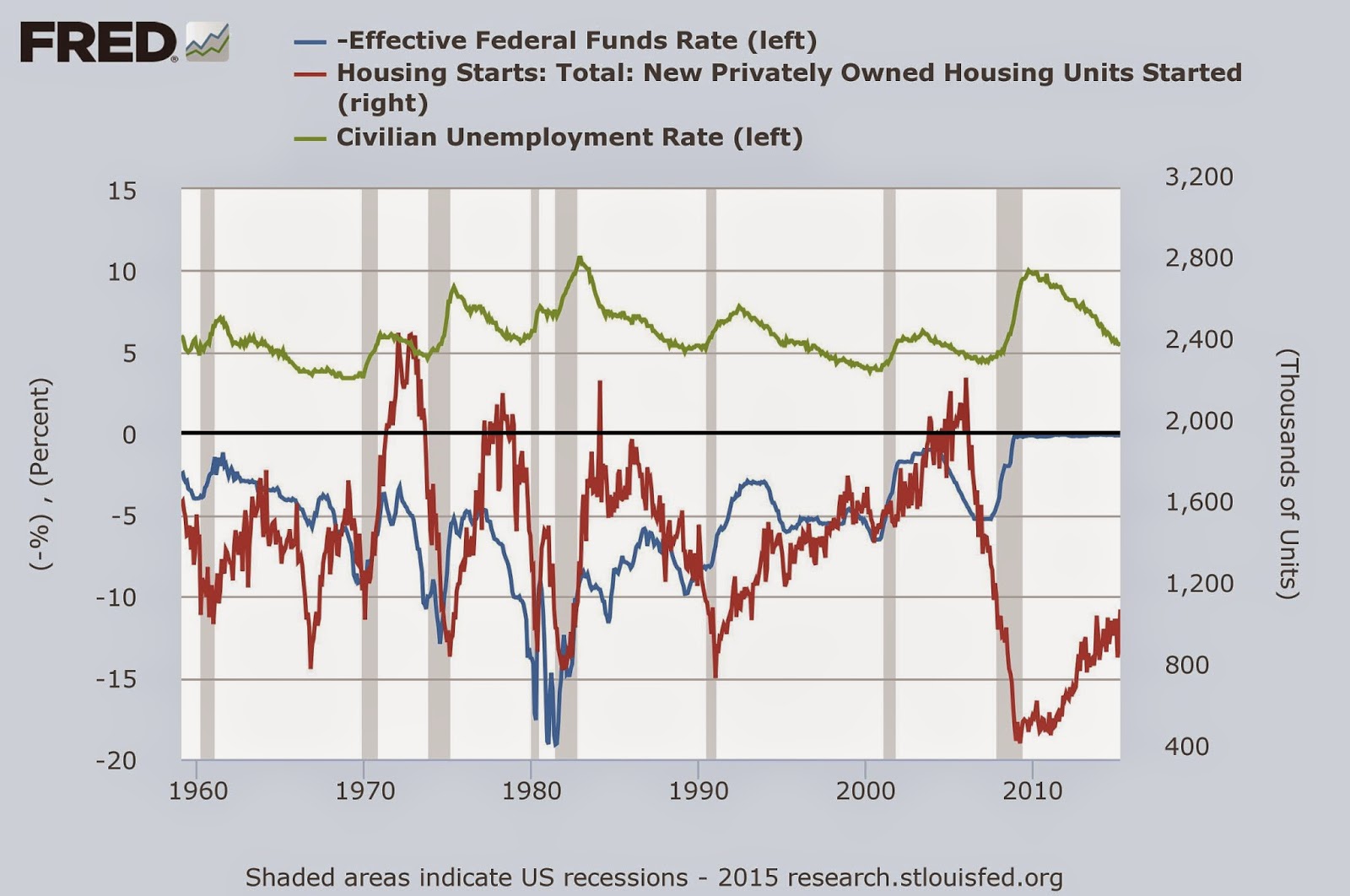
James Montier and Paul Krugman are in a bit of a spat over how much interest rates matter. Krugman put forth data from FRED (Federal Reserve Economic Data) showing a strong correlation between interest rates and housing starts. But, says Cullen Roche, he left out 40% of the data, putting his whole thesis into question. A simple regression of the all the data yields an R-squared of just 0.0453 (in other words, interest rates predict about 4.53% of the variation in housing starts).

But the ultimate problem isn't the missing data but the premise. If monetary policy is effective, we shouldn't see much of a correlation between interest rates and housing starts because, by the nature of the Fed, interest rates should be low during recessions. That's one of the jobs of the Federal Reserve: keep unemployment low.

There's any number of appropriate variables you can pick to factor in market conditions but let's look at the big one: civilian unemployment. Here's the graph with civilian unemployment thrown in:


Unfortunately, it's hard to tell much from this but a regression can help. With change in interest rates AND unemployment predicting housing starts, we get:
  • Unemployment
    • Coefficient: -100.6
    • T-Stat: -11.48 (statistically significant)
  • Interest rate
    • Coefficient: -22.7
    • T-Stat: -5.91 (also statistically significant)
  • R-squared: 0.202 (now we're explaining over 20% of the variation!)
Here's the interesting bit about this regression: Krugman transformed interest rates to be negative. Graphically, this makes it easier to see the relationship: when both lines are increasing, that means a negative correlation. Lower interest rates mean more new construction.

I didn't remove that transformation when I ran the regression. Thus the negative coefficient means positive correlation between interest rates and housing starts. So despite the incomplete approach by his critics, Krugman still appears to be wrong.

But don't throw out the demand curve just yet. New housing starts don't just respond to monetary policy; monetary policy responds to new housing starts. It is the classic causation problem that comes up in statistical analysis, especially regressions.

This is why theory is so important; it just makes too much sense that as interest rates fall, people will want to borrow more. Untangling all the effects to demonstrate that is indeed the case--and to what degree that's the case--cannot be done with something as simple as a correlation coefficient.

Friday, July 13, 2012

Post Hoc Ergo Non Propter Hoc

Ever hear of post hoc ergo propter hoc? It's a Latin phrase describing a logical fallacy: "after therefore because of." But of course just because one thing follows another doesn't mean one caused the other. It's a common mistake, especially in macroeconomics where it's so hard to determine causation. Yesterday Paul Krugman reminded me of a relative: "post hoc ergo non propter hoc" or "after therefore not because of this" (this was assembled via Google Translate so its Latin might be off). Here he is questioning calls for lower taxes on the wealthy:
When John F. Kennedy was elected president, the top 0.01 percent was only about a quarter as rich compared with the typical family as it is now — and members of that class paid much higher taxes than they do today. Yet somehow we managed to have a dynamic, innovative economy that was the envy of the world. The superrich may imagine that their wealth makes the world go round, but history says otherwise.
No where does he say why taxes on the wealthy shouldn't have hamper economic growth. Indeed, he seems to argue that it would enhance it!

Macroeconomics is very, very hard, especially when you draw on history. JFK's America was very different than our own: trade, technology, local and global politics, demographics, etc. etc. All of which have major economic implications. To say nothing of the fact that we are actually much wealthier now than we were 50 years ago.

Friday, June 15, 2012

The Schizophrenic Keynesian

From Robert Reich:
The major reason this recovery has been so anemic is not ...as some liberals contend, because the Obama administration hasn’t spent enough on a temporary Keynesian stimulus. The answer is in front of our faces. It’s because American consumers, whose spending is 70 percent of economic activity, don’t have the dough to buy enough to boost the economy
Wait, wait, wait. The whole theory behind the stimulus package--any stimulus package--is to put money in the hands of consumers.

Yes, Reich's article is about long term growth (he credit our long run problems with inequality). Stimulus is about short term growth; it's not like he's saying there's nothing we can do in the short term.
What to do? There’s no simple answer in the short term except to hope we stay in first gear and don’t slide backwards.
Okay, Okay. Maybe Reich isn't a Keynesian. It's not like he advocated for the stimulus back in 2011, only criticizing it for its meager size.
The economy is in crisis. People are hurting. So government must act, and act quickly. It’s irresponsible at a time like this to suggest that government should simply close down.

But a jeer because the jobs plan he presented isn’t nearly large enough or bold enough to make a major dent in unemployment, or to restart the economy.
I have no idea what Keynesians believe anymore.

Tuesday, May 01, 2012

Every Time I Read the News, I Want to Plan a Trip to Europe

But then I look at the exchange rate numbers. Let me explain. An exchange rate is the price of one currency in terms of another. One U.S. can buy 0.62 British pounds or 81.4 Japanese yen. The more currency you can buy, the less valuable the currency. A weak currency is good if you're traveling. Imagine being able to turn one dollar into two or three of four. Yes, some stuff will cost two or three or four times as much, but on the whole it doesn't completely cancel out the exchange rate. So when I read about Greece protesting austerity measures, Spain re-entering recession, and France about to elect a member of the Socialist party, I naturally think this will lead to fewer people wanting to do business in Europe. This should make the Euro less valuable, which means it's cheaper to buy, which means it's cheaper to vacation there. I think about where I'd like to visit. But then I look at the exchange rate numbers.
I structured the "% change" such that if it's negative, it indicates a falling value (because you can buy more). All values are in dollar terms (one dollar buys you 0.76 euros). "Before" refers to this time last year. All data are from the April 28 Economist. Yes, the Euro's value fell by about 10%, but virtually everyone's falling in value which indicates that it's a stronger dollar, not a weaker Euro, which is driving the change. You can look at the British pound and note that it only fell by 1.64%; Switzerland fell by 3.41%. These are European countries so the Euro-crisis effect is roughly the difference between them. That seems reasonable, but still: a U.S. still can't buy a single Euro? This is really evidence of the strength of German economy. If the Euro breaks up, expect Italy to be much cheaper and Germany more expensive. If France has issues (and The Economist is quite worried about that, for what it's worth), the other major economic pillar of the Euro-zone will stumble. It may be the beginning of the end of the Zone. Intrade predicts a 57.6% chance that one country will abandon the Euro by December of 2014. Lesson: plan the Germany trip for the near future and delay other visits to the continent for about five years.

Thursday, April 19, 2012

The Oncoming Trit Bubble

About a week ago, I found myself back in a game I hadn't played in years: EVE Online, an MMORPG. It has the most sophisticated economy I've seen in a game with tens of thousands of people buying and selling hundreds of goods.

On April 24th, EVE will alter the rules of the game (a "patch" as they call it) which will radically change the economy. Basically it means players will have to create more things themselves, rather than just getting it from killing computer characters. This increased focus on player production (and it is already quite focused) will increase the demand for the game key mineral: tritanium, or trit.

When the patch notes came out earlier this month, trit prices exploded, along with veldspar (an ore that's refined into trit) and hulks (a ship that's really good at mining veldspar). (All screen shots were taken on April 19 at about 19:45 EVE time, or 3:45 EST, in the game region of Verge Vendor.)
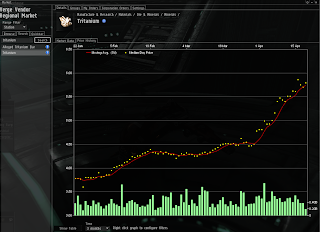
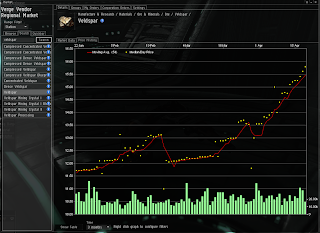
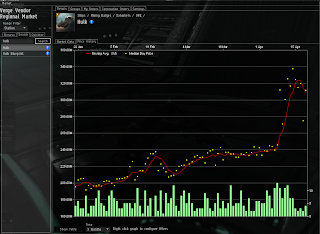


(That recent dip in hulks is interesting; I'll get to that in a sec.)

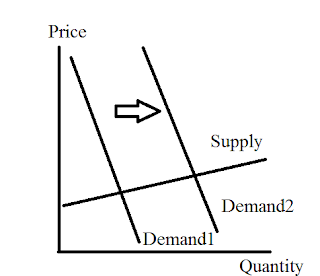
As predicted by basic economics, the price is rising. If the demand shifts out (more people want something), the price will rise. This is why I, and many people in EVE, are mining. Prices are really high. But a friend of mine who plays insists I shouldn't sell my veldspar now. I should sell it after the patch is released because then the price is even higher.

But if the price is over-inflated, as I think it is, then this is a horrible decision. I should sell while the price is high. Like a house in 2007, get out while the getting's good.

It's hard to tell if something is a bubble or not. Is this price increase just the beginning? Or are people holding on to the veldspar and trit because everyone assumes the price will rise, only to find it dropping when they want to sell. I'm inclined to believe the latter for the following reasons:

Elasticity. This is the measure of how sensitive the supply and demand curves are to price changes. It's really easy to mine veldspar. Thus the supply of veldspar is elastic: a small change in price will radically increase how much people will bring to market. This price increase will be small.


But the price increase isn't small. It's gone from from 4.50 to 5.75, a 27.8% increase. The price is probably too high.

Quantity. According to the little model up there, quantity should be off the charts. But the amount of trit sold (seen as the green bars) is (slightly) falling. Hulk sales, on the other hand, saw a jump in quantity when the patch was first release. They're the first thing you'd buy if you're a semi-experienced player (thus able to fly one and can afford one) and want to respond to veldspar prices. But we're not seeing veldspar and trit quantities rising. People are holding onto them. And now that the hulks have been bought, quantity's fallen and price is beginning to, as well. (Though I don't want to read too much into a short-run dip in a price.)

The Winner's Curse. Estimations are normally distributed. Some people will overestimate the future price of trit and others will underestimate it. The person who over estimates the most will pay the most. They will win the bid and they will regret it. Prices are driven by the winning bid so things will seem more valuable than they are. And this is made worse because...

Prices are correlated. EVE uses an English auction: if you're buying you place your bid and the high bid will buy the auction. You can up your bid if you want. But people tend to use other people's prices as information. If someone keeps outbidding me, then I might think that they know something important I don't so I outbid them. They then use my bid to think I know something they don't so they outbid me. Around and around we go until we wise up and the market crashes.

This prediction comes with caveats. (1) I may know that the supply curve is elastic, but I don't know how elastic. I may know the demand will shift, but I don't know how far. It's entirely possible that a 27.8% increase is modest and this is just the beginning. (2) If players can't sell their trit at a price they want, they will probably just hold on it. You don't have to pay a store fee after all. Thus prices might not crash. But if they don't, quantity sold will.

So I could be wrong--I'm not selling all my veldspar now--but I'm selling most of it. In less than a week, I'm going to look either really smart or really dumb. C'est la vie.

Thursday, December 22, 2011

Toil and Trouble

Robert Frank's submission for the Post's "2011 in charts" is number 12 and it's a bit strange. It's the toil index: Franks' term for "the effort required to rent a house served by a school of average quality." It shows a steady increase since the 1950s but it leaves out some key variables over the past 60 years. Homes have gotten larger, people per households have fallen, quality of standard household appliances have increased, etc. Some of these things are hard to measure, but median square feet is easy to find.

Below is the correction, with me eyeballing the original values from Frank's chart. My data only goes back to 1973 so I used those numbers for 1970 and excluded 1950 and 1960.


The original toil index is the green line (left axis) and the adjusted is the red line (right axis). You can think of the adjusted line as "the effort required to rent a square foot of space served by a school of average quality." All of a sudden, those numbers are not so severe. The 2000-2005 jump is still quite noteworthy, but general flattening of the curve cannot be denied (and this was just one correction).

Monday, November 07, 2011

A Very Interesting Sentence

Greece and the United States are two of the very few countries in the world in which defense expenditures exceed 4 percent of GDP.
From Posner.

Tuesday, October 18, 2011

Myths Are Simple

Robert Reich lists 7 myths of economics. None of them are actual myths. Actually, he's worse than that: he calls them lies. Basically the same as a myth but without the quaintness that comes with gods having sex with animals.

If you're calling something a myth (or a lie), you're saying "this is completely wrong and people who know what they're talking about know this is wrong." There should be a lot of wide-spread agreement that the proposed myth is wrong.

For example, all toxicologists agree that it's the dose--not the substance--which makes the poison. Tiny amounts of radiation won't hurt you at all. But drink too much water and you'll stomach will explode. Too much salt is bad for you, but you need a little salt to keep your body functioning.

Actual myths are simple, so simple they completely miss basic lessons of whatever disciple they pertain to. There's a mountain of evidence demonstrating why these myths are wrong. Anyone familiar with how the discipline works knows about the evidence.

Let's look at each of his proposed myths:

1. Tax cuts for the rich trickle down to everyone else. He points to how the median wage is flat over Reagan and dropped since W. Bush. Setting aside the fact that Reagan raised a lot of taxes, simply comparing median incomes doesn't account for income mobility. If you're getting wealthier as new people enter the labor market (young people, immigrants), median income might fall. (See here, unfortunately also claiming to be dispelling myths.)

2. Higher taxes on the rich would hurt the economy and slow job growth. Reich points to historical evidence of high tax rates and high growth but this is sloppy. The question is not is it possible to have high taxes with high growth but will higher taxes reduce growth? Unless Reich wants to overturn the law of supply, the answer, at least on the margin, has to be "yes."

3. Shrinking government generates more jobs. Reich points out that government is an employer. And if the goal was jobs, that would be fine. But for economists, the goal isn't jobs; the goal is efficiency. And due to knowledge and incentive problems, more government generally means less efficiency.

4. Cutting the budget deficit now is more important than boosting the economy. I am sympathetic to this view. If we were at full employment, our budget problems would probably be solved. Not only would expenses go down, revenues would increase. It is not clear how we get to boosting the economy, however, but, in general, cutting government at least makes us more efficient.

5. Medicare and Medicaid are the major drivers of budget deficits. Reich blames rising health care costs, which supports the "lie" rather than contradicts it.

6. Social Security is a Ponzi scheme. Yeah, I wouldn't call it a Ponzi scheme, as those are inherently unsustainable, but it's certainly close to it due to demographics. And if it wasn't it's still quite wasteful due to perverse incentives and the opportunity cost of investment.

7. It’s unfair that lower-income Americans don’t pay income tax. I agree with Riech here, especially given the regressive taxes (tolls, fines, sales taxes, fees, etc). But "fairness" is a normative point. How can that be a lie? Normative is about opinion!

Friday, July 08, 2011

Oil Companies As Profitable As Newspapers

According to Yahoo! Finance, both oil companies (Major Integrated Oil and Gas) have the same profit margin as newspapers (Publishing-Newspapers): 6.5% (for each dollar in sales, 6.5 cents is profit).

I'd still rather have stock in Exxon than The New York Times.

Thursday, June 23, 2011

When to Worry About Debt

Did you know Greece and the US are in roughly the same financial condition? I didn't either but last night's Daily Show taught me that since Greece's debt per capita is roughly the same as the United States' ($44,000 and $45,000, respectively), we're in the same boat. Yes, yes, it's a comedy show and this interpretation leads to funny conclusions. But it's still a sloppy interpretation; population doesn't matter. Wealth does. A single person can take on the whole of Greece's debt and still be solvent if the are wealthy enough.

So let's instead look at public debt as a percent of GDP. The US's public debt is 92.7% (yes this includes states' debt). Greece's is 130.2%. The US's debt is less than its GDP; Greece's debt is 30% more than its GDP. In other words, entirely different.

So perhaps it's not surprising that Daily Show viewers are sometimes very poorly informed about world events.

Wednesday, June 22, 2011

The Difficulty of Following Wealth

After checking out PolitiFact's audit of Jon Stewart's "ignorant FOX viewer" claim, I found myself on this fact check of Steve Moore from February of 2011. In the 1980s, he claimed that "The lowest income people had the biggest gains."

PolitiFact ruled this as incorrect. According to the economist they talked to, Gary Burtless, "Incomes rose in the bottom, middle, and top portions of the income distribution as Mr. Moore stated, although the income gains were certainly bigger at the top compared with the bottom." Interesting fact, but that's not what Mr. Moore said. Moore said, if you were poor in, say, 1980, by, say, 1990 you had the biggest wealth gain of anyone else. In other words, you're not poor anymore. Comparing the lowest quartile in one period with the lowest quartile in the later period tells you nothing since the people who composed those quartiles aren't constant.

Ideally, we would track families and see where they are year-to-year. Data on this isn't consistently available but economist Steve Horwitz took the time to gather some up some of this data from 1975 to 1991. Here's how you read the table. The left hand column indicates various quintiles in 1975. The rows tells us what percent of that quintile is in what quintile in 1991. For example, 0.9% of the top 20% in 1975 were in the bottom 20% in 1991.

Bottom 20% (1991)Fourth 20%Middle 20%Second 20%Top 20%
Bottom 20% (1975)5.114.621.030.329.0
Fourth 20%4.223.520.325.226.8
Middle 20%3.319.328.330.119.0
Second 20%1.99.318.832.637.4
Top 20%0.92.810.223.662.5


Almost 95% of the poorest 1971 Americans rose at least one quintile by 1991. About 60% were in the top two quintiles! This is a radically different story than what PolitiFact suggests, but Horwitz goes farther by looking at the average gains. On average, 1975 families at the bottom quintile had incomes $27,745 higher in 1991. This gain is larger than any other quintile following the same span of years. Contrary to PolitiFact's claims, Mr. Moore's state actually appears to be... .

Tuesday, June 14, 2011

Regional Inflation

Since I'll be moving from DC to West Virginia, I've become very keen on differences of cost of living, or what I think of as regional inflation (as opposed to the more common temporal inflation, or just inflation). The reason why I refer to it as a type of inflation is (a) it is a type of inflation (an increase in the price level) and (b) it reminds us we should adjust for it as it's just as important as conventional inflation.

For example, Matthew Yglesias argues Houston is growing isn't because they are wealthier but because they have room to build new houses. Here's his chart showing that a place like Boston, which is crowded, has a higher average income. If it's higher, why aren't people moving there (captured as more new housing)? "These days most people work providing services to other people, so it’s generally advantageous to be providing those services someplace where incomes are high. But people can’t move to Boston, on net, if it’s not possible to build houses in the Boston area." says Yglesias.


No, not that simple at all. Fundamentally, average wages in Houston are higher than in Boston. You have to adjust for cost of living. And the cost of living is 43% higher in Boston than in Houston (I can't get a permanent link to my inputs; I use Houston-Sugar Land-Baytown TX Metro - Houston TX as my comparison metro area but each of the three choices gives you about the same result). In the above graph, Boston has an average income of about $53,000. Houston's income's about $44,000, but in Boston terms (i.e. you move from Houston to Boston and your standard of living is the same), it's $63,224. Adjusted for cost of living, Houston's 18.9% wealthier than Boston.

Houston has more housing starts than Boston because it's growing. And it's growing (I'd wager) because it's wealthier than Boston.

Thursday, January 20, 2011

Recombinant Growth

I'm going to do something I normally hate doing and that's comment on something I haven't read.

Tyler Cowen has an e-book out arguing American technological progress has plateaued. From the description:
In a figurative sense, the American economy has enjoyed lots of low-hanging fruit since at least the seventeenth century: free land; immigrant labor; and powerful new technologies. Yet during the last forty years, that low-hanging fruit started disappearing and we started pretending it was still there. We have failed to recognize that we are at a technological plateau and the trees are barer than we would like to think.
Arnold Kling notes the irony that an argument about plateaued grow is coming in the form of a digital book for only $4. Of course you could argue that this constitutes "cutting edge" is a point in favor of Cowen's argument.

Based on my educated guess, Cowen's making an increasing marginal cost claim: as you pick the low hanging fruit, you're forced to climb the tree and go after the stuff that's harder to get. I use the same analogy when I teach principles. It works great for basic stuff like picking apples. But new technology is another story.

In a great 1998 paper, Martin Weitzman argues that knowledge causes "recombinant growth," or growth that builds on itself as ideas combine with other ideas. "The paper's main theme is that the ultimate limits to growth lie not so much in our ability to generate new ideas as in our ability to process an abundance of potentially new ideas into usable form."

It's not that we make technology, enjoy the benefits, and start again where we were. If it was, then we would have fallen back into gut-wrenching poverty long ago. The ideas we gain (not to mention the immigrants who help make those ideas) stay with use, which we use to make yet more ideas. These ideas combine with other ideas and make cutting edge stuff easier to achieve than our ancestors ever thought possible. High-hanging fruit doesn't seem high hanging. It's as if the fruit we pick not only nourished us but cause us to grow larger and provided seeds for new trees to boot.

Monday, December 13, 2010

Growth Is Efficiency

An article by Steve Horwitz brought on one of Brad Delong's most prestigious awards: Stupid Economist Alive. Horwitz argues that supply, not demand, is the key behind economic growth.
Starting the analysis with consumption assumes one has already acquired means. Contrary to that analysis, wealth is created through acts of production that rearrange resources in ways people value more than alternative arrangements. These acts are financed with savings that come from households refraining from consumption.
Delong (and Karl Smith and Matthew Yglesias and other Keynesians) argue growth comes from demand (hence the call for stimulus packages). From Smith:
That having been said there is a difference between consumption and investment. Investment – which is perfectly good Keynesian demand by the way – is using the resources of the universe to create tools that will allow me to make even more stuff in the future.

However, I don’t just do this for the hell of it. I hope that one day this investment will lead to a world of even greater consumption. Consumption is still the ultimate goal.
The whole discussion strikes me as silly because it ignores what economic growth is and it's not people buying things or people making things. The Soviet Union learned that when it made a bunch of stuff people didn't want and then bought of bunch of stuff people didn't want. Growth is efficiency. Period.

When we think of efficiency, we think of giant machines doing monotonous tasks but efficiency is much more than that. At its core, it's getting more output with the same amount of input, "output" and "input" broadly defined. So this isn't just technology. It's also new companies, new products, new hobbies, a better division of labor, smarter organization, etc. Anything that enriches our lives in a material or non-material way. If there's a new religion that enriches souls more fully than an older one (holding costs equal), that's growth (maybe not in terms of GDP, but growth in a way that still matters).

Now if you think this sounds like I'm echoing Horwitz's argument, think again because achieving efficiency isn't free. If it was, we'd have invented flying cars and Google a long time ago. Inventing new technology, taking on the new workers for the better division of labor, designing new products...these things are expensive to do. I'll need some kind of incentive to take on these costs, not to mention the costs associated with uncertainty. To achieve efficiency, we need not just the means, but the motive.

Roughly stated, the means are what we hear from the right/libertarians. Reduce capital gains taxes, cut down on regime uncertainty, etc. It's all about reducing the costs of operating a business, which is largely about finding ways to boost efficiency. And roughly stated, the motives are what we hear from the left/Keynesians. Increase unemployment benefits, make stimulus packages, boost aggregate demand. My point is that you need both mindsets.

This doesn't mean I'm behind more stimulus spending or cutting taxes across the board. There are good ways to embolden means and motives and there are not-so-good ways. The key point is that these two sets of policies aren't substitutes...they're complements. If you increase aggregate demand and pair it with a drop in aggregate supply (costs), then you're much more likely to increase efficiency than if you do just two policies from one set of theories.

Growth is efficiency. Understand that basic point and it's clear that the debate about if supply or demand is behind economic growth is foolish debate. You might as well ask which blade of the scissors cuts the paper.

Thursday, October 14, 2010

Market Madness

This year's American Economic Association (AEA) Annual Meeting website presents "Market Madness," a spin off March Madness where 16 suggested reasons for the recession are pitted against each other. The winner of each pair is determined by voting (I think it was among AEA members). The pairings were made by Allen Sanderson and requested by University of Chicago Magazine. Here are the results (a description of each entry is here).

Monday, September 27, 2010

Great Sentence on Development

Lant Pritchett at AidWatch:

The MDGs are correctly interpreted as what will be accomplished when there has been development–not vice versa.

Sunday, September 05, 2010

A Tale of Two Frances

Measuring GDP per hour worked, adjusting for purchasing power, France ranks very high in terms of productivity:

CountryGDP/hr
USA38.00
Norway36.24
France35.74
Belgium34.88
Luxembourg34.11

This is surprising given their laws making it difficult to fire existing workers. But there's another way to look at the data. Suppose a firm is pretty good at estimating worker productivity which occur at low (L), medium (M), and high (H). But the firm is not perfect and sometimes one level off: L can be mistaken for M, H can be mistaken for M, M can be mistaken for L or H, etc. If you know that getting an L will lock you into that person, and since the Ls can make the Ms and Hs worse, you refuse to hire anyone that's an L or an M just be sure. Therefore, French companies are chuck full of Ms and Hs while the unemployed are all Ls and Ms. There may not be two Americas, but there just might be two Frances.

Tuesday, August 10, 2010

In Defense of Recalculation and Capitalism

Arnold Kling's gotten some heat that the Recalculation Story suggests, as Matthew Yglesias puts it, "radical underlying flaws in the capitalist economic model that call not for small-bore government intervention but for wholesale rethinking of the way the economy functions." For those of you just joining us, the Recalculation Story attempts to explain booms and busts through fundamental changes in the landscape of the economy and the difficulties in adapting to those changes. The wrong people go to the wrong jobs as firms try to adapt. Productivity struggles until firms figure out how this brave new world functions.

Nothing in the story suggests the capitalist system is fundamentally flawed and should be scrapped. When there's massive technological change, growth is hard. This should not be surprising because growth requires time to invest in both skills and capital. It requires planning and when you can't plan, you can't grow. But once you figure out the landscape, you're much better off for it.

Think of high schoolers dating. You don't really know what you want in a partner when you're young but dating's fun and you get pretty good at it. You might happily date someone regularly for years. But then you go to college and everything changes: you're exposed to new people, new ideas, things you never considered before, couldn't consider before, because you lived your life in a world in which you had no idea how small it was. Try to return to your old ways and you'll be miserable. So you break up and spend a lot of time dating new people, trying to determine what you want in this much larger world. That's recalculation.

Technology expands our world. It makes things we thought impossible, possible. This is hard to adapt to: clearly seen in how newspapers are struggling to evolve with the Internet. And yes, the system is not perfect, but few economists will say capitalism is perfect. But trying to fix the problems derived from mere mortals by mere mortals is doomed to make a mess of things. In some countries, we still have that in dating: arranged marriages. And young people hate it.

Saturday, August 07, 2010

Krugman on Spending

Paul Krugman argued that the Obama administration actually hasn't spent that much. When you adjust for potential GDP (as defined by the CBO), government consumption and investment is about 19% of GDP. Throw in the transfer payments--Medicare, Medicaid, Social Security, unemployment insurance--and we get a leap to almost 34% of GDP.

All interesting stuff. But then it gets weird.
In short, the giant increases in government spending we keep hearing about are a myth
Wait, what? Let's look at that chart again.

That looks like a giant increase in spending to me! Yes, Krugman's addressing the concerns about Obama going on a spending binge with policy but really the increases are coming from automatic stabilizers. But since Obama approved extending unemployment insurance, that automatic stabilizer Krugman credits for the spike, then those arguments about a spending binge stay just were you left them, though admittedly in a different form.

It seems strange to judge if someone's spending too much by basing it on GDP: you can still overpay for something if you're rich, especially when the opportunity cost is high. And since government tends to be less efficient than non governments, you can almost always bet that opportunity cost is high. A government spending 30% of a small GDP country is less damaging than a government spending 10% of a country with 100 times the GDP (ceteris paribus). The bigger country has more potential: more schools, technology, fashion, whatever that is lost. That's because the "slimmer" country is sacrificing more wealth than the bureaucratic country, even if (and possibly because) it is producing more wealth, too.

Monday, July 26, 2010

James Surowiecki Forgets How To Do Marginal Analysis

His interesting piece about regime uncertainty and its role in the sluggish recovery leaves me confused.
Those who think that they are say that “uncertainty surrounding regulations and taxes,” ... is making business hold back. But uncertainty is a fact of business life,
So if there's already some uncertainty in an activity, then adding uncertainty shouldn't change your behavior? Suppose flipping a coin costs you $1 and you get $3 if it turns up heads. If the rules change to flipping two coins for $1 and you get $3 when they both come up heads this is clearly a smaller gain (in fact, your expected gains in the first are positive while in the second, they are negative). But not to Surowiecki.
and the impact of new regulations on most companies has been overhyped: unless you’re a financial-services or health-care company, Obama’s initiatives aren’t remaking your business.
But they are! Markets are linked and those two altered sectors are big and critical parts of the economy. It's not as if there was heavy reform in the knitting sector. If the financial sector is a big part of the cause of the recession (and I think it was) then uncertainty in the financial sector is likely a big part of why the recovery is slow. This doesn't even touch on people's expectations about future regulation. If the administration is willing to turn not one but two sectors of the economy upside down, then where is the line? The BP disaster already brings on calls for re-regulation in the energy sector.
If businesses aren’t hiring or investing, in other words, it’s because they don’t need to: they have enough workers and factories to meet the demand for their products. And there are few signs that this is going to change any time soon: consumer demand remains weak, economic indicators—inflation rates, consumer confidence, the stock market, bond rates—aren’t forecasting a quick return to boom times, and, just last week, the Fed chairman, Ben Bernanke, told Congress that the state of the U.S. economy was “unusually uncertain.” So it’s no wonder that companies are feeling cautious.
No doubt uncertainty about future economic growth retards current economic growth. But uncertainty about the administration compounds that uncertainty about the economy. Regulation has the potential to transform good ideas into poor ones so even if a company's willing to try out an investment despite poor confidence, regime uncertainty can cause them to hold back. If heads comes up on only one coin, the deal will still sink.

Yes, recovery is not a simple matter of "making the suits feel better" but on the margin, it does make things worse. When it comes to uncertainty President Obama is no FDR but the demand curve still slopes down.