In case you haven't been paying attention (or are more concerned about bigger news items), on June 8th the Democrats in South Carolina had their primary for the Senate campaign. To everyone's surprise, the winner was Alvin Greene: a man with no job, no campaign staff, and no known financial support.
When I first heard about Alvin Greene, my first thought was election manipulation. But as I learned more about it that seemed less likely. Polling places dropping the ball would need to be more systematic than is reasonably plausible and fraud on this scale would require massive resources. If Greene was behind it (perhaps using illicit resources the public doesn't know about) then his win would be more planned out. He'd at least have a website and be more eloquent when talking to reporters. Republicans simply don't have a motive to commit the fraud. DeMint, the Republican incumbent, won by nearly ten points and the Democratic party basically ignored the primary race. Remember, this is the state that tried to get the Confederate flag flown over its capital. It doesn't make sense that Republicans would pull such a desperate act (this also goes to the even stranger and less relevant accusation of a plant).
It's still very early to tell; perhaps various investigations will reveal an elaborate conspiracy. It's still a mystery how he got the filing fee. But right now my best guess is the following simple story:
Alvin Greene's life was in the toilet. He had no job, no prospects, no plan. Then he got a windfall: perhaps it was an inheritance, or from criminal activity. Maybe he really was saving (though longer than the claimed two years). Not sure what to do, he runs for Senator. Yeah, he probably would have been better off going to a technical school, but maybe he's a poor student or just didn't want to put up that much effort. He has a degree in political science, after all, and it hasn't seemed to have done him any good. But a senatorial candidate? That's easy and potentially very impressive on his résumé. In his mind, he didn't need to win; he just need to fill a gap in his employment history and make himself sound more impressive to potential employers. Yeah it sounds crazy, but I'm not the first person to question his mental health.
But then he won, mostly because no one paid attention to the race. Being listed before his opponent and sharing a name with a famous singer surely helped two. Cameras descended on Greene, especially after people learned about the felony charges. In his heart of hearts, Greene knows he doesn't deserve this. But admitting that would require him to take a hard look at himself and come to terms that not everything happens for reason. It's hard to recognize that you got something you didn't earn so Greene tells people he wasn't surprised by the results (really!?) and insists he went all over the state campaigning, though he can't remember any towns he went to.
Whatever the reason, this is a vivid example of what happens when a lot of people see their vote as cheap talk. Stampedes only happen when the entire herd runs to Greene pastures.
Wednesday, June 16, 2010
Saturday, June 12, 2010
Reporters Will Be Reporters


An interesting article at The Atlantic by Hanna Rosin puts a lot of emphasis on a claim that more people want girls over boys.
So there are scientific polls which conclude that people have equal preference for boys and girls but Rosin relies on the sperm clinic survey method instead. But that's a non-random sample: a fatal mistake (and disturbingly common for reporters, especially when shows tout their online polls). What these clinics are really saying is that people who can afford to try to control the sex of their child prefers girls. Rich people like girls.
Rosin might claim that this makes sense: wealthy people prefer girls because wealthy people have the resources to see where the global trends are going. They know a girl will, on average, be more successful than a boy. But that doesn't fix the problem of the scientific surveys: if wealthy people preferred girls and everyone else were indifferent, then you'd still see a slight preference for girls on the aggregate. If everyone else preferred boys, you'd see a preference for boys because there's a lot more non-rich people than rich people. It would be a pretty amazing coincidence if it all evened out nicely. (I don't know if these studies controlled for income, which would be interesting to see.)
There's a better explanation. Without trying, wealthy people tend to have more boys and poor people tend to have more girls. Wealthy people are just using the clinics to balance out these natural tendency to have more boys. Their preference of girls at the clinic is evidence of their equal preference at the nursery.
Polling data on American sex preference is sparse, and does not show a clear preference for girls. But the picture from the doctor’s office unambiguously does. A newer method for sperm selection, called MicroSort, is currently completing Food and Drug Administration clinical trials. The girl requests for that method run at about 75 percent.
So there are scientific polls which conclude that people have equal preference for boys and girls but Rosin relies on the sperm clinic survey method instead. But that's a non-random sample: a fatal mistake (and disturbingly common for reporters, especially when shows tout their online polls). What these clinics are really saying is that people who can afford to try to control the sex of their child prefers girls. Rich people like girls.
Rosin might claim that this makes sense: wealthy people prefer girls because wealthy people have the resources to see where the global trends are going. They know a girl will, on average, be more successful than a boy. But that doesn't fix the problem of the scientific surveys: if wealthy people preferred girls and everyone else were indifferent, then you'd still see a slight preference for girls on the aggregate. If everyone else preferred boys, you'd see a preference for boys because there's a lot more non-rich people than rich people. It would be a pretty amazing coincidence if it all evened out nicely. (I don't know if these studies controlled for income, which would be interesting to see.)
There's a better explanation. Without trying, wealthy people tend to have more boys and poor people tend to have more girls. Wealthy people are just using the clinics to balance out these natural tendency to have more boys. Their preference of girls at the clinic is evidence of their equal preference at the nursery.
Friday, June 11, 2010
Public Choice and Police Videos
Here's an excellent piece on video-taping police while they do their jobs.
Balko's advice, sadly, will probably not be followed. Polices officers are unionized and not getting their support easily translates into the deadly "soft on crime" label during an election. The public, in contrast, has a generally high opinion of police officers so painting yourself as questioning their honesty doesn't help you much.
In at least three states, it is now illegal to record any on-duty police officer...The legal justification for arresting the "shooter" rests on existing wiretapping or eavesdropping laws, with statutes against obstructing law enforcement sometimes cited. Illinois, Massachusetts, and Maryland are among the 12 states in which all parties must consent for a recording to be legal unless, as with TV news crews, it is obvious to all that recording is underway...When the police act as though cameras were the equivalent of guns pointed at them, there is a sense in which they are correct. Cameras have become the most effective weapon that ordinary people have to protect against and to expose police abuse. And the police want it to stop...As journalist Radley Balko declares, "State legislatures should consider passing laws explicitly making it legal to record on-duty law enforcement officials."
Balko's advice, sadly, will probably not be followed. Polices officers are unionized and not getting their support easily translates into the deadly "soft on crime" label during an election. The public, in contrast, has a generally high opinion of police officers so painting yourself as questioning their honesty doesn't help you much.
Thursday, June 10, 2010
So Many Things...
The authority does not have authority to do whatever they want to do.That's Jackie Jeter, president of Local 689: Washington's Metro system's union workers. That, by the way, is the comment she issued on two employees being reinstated after the Metro system fired them. One was fired for being involved in a fatal car crash. It's up for debate if the driver was responsible for it (Metro believes he ran a red light). The other driver punched an off duty cop dressed as the McGruff the Crime Dog. That's not as bad a fatal car accident, but there's no doubt that it was his fault.
"Yes, he made a stupid mistake," Jeter said. "Should he have lost the job he had been on for eight years because of a silly mistake?"Yes!
Wednesday, June 09, 2010

Great Words On Macroeconomics
It's not clear that you can write down a consistent model in which this works, but it is not clear the world behaves according to a consistent model.That's Brad DeLong commenting on fiscal austerity translating into greater confidence in the stability of the economy of the government in question, thus heralding a recovery. But while the model's elusive the empirical evidence is hopeful.
Tuesday, June 08, 2010
Rent Seeking in Everything
It turns out more people like Wal-Mart than I thought. A Wall Street Journal article yesterday exposes that many of the "grassroots" campaigns trying to block local Wal-Marts are actually backed by their competitors. This isn't really a surprise; what's news is that these competitors organize and/or expand the campaigns through a company called Saint Consulting Group, a firm which specializes in making the astrotruf seem genuine.
For the typical anti-Wal-Mart assignment, a Saint manager will drop into town using an assumed name to create or take control of local opposition, according to former Saint employees. They flood local politicians with calls, using multiple phones to make it appear that the calls are coming from different people, the former employees say.
Monday, May 31, 2010
Brad DeLong Channels His Inner Shopaholic
Addressing Tyler Cowen's take on the crisis, Brad DeLong writes
To DeLong's credit he acknowledges that the low interest rate means fiscal policy passes various cost-benefit tests. However many economists question the fundamental effectiveness of expansionary fiscal policy; indeed, this is exactly what Cowen was addressing. That then puts into question every cost-benefit test you can cite. I don't care how pretty the dress is. If it turns out to have a big hole in it, the sale doesn't matter. Not unless they pay you to take it. (And a negative interest rate is the only condition I'd like to see the government borrow at this point.)
So I don't see how Tyler then gets to:Just because something's cheap doesn't mean you should buy it.But even if that fiscal policy is a good idea...Where does the "but even" come from? I see no "but even" earlier in the market: the cost of borrowing for the government has fallen--the market value troday [sic] of future cash tax flow earmarked for debt repayment has gone way, way up--therefore we should dedicate more future cash flow to debt repayment by borrowing more. There is no "but even." Expansionary fiscal policy is a good idea,
To DeLong's credit he acknowledges that the low interest rate means fiscal policy passes various cost-benefit tests. However many economists question the fundamental effectiveness of expansionary fiscal policy; indeed, this is exactly what Cowen was addressing. That then puts into question every cost-benefit test you can cite. I don't care how pretty the dress is. If it turns out to have a big hole in it, the sale doesn't matter. Not unless they pay you to take it. (And a negative interest rate is the only condition I'd like to see the government borrow at this point.)
Thursday, May 27, 2010
Governance Is Not the Same Thing As Action
In response to Sen. Hatch's stanch opposition to any tax increases in Obama's announcement to reduce the deficit, Ali Frick asks
How is it that fundamentally unserious people — people who do not want to govern and have no business governing — keep running for and winning governing office?Because the constituents know he's governing; he's just not governing the way you want him to. And since they're right-wing and you're left-wing, that's exactly why they re-elect him. Reducing the deficit almost certainly means increasing taxes but battling another branch of the government, even if it means to stone wall, is a political tactic. And such tactics are used to manage the Union, even if management means preventing harmful policy. Especially if it means preventing harmful policy.
The Mbaiki Witch Trials
His principal advice to clients, he said, was to act normally and refrain from casting any spells in the courtroom.That's from this article about witch trials in the Central African Republic.
By some estimates, about 40 percent of the cases in the Central African court system are witchcraft prosecutions. (Drug offenses in the U.S., by contrast, account for just 12 percent of arrests.) In Mbaiki—where Pygmies, who are known for bewitching each other, make up about a tenth of the population—witchcraft prosecutions exceed 50 percent of the case load, meaning that most alleged criminals there are suspected of doing things that Westerners generally regard as impossible.But how does the court determine if someone's a witch? Surely it can't be as sloppy as just arbitrarily declaring yes or no just by looking at them.
I asked how one determined guilt in cases where the alleged witches denied the charges. “The judge will look at them and see if they act like witches,"Wow. Well surely this witchcraft law is actively trying to be repealed by local groups and international NGOs alike. I can't imagine any reason to keep this law on the books.
[an Italian group called COOPI that exists to promote human rights and the rule of law] supported keeping the laws on the books, for pragmatic reasons: if people thought witches could hex with impunity, mobs would simply seize the alleged offenders, bring them to a pit, and bury them alive.Drat.
HT: Alex Tabarrok
Thursday, May 20, 2010
Yglesias on Paul on Civil Rights
I enjoy reading Matthew Yglesias and more often than not, I learn something new. But when it comes to politics his brain seems to fall out of his head:
....Rand Paul let the cat out of the bag and admitted that under his brand of libertarian conservatism he can’t support the 1964 Civil Rights Act or other non-discrimination legislation as applied to private businesses. He goes out of his way to explain that he doesn’t actually favor segregated lunch counters, he just thinks it would be wrong to do anything about them.No, no he doesn't. Not supporting the law is not the same thing as being indifferent to the injustices of Jim Crow unless you're foolish enough to think that the only instrument of good in this world is government. This isn't to say that the 1964 bill wasn't a good idea but it wasn't the only possible way to eliminate segregation.
Tuesday, May 18, 2010
Costs and Benefits of Virtual Federalism
Arnold Kling and Tyler Cowen argue for virtual federalism (VF) to solve the Middle East conflict. Arnold Kling explains
But the logistics of snow removal get absurd. Trucks would have to lift their plows when they pass an outsider's home, which keep banks of snow that your neighbors have to navigate around. If you live in a cul-de-sac and two guys on either side of the street at the mouth of the dead end get their snow removal from someone far away, and the snow is bad enough, those on the inside get snowed in even though the snow plows have already passed. And since any local government would focus on the areas with the highest concentration of customers (which will probably be the neighborhood nearest the snowplows), those on the inside of the cul-de-sac could wait for a while.
Okay, so you could say that a path's made to link trapped areas with everything else, but how do you handle fires? A fire in one house can spread to another depending on wind. If the fire department for the home on fire is located farther away than the department for the neighbors, you'd get fire fighters arriving to contain (but not put out) the fire while someone might be inside suffocating. It seems remarkably inefficient.
But it still could be optimal--I don't know how much waste fire departments would eliminate in response to competition nor do I know how much people will opt to go for the closer department simply because it's closer (which would mitigate the impact of the first issue). But I suspect that time-sensitive services will be less efficient than than services that are not time-sensitive.
You don't really care when your trash is picked up, as long as it is picked up sometime that day. But the local governments want their trash route to be all in the same general area to makes it cheaper to pick it up. So trash services will be pretty good: they will make recycling easy for you, they take a large variety of trash (furniture, e-waste, yard waste). They know you'd easily change to a farther away government (because you don't really care) and the costs of many people leaving is high relative to the benefit, so they will work hard to keep you.
Time-sensitive services like fire fighting, snow removal, and water pipe repair will get worse because governments know it will be more expensive for you to go to a farther away competitor. If the plows nicks your car, you might let it slide because you're not willing to switch allegiance to a distant competitor where you'd have to wait an extra hour or two while he takes care of people who are close by.
Competition is not immune to waste and I'm not sure if this system has less of it. But VF buys peace in Jerusalem, then I'm sure it's worth it. But for us? Seems cheaper just to move.
I would like to have a different sovereign, but without having to move. Under virtual federalism (as proposed in the widely-unread Unchecked and Unbalanced), we would unbundle the services that the County provides. I could then contract with another provider for trash collection, snow removal, fire protection, or other services.My initial thought is that this results in lots of important questions related to geographically-derived economies of scale. If several people have different sovereigns, then you've created a mix match of territory a government has to cover. With trash collection, this isn't a huge deal--workers just has to drive around everywhere, probably with an on board computer, and collect from customers. Kind of like UPS but in reverse.
But the logistics of snow removal get absurd. Trucks would have to lift their plows when they pass an outsider's home, which keep banks of snow that your neighbors have to navigate around. If you live in a cul-de-sac and two guys on either side of the street at the mouth of the dead end get their snow removal from someone far away, and the snow is bad enough, those on the inside get snowed in even though the snow plows have already passed. And since any local government would focus on the areas with the highest concentration of customers (which will probably be the neighborhood nearest the snowplows), those on the inside of the cul-de-sac could wait for a while.
Okay, so you could say that a path's made to link trapped areas with everything else, but how do you handle fires? A fire in one house can spread to another depending on wind. If the fire department for the home on fire is located farther away than the department for the neighbors, you'd get fire fighters arriving to contain (but not put out) the fire while someone might be inside suffocating. It seems remarkably inefficient.
But it still could be optimal--I don't know how much waste fire departments would eliminate in response to competition nor do I know how much people will opt to go for the closer department simply because it's closer (which would mitigate the impact of the first issue). But I suspect that time-sensitive services will be less efficient than than services that are not time-sensitive.
You don't really care when your trash is picked up, as long as it is picked up sometime that day. But the local governments want their trash route to be all in the same general area to makes it cheaper to pick it up. So trash services will be pretty good: they will make recycling easy for you, they take a large variety of trash (furniture, e-waste, yard waste). They know you'd easily change to a farther away government (because you don't really care) and the costs of many people leaving is high relative to the benefit, so they will work hard to keep you.
Time-sensitive services like fire fighting, snow removal, and water pipe repair will get worse because governments know it will be more expensive for you to go to a farther away competitor. If the plows nicks your car, you might let it slide because you're not willing to switch allegiance to a distant competitor where you'd have to wait an extra hour or two while he takes care of people who are close by.
Competition is not immune to waste and I'm not sure if this system has less of it. But VF buys peace in Jerusalem, then I'm sure it's worth it. But for us? Seems cheaper just to move.
Sunday, May 16, 2010
The House of Econometrics
Last week Russ Roberts interviewed Ed Learner about econometrics. They noted, quite correctly, that any given econometric study has a lot of arbitrariness of it. the author of any work can jiggle the model until s/he gets the desired results. This is a problem and every economist knows it. And because we know it, it takes a lot of studies saying the same thing to be convinced of anything. A brick is too small to build up a house, so we get a lot of bricks. A single study is too precarious to hang a major conclusion on, so you get a lot of studies.
This is crucial because Roberts often points out that whenever he asks another economist to point to an econometric study which changed their opinion on economics, he doesn't get an answer. Of course he doesn't get an answer; no study is good enough! It's like asking which brick of a house holds its roof up. All of them do. But unless you've specialized in the field, you can't remember all of the studies. You probably haven't read them all (hence it appears that studies just confirm people's belief).
Which is why Roberts' question is a bit of a red herring. Intellectual houses are built over decades--it takes that long to get enough studies done. That's why the process of adoption is so slow and why it looks like it doesn't convince anyone. Yesterday's studies convince tomorrow's economist.
This is crucial because Roberts often points out that whenever he asks another economist to point to an econometric study which changed their opinion on economics, he doesn't get an answer. Of course he doesn't get an answer; no study is good enough! It's like asking which brick of a house holds its roof up. All of them do. But unless you've specialized in the field, you can't remember all of the studies. You probably haven't read them all (hence it appears that studies just confirm people's belief).
Which is why Roberts' question is a bit of a red herring. Intellectual houses are built over decades--it takes that long to get enough studies done. That's why the process of adoption is so slow and why it looks like it doesn't convince anyone. Yesterday's studies convince tomorrow's economist.
Thursday, May 13, 2010
There Ought To Be a Law
I'm not too fond of new laws but new CBO estimates for the health care bill tack on an additional $115 billion (silly them; they forgot to consider administration costs and other spending). Each new bill (or bill for which the CBO makes estimates for), should include a clause that if it turns out the bill is much more expensive than originally estimated, it should be automatically repealed and put to a re-vote. A lot of people defended this bill because it would help with the deficit; now those costs undo most of that (and you can be sure these costs will only go up). Those supporters have been duped and a re-vote seems to be the only fair way to fix the wildly inaccurate estimation.
But I guess Congress is too busy blaming banks for misleading customers.
Update: Most of that increase is the continuation of existing programs and isn't really part of the bill. Still, there ought to be a law.
But I guess Congress is too busy blaming banks for misleading customers.
Update: Most of that increase is the continuation of existing programs and isn't really part of the bill. Still, there ought to be a law.
Tuesday, May 11, 2010
Flying the Quiet Skies
Christopher Elliot has a nice piece on loud children on planes, suggesting planes ban parents who have proven to let their children scream. Elliot admits that after his first plane trip with his three kids, he realized he couldn't control them and grounded his family. That's a wonderful sentiment and I wished more families were as concerned about their externalized costs as Elliot is. But it's just not a practical solution. Suppose a family emergency necessitated speedy travel: would he still refuse to fly? I doubt it. Therefore, the optimal solution isn't a corner solution.
Instead, we could use a Coasean solution (well, Coase-like since transaction costs are too high for full bargaining and we're not focusing on the least cost avoider). Airlines would amend the agreement when you buy the ticket (which already includes clauses about when you can cancel the reservation, etc) to include a provision that if the stewardesses feel your child is too loud (perhaps in part based on customer complaints), they charge some additional price based on the length of the flight. To prevent the company from saying anything is too loud and to compensate those suffering from the screaming child, the airline then reallocates that money to those in the seats nearest the screaming child.
This system punishes those parents who don't control their child (generating the incentive for them to be better parents or avoiding flying altogether) while still allowing them to fly if they feel circumstances warrant it. The costs to the airline would be small since so much passenger information, including credit card numbers, is in their database anyway. But it's not zero, so there's an incentive to not report every little scream as a violation.
Instead, we could use a Coasean solution (well, Coase-like since transaction costs are too high for full bargaining and we're not focusing on the least cost avoider). Airlines would amend the agreement when you buy the ticket (which already includes clauses about when you can cancel the reservation, etc) to include a provision that if the stewardesses feel your child is too loud (perhaps in part based on customer complaints), they charge some additional price based on the length of the flight. To prevent the company from saying anything is too loud and to compensate those suffering from the screaming child, the airline then reallocates that money to those in the seats nearest the screaming child.
This system punishes those parents who don't control their child (generating the incentive for them to be better parents or avoiding flying altogether) while still allowing them to fly if they feel circumstances warrant it. The costs to the airline would be small since so much passenger information, including credit card numbers, is in their database anyway. But it's not zero, so there's an incentive to not report every little scream as a violation.
Monday, May 03, 2010
The Housing "Crisis" Was in the Past
On the housing crisis John Stossel asks of real estate lobbyists "why is the price drop a crisis? Sellers are hurt, but buyers benefit." True enough, if oil prices fell as fast as housing prices, the only ones who would call that a crisis are environmentalists. So why are falling prices a crisis? They're not. They are a sign we were in a crisis. It only seems like a problem because the cure is more painful than the disease even though it is less fatal.
Falling prices mean we over-invested in housing. That was a mistake in the past; had there been less investment in home building, there would have been more investment elsewhere and, since housing prices fell so much, we can confidently say that the "elsewhere" would have been much more productive.
Falling prices means people were over-dependent on the value of their homes when they used it to back a loan. This is particularly bad for banks who collect these homes when people defaulted. If housing prices were lower (as they should have been), banks would have demanded more collateral, which would have reduced today's defaults and today's cost of defaults. There's an element of the financial problems in this as well and certainly the housing mis-allocation contributed to it.
The inflated housing prices in the past is like a bad relationship. The break up might be messy, but the problems were in the past.
Falling prices mean we over-invested in housing. That was a mistake in the past; had there been less investment in home building, there would have been more investment elsewhere and, since housing prices fell so much, we can confidently say that the "elsewhere" would have been much more productive.
Falling prices means people were over-dependent on the value of their homes when they used it to back a loan. This is particularly bad for banks who collect these homes when people defaulted. If housing prices were lower (as they should have been), banks would have demanded more collateral, which would have reduced today's defaults and today's cost of defaults. There's an element of the financial problems in this as well and certainly the housing mis-allocation contributed to it.
The inflated housing prices in the past is like a bad relationship. The break up might be messy, but the problems were in the past.
Saturday, May 01, 2010
The Apartment that Simon Built
It was Julian Simon who wrote in the Ultimate Resource 2 (p12):
The narrator calls the house "a technological marvel" but there's nothing in inherent the idea which prevents it from being implemented 10, 20, or 50 years ago (and to lesser degrees, such an idea has been used before). What's important is that all this amazing apartment took was hard work and some creativity, effort that might not have been worth the time if Hong Kong had fewer people in it.
Greater consumption due to increase in population and growth of income heightens scarcity and induces price run-ups. A higher price represents an opportunity that leads inventors and businesspeople to seek new ways to satisfy the shortages. Some fail, at cost to themselves. A few succeed, and the final result is that we end up better off than if the original shortage problems had never arisen.In Hong Kong, population density means space is at a premium. Responding to high rents and tight quarters, architect Gary Chang found a way to fit 24 rooms into one.
The narrator calls the house "a technological marvel" but there's nothing in inherent the idea which prevents it from being implemented 10, 20, or 50 years ago (and to lesser degrees, such an idea has been used before). What's important is that all this amazing apartment took was hard work and some creativity, effort that might not have been worth the time if Hong Kong had fewer people in it.
Tuesday, April 27, 2010
Matthew Yglesias Is Hoarding the Internet
Matthew Yglesias, in a two (or more?) part series (I here; II here) calls high salaries inherently immoral:
It’s greedy, absurd, and morally indefensible for talented people born in favorable circumstances to be dedicating their lives to accumulating huge sums of money in order to engage in lavish consumption....While I was writing this post, I took a break from waxing indignant about multi-millionaires buying their third houses to donate some money to UNICEF.If, like me, you're a regular reader of Yglesias's blog, you might know he posts more often than the prolific Tyler Cowen, often scooping people who could have posted on items he already posted on. Just as the wealthy hoard money, Yglesias is hoarding blog posts. With so many struggling blogs out there, he should take his own advice e-mail their bloggers with his latest discoveries so they have a chance to be well read as well. To paraphrase Yglesias, becoming obscenely knowledgeable in the Internet world and then hoarding your information is, itself, morally wrong.
Tuesday, April 20, 2010
Show Me the Broccoli (Ads)!
Matthew Yglesias asks, "Where are the Broccoli Ads?"
Couldn't all fruits and vegetables have packaging? In theory, sure, but such foods spoil more easily (they are often sprayed with water to keep them crisp, something packaging would prevent). Note that Express salad mix is a mix, not just a head of lettuce in bag so there's good reason to give up a bit of freshness for the convenience (their ads also underline how fresh their mix is). Many customers like to investigate such foods before buying them. If you package your food, that makes it harder to inspect and customers might think you're hiding something.
So why don't we see ads brought to us by broccoli farmers? I've seen ads for why natural gas is so great and high fructose corn syrup isn't as bad as we think it is. Surely there's a national association of broccoli growers out there to wanting to get people off the sugar stuff.
And there is (unfortunately I couldn't embed the video).
Why is it that nobody’s marketing broccoli and bananas? This stuff is sold in stores, in exchange for money. Presumably there are for-profit enterprises out there with a vested interest in selling more.In contrast to candy bars and potato chips, most fruits and vegetables have no packaging and thus no easily identifiable brand name. An ad for Bob's Broccoli will probably help Betty's Broccoli sales since it's not clear which is which. Advertising for healthy foods becomes a public good and, thus, under-provided. Note that some vegetables do advertise--Express Salad Mixes keep popping up--but these vegetables have packaging.
Couldn't all fruits and vegetables have packaging? In theory, sure, but such foods spoil more easily (they are often sprayed with water to keep them crisp, something packaging would prevent). Note that Express salad mix is a mix, not just a head of lettuce in bag so there's good reason to give up a bit of freshness for the convenience (their ads also underline how fresh their mix is). Many customers like to investigate such foods before buying them. If you package your food, that makes it harder to inspect and customers might think you're hiding something.
So why don't we see ads brought to us by broccoli farmers? I've seen ads for why natural gas is so great and high fructose corn syrup isn't as bad as we think it is. Surely there's a national association of broccoli growers out there to wanting to get people off the sugar stuff.
And there is (unfortunately I couldn't embed the video).
Sunday, April 18, 2010
Drug Legalization and the Urban Poor
Gary Becker calls for better schools and better teachers, writing
Kids drop out for lots of different reasons. But since the problem is so common in poor neighborhoods, where jobs and education are scarce, of course the few financially successful people in those neighborhoods are going to have a big impact. And those individuals are drug lords, people who have made a handsome profit off the black market. It's easy to look up to them and admire them. And it's easy to learn the trade since all drug lords need a large company--er, gang--to support the enterprise so they have a financial incentive to teach them well (or by fear or force). And I guarantee you, they don't require a high school education. One should not be surprised that, in a world where the choice is between learning from a poorly trained teacher with no obvious financial rewards and learning from a gangster who's involved in your daily life and will pay you for "on-the-job" training, more than a few students take the latter. Yeah, there's danger of getting arrested (though from what I gather that's more of a badge of honor) and being killed, but the payoffs are some of the best the kids can choose from and that means a lot when money is so scarce.
The best longer-term solution to the [income] inequality problem is to reduce the fraction of Americans who dropout of high school...This drop out fraction has been stagnant for the past several decades at about 30% for males, and a somewhat lower but still high percent for females. This is almost surely the highest fraction of high school dropouts among rich countries, and is heavily concentrated among children from African-Americans and Hispanic families. In large cities, often less than half of all the children enrolled in public schools end up graduating.No doubt better teachers (and better incentives for teachers) would reduce drop-out rates. But let's not ignore a much simpler and (economically) cheaper way to reduce the number of drop-outs: legalize narcotics. This isn't merely about the money saved from enforcement, imprisonment, and judiciary costs. It's primarily about the choices kids face.
Kids drop out for lots of different reasons. But since the problem is so common in poor neighborhoods, where jobs and education are scarce, of course the few financially successful people in those neighborhoods are going to have a big impact. And those individuals are drug lords, people who have made a handsome profit off the black market. It's easy to look up to them and admire them. And it's easy to learn the trade since all drug lords need a large company--er, gang--to support the enterprise so they have a financial incentive to teach them well (or by fear or force). And I guarantee you, they don't require a high school education. One should not be surprised that, in a world where the choice is between learning from a poorly trained teacher with no obvious financial rewards and learning from a gangster who's involved in your daily life and will pay you for "on-the-job" training, more than a few students take the latter. Yeah, there's danger of getting arrested (though from what I gather that's more of a badge of honor) and being killed, but the payoffs are some of the best the kids can choose from and that means a lot when money is so scarce.
Thursday, April 15, 2010
Following the Money
Mark Thoma has a cool chart about where your tax dollars go. When people want to fix the federal budget, they generally cite foreign aid or pork barrel spending or government wages or corporate welfare to cut. But these are all very small parts of the budget (they are in the "other" part of the graph...a total of 4%).

Suppose you're a congressman. You want to cut the budget? You might want to start with Medicare, Medicaid, or CHIPS which are health insurance for the elderly, poor, and children respectively. That will upset a lot of your constituents and I'm sure you're hear about it in the next election when your opponent tells the district you hate some of America's most vulnerable citizens. OK so you can cut Social Security instead, but that will only upset a smaller group of people with even greater fervor. Maybe you could cut the safety net expenses, but that won't be politically smart during a recession. Military's high, but a lot of this is concentrated in major contracts and military bases: a mighty large group of people to upset and has the public sympathy of defending the nation.
In other words, there's no easy way to cut the budget. The reason why these are the big areas of the budget is because they concern people with a lot of public sympathy, sympathy they were able to transform into payments. And it's that sympathy which secure those payments now. If they didn't have that public support (such as from Reagan's famed stories of "welfare queens" which promoted welfare reform), then things would be different. The best way to cut the budget is if hundreds of thousands of elderly people were using their social security checks to fund terrorism.
Suppose you're a congressman. You want to cut the budget? You might want to start with Medicare, Medicaid, or CHIPS which are health insurance for the elderly, poor, and children respectively. That will upset a lot of your constituents and I'm sure you're hear about it in the next election when your opponent tells the district you hate some of America's most vulnerable citizens. OK so you can cut Social Security instead, but that will only upset a smaller group of people with even greater fervor. Maybe you could cut the safety net expenses, but that won't be politically smart during a recession. Military's high, but a lot of this is concentrated in major contracts and military bases: a mighty large group of people to upset and has the public sympathy of defending the nation.
In other words, there's no easy way to cut the budget. The reason why these are the big areas of the budget is because they concern people with a lot of public sympathy, sympathy they were able to transform into payments. And it's that sympathy which secure those payments now. If they didn't have that public support (such as from Reagan's famed stories of "welfare queens" which promoted welfare reform), then things would be different. The best way to cut the budget is if hundreds of thousands of elderly people were using their social security checks to fund terrorism.
Tuesday, April 06, 2010
Should We Tax Happiness?
A new study suggests that a good part of income (for cricket players) comes from luck. Home field advantage matters a lot in cricket (apparently), scout show up randomly, and a good debut has a lasting impact on your career. If you happen to be on your home turf when the scout shows up, you're be in a better long-term position than your opponents. (The study was able to separate out performance from the field and performance from skill.) Matthew Yglesias argues that this is evidence for "Progressive taxes and more and better public services."
This leads to an intriguing question: should we tax happiness? The goal of public services (in this context) to the help the worst off and we use progressive taxes to fund those services, ethically justified because the wealthy didn't "earn" 100% of what they made. And because taxing someone because they got something by luck is justified in the area of salary, then taxing someone because got something else by luck must be equally justified.
Before I go further, two points. One is that this is not a serious policy proposal. Measuring happiness is very hard to do, made even more so since you'll be taxing people based on information that's completely subjective. I have no idea how you would do it nor do I care to figure it out. It's just a discussion to check for consistency. Second, yes generic happiness and wealth are functionally the same thing. Yes, the happiness research disagrees with me on this, partly because of issues with happiness research and the difficulty of measurement. All I'm saying is that when you take money away from people, you make them less happy and when you give them money they are more happy. The two are, on the margin, interchangeable (so no comments about how taxing income takes away what people didn't earn but taxing happiness doesn't collect "happiness" for the government to consume).
With that out the way, consider your own happiness. Most notable in my happiness is my relationship with my girlfriend, Tanya. I love her a great deal and she's by far the most serious relationship I've had. We met somewhat by chance, via match.com. (I call this is by chance because I was thinking about leaving the site having gone on so many dead-end dates and she had recently joined it.) According to Yglesias, this is grounds for a tax on my happiness. Most happiness that comes from social interaction is very similar to the cricket story: if you happen on a good opening conversation (performance) with the right person (scout), it can scale into something truly astounding. The question becomes, is this a stupid idea because it's impractical or because the whole notion of taxing happiness inequalities is silly? My vote is the latter as, I wager, it would be for most people.
This leads to an intriguing question: should we tax happiness? The goal of public services (in this context) to the help the worst off and we use progressive taxes to fund those services, ethically justified because the wealthy didn't "earn" 100% of what they made. And because taxing someone because they got something by luck is justified in the area of salary, then taxing someone because got something else by luck must be equally justified.
Before I go further, two points. One is that this is not a serious policy proposal. Measuring happiness is very hard to do, made even more so since you'll be taxing people based on information that's completely subjective. I have no idea how you would do it nor do I care to figure it out. It's just a discussion to check for consistency. Second, yes generic happiness and wealth are functionally the same thing. Yes, the happiness research disagrees with me on this, partly because of issues with happiness research and the difficulty of measurement. All I'm saying is that when you take money away from people, you make them less happy and when you give them money they are more happy. The two are, on the margin, interchangeable (so no comments about how taxing income takes away what people didn't earn but taxing happiness doesn't collect "happiness" for the government to consume).
With that out the way, consider your own happiness. Most notable in my happiness is my relationship with my girlfriend, Tanya. I love her a great deal and she's by far the most serious relationship I've had. We met somewhat by chance, via match.com. (I call this is by chance because I was thinking about leaving the site having gone on so many dead-end dates and she had recently joined it.) According to Yglesias, this is grounds for a tax on my happiness. Most happiness that comes from social interaction is very similar to the cricket story: if you happen on a good opening conversation (performance) with the right person (scout), it can scale into something truly astounding. The question becomes, is this a stupid idea because it's impractical or because the whole notion of taxing happiness inequalities is silly? My vote is the latter as, I wager, it would be for most people.
Sunday, April 04, 2010
The Political Incentives of Being a Jerk
For as long as I can remember, Republicans act like dicks and Democrats act like wusses and for my more partisan friends, those qualities are endemic to their ideological opponents. Republicans are heartless: they hate poor people, gays, atheists, blacks, Jews, Muslims, and the suffering masses. It's no wonder they don't compromise and spread fear and misinformation to the electorate. And Democrats are bleeding hearts: they want subsidies for nice-sounding idea that comes across their desk and throw away the realities of the world for a fantasy worker's paradise. It's no wonder they have no backbone.
But when you add some economics, it's a strange story. Why is there no one willing to break the mold: a Republican who wishes to act even a little dovish to attract some swing support or a Democrat who's just a bit quicker to be hawkish? Such is only the stuff of fiction. The two parties must be locked in this equilibrium for some reason.
Via Matthew Yglesias, I've found strong evidence that the Democrats are a much bigger tent party than Republicans. Because Democrats have to please a larger variety of voters, they have to be more willing to compromise and just don't have that much wiggle room when it comes to policy. Knowing this, Republicans have a strong incentive to be political bullies. This isn't a value judgement; it's a law of nature. If you know your opponents don't have a lot of flexibility, you make demands (especially since there's more than a little overlap between the two parties). Thus even with majorities in both chambers of Congress and a Democratic president, Republicans can hamper or even dislodge major policy changes. It's still a bit of a miracle that health care reformed passed but it's not surprising it took as long as it did.
But when you add some economics, it's a strange story. Why is there no one willing to break the mold: a Republican who wishes to act even a little dovish to attract some swing support or a Democrat who's just a bit quicker to be hawkish? Such is only the stuff of fiction. The two parties must be locked in this equilibrium for some reason.
Via Matthew Yglesias, I've found strong evidence that the Democrats are a much bigger tent party than Republicans. Because Democrats have to please a larger variety of voters, they have to be more willing to compromise and just don't have that much wiggle room when it comes to policy. Knowing this, Republicans have a strong incentive to be political bullies. This isn't a value judgement; it's a law of nature. If you know your opponents don't have a lot of flexibility, you make demands (especially since there's more than a little overlap between the two parties). Thus even with majorities in both chambers of Congress and a Democratic president, Republicans can hamper or even dislodge major policy changes. It's still a bit of a miracle that health care reformed passed but it's not surprising it took as long as it did.
Saturday, April 03, 2010
The True Cost of the Soda Tax
Monica Potts argues that a soda tax isn't regressive even though lower income families spend more of their money (as a percent) on groceries compared to higher income families:
People buy soda for the same reason they buy anything else: it's the best value given the price. Yes, I'm sure if you increase the price people will buy less of it but they will shift to options that, when you consider costs and benefits, are less desirable. Even if they end up spending the same amount of money on groceries they are worse off than before the tax, by definition. They can only be made equally happy if they spend more.
This point deserves stress. The standard cannot be "if people are spending the same amount as before, then they are largely unaffected." That's a nonsense comparison. You must weigh the costs (including not just money but time, risk, etc) and the total benefits. Or, if you can, hold everything else equal.
But that assumes lower-income families won't substitute something else, or just stop buying soda...If lower-income families are drinking a lot of soda, it's only because it's disproportionately cheap compared with healthier foods and drinks.I really doubt that last statement's true since water's far cheaper and healthier than soda.
People buy soda for the same reason they buy anything else: it's the best value given the price. Yes, I'm sure if you increase the price people will buy less of it but they will shift to options that, when you consider costs and benefits, are less desirable. Even if they end up spending the same amount of money on groceries they are worse off than before the tax, by definition. They can only be made equally happy if they spend more.
This point deserves stress. The standard cannot be "if people are spending the same amount as before, then they are largely unaffected." That's a nonsense comparison. You must weigh the costs (including not just money but time, risk, etc) and the total benefits. Or, if you can, hold everything else equal.
Wednesday, March 31, 2010
Mankiw on Taxes
Greg Mankiw proposes we re-think measuring tax burdens. We generally measure them by calculating taxes, adjusted for GDP.
There's a reason why Mankiw focused on the countries he did: institutions. Japan, Italy, US, and the UK have similar economic systems (similar compared to the rest of the world). Mindlessly treating North Korea as the same as South Korea makes the same mistakes economists made decades ago when we wondered why all countries weren't converging to the same GDP. But the Solow model's predictions only work when countries are institutionally similar: "conditional convergence." Comparing Solvakia and Spain about tax revenue misses the point.
Looking at taxes as a percentage of GDP may mislead us into thinking we can increase tax revenue more than we actually can. For some purposes, a better statistic may be taxes per person, which we can compute using this piece of advanced mathematics:Brad Delong and Matthew Yglesias says this implies that North Korea is a wonderful tax haven and Slovakia could stand much higher tax rates.
Taxes/GDP x GDP/Person = Taxes/Person
Here are the results for some of the largest developed nations:
France: .461 x 33,744 = 15,556.
Germany: .406 x 34,219 = 13,893.
UK: .390 x 35,165 = 13,714.
US: .282 x 46,443 = 13,097.
Canada: .334 x 38,290 = 12,789.
Italy: .426 x 29,290 = 12,478.
Spain: .373 x 29,527 = 11,014.
Japan: .274 x 32,817 = 8,992
The bottom line: The United States is indeed a low-tax country as judged by taxes as a percentage of GDP, but as judged by taxes per person, the United States is in the middle of the pack.
There's a reason why Mankiw focused on the countries he did: institutions. Japan, Italy, US, and the UK have similar economic systems (similar compared to the rest of the world). Mindlessly treating North Korea as the same as South Korea makes the same mistakes economists made decades ago when we wondered why all countries weren't converging to the same GDP. But the Solow model's predictions only work when countries are institutionally similar: "conditional convergence." Comparing Solvakia and Spain about tax revenue misses the point.
Tuesday, March 30, 2010
Logic 101
Menzie Chinn comments on Robert Samuelson's concerns about the true budget impact of PPACA:
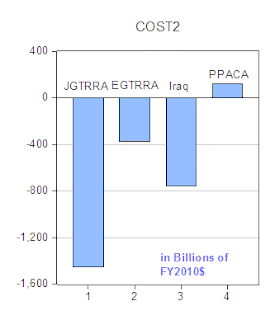
The bottom line is that the CBO scoring system, like most systems, can be gamed.
Here is where Mr. Samuelson dismisses the entire budgeting process in Washington:Actually the logical implication is that the CBO scoring for the health care bill is nonsense and you shouldn't make graphs like this one (JGTRRA is the second Bush tax cut and EGTRRA is the first).But the CBO estimate is misleading, because it must embody the law's many unrealistic assumptions and gimmicks. Benefits are phased in "so that the first 10 years of [higher] revenue would be used to pay for only six years of spending" increases, a former CBO director, Douglas Holtz-Eakin, wrote in the New York Times on March 20. Holtz-Eakin also noted the $70 billion of premiums for a new program of long-term care that reduce present deficits but will be paid out in benefits later. Then there's the "doc fix" -- higher Medicare reimbursements under separate legislation that would cost about $200 billion over a decade.The logical implication based upon this argument: Might as well close up CBO.

The bottom line is that the CBO scoring system, like most systems, can be gamed.
Sunday, March 28, 2010
Priorities on GW
Robert Stavins wonders who killed cap-and-trade and argues that
U.S. public support on this issue has decreased significantly, as has been validated by a number of reliable polls, including from the Gallup Organization. Indeed, in January of this year, a Pew Research Center poll found that “dealing with global warming” was ranked 21st among 21 possible priorities for the President and Congress.A quick glance confirms this--global warming is not a top priority--but that's not a perfect measure. It could be a somewhat high priority on everyone's list which would mean it's still pretty damn important. Scroll down on the Pew link and you'll find that GW has never been that high as a top priority (topping 38% in 2007, when they started asking about it). It looks like GW was just edged out due to recent events; people haven't stopped caring. I wouldn't call it dead yet.
Saturday, March 27, 2010
Krugman on Reform
Paul Krugman has a smart insight about financial (or any) reform. Straightforward reform only needs mediocre regulators. Highly specialized and nuanced reform requires smart regulators to implement right. Get the so-so regulators with complex reform and you'll get something far worse than no reform at all.
That doesn’t make financial reform useless. But it is a worry, since you can’t count on always having smart, well-intentioned people doing the regulating.Always? How about ever?
Wednesday, March 24, 2010
Obamacare and Entrepreneurship
With legislation as sweeping as the recent health care reform, lots of interesting questions boil to the surface. For one, will the reform be good for entrepreneurship or bad for it? Two commentators at Megan McArdle give conflicting reports, one arguing that it's good and the other that it's bad.
On one hand, entrepreneurs tend to be younger people and younger people tend not to buy health insurance even if they can afford it. The reform makes people buy insurance (though the penalty for not doing so is somewhat low) and will subsidize those who make little enough to purchase it. Thus there are those who have to buy it but make enough so they will get little or no government help. A forced expense will take money away from the all-important start-up capital.
On the other hand, those with a pre-existing condition (since you can't deny someone based on if they have a pre-existing condition) can now leave their employer's health plan and strike out on their own, confident they can get the health insurance they need. Untethered, we could see more entrepreneurship.
Which effect is more powerful depends on various questions: How important is a few to several hundred dollars a month for a new business? How common are people with pre-existing conditions? Are people with pre-existing conditions more or less likely to start a business (unlikely but if it's true it would probably be the most important variable)? I don't know the answer to any of these, but I suspect the bad outweighs the good.
Bryan Caplan, however, points out another possible confounding issue:
This could push it to being good for entrepreneurship as companies can pay the fine and neither has health insurance until the employee gets sick (in which case they might get a subsidy).
It's not an easy thing to sort out.
On one hand, entrepreneurs tend to be younger people and younger people tend not to buy health insurance even if they can afford it. The reform makes people buy insurance (though the penalty for not doing so is somewhat low) and will subsidize those who make little enough to purchase it. Thus there are those who have to buy it but make enough so they will get little or no government help. A forced expense will take money away from the all-important start-up capital.
On the other hand, those with a pre-existing condition (since you can't deny someone based on if they have a pre-existing condition) can now leave their employer's health plan and strike out on their own, confident they can get the health insurance they need. Untethered, we could see more entrepreneurship.
Which effect is more powerful depends on various questions: How important is a few to several hundred dollars a month for a new business? How common are people with pre-existing conditions? Are people with pre-existing conditions more or less likely to start a business (unlikely but if it's true it would probably be the most important variable)? I don't know the answer to any of these, but I suspect the bad outweighs the good.
Bryan Caplan, however, points out another possible confounding issue:
If preliminary summaries of Obamacare are true, it looks like individual health insurance will soon be a better deal than employer-provided health insurance. In the individual market, you can now wait until you're really sick to buy insurance: "Heads I win, tails I break even." Firms won't have that gimme - and it seems more valuable than premiums' tax deductibility. Admittedly, Obamacare imposes a small penalty on individuals who don't buy insurance, and a moderate penalty on firms that don't provide it. But it still seems like it will be in the financial self-interest of many firms and their workers to get rid of insurance, and split the (cash savings minus penalties).
This could push it to being good for entrepreneurship as companies can pay the fine and neither has health insurance until the employee gets sick (in which case they might get a subsidy).
It's not an easy thing to sort out.
Monday, March 15, 2010
Health Care Profitability
Everyone's talking about how profitable health insurance companies are (notably on tonight's Daily Show) but the secret is they're not that profitable compared to other industries. The large numbers shot around about increased profits are absolute dollars, not relative to their revenue, and tell us nothing about how profitable an industry actually is. Profit margin (which adjusts for revenue) is a much better measure. And health insurance performs quite bad compared other industries. I got the data from Yahoo Finance; here's the most recent quarter.
Note, REIT is healthcare facilities, not health insurance nor hospitals. According to Yahoo, these companies are in finance...basically real estate for health-related services. Healthcare plans (including Aetna, Wellpoint, Universal Americacore, etc) is number 88. Home health care was 55. Hospitals rank 100 (out of 215).
I thank Mark Perry who did a table for August of 2009. (Insurance companies dropped by two ranks since then.)
Note, REIT is healthcare facilities, not health insurance nor hospitals. According to Yahoo, these companies are in finance...basically real estate for health-related services. Healthcare plans (including Aetna, Wellpoint, Universal Americacore, etc) is number 88. Home health care was 55. Hospitals rank 100 (out of 215).
| Rank | Industry | Profit Margin |
| 1 | Closed-End Fund - Foreign | 38.3 |
| 2 | REIT - Healthcare Facilities | 25.2 |
| 3 | Drug Manufacturers - Major | 22.2 |
| 4 | Publishing - Periodicals | 21.8 |
| 5 | Cooper | 20.9 |
| 6 | Application Software | 20.6 |
| 7 | Cigarettes | 19.2 |
| 8 | Internet Information Providers | 18.7 |
| 9 | Healthcare Information Providers | 16.8 |
| 10 | REIT - Industrial | 16.6 |
| 11 | Agricultural Chemicals | 16.4 |
| 12 | Long Distance Carriers | 15.1 |
| 13 | Networking & Communication Devices | 14.4 |
| 14 | Beverages - Brewers | 13.8 |
| 15 | Personal Products | 13.4 |
| 16 | Oil & Gas Drilling & Exploration | 12.8 |
| 17 | Information & Delivery Services | 12.6 |
| 18 | Beverages - Wineries & Distillers | 12.3 |
| 19 | Air Services, Other | 12.3 |
| 20 | Railroads | 12.2 |
| 21 | Diversified Investments | 11.8 |
| 22 | Gold | 11.6 |
| 23 | Drug Manufacturers - Other | 11.1 |
| 24 | Technical & System Software | 10.9 |
| 25 | Biotechnology | 10.7 |
| 26 | Shipping | 10.5 |
| 27 | Education & Training Services | 10.3 |
| 28 | Medical Instruments & Supplies | 10.2 |
| 29 | Beverages - Soft Drinks | 10.1 |
| 30 | Wireless Communications | 9.9 |
| 31 | Industrial Metals & Minerals | 9.9 |
| 32 | Telecom Services - Domestic | 9.6 |
| 33 | Steel & Iron | 9.5 |
| 34 | REIT - Residential | 9.3 |
| 35 | Processed & Packaged Goods | 9.2 |
| 36 | Electric Utilities | 9.2 |
| 37 | Business Software & Services | 9.2 |
| 38 | Foreign Regional Banks | 8.9 |
| 39 | Personal Services | 8.7 |
| 40 | Semiconductor - Specialized | 8.6 |
| 41 | CATV Systems | 8.6 |
| 42 | Restaurants | 8.5 |
| 43 | Diversified Computer Systems | 8.5 |
| 44 | Regional - Southwest Banks | 8.3 |
| 45 | Diversified Utilities | 8.2 |
| 46 | Cleaning Products | 8.1 |
| 47 | Medical Laboratories & Research | 7.9 |
| 48 | General Entertainment | 7.7 |
| 49 | Gas Utilities | 7.7 |
| 50 | Publishing - Books | 7.6 |
| 51 | Personal Computers | 7.6 |
| 52 | Oil & Gas Equipment & Services | 7.4 |
| 53 | Investment Brokerage - Regional | 7.4 |
| 54 | Toys & Games | 7.3 |
| 55 | Home Health Care | 7.2 |
| 56 | Textile - Apperel Footwear & Accessories | 7.0 |
| 57 | Waste Management | 6.9 |
| 58 | Conglomerates | 6.7 |
| 59 | Accident & Health Insurance | 6.7 |
| 60 | Aerospace/Defence Products & Services | 6.6 |
| 61 | Major Integrated Oil & Gas | 6.5 |
| 62 | Telecom Services - Foreign | 6.4 |
| 63 | Oil & Gas Piplines | 6.4 |
| 64 | Food - Major Diversified | 6.4 |
| 65 | Business Services | 6.4 |
| 66 | Auto Parts Stores | 6.2 |
| 67 | Sporting Activities | 5.8 |
| 68 | Medical Appliances & Equipment | 5.8 |
| 69 | Entertainment - Diversified | 5.8 |
| 70 | Photographic Equipment & Supplies | 5.7 |
| 71 | REIT - Retail | 5.6 |
| 72 | Drug Delivery | 5.6 |
| 73 | Tobacco Products, Other | 5.5 |
| 74 | Diversified Communication Services | 5.4 |
| 75 | Specialty Eateries | 5.3 |
| 76 | Industrial Electrical Equipment | 5.3 |
| 77 | Small Tools & Accessories | 5.1 |
| 78 | Semiconductor - Broad Line | 5.1 |
| 79 | REIT - Office | 5.1 |
| 80 | Pollution & Treatment Controls | 5.1 |
| 81 | Drugs - Generic | 5.1 |
| 82 | Insurance Brokers | 5.0 |
| 83 | Management Services | 4.9 |
| 84 | Research Services | 4.7 |
| 85 | Consumer Services | 4.7 |
| 86 | Confectioners | 4.7 |
| 87 | Information Technology Services | 4.4 |
| 88 | Health Care Plans | 4.4 |
| 89 | Auto Parts Wholesale | 4.3 |
| 90 | Packaging & Containers | 4.1 |
| 91 | Security & Protection Services | 3.9 |
| 92 | Cement | 3.9 |
| 93 | Chemicals - Major Diversified | 3.8 |
| 94 | Industrial Equipment Wholesale | 3.7 |
| 95 | Industrial Equipment & Components | 3.7 |
| 96 | Home Improvement Stores | 3.7 |
| 97 | General Contractors | 3.5 |
| 98 | Aerospace/Defense - Major Diversified | 3.5 |
| 99 | Housewares & Accessories | 3.4 |
| 100 | Hospitals | 3.4 |
I thank Mark Perry who did a table for August of 2009. (Insurance companies dropped by two ranks since then.)
Monday, March 08, 2010
Peltzman on Germs
Slate columnist Darshak Sanghavi blames hand sanitizers' fundamental approach for their lack of effect on flu prevention.
Sam Peltzman discovered that increased safety standards on cars don't reduce accident fatalities. Because cars are safer, people feel safer and drive more recklessly. Similarly, hand sanitizer makes people feel braver and expose themselves to more germs. On net, there's no change, but it's not Purell's fault.
To begin, the influenza virus mostly spreads via tiny droplets in the air (for example, from sneezes)—not by dirty hands or surfaces—which limits the role of Purell. It probably wouldn't matter even if flu transferred though hand contact, which is how most cold viruses spread...The average child touches his or her mouth and nose every three minutes, and both adults and children come in contact with as many as 30 different objects every minute. Even hospitals can't get staff to use Purell before seeing patients; it's impossible for day care staff, parents, or teachers to wash a child's hands 20 times each hour.But what about adults? For that, I immediately thought of the Peltzman Effect.
Sam Peltzman discovered that increased safety standards on cars don't reduce accident fatalities. Because cars are safer, people feel safer and drive more recklessly. Similarly, hand sanitizer makes people feel braver and expose themselves to more germs. On net, there's no change, but it's not Purell's fault.
Sunday, March 07, 2010
Tattletales and Signaling Theory
You learn lots of important things in kindergarten. Don't lie. Don't cut in line. Always say "please" and "thank you." Share your toys. Don't tattle. These are all good lessons, but the last one doesn't really make sense. Tattletales inform proper authorities of people who broke the rules. If the rules are just, exposing violators of those rules should also be just. If it's not good to point out that little Suzy cut in line, how can one say it's bad to cut in line? And yet, if you're hosting a party and a guest came to you to rat out another guest because she jumped in front of everyone at the buffet table, you'll probably have a lower opinion of the informant, not the accused.
It gets even more confusing because it's not a hard fast rule. "Tattling" on a murderer or a thief is generally considered an act of bravery. Same thing goes with exposing corrupt politicians or companies doing unethical accounting or illegal polluting. We call them whistle blowers and put them on the cover of Time Magazine. Context matters a lot: during the 2009 snow storm I, like so many others, were stranded at the Dulles Airport. A woman cut in line for rebooking (a line I was waiting in for two hours). It took us a while to figure out she was cutting and not asking a humdrum question and while no one protested, we wish we had. (Why we didn't is another story entirely.)
My best guess to explain this asymmetry is signaling theory. Signaling is economics speak for "actions speak louder than words." It's about using demonstrative actions to show people you have some quality. Saying you're a trustworthy person doesn't mean much. But if you fess up to something you did wrong, you can signal you're a trustworthy person and people are more likely to believe you. Tattletales interfere with that signaling system.
Suppose I cut in line at a buffet to get the last Swedish meatball. If I sneak away to devour my ill-gotten gains in peace, those who witnessed it will look down on me for my selfishness and rudeness. But suppose I admit to everyone that I cut in line and apologize. I've put myself out there, subjecting myself to the will of the mob. By admitting dishonesty, everyone would look down on me. Someone might lay claim to my meatball. But it's also possible that everyone would laugh it off and they'll go away thinking "that David fellow is an honest guy; he didn't have to admit to such a minor offense but he did and that says a lot."
Now I'm not saying that a good way to gain people's trust is to swipe something and then fess up. The whole point is you're putting yourself at risk to be worse off than if you said nothing and it certainly doesn't work if you follow up every heart-felt apology with another act of rudeness. But it shows that there's value in not exposing a violator because doing so denies them the opportunity to signal honesty. If a third party tells everyone I cut in line, then me stepping up to admit it doesn't mean anything. Thus, we discourage tattletales because they mess up our signaling system.
This signaling system doesn't always work. When the expected costs of signaling are unconditionally greater than the expected benefits, we don't expect anyone to signal so we tolerate, no, celebrate, tattlers. From murderers to emergency situation line jumpers, whistle blowers end up just getting rid of the creeps.
It gets even more confusing because it's not a hard fast rule. "Tattling" on a murderer or a thief is generally considered an act of bravery. Same thing goes with exposing corrupt politicians or companies doing unethical accounting or illegal polluting. We call them whistle blowers and put them on the cover of Time Magazine. Context matters a lot: during the 2009 snow storm I, like so many others, were stranded at the Dulles Airport. A woman cut in line for rebooking (a line I was waiting in for two hours). It took us a while to figure out she was cutting and not asking a humdrum question and while no one protested, we wish we had. (Why we didn't is another story entirely.)
My best guess to explain this asymmetry is signaling theory. Signaling is economics speak for "actions speak louder than words." It's about using demonstrative actions to show people you have some quality. Saying you're a trustworthy person doesn't mean much. But if you fess up to something you did wrong, you can signal you're a trustworthy person and people are more likely to believe you. Tattletales interfere with that signaling system.
Suppose I cut in line at a buffet to get the last Swedish meatball. If I sneak away to devour my ill-gotten gains in peace, those who witnessed it will look down on me for my selfishness and rudeness. But suppose I admit to everyone that I cut in line and apologize. I've put myself out there, subjecting myself to the will of the mob. By admitting dishonesty, everyone would look down on me. Someone might lay claim to my meatball. But it's also possible that everyone would laugh it off and they'll go away thinking "that David fellow is an honest guy; he didn't have to admit to such a minor offense but he did and that says a lot."
Now I'm not saying that a good way to gain people's trust is to swipe something and then fess up. The whole point is you're putting yourself at risk to be worse off than if you said nothing and it certainly doesn't work if you follow up every heart-felt apology with another act of rudeness. But it shows that there's value in not exposing a violator because doing so denies them the opportunity to signal honesty. If a third party tells everyone I cut in line, then me stepping up to admit it doesn't mean anything. Thus, we discourage tattletales because they mess up our signaling system.
This signaling system doesn't always work. When the expected costs of signaling are unconditionally greater than the expected benefits, we don't expect anyone to signal so we tolerate, no, celebrate, tattlers. From murderers to emergency situation line jumpers, whistle blowers end up just getting rid of the creeps.
Saturday, February 27, 2010
Six Percent and the Secrets of Real Estate
Several years back, Alex Tabarrok pointed out the mystery of real estate commission. No matter where you go, or what's being sold, real estate agents take 6% of the home's selling price (typically, 3% goes to them and 3% goes to the the agency they work for). This is bizarre: why would agents in Montana be charged the same percent as agents in California, where homes are much more expensive? Is the increase in work to sell a home really so perfectly proportional to its price? Seems unlikely.
I ran into a real estate agent on the train while traveling to New Haven, CT on Thursday and asked her about it. She insists it's not true. Even before the crash, commission's negotiable: she's done 4% or 5% for some buys and she's charged 7% for major sales (such as if selling the home requires that she rents a helicopter and takes aerial photographs). If she's selling a home and finds a buyer willing to be represented by her, she takes a smaller commission on each (though she gets more overall; 4% twice is more than 6% once). "Everything's negotiable," she says. That's reassuring.
While she's been in the business since the mid 1990s, this is just one data point. Still, with so much freedom of entry and variation across real estate markets, I'm more likely to believe that this 6% level is more urban legend than industry practice.
I ran into a real estate agent on the train while traveling to New Haven, CT on Thursday and asked her about it. She insists it's not true. Even before the crash, commission's negotiable: she's done 4% or 5% for some buys and she's charged 7% for major sales (such as if selling the home requires that she rents a helicopter and takes aerial photographs). If she's selling a home and finds a buyer willing to be represented by her, she takes a smaller commission on each (though she gets more overall; 4% twice is more than 6% once). "Everything's negotiable," she says. That's reassuring.
While she's been in the business since the mid 1990s, this is just one data point. Still, with so much freedom of entry and variation across real estate markets, I'm more likely to believe that this 6% level is more urban legend than industry practice.
Thursday, February 11, 2010
Pictures From Snowmageddon
I normally don't do personal stuff here but the pictures from the twin blizzards are pretty interesting (and should be convincing to those knowledgeable of Midwestern winters that if I complain about the snow, it's not because I've gone soft).
The first shots are from the first blizzard. In this shot, I've already dug out the back area (which took about an hour). Yes, I actually had to do some digging to confirm the car was mine (the snow was originally hiding the plate and my IHS bumper sticker).


There is, of course, some economics in this post. For one, I note a similar mystery that Bryan Caplan pointed out. For example, here's the milk section at the local supermarket I visited today (note the soy milk, way at the end, is pretty well stocked).

Bryan thinks it's strange that the brand name stuff is grabbed more than the off brand. As staple products, if people like them five times as much, why isn't there five times as many of it? Several days into the storms, I still found other strange juxtapositions.


Some of this might have been due to constant restocking but based on Caplan's observations (and others that went out right before the storm concur), it's equally possible that this is not the case.
It also highlights the problem of inflexible prices, especially during a crisis. It's probably due to price-gouging laws, which exist is most, if not all, states. Luckily when I went today, I was able to get everything I needed (but only because the nearby Wal-Mart just restocked its milk).
The first shots are from the first blizzard. In this shot, I've already dug out the back area (which took about an hour). Yes, I actually had to do some digging to confirm the car was mine (the snow was originally hiding the plate and my IHS bumper sticker).


There is, of course, some economics in this post. For one, I note a similar mystery that Bryan Caplan pointed out. For example, here's the milk section at the local supermarket I visited today (note the soy milk, way at the end, is pretty well stocked).

Bryan thinks it's strange that the brand name stuff is grabbed more than the off brand. As staple products, if people like them five times as much, why isn't there five times as many of it? Several days into the storms, I still found other strange juxtapositions.


Some of this might have been due to constant restocking but based on Caplan's observations (and others that went out right before the storm concur), it's equally possible that this is not the case.
It also highlights the problem of inflexible prices, especially during a crisis. It's probably due to price-gouging laws, which exist is most, if not all, states. Luckily when I went today, I was able to get everything I needed (but only because the nearby Wal-Mart just restocked its milk).
Friday, February 05, 2010
Ryanair: Cheap, Reliable, and Safe
Ryanair ranks in the bottom 10 of 581 companies on ethics (based on social responsibility, environmental awareness, etc), compiled by Geneva-based Covalence. Henry at Crooked Timber notes that Ryanair is unique among its low ranked brethren: it seems to covet its slimly image.
Ryanair is trying to attract well-informed consumers who will see the add-on charges beforehand and adjust for it; they end up with a very cheap airfare (it's apparently an inexpensive way to travel) and no surprises. Ill-informed consumers end up footing the bill. This is a nifty argument but I don't see it holding in equilibrium, especially when you're issuing press releases about charging for using the bathroom. Something like that is likely to get out to even the poorly informed consumer.
Ryanair is signalling safety. Since they are inexpensive, the company is showing where they get revenue from thus customers aren't afraid that they got a deal because the firm skimped on safety checks. But it seems that the safety regulations which govern air travel would put customers' mind at ease. At the same time, you could argue the fear is that they cut corners in other ways, such as paying their flight attendants very little which would result in rude service.
Ryanair is signally honesty and reliability. When you travel, there's a lot of stress so when you discover some small fee it seems like a much bigger problem than it is. By outlining all their add-on costs before you pack your bags, they're cutting out uncertainty (and the fear of uncertainty). Yeah, you have to pay to use the bathroom, but since you knew about it ahead of time, it doesn't seem as bad as if you discovered it after drinking six glasses of water. Since everyone knows companies spin the truth in commercials, blatantly not spinning it sends a strong signal that "this is all you will have to deal with."
What I like about this last argument is that it bears a striking resemblance to Domino's "sorry we had horrible pizza but now it's good" campaign. Some commentators laugh at it, replaying old commercials touting the flavor of Domino's "cardboard." But no one really cares; every pizza chain says their pizza is great. But Domino's admitting a lot of people didn't like and now we're fixing it speaks volumes. Down right honesty is often an under appreciated business practice.
The company prides itself not only on being perceived as having no social conscience, but as having a reputation for screwing its customers as systematically and mercilessly as possible. Which other airline’s CEO would announce that he wanted to charge passengers to use the toilet as a publicity stunt? Clearly, Ryanair thinks that this reputation is a money spinner for them (it is quite deliberately cultivated), and they have indeed made quite a lot of money. But why (if they are right) would a reputation for shafting your customers be a commercial asset for a consumer-oriented business in a relatively competitive sector? The standard economic account doesn’t seem to provide much insight. Help me out here.There are many sloppy explanations, but three good ones stand out.
Ryanair is trying to attract well-informed consumers who will see the add-on charges beforehand and adjust for it; they end up with a very cheap airfare (it's apparently an inexpensive way to travel) and no surprises. Ill-informed consumers end up footing the bill. This is a nifty argument but I don't see it holding in equilibrium, especially when you're issuing press releases about charging for using the bathroom. Something like that is likely to get out to even the poorly informed consumer.
Ryanair is signalling safety. Since they are inexpensive, the company is showing where they get revenue from thus customers aren't afraid that they got a deal because the firm skimped on safety checks. But it seems that the safety regulations which govern air travel would put customers' mind at ease. At the same time, you could argue the fear is that they cut corners in other ways, such as paying their flight attendants very little which would result in rude service.
Ryanair is signally honesty and reliability. When you travel, there's a lot of stress so when you discover some small fee it seems like a much bigger problem than it is. By outlining all their add-on costs before you pack your bags, they're cutting out uncertainty (and the fear of uncertainty). Yeah, you have to pay to use the bathroom, but since you knew about it ahead of time, it doesn't seem as bad as if you discovered it after drinking six glasses of water. Since everyone knows companies spin the truth in commercials, blatantly not spinning it sends a strong signal that "this is all you will have to deal with."
What I like about this last argument is that it bears a striking resemblance to Domino's "sorry we had horrible pizza but now it's good" campaign. Some commentators laugh at it, replaying old commercials touting the flavor of Domino's "cardboard." But no one really cares; every pizza chain says their pizza is great. But Domino's admitting a lot of people didn't like and now we're fixing it speaks volumes. Down right honesty is often an under appreciated business practice.
Thursday, February 04, 2010
The Myth of Magic Medicare
Insurance companies are greedy. Everything its CEOs work for is to make as much profit as possible. They are hesitant to do anything that increases their revenues, and anxious to adopt anything which decreases their costs. Until today, I didn't think anyone would disagree with this until tonight, when Congressman Anthony Weiner went on The Daily Show.
Congressman Weiner argues that Medicare should be expanded to all citizens, citing its very low administration costs (about 3% of its total payouts) as a way to save money. Insurance companies, by contrast, have about 12% overhead.
What magic has Medicare mastered to keep its overhead so low, magic that continues to allude our greedy insurance companies? It's not economies of scale. Medicare has about 45 million customers, while AIG covers 74 million. Even if you adjust for the fact that AIG covers people worldwide while Medicare only works within the US, such a massive difference in overhead is hard to explain with just economies of scale. After you measure your customers in the millions, those efficiency gains from volume tend to disappear. Otherwise we'd have far fewer insurance companies (I counted 31 health insurance companies in the US from this Wikipedia list with 27 confirmed as currently active). It's hard to think of another argument which could possibly justify this vast difference in overhead between the public and private sectors. I wonder how Rep. Weiner explains it; perhaps insurance companies don't care as much about profits as we thought. Or government is far more cut throat than anyone possibly imagined. Or maybe the folks at Medicare has some sort of genie/manager.
Now you could argue that Medicare doesn't have to worry about paying for advertisers nor state taxes. That's a lot better but 9 percentage points for TV commercials and taxes is hard to believe. There are two other explanations which justify this difference and neither of them help Weiner's argument.
First, Medicare covers only those over 65. Since the elderly, on average, need more medical assistance than the rest of us, the payouts in relation to administration costs drastically increase. It's not that Medicare has some secret which keeps overhead low; its payouts are just biased upward.
Second, Medicare spends very little money investigating the claims it accepts. And medical insurance fraud is a big problem. Just because you're spending less money, doesn't mean it's actually saving money.
Congressman Weiner argues that Medicare should be expanded to all citizens, citing its very low administration costs (about 3% of its total payouts) as a way to save money. Insurance companies, by contrast, have about 12% overhead.
What magic has Medicare mastered to keep its overhead so low, magic that continues to allude our greedy insurance companies? It's not economies of scale. Medicare has about 45 million customers, while AIG covers 74 million. Even if you adjust for the fact that AIG covers people worldwide while Medicare only works within the US, such a massive difference in overhead is hard to explain with just economies of scale. After you measure your customers in the millions, those efficiency gains from volume tend to disappear. Otherwise we'd have far fewer insurance companies (I counted 31 health insurance companies in the US from this Wikipedia list with 27 confirmed as currently active). It's hard to think of another argument which could possibly justify this vast difference in overhead between the public and private sectors. I wonder how Rep. Weiner explains it; perhaps insurance companies don't care as much about profits as we thought. Or government is far more cut throat than anyone possibly imagined. Or maybe the folks at Medicare has some sort of genie/manager.
Now you could argue that Medicare doesn't have to worry about paying for advertisers nor state taxes. That's a lot better but 9 percentage points for TV commercials and taxes is hard to believe. There are two other explanations which justify this difference and neither of them help Weiner's argument.
First, Medicare covers only those over 65. Since the elderly, on average, need more medical assistance than the rest of us, the payouts in relation to administration costs drastically increase. It's not that Medicare has some secret which keeps overhead low; its payouts are just biased upward.
Second, Medicare spends very little money investigating the claims it accepts. And medical insurance fraud is a big problem. Just because you're spending less money, doesn't mean it's actually saving money.
Monday, February 01, 2010
How the Middleman Can Save You Money
Tonight's Daily Show featured Austan Goolsbee of the Council of Economic Advisers to the President. He argued in favor of the government taking over lending to students and cutting the middleman (various financial intermediaries) to save money. Cutting the middleman is a time-honored way to try to boost efficiency but it doesn't always work. Middlemen exist for a reason. In this case, they provide specialized knowledge and an incentive for efficiency since they keep the profits and suffer the losses (most of the time anyway).
This isn't simply a matter of buying your mattress directly from the factory (though, even there the middleman probably has better customer relations). Lending money is hard because because you have to avoid the twin pitfalls of those who can't pay you back and those who won't pay you back (aka adverse selection and moral hazard). People still default on loans despite various inventive mechanisms banks developed over the years to avoid these pitfalls; mistakes are easy to commit.
But it's even easier when you're not fighting for your life. No matter how well trained a government employee is, they are much less likely to get fired for approving a lot of loans which later default than for an employee at a for-profit company.
It still might be cheaper for the government to provide this service directly (though I'm skeptical). But it's not simply a matter of pocketing the middleman's cut.
This isn't simply a matter of buying your mattress directly from the factory (though, even there the middleman probably has better customer relations). Lending money is hard because because you have to avoid the twin pitfalls of those who can't pay you back and those who won't pay you back (aka adverse selection and moral hazard). People still default on loans despite various inventive mechanisms banks developed over the years to avoid these pitfalls; mistakes are easy to commit.
But it's even easier when you're not fighting for your life. No matter how well trained a government employee is, they are much less likely to get fired for approving a lot of loans which later default than for an employee at a for-profit company.
It still might be cheaper for the government to provide this service directly (though I'm skeptical). But it's not simply a matter of pocketing the middleman's cut.
Tuesday, January 12, 2010
The Meaning of Wealth
While defending China's long term prospects, Robert Fogel paints a bleak picture for Europe.
GDP is a useful proxy for wealth but its dangerous to forget it's just a proxy. This idea stretches all the way to Adam Smith (as so many great ideas do). He noted that all jobs are relativity equal if take the large picture (including educational requirements, work hours, effort, stress, independence, and of course pay). Natural differences in the nature of work will be balanced by the size of the salary. (Later called compensating wage differentials.) Professors have great freedom and jobs, but don't get paid that much given their educational background. CEOs get paid a lot but have to work long hours. Some people prefer the salary and become management; some prefer flexibility in their time and become professors.
Like GDP, we use salary as a rough estimate of how successful we are. But, when pressed, we know it's more than that. Not all of us wish to work the 80-100 hour weeks of a CEO, stock broker, or high-powered lawyer. Nor do all of us wish to go to school for years and years, only to have all that work result in less than six figures a year (save rare exceptions).
On the macro scale, you can say it's different. More spending means more jobs and no matter how bohemian you enjoy your lifestyle, you still need to eat. If the people prefer time, rather than stuff, then their economy is in a bad position; you can't sell time. But you can; by making life easier for your customers, you effectively sell time. This is what the services industry is all about. While I agree that Europe's shrinking population is a problem, the preferences of its people is not.
In another way, Europe's culture confounds economists. Citizens of Europe's wealthy countries are not working longer hours to make higher salaries and accumulate more goods. Rather, European culture continues to prize long vacations, early retirements, and shorter work weeks over acquiring more stuff, at least in comparison to many other developed countries, such as the United States...A promenade in the Jardin du Luxembourg, as opposed to a trip to Walmart for a flat-screen TV, won't help the European Union's GDP growth.No doubt that the laws requiring long vacations and strong job security has had unintended consequences for the countries' economy and employment rates. But stuff (GDP) is not wealth. It is a source of wealth, but it is not wealth. The closest thing to wealth is happiness (a notoriously difficult thing to measure). Its people's priority over non-pecuniary benefits is not confounding at all.
GDP is a useful proxy for wealth but its dangerous to forget it's just a proxy. This idea stretches all the way to Adam Smith (as so many great ideas do). He noted that all jobs are relativity equal if take the large picture (including educational requirements, work hours, effort, stress, independence, and of course pay). Natural differences in the nature of work will be balanced by the size of the salary. (Later called compensating wage differentials.) Professors have great freedom and jobs, but don't get paid that much given their educational background. CEOs get paid a lot but have to work long hours. Some people prefer the salary and become management; some prefer flexibility in their time and become professors.
Like GDP, we use salary as a rough estimate of how successful we are. But, when pressed, we know it's more than that. Not all of us wish to work the 80-100 hour weeks of a CEO, stock broker, or high-powered lawyer. Nor do all of us wish to go to school for years and years, only to have all that work result in less than six figures a year (save rare exceptions).
On the macro scale, you can say it's different. More spending means more jobs and no matter how bohemian you enjoy your lifestyle, you still need to eat. If the people prefer time, rather than stuff, then their economy is in a bad position; you can't sell time. But you can; by making life easier for your customers, you effectively sell time. This is what the services industry is all about. While I agree that Europe's shrinking population is a problem, the preferences of its people is not.
Sunday, January 03, 2010
Not Quite a Wage Control
The Heritage Foundation issued this summary of what the Senate Health Care bill will change when. Some of these summaries looks suspiciously harsh (such as the one claiming the bill won't allow insurance companies to revoke the insurance from someone who committed fraud). Another, less obviously exaggerated, one caught my eye: In 2012, "Health insurance company employees may not be paid more than $500,000 per year."
I was curious to see how this was worded so I checked the Senate bill where it's listed under Section 9014. The section is strangely worded (of course), making references to deductions and the Section 162 of the 1986 tax code. After consulting that, I got an idea what this clause was actually about.
For one, the change doesn't occur until 2013, not 2012, but that's a minor point. Moreover, the "payment cap" isn't really a cap. It just means that if you make more than half a million a year and work for health insurance provider, you can't take any deductions relating to trade or business expenses (as allowed by the 1986 reform). I don't know how big of an impact this will have on health insurance employees making more than $500,000 a year as I have no idea what their business deductions are, but it's not a wage control.
I was curious to see how this was worded so I checked the Senate bill where it's listed under Section 9014. The section is strangely worded (of course), making references to deductions and the Section 162 of the 1986 tax code. After consulting that, I got an idea what this clause was actually about.
For one, the change doesn't occur until 2013, not 2012, but that's a minor point. Moreover, the "payment cap" isn't really a cap. It just means that if you make more than half a million a year and work for health insurance provider, you can't take any deductions relating to trade or business expenses (as allowed by the 1986 reform). I don't know how big of an impact this will have on health insurance employees making more than $500,000 a year as I have no idea what their business deductions are, but it's not a wage control.
Friday, January 01, 2010
Public Domain Day
It's Public Domain Day, the day when hundreds of authors' works enter the public domain. Here's a complete list. Some highlights:
-William Butler Yeats, who won the Nobel Prize in literature in 1923
-Sigmund Freud, famed psychologist
-Zane Grey, a prolific Old West novelist
-Luis Philip Senarens, one of the most prolific dime novelists of his day
-Henry Salt, credited as the first writer who argued that animals should have rights
-Zona Gale, Pulitzer Prize-winning playwright
-Siney Howard, a playwright and screen writer who won a posthumous Academy Award for the screenplay of Gone With the Wind
-William Butler Yeats, who won the Nobel Prize in literature in 1923
-Sigmund Freud, famed psychologist
-Zane Grey, a prolific Old West novelist
-Luis Philip Senarens, one of the most prolific dime novelists of his day
-Henry Salt, credited as the first writer who argued that animals should have rights
-Zona Gale, Pulitzer Prize-winning playwright
-Siney Howard, a playwright and screen writer who won a posthumous Academy Award for the screenplay of Gone With the Wind
Tuesday, December 29, 2009
Another Reason to Buy a House
Megan McArdle points out some reasons to buy a home--such as avoiding costs to moving and having the freedom to customize your space--but she forget a key issue: avoiding horrible landlords. While buying a house comes with the risk of getting a lemon, landlords can be the same way. They can be behind on repairs, rude, or lax on the law (which can cause many problems for you later). In one place I lived, a surprise investigation revealed that one of the rooms was not legally occupied since it lacked the proper amount of window space. A huge headache followed, eventually resulting in the occupant leaving the house.
There's something to be said for removing another person from the upkeep equation. While you lose the chance of professional specialization, you also remove the possibility of negligence which often accompanies a new (or even experienced) landlord. Many of these problems go away when you own your own home (sure, the plumbing still needs fixed, but now you're depending on the plumber instead of depending on the landlord who's depending on the plumber).
There's something to be said for removing another person from the upkeep equation. While you lose the chance of professional specialization, you also remove the possibility of negligence which often accompanies a new (or even experienced) landlord. Many of these problems go away when you own your own home (sure, the plumbing still needs fixed, but now you're depending on the plumber instead of depending on the landlord who's depending on the plumber).
Sunday, December 27, 2009
Santa the Slaver
In countless Christmas movies, we get the impression that the elves of Santa's workshop are happy, joyful people who do all their work for fun. It's part of the myth: who would want toys from a man who forces elfin creatures to do his bidding only to then give away all of their hard work to strangers and force them to start all over? The more you think about Santa, the more I realize those elves are his slaves.
(1) Santa has no income. Maybe all those fake Santas which crowd the malls bump up part of their paycheck to the big man (think of it like a franchise), but that wouldn't be enough to cover the cost of materials, let alone labor.
(2) There's no way that the North Pole is the elves' natural habitat. They don't have the fur needed comfortable survive there. Typically elves live in the forest. Now, obviously, Santa wants to be isolated from the humans which is why he lives in the North Pole. But there are plenty of other places he could be, places more hospitable for his elves (here's a map of the world based on how long it takes to get to a major city). The Amazon is quite isolated, as is the Sahara Desert. The Himalayas are warmer than the North Pole if you don't go too high. All are viable candidates. But Santa picked one of the most inhospitable places on the planet for one reason: to keep the elves indoors. If he was in the Amazon, in a place they were comfortable in, they might run outside instead of working. Not only did Santa kidnap them, he's trapped them in a work camp.
(3) But if they like to work, then it's ok, right? Well, if they like to work, why do they need Santa? Why not just stay in their natural habitat and send toys out into the world? Hauling cargo is work, too. Yes, they won't have Santa's magical powers to deliver them all on Christmas Eve, but so what? Unless you're talking about something that could spoil or die (which accounts for a tiny fraction of presents), they can be delivered weeks or even months in advance. It's more likely that after Santa kidnapped them, he lied, claiming the presents had to come out on the 24th and only the 24th, thus "justifying" the kidnapping.
(4) But what about all the shots from movies and television with the happy elves? For one, that's fantasy and you're mistaking what's fake for what's real. (Grow up, seriously.) Besides, Santa's an all powerful being (which brings up the question of why he doesn't make the toys himself): he brain-washes them.
(1) Santa has no income. Maybe all those fake Santas which crowd the malls bump up part of their paycheck to the big man (think of it like a franchise), but that wouldn't be enough to cover the cost of materials, let alone labor.
(2) There's no way that the North Pole is the elves' natural habitat. They don't have the fur needed comfortable survive there. Typically elves live in the forest. Now, obviously, Santa wants to be isolated from the humans which is why he lives in the North Pole. But there are plenty of other places he could be, places more hospitable for his elves (here's a map of the world based on how long it takes to get to a major city). The Amazon is quite isolated, as is the Sahara Desert. The Himalayas are warmer than the North Pole if you don't go too high. All are viable candidates. But Santa picked one of the most inhospitable places on the planet for one reason: to keep the elves indoors. If he was in the Amazon, in a place they were comfortable in, they might run outside instead of working. Not only did Santa kidnap them, he's trapped them in a work camp.
(3) But if they like to work, then it's ok, right? Well, if they like to work, why do they need Santa? Why not just stay in their natural habitat and send toys out into the world? Hauling cargo is work, too. Yes, they won't have Santa's magical powers to deliver them all on Christmas Eve, but so what? Unless you're talking about something that could spoil or die (which accounts for a tiny fraction of presents), they can be delivered weeks or even months in advance. It's more likely that after Santa kidnapped them, he lied, claiming the presents had to come out on the 24th and only the 24th, thus "justifying" the kidnapping.
(4) But what about all the shots from movies and television with the happy elves? For one, that's fantasy and you're mistaking what's fake for what's real. (Grow up, seriously.) Besides, Santa's an all powerful being (which brings up the question of why he doesn't make the toys himself): he brain-washes them.
An Item From Santa's Lap
Paul Krugman applauds the Senate health care bill for, among other things, forcing insurance companies to cover patients with pre-existing conditions. This has been a long standing point of reform: why should a family be forced to cover the expenses of a medical problem when they had no role to play in the development of the condition. It's not as if they're smokers suffering from lung cancer. And many families can't afford the very expensive treatments that come with such conditions. But insurance companies can and so, the argument goes, they should pay.
For one, I'm not sure they can, but there's a deeper point. A pre-existing condition is tragic, doubly so if burdened on a family who cannot afford to properly address the issue. But that does not translate into forcing someone else to shoulder the burden, whether the target is insurance companies, hospitals, or the U.S. government (though the last is most justified since, in theory, it works for all of us). Some believe that doesn't matter; covering such individuals is the right thing to do. But that misses the larger picture. Even if they could afford it and even if they could continue to afford it for the foreseeable future, it would be ethically wrong to force one group to shoulder the problems of another group. Yes, I know we do this a lot already, but that's hardly grounds to keep doing it.
Here's an analogy. Some people are born ugly, or stupid, or socially awkward. Such people have difficulty getting dates or maintaining friendship. While befriending a person with such a pre-existing condition just to be nice would be seen as an admirable act of kindness, no one would agree to a policy which forces people to befriend or date such individuals. It would be seen as unethical, even if the individual is not able to "afford" such loneliness (i.e. they are suicidal).
It's all well an good to ask for things but you have to think about where they come from.
For one, I'm not sure they can, but there's a deeper point. A pre-existing condition is tragic, doubly so if burdened on a family who cannot afford to properly address the issue. But that does not translate into forcing someone else to shoulder the burden, whether the target is insurance companies, hospitals, or the U.S. government (though the last is most justified since, in theory, it works for all of us). Some believe that doesn't matter; covering such individuals is the right thing to do. But that misses the larger picture. Even if they could afford it and even if they could continue to afford it for the foreseeable future, it would be ethically wrong to force one group to shoulder the problems of another group. Yes, I know we do this a lot already, but that's hardly grounds to keep doing it.
Here's an analogy. Some people are born ugly, or stupid, or socially awkward. Such people have difficulty getting dates or maintaining friendship. While befriending a person with such a pre-existing condition just to be nice would be seen as an admirable act of kindness, no one would agree to a policy which forces people to befriend or date such individuals. It would be seen as unethical, even if the individual is not able to "afford" such loneliness (i.e. they are suicidal).
It's all well an good to ask for things but you have to think about where they come from.
Monday, December 14, 2009
Patent Number 5,547,091
When I shop for toothpaste, I prefer the caps with the flip top so I don't have to remove the cap when I brush my teeth. I usually forget to look since I tend to forgot to buy it in the first place but today I remembered. In my search for the flip-top cap, I discovered only one brand, Colgate, has them. Moments after I thought that was strange, I suspected the answer. A search at the PTO website confirmed my suspicions. It's patent number is 5,547,091. Here's the abstract:
A closure for a container having a dispensing nozzle include a central aperture to receive the nozzle. In one embodiment, the nozzle extends through the aperture and projects upwardly from the base cap. The base cap further includes a top wall inclined with respect to the central axis of the base cap to assist in dispensing of the contents of the container. A cap lid is hinged to the base cap by a snap hinge assembly.The patent was issued on August 20, 1996. Thus, on 2016, the "who didn't replace the cap on the toothpaste" arguments will evolve into "who didn't shut the toothpaste" arguments. And we'll all be happier for it.
Sunday, December 13, 2009
Darwin Zero
I found this post via Megan McArdle concerning the data surrounding climate change in the wake of "climategate." It's an interesting post but it's long. It's a case study on a temperature record station, Darwin Zero, and how climatologists adjust the raw data to something that is consistent across the past century. There's good reason to have adjustments (changes in station location, instruments, time of temperature recording, etc) but the adjustments to Darwin Zero are very...strange.

From the author:
This doesn't mean that all adjustments are suspect or that climatologists are lying or even that these are falsifications (though you can bet I'd like to know the reasoning behind those adjustments). And over the years, I've become more sympathetic of climatologists' claims (decentralized researchers all saying about the same thing is a good litmus test for truth). But it does highlight the need for publicly available raw data and comprehensive explanations for all the adjustments. If the scientists really want to convince people, transparency is key.
From the author:
Yikes again, double yikes! What on earth justifies that adjustment? How can they do that? We have five different records covering Darwin from 1941 on. They all agree almost exactly. Why adjust them at all? They’ve just added a huge artificial totally imaginary trend to the last half of the raw data! Now it looks like the IPCC diagram in Figure 1, all right … but a six degree per century trend? And in the shape of a regular stepped pyramid climbing to heaven? What’s up with that?
This doesn't mean that all adjustments are suspect or that climatologists are lying or even that these are falsifications (though you can bet I'd like to know the reasoning behind those adjustments). And over the years, I've become more sympathetic of climatologists' claims (decentralized researchers all saying about the same thing is a good litmus test for truth). But it does highlight the need for publicly available raw data and comprehensive explanations for all the adjustments. If the scientists really want to convince people, transparency is key.
Monday, December 07, 2009
Ten Red Balloons
DARPA's awarding $40,000 to the first person or team to find ten red balloons which were spread all over the country on December 5th. The goal is to learn how people organized in large teams use computers to socially network. What software will we see? Will there be spying? Attempts to misinform other teams? I'm not clear how they will measure all they want to measure, but the prospects look very interesting.
December 5th was the 40th anniversary of Arpanet, the Internet's precursor.
HT: Alex Tabarrok
Update: Here are the results.
December 5th was the 40th anniversary of Arpanet, the Internet's precursor.
HT: Alex Tabarrok
Update: Here are the results.
Sunday, November 29, 2009
The Paradox of Happiness
Disciplines are always most interesting when they cross with other disciplines and the economics of happiness is no exception. Talking to some of my friends the other day (one versed in anthropology and another in psychology), we noted how much people value a sense of genuine accomplishment and is probably why, in some cases, wealthy people aren't as happy as less wealthy people. (Setting aside the lower mortality rates in poorer societies.)
For example, the people of the indigenous tribe that must work every day to get a meal are going to be happier (assuming they are successful) than the middle management who, while isn't concerned about getting his next meal, has no sense of accomplishment and feels as though his life is wasted. (This, by the way, is how many mid-life crises take root.) Indeed, people who have the option to leave their tribe in favor of modern life tend not to take it (I know this is very common among the Amish, and I'm sure a similar story can be told for other groups).
However, I argue that the wealthier, accomplished person will be happier than the less wealthy accomplished person ("accomplished" being defined as the standard of the society...for example, getting a book published in the wealthier society versus bringing home a kill in the less wealthy one). Some expressed doubt to the claim, so here's my reasoning.
First definitions: p (probability of achieving an accomplishment); S (happiness from achieving survival); s (happiness from surviving); A (happiness from achieving something else); and a (happiness from that something else). This draws the distinction, for example, between the sense of achievement from a book published and the royalties received from getting a book published. Note I'm also assuming it's equally likely to achieve something in a rich society and in a poorer society. This is primarily to make the math easier.
A person would be indifferent between two societies if:
p(S+s) = p(A+a)+s,
where the right-handed side is the wealthier society (they get the benefits of survival without trying) and the left-handed side is the indigenous society. Simplifying reveals:
S-A = a+((1-p)/p)s
In other words, there must be a larger sense of accomplishment from surviving than from other accomplishments to make a person indifferent. To make a person prefer the less wealthy societies (which I strongly doubt), the premium (S-A) would have to be greater than a+((1-p)/p)s, which I doubt since both values are positive and a might well be quite large.
Now consider the scenario when p=1, or when you are comparing people in each society who have made achievements (either in survival or in something else). The equation becomes:
S-A = a
If we think of such individuals in each society as sharing common traits (intelligence, drive, etc), then this means that more capable people are less likely to prefer modern society compared to less capable people--it all depends on the additional satisfaction derived from achieving survival versus achieving something else. While I imagine this premium to be quite small, the fact that this (simple) model predicts "stronger" people are more likely to prefer an environment that is more dangerous seems to be quite the paradox.
For example, the people of the indigenous tribe that must work every day to get a meal are going to be happier (assuming they are successful) than the middle management who, while isn't concerned about getting his next meal, has no sense of accomplishment and feels as though his life is wasted. (This, by the way, is how many mid-life crises take root.) Indeed, people who have the option to leave their tribe in favor of modern life tend not to take it (I know this is very common among the Amish, and I'm sure a similar story can be told for other groups).
However, I argue that the wealthier, accomplished person will be happier than the less wealthy accomplished person ("accomplished" being defined as the standard of the society...for example, getting a book published in the wealthier society versus bringing home a kill in the less wealthy one). Some expressed doubt to the claim, so here's my reasoning.
First definitions: p (probability of achieving an accomplishment); S (happiness from achieving survival); s (happiness from surviving); A (happiness from achieving something else); and a (happiness from that something else). This draws the distinction, for example, between the sense of achievement from a book published and the royalties received from getting a book published. Note I'm also assuming it's equally likely to achieve something in a rich society and in a poorer society. This is primarily to make the math easier.
A person would be indifferent between two societies if:
where the right-handed side is the wealthier society (they get the benefits of survival without trying) and the left-handed side is the indigenous society. Simplifying reveals:
In other words, there must be a larger sense of accomplishment from surviving than from other accomplishments to make a person indifferent. To make a person prefer the less wealthy societies (which I strongly doubt), the premium (S-A) would have to be greater than a+((1-p)/p)s, which I doubt since both values are positive and a might well be quite large.
Now consider the scenario when p=1, or when you are comparing people in each society who have made achievements (either in survival or in something else). The equation becomes:
If we think of such individuals in each society as sharing common traits (intelligence, drive, etc), then this means that more capable people are less likely to prefer modern society compared to less capable people--it all depends on the additional satisfaction derived from achieving survival versus achieving something else. While I imagine this premium to be quite small, the fact that this (simple) model predicts "stronger" people are more likely to prefer an environment that is more dangerous seems to be quite the paradox.
Saturday, November 21, 2009
The Value of the Original
The Original of Laura, the last novel of Vladimir Nabokov, was published last week. Normally, a new novel doesn't get a lot of media attention but this one's a little different: Nabokov didn't want it to be published. In fact, he wanted it burned.
It was in his last will and testament that all unfinished works of his should be destroyed. When Nabokov died in 1977, his family didn't carry out this wish. They were emotionally distraught and procrastinated the decision, putting the work in a bank vault. For thirty years, a battle of what The Times called "the demands of the literary world versus the posthumous rights of an author over his art" worn on. Eventually, the literary world won...sort of. The novel, apparently, isn't very good (at least in the state it's in).
According to the author's son, destroying the manuscript was something he never seriously considered. Such an attitude makes me nervous; not only did his son fail to follow an aspect of his last will and testament (as did his wife, who died in 1991), it has the potential to shrink the number of good novels.
Nabokov, like many writers, clearly didn't want works published that fail to live up their standards: even after death (the idea that you leave a part of yourself behind after you die is, I'm sure, a motivation for many writers). Suppose the standard attitude of posthumous publishing becomes "ignore last requests and publish anyway." I guarantee you, some aging authors will be less willing to even start a novel in fear that they won't be able to complete it before their death, even if it turns out they could. This can cost the literary world something very valuable. While suffering from tuberculosis, and certainly concerned he might die soon, Orwell worked on 1984, which was only published a year before his death. Mark Twain, Jane Austen, Charles Dickens, and Jules Verne (to name a few) also published several works near the end of their lives.
It was in his last will and testament that all unfinished works of his should be destroyed. When Nabokov died in 1977, his family didn't carry out this wish. They were emotionally distraught and procrastinated the decision, putting the work in a bank vault. For thirty years, a battle of what The Times called "the demands of the literary world versus the posthumous rights of an author over his art" worn on. Eventually, the literary world won...sort of. The novel, apparently, isn't very good (at least in the state it's in).
According to the author's son, destroying the manuscript was something he never seriously considered. Such an attitude makes me nervous; not only did his son fail to follow an aspect of his last will and testament (as did his wife, who died in 1991), it has the potential to shrink the number of good novels.
Nabokov, like many writers, clearly didn't want works published that fail to live up their standards: even after death (the idea that you leave a part of yourself behind after you die is, I'm sure, a motivation for many writers). Suppose the standard attitude of posthumous publishing becomes "ignore last requests and publish anyway." I guarantee you, some aging authors will be less willing to even start a novel in fear that they won't be able to complete it before their death, even if it turns out they could. This can cost the literary world something very valuable. While suffering from tuberculosis, and certainly concerned he might die soon, Orwell worked on 1984, which was only published a year before his death. Mark Twain, Jane Austen, Charles Dickens, and Jules Verne (to name a few) also published several works near the end of their lives.
Subscribe to:
Posts (Atom)


