In the midst of his victory in Wisconsin Obama spoke of respect for the free market and the importance of trade. But a sentence later he declared to give tax breaks to domestic industries to assuage outsourcing.
The logic of the free market does not stop at political borders. Entrepreneurs do not become stupid once they cross over to Mexico or China or Germany. Products made overseas are not inherently undesirable. And ones made within this country are not handed down from God.
Change is the essential element of all free markets and Sen. Obama should know this; he is the candidate for change. So he should celebrate our economy's evolution from manufacturing to service. He should revel in the constant experimentation and that remains so prominent. He praise people who find better ways to make the things we desire, embrace those that invent tomorrow's standards, and inspire more to engage in our oh-so dynamic economy.
Few forces are as potent sources of change--real, positive social change--than that of the free market. But it works best if we leave it unmolested and free to go places some may not want it to. As a self proclaimed free marketer and the candidate of change, Sen. Obama should know this.
Tuesday, February 19, 2008
Wednesday, February 13, 2008
The Greater the Risk, the Sadder I Am


Michael Shermer at the LA Times wrote about loss aversion: that people are willing to take a financial hit to avoid any pains of regret. This follows nicely from my money and banking on Monday, when we explored the equity premium puzzle.
Adjusted for inflation, equity (stocks) have a much higher payoff than bonds. Over a period of 20-30 years, the former will return at about 8% a year; the latter just 1%. One of the possible explanations is loss aversion: people don't like to see value decrease so they gravitate towards bonds, which are always increasing. Shermer uses loss aversion to explain why people tend to choose B:
The origins of loss aversion and relative wealth probably lie in evolutionary psychology. Economics should be particularly interested in this field; it can explain why people dislike free trade, feel economies are zero-sum, and romanticize the poorer but more familiar past.
HT: Brian Hollar
Adjusted for inflation, equity (stocks) have a much higher payoff than bonds. Over a period of 20-30 years, the former will return at about 8% a year; the latter just 1%. One of the possible explanations is loss aversion: people don't like to see value decrease so they gravitate towards bonds, which are always increasing. Shermer uses loss aversion to explain why people tend to choose B:
A is waiting in line at a movie theater. When he gets to the ticket window, he is told that as he is the 100,000th customer of the theater, he has just won $100.Another possible reason is the tendency for people to judge their wealth in relative and not absolute terms. I'd rather be wealthier than the people around me, not even more wealthier if it means others become richer than I. In the land of the blind, the one-eyed man is king. Research suggests a lot of people would rather be king than have depth perception.
B is waiting in line at a different theater. The man in front of him wins $1,000 for being the 1-millionth customer of the theater. Mr. B wins $150.
Amazingly, most people said that they would prefer to be A. In other words, they would rather forgo $50 in order to alleviate the feeling of regret that comes with not winning the thousand bucks. Essentially, they were willing to pay $50 for regret therapy.
The origins of loss aversion and relative wealth probably lie in evolutionary psychology. Economics should be particularly interested in this field; it can explain why people dislike free trade, feel economies are zero-sum, and romanticize the poorer but more familiar past.
HT: Brian Hollar
Political Rules
Paul Krugman calls them "Clinton rules," where everything a candidate says is distorted by the other side into a negative ad. Negative campaigning in general sickens Krugman and warns the DNC "...if history is any guide, if Mr. Obama wins the nomination, he will quickly find himself being subjected to Clinton rules. Democrats always do." (Hate Springs Eternal, February 11, 2008)
It's not clear which party engages in more negative campaigning, but I bet it has a lot more to do with the desperation of the campaign than its party. Despite what the electorate claims, negative campaigning works and is especially tempting in the political sphere where the runner-up is still a failure. There is so much to lose. Recall one of the most famous (and most negative) campaign ads in U.S. history, where Democrat Lyndon Johnson suggested Republican Barry Goldwater would be responsible for a nuclear war if he was elected. Mr. Krugman should read his own titles: hate truly does spring eternal.
It's not clear which party engages in more negative campaigning, but I bet it has a lot more to do with the desperation of the campaign than its party. Despite what the electorate claims, negative campaigning works and is especially tempting in the political sphere where the runner-up is still a failure. There is so much to lose. Recall one of the most famous (and most negative) campaign ads in U.S. history, where Democrat Lyndon Johnson suggested Republican Barry Goldwater would be responsible for a nuclear war if he was elected. Mr. Krugman should read his own titles: hate truly does spring eternal.
Do You Want Morphine With That?
It's quite clear that as manufacturing jobs disappear, they are being replaced with service jobs. Really this is only a half-truth; professional and related occupations are increasing at the same rate as the service sector (17%) and each have about the same number of workers (just shy of five million).
Most people bemoan the growth of services. When they think of "service sector" they think of waiting tables and stocking shelves. And yes, in absolute terms most of the new jobs in the next ten years are likely to be in retail.
But the absolute numbers don't really matter; the growth rates do. Suppose we see 1000 jobs added in a high wage sector and 1000 added in a low wage sector. You might think the two are keeping in perfect step with each other. But suppose the former had 10,000 to begin with and the latter had 100,000. Now it's a 10% increase versus just 1%. Percents are much more useful because they show us the trend of employment. Is America heading to a high-wage service sector or a low-wage service sector. These projected numbers from the BLS (2006-2016) have the answer.
25% Health care and social assistance
23% Professional and business services
14% Financial activities
14% Leisure and hospitality
13% Other services
11% Educational services
10% Construction
9% Transportation and utilities
8% State and local government (except hospitals and education)
7% Information
5% Retail
Just because your most common exposure to the service sector is retail doesn't mean that's what is seeing the most growth. Guess we all won't work for Wal-Mart after all.
Tuesday, February 12, 2008
Focus on the Fundamentals
Of the Millennial generation, Michelle Conlin writes "They don't need an economics degree to understand that the middle class is squeezed." You can be sure of that, only because those who with such degrees know better.
Adjusting for fringe benefits and improving quality, people of all income levels are experiencing rising standards of living. Those that rely only on income data miss what those incomes can buy. The vast majority of products are cheaper, either in the form of lower prices or better quality. The evidence is all around us: Americans eat out more, retire earlier, own more cars, and send more kids to college than they did thirty years ago. They have iPods, Internet, laptops, cell phones, cable TV, DVDs, and eBay. More Americans own microwaves, multiple cars, dishwashers, color televisions, and air conditioning. Despite what movies like Office Space claim, working in a cubicle is cleaner, safer, and more pleasant than a factory floor. Health costs are increasing in part because we now have procedures that simply weren't available twenty or thirty years ago. Arnold Kling argues that a key problem with health care in the U.S. is that we have too much expertise, calling it a Crisis of Abundance.
Income data is certainly not nothing, but it's hardly enough to tell us what's really going on. Economies fluctuate, a reality people only seem to acknowledge when they does well. But the fundamentals of the economy are still good, so let's all take a breath and remember the trend is still overwhelmingly upward and the bad times are still brief and rare.
HT: Rhett Butler
Saturday, February 09, 2008
Hillary's War on Health Care
In Lewiston, Maine today Sen. Clinton referred to a time when she used her influence to get an insurance company to pay for a claimant's health care. It shouldn't take a senator to get them to do this, she argued. She called for a cap on insurance premiums yet paradoxically emphasized the importance of preventive care. Sen. Clinton desperately needs a lesson in basic economics.
Any doctor will tell you people can engage in their own preventive care through every day activities: eating healthier, exercising more, quit smoking, having regular checkups. But each of these things require initiative on the part of the patient, not the doctor, not the insurance company. But if we make it cheaper for those with insurance to ignore preventive care (by capping premiums), they won't be as interested in it.
Yet the very companies Clinton demonizes have that incentive. Non-smokers get a better insurance deal than smokers. Those in better shape get a better deal. Companies already reward those who engage in preventive care because they know such people are cheaper to care for. Despite what the Senator suggests, these firms keep their promises and they pay up often. It doesn't take a senator to get them to keep their promises. It does, however, take one to get a company to go beyond their promises and pay for another's mistakes or bad luck. With all the politicians wanting to gut these firms, it's a wonder that anyone stays in this business at all.
Thursday, February 07, 2008
Makes Cents
My little sister shared this bit from Snopes.com, the urban legend police, verifying the rumor that the cost of a penny exceeds its exchange value. A good example of how a monopoly-free coinage market would be more efficient than the Federal Mint? If pennies aren't worth the cost involved, people would just stop making them.
Wednesday, February 06, 2008
SAG Unfair!
So, first, members of the Writers' Guild of America strike. Then the Screen Actors' Guild orders all of its members to boycott the Golden Globe Awards to show support for them. Fashion bloggers all over the world bemoaned the loss: No pretty outfits to "ooh" and "ah" over. No heinous fashion crimes to gossip about. Nothing.
Now, there's rumor of a repeat with the Academy Awards. Solution? I think that the fashion and beauty industry should respond with their own strike! Revenge on the movie stars! Designers and stylists will protest all of the money lost over the last month or so.
Think about it: No free $5,000 shoes. No begging designers. No perfectly orchestrated ensembles. No perfectly done nails, makeup, and hair. No gushing fashion journalists. We'll watch as the SAG members attend next year's big events in last year's get-ups and self-applied dye jobs. Scary isn't it?
Most interesting sentence I've read today
From a book review on the Roman Empire:
The animals of Roman Italy slept in better buildings than the kings of post-Roman northern Europe.
Tuesday, February 05, 2008
Car of the Future?
I mentioned recently a $1 billion prized if you can "Achieve 150 miles per gallon of gasoline in a 3,000 lb. car, using EPA standards; without increasing the cost of a normal car more than 10%." I wonder if this guy knows about it. It looks like he is working for a different prize, although for a bit less money.
Saturday, February 02, 2008
Non-Voters Are Still Citizens
As Super Tuesday draws near, commentators of all stripes agree that only voters get to complain. It's one of the stranger get-out-the-vote strategies: if you don't support one candidate, you're not allowed to point out any the flaws of the political system.
How does this work? If a non-voter protests government corruption, their facts are not falsified and their arguments are not rendered illogical. Are such commentators suggesting we ignore intelligent points simply because someone didn't side with a candidate? Perhaps they believe that the governance of the country is only the business of those who participate regardless of who fund it or the who is affected by it. Should all their rights be ignored, along with freedom of speech? It hardly seems ethical to demand that either people support a candidate or become a second-class citizen.
Protest is a right, not a privilege; it's to be maintained, not earned. One does not need to be part of the institution to note its flaws. Indeed, it is only from the outside where the most insidious failings can be found. In some ways non-voters should garner special attention. They are so disenchanted with the choices at hand, they will refuse to participate even in the face of those who paint silent disapproval as ignorance and irrelevance.
Wednesday, January 30, 2008
More Prizes
Via Arnold Kling, here are four billion dollar projects.
1. Develop a cure for breast cancer.
2. Develop a cure for diabetes.
3. Reduce greenhouse emissions from petroleum powered automobiles by 95% without increasing the cost of a normal car more than 5%.
4. Achieve 150 miles per gallon of gasoline in a 3,000 lb. car, using EPA standards; without increasing the cost of a normal car more than 10%.
Self-Interest Is the Secret to Growth
Paul Krugman correctly points out that the developing stimulus plan is hogwash, but for all the wrong reasons. The goal is not, as Krugman states, to increase consumer spending. That's easy; we can do that tomorrow. Simply ban all forms of investment. But everyone knows that won't be growth (thankfully).
Similarly, as Don Boudreaux explains, moving money around won't expand the economy either. You can't fill a pool by moving buckets of water from the deep end to the shallow end. You can't make society wealthier by taking from some and giving to others.
Economies grow from a rising living standard, a standard that betters as skill and productivity expand. Krugman quotes FDR: “We have always known that heedless self-interest was bad morals; we know now that it is bad economics.” But the opposite is true. Self-interest motives countless investors and entrepreneurs to find ways to increase our capacity to make things people want. Spending is a reward, not a means.
HT: Rhett Butler
Tuesday, January 29, 2008
Koch Classic
If you'll be on Mason campus on February 12 or March 19-20 you might want to hunt down Lea Krohn who'll be fielding questions concerning the Koch Associate Program.
I recommend stopping by not merely because she's an alum of my undergraduate almamater (Beloit College). Not merely because she is one of a handful of female classical liberals and is thus a wonder to behold. Not merely because she contacted me to request a promotion on this little blog. Not merely because she dropped the name of a mutual friend, (even though this friend works for a senator). No; most of all Koch programs are prestigious recognitions of excellence, emphasizing practical experience and valuable networking opportunities. Kcoh fellow go very far and it's worth taking a moment to find out if you have what it takes to be one.
I recommend stopping by not merely because she's an alum of my undergraduate almamater (Beloit College). Not merely because she is one of a handful of female classical liberals and is thus a wonder to behold. Not merely because she contacted me to request a promotion on this little blog. Not merely because she dropped the name of a mutual friend, (even though this friend works for a senator). No; most of all Koch programs are prestigious recognitions of excellence, emphasizing practical experience and valuable networking opportunities. Kcoh fellow go very far and it's worth taking a moment to find out if you have what it takes to be one.
Monday, January 28, 2008
Plus ca change, plus c'est la meme chose
Recently I just finished reading Anything for a Vote: Dirty Tricks, Cheap Shots, and October Surprises. The book goes through each presidential election in US history and focuses on how dirty each was. Each election gets 2-6 pages or so. Here are some of the highlights:
In 1800 Jefferson’s people called Adams “a hideous hermaphroditical character which has neither the force and firmness of a man, nor the gentleness and sensibility of a woman.” Adam’s supporters responded with “Jefferson is a mean-spirited low-lived fellow, the son of a half-breed Indian squaw, sired by a Virginia mulatto father.” They also spread rumors that Jefferson was dead.
In 1828 John Quincy Adam’s supports taunted Andrew Jackson in the hopes that he would challenge someone to a duel. Jackson supporters spread rumors that Adams had offered his wife’s maid to the czar as a concubine.
Davy Crockett in 1836 said that “Martin Van Buren is laced up in corsets, such as women in a town wear, and if possible tighter than the best of them. It would be difficult to say from his personal appearance, whether he was a man or a woman, but for his large red and gray whiskers.”
One of the worst elections ever was 1876. Tilden’s supports said that Hays shot and wounded his mother “in a fit of insanity.” Hays people claimed Tilden got syphilis from an Irish whore which made him susceptible to blackmail.
For the 1896 election the New York Times published an article called “Is Mr. Bryan Crazy?” It stated that if Bryan was elected “there would be a madman in the White House.” Two days later another article appeared that said Bryan suffered from megalomania, paranoia querulent (complaining too much), and querulent logorrhea (talking about complaining too much).
It was an enjoyable read, and I learned a lot not only about dirty political tactics but American history as well. I recommend this book, especially if you think that politics has never been worse than it is today.
Wednesday, January 23, 2008
Contracts Are Not Jails
About five months ago, I signed a nine-month lease with my landlord. Since that time his relatively quiet one-and-a-half-year-old has morphed into a louder two-year-old, my landlord got an additional dog, the wiring in the house is now in noticeably poor shape, and my evolving requirements have exceeded the small space I live in. These are all relatively slight annoyances, but enough to make me want to move. But I have to wait until May, when my lease runs out. No big deal. I see myself in an unfortunate situation of partly my own doing. But not according to Bob Sullivan because I'm "in jail."
For the record, jail is where you go when people take you by force and hold you there. You do not volunteer to go there. Yet Sullivan paradoxically announces that Americans are in "cell phone jail" because they face stiff penalties if they end their contract early. This phrase is utter nonsense. Contracts are not jails, but promises both parties agree to. In this case, the customer loses flexibility and gains lower prices or peace of mind (not having to keep track of your minutes is valuable to many).
Granted, some people later regret their decision. Cell phone companies change prices. Coverage wasn't what was hoped for. For people to pay for something they don't want is undesirable. But when the contract (usually two years) is up, people can switch at no charge. Most don't. Now if many people made a stink about their provider and switched en masse we'd see lower fees, better coverage, and other improvements Sullivan claims can't exist because Americans are prisoners. But people are generally happy with their service, a fact we forget in the heat of the moment because we focus on the few times it doesn't work and not how often it does.
If we were truly prisoners, why would any cell phone company try to please us at all? Why not just cut costs down to nothing, sell people toy phones, and charge them $1,000 a month? It's because we're customers who tie our own hands for a time but will refuse to do it again the moment we feel we are truly "jailed."
HT: Jason Youngberg
Sunday, January 20, 2008
The Ten Really Important Things To Remember
Friday on Real Time, Bill Maher argued the Ten Commandments demonstrate the backwardness of religion and have little to do with our time. Most of them are stupid, referring to how great God is, and others are simply obsolete.
But those first five are really about making the second five legitimate. This is the word of the only God (a word your parents are likely to share), and he's serious about being the only God. You better not pay attention to anyone who says some other deity wants to add, subtract or modify the laws. And they're good laws. I'm not a religious person, but it's easy to see the advantages in taking these things to heart. The sentiment, the big picture, behind the second five are things all cultures can embrace:
-Don't murder.
-Don't commit adultery (or, generally, "keep your promises")
-Don't steal.
-Don't lie about your neighbor (or, generally, don't lie)
-Don't covet your neighbor's wife/house (or, don't desire stuff to the point that it hurts others)
True, these are not perfect and could use some updating. But the essential elements of the sanctity of people, property, and promises are there. Religion isn't mindless and the people of the past weren't stupid. Just because it's about God doesn't make it worthless.
Friday, January 18, 2008
When Maps Meet Encylopedias
Google Maps is a great resource for finding your way around the city, especially in an area you've never been to. The only problem is everything looks so unrecognizable from the satellite and it gets time consuming to pin point every needed locale. Google Maps Street View is nice, but only available in some parts of a few cities.
Enter Wikimapia which combines all the great aspects of Wikipedia with all those of Google Maps. Everything on Wikimapia looks like what you would see on any satellite except the screen is covered with a cornucopia of boxes. Hover over a box, and it'll tell you what you're looking at. Click on it and a little window will pop up, giving you a short description. There are ads, done, of course, by Google.
Only a year and a half old, users have tagged over five million sites. Few things are perhaps as good as capturing Hayek's "man on the street" as this.
Tuesday, January 15, 2008
Green Greed
In our own way, we are all environmentalists. Rare is the person who desires to see animals go extinct or bulldozes old growth forests for kicks. The question is not should we embolden the natural environment but how.
Enter such phrases as "free market environmentalism." Economic development and environmental protection are not mutually exclusive, though pundits often paint them as such. Polluting less can save a company money; all pollution is something the company bought, reformed, and then throws away. A power plant in my hometown sells its excess heat to an adjacent Alcoa plant instead of the Mississippi River. The plant is happy, Alcoa's happy, and the fish are happy.
Economic growth comes from fulfilling people's desires and that includes environmental concerns. Harry Smith at CBS writes to inform us of a car that runs on batteries instead of the internal combustion engine. Ok, it may not get rid of pollution if the homes are powered by coal plants or the supply chain to make the battery yields a net loss. But it does demonstrate that firms are willing to invest millions in these new technologies because they know it will attract paying customers. To paraphrase a great economist, it is not from the benevolence of the builder, the banker, and the boss that we expect a cleaner environment, but from their regard to their own self interest.
Friday, January 11, 2008
Safety Regulations Can Be Dangerous
People often scoff when I argue that more laws and standards reduce innovation. Scoffers probably can't think of an example of what wasn't created because of those restrictions. Enter the Tata Nano, a $2,500 unveiled in India yesterday. In a country where the next cheapest car runs about four times as much, the Nano has a lot of potential to give mobility (and opportunity) to a lot of people.
But don't expect the US (or Europe) to benefit from mobility--the Nano won't meet the government's safety standards. We are forced to favor safety over price, or get nothing and the poorest are hurt most of all. In a country where it's hard to go anywhere without a car, those who need the most opportunities find their job choices severely curtailed.
Some might say we don't want less safe (but cheap) cars, but even that is not obvious. Recall that in the wake of Hurricane Katrina, where people lost their lives because they has no way to escape New Orleans, the more expensive car was the more dangerous one.
Monday, January 07, 2008
Demand Curves Still Slope Down
Paul Krugman argues (January 7) that increasing taxes on the wealthy will not hinder the slowing US economy. It's a strange argument considering the wealthy invest much more and this investment is a key input into how economies grow. If you tax people more, especially on investment, they will be less likely to invest. Krugman cites the high growth rates in the Clinton era but it isn't, as he implies, due to high taxes. The plethora of possibilities was due to the dotcom boom. Krugman is mistaking coincidence for logic.
Of course if you do want to play this game, Herbert Hoover sharply raised taxes in 1932 and it didn't fix the problem.
Of course if you do want to play this game, Herbert Hoover sharply raised taxes in 1932 and it didn't fix the problem.
Thursday, January 03, 2008
The Tyranny of Oil?
During his Iowa Caucus victory speech, Barack Obama promised (among many, many other things) an end to the "tyranny of oil." Mr. Obama must be confused--Americans voluntarily buy countless barrels every day. We habitually downplay substitutes, opting to live far from city centers, shunning buses, and using candles primarily for romance. Claiming we are under a tyranny of the very thing we choose to buy is like accusing Google, McDonald's, and Nintendo of being dictators.
Mr. Obama ironically said this in Iowa, where farmers collect taxpayer money to grow corn. This is money taken by force and handed out to a select few, offering no clear benefit to society. Ethanol, not oil, is the closer autocrat.
Mr. Obama ironically said this in Iowa, where farmers collect taxpayer money to grow corn. This is money taken by force and handed out to a select few, offering no clear benefit to society. Ethanol, not oil, is the closer autocrat.
Tuesday, January 01, 2008
The Separation of School and State
Okay, it's getting down to the worse time of year for me. It's that time when every California state university and college student is pressured to register to vote. And those doing the pressuring make no bones about putting in a good word for their own favorites.
Back when Governor Kennedy (aka, the "Governator") was running, I was hounded by campus advocates collecting Social Security numbers - in the form of voting registrations. One rep actually told my friends and me that we needed to register "so that you can vote 'No' on the recall and for Bustamonte for governor"!!! So, I need to be told how to vote? By a campus rep?
A year later, during a grad student orientation, some rep from the Office of the Dean of Graduate Studies actually told the non-California residents that they needed to vote in California to get residency...a blatant lie! She also hinted that their votes were needed to it to avoid a repeat of the 2000 Presidential election. She failed to mention that, regardless of what these students did, California's electoral votes were going to go to the Democratic candidate. All she did was encourage students from borderline states to throw their votes away!
Why pressure college students to vote? Yes, they're underrepresented in the voting population, but isn't that their business? Why have links on the school website? Why the pop-up ads? Why let activists take up precious classroom time to encourage full-grown adults to do something that they obviously would have done if they cared about it? I call for the separation of school and state! Leave the on-campus recruiting to independent groups and their sidewalk booths and rallies. At least, they're expected to be partisan.
Sunday, December 30, 2007
Hillary's Magic Wand
My friend's support for Clinton encouraged me visit her site and poke around. While scanning the endless and all-too-familiar prattle of empty promises, I discovered a rather strange campaign promise of "ensuring our trade laws work for all Americans"
I don't think the former first lady realizes what a tall order that is. Freer trade will harm some farmers, steel workers, and other competitors of foreign imports. Protectionist policies will harm all other Americans. In competition, there must be losers.
Mrs. Clinton's efforts to retrain them does not make the issue disappear. If they wanted to be retrained, they would have quit long ago. If all that was stopping them was the $440 million she wants to send to Trade Adjustment Assistance (TAA) program, then now the taxpayers are the losers.
Granted, it's not impossible for everyone to come out ahead in this match up. But given the uncertainty of finding a new job and constant calls for less trade, I wouldn't place money on this alleged Pareto improvement fulfilling its promise.
Saturday, December 29, 2007
The Exaggerated Cost of Low Prices
My mom hates Wal-Mart, something we inevitably bring up whenever I come home. And because I love driving her crazy, each Christmas I buy at least one of her presents from the discount retailer.
Yesterday morning while saying goodbye to my parents to go through security, I let her know where I got that the orange chocolate she likes so much. "But David!" she said. "They treat their workers so badly." I didn't have time to go through all the reasons why that statement was wrong, so I just reminded her that they are not slaves. People choose to work at Wal-Mart.
Granted, many of them don't have much of a choice. But their situation is not the employer's fault. And when you understand that because they are "treated poorly" (as in no generous health benefits), Wal-Mart can offer more jobs to people who need them the most, it's hard to call them evil. The employer/employee relationship is one of exchange, not serfdom. The only things employers owe to employees is what they promise.
This recent article by the Economist (indirectly) notes how powerful these low wages (and thus low prices) can be to those that need the most help.
Jerry Hausman of the Massachusetts Institute of Technology and Ephraim Leibtag of the United States Department of Agriculture, show that Wal-Mart's move into the grocery business has lowered food prices. Because the poorest spend the largest part of their budget on food, lower prices have benefited them most.It's not just that the costs of low prices are exaggerated; the benefits are often shunned.
A Bet Four Years In the Making
With the Iowa caucuses looming, my visit home was replete with the underlying theme of politics. This particularly came up when I had lunch with Jon, a headstrong Democrat and old friend from high school.
I told Jon that while I think all politicians are slime balls, I support any Republican. No, it's not because I count myself among the GOP, but because the Democrats control both the House and the Senate. Someone needs to watch them (as no one watched the Republican-controlled government from 2000-2006). Jon disagreed. As a Hillary supporter, he thought she would set all things right. Besides, the GOP is evil and the worst Democrat is better than the best Republican. (I might be over-simplifying a bit, but not by much.) I thought a Democratic president (assuming the same party in Congress) would cause spending and deficit to rise. Jon agreed on spending but claimed the deficit would fall. More social spending would be corrected by lowering war spending and, most of all, a higher capital gains tax.
After a few discussions we decided to have a bet. With $20 riding, if a Democrat--any Democrat--is elected president and if both chambers of Congress will stay Democratic until 2012, then I predict that at the end of the next president's first term, the government deficit will increase. Jon figures it'll decrease.
According to the U.S. National Debt Clock, today's debt stands at $9,126,556,172,755.16 ($9.1 trillion). I really hope I'm wrong.
Thursday, December 27, 2007
Barzan
Today for my last excursion in Qatar, I went to Barzan.

It was used as a lookout for pearl divers (which used to be a big thing here), oncoming ships, and as a lunar observatory. There are two towers, and were built in 1910. Here’s the second tower, as seen from the one above.

My mom and I drove through a little town to get there, but by the towers there was no one around at all. When we got to the first tower, there was a door. I hesitated, then let myself in.

They sell picture frames here that have a door such as this over the picture and you open it up to see it. I assumed it was traditional here, but this was the first time I had seen a door like this. The immediate inside was full of trash, and there were stairs to the side. I went up the stairs to the landing and it was small.

I went over to be inside under the tower

and saw a guano covered ladder. I couldn’t not climb up it, so I went up to the top of the fort, knocking down the guano and I went up.

As I was climbing up, I could hear a bunch of birds fly away. The top wasn’t that big, but it did have a bit of guano.

But it did have a great view of the other tower

and of the city of Doha.

My camera batteries died after I took my first picture from the top, and I left my camera bag at the base of the tower since I had to have both hands free to climb up. So I had to climb up twice, since I had to climb down to get new batteries. I then climbed it a third time after I gave my mom the camera so she could take a picture of my at the top. I think the birds were glad that I was gone.

We then walked over to the other tower. I couldn’t go inside, since the door was inside a fenced off area on someone’s land. By this tower there was a little creek and it was green around it. It was the most green that I’ve seen my whole time here. I guess I didn't realize how much of a desert this place is until I was shocked to see something so green.

There was a courtyard by the tower that I could walk around in,

but it had litter everywhere.
This was a fun little place to visit, and it was only about half an hour from my mom’s apartment. It seemed like no one had been there in a long time, even the trash looked old. Even though the towers look desolated, the area around it had built up. The pictures I had seen of it before (on the link at the top and in other places) have just the towers in the desert. But now there were little dwelling places all around, with construction going on as well. Hopefully someone will clean up the place and the towers won’t fall into complete disrepair in the future.
Monday, December 24, 2007
Al Souq
The souq is the traditional shop/market of the Mideast. There is a big souq in Doha built where a fort was.

The souq has many, many little stores inside. There are a lot of pathways, and it’s easy to get lost and turned around. The alley ways go in all directions and feed into the main street on the inside or to the road on the outside.

In the shops there are all sorts of things for sale, like swords, Iraqi money, clothes, and food. There are also various restaurants. Phonographs are quite popular, for some reason.

Fancy decorations are available,

as are pictures and other random things,

not to mention a boat or two.

Instead of shopping carts, there are old men with wheelbarrows who will cart around your stuff for you.

Close to this souq is the old souq, which has the pigeon masque outside of it.

There are a lot of pigeons.

Across the road from this there are the gold souqs. There are at least ten of these all bunched together.

The souqs are fun to walk around and look. It’s good because there are touristy things to buy (like little magic genie lamps, post cards, pictures, etc.) but also real things that natives buy (food, clothes, pots and pans, etc). You get a good mix of enough foreigners so you can get by in English, but also enough natives so not everyone speaks English and you have an authentic feel.
Sunday, December 23, 2007
Where the Money Goes
The other night I attended a dinner party with the folks. Since the caucus is just a few weeks away, politics was on everyone's lips. One guest was particularly angry about outsourcing. While he has no problem with it in general, he disapproves when firms outsource (or employ illegal immigrants) but the price of the good does not fall. This is an interesting concern and one worth exploring. Let us consider some of the possibilities where these savings go to and if/how that improves social welfare.
Quality. If you can spend three dollars to increase the value of a good by four dollars, that's a lot better than dropping the price by three dollars (two ways to spend three bucks). Quality's harder to measure since you actually might never experience it: the product could be offered in more colors, have better consumer service, be more durable, and so on.
Investment. Related to quality but more general, the savings from product A could be used to better or even create product B. This, I imagine, becomes particularly common as firms become bigger since their assets are spread out more.
Dividends. Perhaps the money is instead sent outside the firm to stockholders as a payment for holding their stock (called a dividend). Smart investors know that good dividend payments mean a stable company. Increasing the dividend will attract new investors, encouraging existing holders to buy more stock and discourage them from selling what they have. This is ultimately a form of investment: a way to secure even more funds to finance things like investment and quality. It's just more long term than the direct approach.
Bonuses. This is a lot like dividends--the best way to secure a good CEO is to pay the CEO (and underlings) a good hunk of money. However, this could also be a bad sign in the form of a principal-agent problem: the CEOs don't need the additional incentive to keep working at the firm, or they are not worth the additional payment. However, since--to my knowledge--bigwig bonuses rarely/never equal total savings, the effect is likely ambiguous. Note also, bonuses are one time increases in pay, while outsourcing/immigrant savings accrue every year. And again, it is possible the upper management deserved the payment.
Material costs/Debt. Contrary to popular belief, firms don't like increasing their price. It can ruin a reputation and give the competition a sudden leg up (for most products, people are very sensitive to price). Thus when costs begin to creep up, or sudden expenses appear, the firm tends to foot the bill in hopes it can weather the storm without increasing its price. Thus, in a round-about way, lowering costs through outsourcing can effectively lower the price, not by actually lowering it but by not raising it despite the pressures to.
Setting aside the real, but small, impact of functional embezzlement, there are real social gains to corporations lowering their costs. Even if we assume that the costs mostly translate into profits, those gains generate an incentive for entrants to compete, offering opportunities for more choice, lower prices, better products, and smarter management. And we haven't even touched on the gains to the new workers.
Markets in Everything; Qatari Edition
In Qatar you don't have to worry about mowing your lawn, but it is dusty. Sand blows around all over the place, and cars get covered in the dust and sand quickly. So people here wash vehicles like people mow lawns in America. Once a week a guy comes by and washes my mom's car. It is definitely necessary here.
Saturday, December 22, 2007
"Riding the dunes is like dancing salsa."
Here's my second post on vacation in Qatar (this is the first).
Today my parents and I and some American friends headed south of Doha to the sand dunes and the Inner Sea – a part of the Arabian Gulf (don’t call it the Persian Gulf here) that juts into Qatar. (You can click here and zoom in on the southeast corner of the country right next to Saudi.)
We went in two SUVs and drove until the road ended. There were some camels there,

and I hoped on one for a short ride.

Our drivers/guides deflated the tires a little bit and we drove into the desert, leaving any roads behind us. Unlike the rocky desert in the northern part of Qatar, this was all sand.

I have no idea how they knew where they were going, but they did. We stopped off at a pool of water that is left from high tide of the gulf.

We got back in the SUVs and kept driving. And this was quite the drive. We would go over the dunes, with the driver gunning it, then we would go down big dunes with the car turning sideways. It’s hard to grasp with a picture what it was like or explain it. The closest thing is a roller coaster with a car. My feet would be airborne and my camera would jump off my lap as we went up and down. We would drive on top of a dune a few feet from a 50-100 foot plunge. We went up and down all sorts of dunes like this.

This was about the angle we were at a lot of the time. The dark ground on the left was the flat ground.

They had walkie-talkies in the car. The best was when they started talking in Arabic, then suddenly we would both at the top a huge dune next to each other like a race. Here’s one hill where we went down almost completely sideways.

As we were sliding down the dunes, I asked our driver if he's ever seen cars flip over. He said "plenty of times." It wasn't the most reassuring thing I've ever heard.
The height and slope are hard to picture, but this is what it looks like from the rear view mirror.

In the car we were listening to American hip-hop and Latin music, though when we first started going on the dunes he put on music from Pirates of the Caribbean. As we were driving, our driver told me “riding the dunes is like dancing salsa.” We drove for about 45-60 minutes in the desert jumping over dunes, when suddenly we were at the Arabian Gulf.

The land in the distance is Saudi Arabia. I put on my bathing suit and went for a quick swim.

The water was great. I only wish that we could have spent a few hours there. But after half an hour or so, we piled back in and drove back up to the road, filled the tires with air, and came home.
Al Zubarah
My parents moved to Doha, Qatar and for Christmas I have come to visit. And so channeling my inner King Holler, here's what I did my first full functional day in the country.
I went to the west side of the country with my mom and two other people she knows. We were going west across the country on a highway, and stopped to look at some camels on the side of the road.
They were behind a fence, and were being raised the way Americans raise horses. The desert isn’t sand like I expected, it is mostly hard ground and rock.

We then went to the al Zubarah fort. It was built in 1938 on the ruins of a destroyed castle and used as a defense against Bahrain. The holes in the building were meant for guns to shoot out at intruders. The fort was then used as a jail as late as the 1970s, and as a Coast Guard place until the 1980s. It was then turned into a museum.
When we got there, there was no one there. We just walked on in and went around. After a while some other people arrived.

After going around the fort, we went to the Arabian Gulf. I waded out, it is really shallow and I couldn’t really go swimming.

Then we went to al Zubarah town. It was build in the late 1600s, and most of it has not been unearthed. In its day it was huge – some European maps called all of Qatar Zubarah after the town.

Coins from India, China, and European Africa have been found there. The city is estimated to be 2,000 by 800 meters. It will be much more impressive if it is ever fully excavated. Like the fort, we just walked on in. There wasn’t a place for anything official, it was completely self guided.

On our way home we stopped by the Emir's personal zoo, and could look in through the fence. He had various animals (mostly African) including the oryx - the national animal of Qatar.
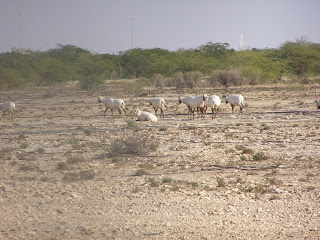
The animals were hunted to extinction in the wild, but the Emir's herd was so successful that some were reintroduced back into the desert.
I went to the west side of the country with my mom and two other people she knows. We were going west across the country on a highway, and stopped to look at some camels on the side of the road.

They were behind a fence, and were being raised the way Americans raise horses. The desert isn’t sand like I expected, it is mostly hard ground and rock.

We then went to the al Zubarah fort. It was built in 1938 on the ruins of a destroyed castle and used as a defense against Bahrain. The holes in the building were meant for guns to shoot out at intruders. The fort was then used as a jail as late as the 1970s, and as a Coast Guard place until the 1980s. It was then turned into a museum.
When we got there, there was no one there. We just walked on in and went around. After a while some other people arrived.

After going around the fort, we went to the Arabian Gulf. I waded out, it is really shallow and I couldn’t really go swimming.

Then we went to al Zubarah town. It was build in the late 1600s, and most of it has not been unearthed. In its day it was huge – some European maps called all of Qatar Zubarah after the town.

Coins from India, China, and European Africa have been found there. The city is estimated to be 2,000 by 800 meters. It will be much more impressive if it is ever fully excavated. Like the fort, we just walked on in. There wasn’t a place for anything official, it was completely self guided.

On our way home we stopped by the Emir's personal zoo, and could look in through the fence. He had various animals (mostly African) including the oryx - the national animal of Qatar.

The animals were hunted to extinction in the wild, but the Emir's herd was so successful that some were reintroduced back into the desert.
Sunday, December 16, 2007
Cramer and Paul Channel Friedman
Jim Cramer talked to presidential hopeful Ron Paul recently concerning adding oversight to the Fed Reserve. Their conversation bears a similar cord Russ Roberts interview (transcript) with the late Milton Friedman last year on EconTalk. The lack of transparency is so severe, the potential for disaster so high, Friedman said
I've always been in favor of abolishing the Federal Reserve and substituting a machine program that would keep the quantity of money going up at a steady rate.
Sunday, December 09, 2007
Speaking of Moral Hazard....
I hope my money and banking students can answer the following:
Was the Federal Reserve justified in its role in preventing the bankruptcy of LTCM? In answering this question, be sure to address issues of moral hazard and the key goal of the central bank.
Saturday, December 08, 2007
No Long Term Fix
President Bush is mistaken if he thinks he--or Congress--can "fix" subprime mortgages. Force banks to give people, even a few people, a lower rate than agreed on and you set a precedent for abuse. While their situation is unfortunate, borrowers are not victims. If you treat them as such, years from now they will gamble as though they cannot lose.
AP paradoxically called Bush's plan a "no quick fix" but it's the long run that could prove more disastrous. Give a man a Pinto and he will drive like a saint. Give him a tank and he'll drive like however he wants.
AP paradoxically called Bush's plan a "no quick fix" but it's the long run that could prove more disastrous. Give a man a Pinto and he will drive like a saint. Give him a tank and he'll drive like however he wants.
Sunday, December 02, 2007
Our Utopian Society
From an article on Salon about the history of cleanliness, I found this quote to be interesting:
Last Christmas I visited a great aunt of mine who lives in an old house in rural Ohio. She still doesn't have indoor plumbing; she has an outhouse and a pump in the kitchen for her sink. It's amazing how far we've come in the past couple hundred years, especially in things we take for granted like the number of bathrooms in our houses.
In the 19th century, Harriet Beecher Stowe, who wrote "Uncle Tom's Cabin," said she dreamed of a time when there would be one bathroom in an American house for every three or four bedrooms. People at the time thought that was just crazy utopian, just so over the top compared to what they were used to. Now a luxury apartment across from the Metropolitan Museum in New York City has more bathrooms than bedrooms.
Last Christmas I visited a great aunt of mine who lives in an old house in rural Ohio. She still doesn't have indoor plumbing; she has an outhouse and a pump in the kitchen for her sink. It's amazing how far we've come in the past couple hundred years, especially in things we take for granted like the number of bathrooms in our houses.
The Cure Is Worse Than The Disease
An FDA report will be discussed tomorrow concerning the agency's poor performance. The agency claims it simply needs more funding which it will use to centralize its work and add management positions.
It would make more sense to return the agency to an advisory status. This would drastically reduce its costs and could accomplish a handful of things really well instead of doing many things poorly.
Throwing money at a problem rarely solves it--the organization must have to have a strong incentive to use resources wisely. Companies have an incentive to make a safe and useful product. Dangerous ones will slip through, but at least the error is self-correcting. When things go bad, the drug is pulled. The FDA, however, is rewarded when it turns out most drugs--even good ones that can save lives. And this error doesn't disappear. People continue to needlessly die.
The question is not if free markets or government is perfect at screening disease. Neither is perfect; it's a useless inquiry. The question is which one is most robust against error: a single government agency or the collective wants and constraints of millions of interacting people.
Thursday, November 29, 2007
Employment Is Cooperation
The Democratic candidates refused to cross a picket line of striking writers yesterday (thus canceling their debate), affirming their general support for the guild strike. As private citizens, it is their right to support or not support whomever they wish and they were put in the position to make one decision or the other. But their actions contribute to a disturbing conclusion emerging about the strike: the writers are downtrodden workers and the studios are the greedy extortionists.
Such a story is simplistic and deceptive. Employees are not victims and employers are not slavers. They work together in mutual cooperation; a strike is not a rebellion. To my knowledge, neither party (the Writer's Guild or the studios) use the law to force one to cooperate with the other. But the studio is increasingly seen as immoral and greedy.
This is no doubt in part due to the seemingly reasonable request of the guild--compensation on new media. Yet studios shoulder most of the risk for new projects and the risk is high. Most shows fail tremendously and it makes sense that the studios are trying to shoulder against that risk with enhancing the gains from the rare success. The point is it is not at all clear what the compensation--if any--should be. There are too many factors to take into account. Outsiders should be the last people to take sides. Let the informed decide for themselves.
Keeping us safe from leaves in the road
I'm tend to be skeptical of government's efforts, and this is another example why.
So if a leaf falls from a tree to the road, that's okay. But if a leaf falls two inches from the road and you sweep it the two inches, that's a date in court.
Fortunately in this case sanity prevailed and the local government had to back down from fining an 88 year old woman for keeping things tidy.
Grandmother Betty Davies has swept the street clean outside her house for the past 62 years without so much as raising an eyebrow.
The 88-year-old widow prides herself on keeping her front doorstep and pavement pristine.
But after one of her daily tidy-ups, a council worker knocked on the door of her home in Splott, Cardiff, to warn her she could be taken to court.
Mrs Davies was told she could be breaking litter laws and might be fined for brushing the leaves into the roadway.
So if a leaf falls from a tree to the road, that's okay. But if a leaf falls two inches from the road and you sweep it the two inches, that's a date in court.
Fortunately in this case sanity prevailed and the local government had to back down from fining an 88 year old woman for keeping things tidy.
Sunday, November 25, 2007
Panic Is Not Growth
In 1773 famed French astronomer Jérôme Lalande predicted that a comet would smash into the earth in 1789, destroying all life. Terror swept the country and church attendance skyrocketed.
But it was all for not. Lalande published his results and true enough, he predicted a disaster, but with only a chance of 1 in 64,000. As the panic subsided philosopher and mathematician Marquis de Condorcet noted that at least the sharp rise in unleavened bread boosted the economy.
The parable of the broken window was still 77 years away, so we can at least be sympathetic to the philosopher's poor economics. But that does not make the claim valid. The panicked purchase of leavened bread no more betters the economy than the purchase of bomb shelters during the Millennium bug scare. If it was truly this easy to grow the economy, then government agencies should relay false reports every few years predicting mass calamities. We'd be swimming in toilet paper, but we wouldn't be wealthier.
Source: The Measure of All Things. Ken Alder
Friday, November 23, 2007
Want Nothing Day
As the sun sets, another Black Friday concludes as does its perverse cousin, Buy Nothing Day, an anti-consumerism group.
What's strange about Buy Nothing Day is that activists gather outside stores and in shopping districts. The protest is directed at a group the vast majority of whom are buying things for others. If the goal is to assuage consumerism, their actions would merely shift the buying from the gift-giver to the gift-receiver. If they really wanted to be effective they would target those that accept gifts and do not give them. Cut consumerism off at the source.
Thus Buy Nothing Day protests should focus on the "purely greedy," the infants, toddlers, and kids who ask for, and often demand, mass-produced consumer products. Do not blame the shoppers who are merely following their wishes, and, arguably being the least selfish and contributory to "over-consumption." Protests should be outside Santa, not Sears.
Thursday, November 22, 2007
Happy Thankskeeping Day
John Stossel reminds us that Thanksgiving is really a celebration of private property, not community and hearth. The Pilgrims starved for their first two years in the New World because communal farming doomed them all. When they finally instituted private property, no one had an incentive to shirk; everyone worked harder. The result was a bumper crop and, in time, a new holiday.
HT: Matt Huber
HT: Matt Huber
Tuesday, November 20, 2007
To the Masses Go the Spoils
Last night during industrial organization, Alex Tabarrok told us something only an economist could truly appreciate: "People in China are now dying of cancer and this makes me very happy." It makes me happy as well. Yet we are not motivated by malevolence but a recognition of how humanity progresses.
As China becomes wealthier, its people no longer starve or work themselves to death. Instead they live longer and die of of other ills later in life. And in their wealth they gain the ability to pay to assuage their suffering. Firms the world over now have extra incentive to develop cures not just for cancer, but Parkinson's disease, Alzheimer's, and other aliments which tend to appear later in life. For most of human history, it was an extra burden to want something popular or common for everyone else wanted the same limited supply. But under capitalism, wanting what is popular often translates into getting it easier. Common diseases are rarely death sentences, a trend that is likely to intensify in the near future.
As China becomes wealthier, its people no longer starve or work themselves to death. Instead they live longer and die of of other ills later in life. And in their wealth they gain the ability to pay to assuage their suffering. Firms the world over now have extra incentive to develop cures not just for cancer, but Parkinson's disease, Alzheimer's, and other aliments which tend to appear later in life. For most of human history, it was an extra burden to want something popular or common for everyone else wanted the same limited supply. But under capitalism, wanting what is popular often translates into getting it easier. Common diseases are rarely death sentences, a trend that is likely to intensify in the near future.
Saturday, November 17, 2007
A Multitude of Villianies Do Swarm Upon Us
Set aside the rampant talk on the campaign circuit about universal health care. Table arguments for protection at the cost of fundamental civil liberties. It is possible there is a candidate who would bring yet more nonsense to next year's election: Lou Dobbs.
Right now trade and immigration--especially immigration--are in party platforms. Despite that these issues are pretty much the same (both move jobs to foreigners), each of the parties treats them differently. Democrats don't like free trade, Republicans don't like illegal immigration. A crude line to draw, but useful.
Lou Dobbs, on the other hand, doesn't like either. At least he has the virtue of consistency. But if he would enter the race, his popularity would surely encourage candidates to call to assuage both instead of neither. Dobbs doesn't even have to be a viable candidate, he merely needs to make enough noise on the campaign trail. And when you're as popular and opinionated as Dobbs is, such a feat is as second nature as breathing.
HT: Mike Mills
Thursday, November 15, 2007
The Oath of Office
Senator Dodd:
Imagine if you will interviewing an applicant for a job opening you have. The first question you might ask is whether the applicant understands the job description. Let's imagine this applicant fails to understand even the most basic requirements of the job. You would be surprised, perhaps confused, as to why the applicant wasted everyone's time by failing to do even rudimentary research.
So you should understand my surprise, and my disappointment, when you failed to grasp the job description for the job you currently seek. To wit, in the debate tonight, you stated that "When you take the oath of office, on January 20, you promise to do two things, and that is to protect and defend the Constitution of the United States, and protect our country against enemies, both foreign and domestic. The security of the country is number one."
Sir, Article II, §1 of the Constitution lays out very simply the job description--the oath of office--as such: "I do solemnly swear (or affirm) that I will faithfully execute the office of President of the United States, and will to the best of my ability, preserve, protect and defend the Constitution of the United States." The President has but one duty, and that is to defend the Constitution. While the argument can be successfully and articulately made that national security is a component of defending the Constitution from its enemies, it is not the chief objective. This is not an issue of vague language or unclear intent by the founders. The Constitution is unambiguous on its supremacy. Article VI states, plainly, that "This Constitution . . . shall be the supreme law of the land." Were the values of the Constitution to come in conflict with national security goals, then the Constitution, and the Oath of Office, make clear which choice the President must make.
Security, sir, is emphatically not "number one," The Constitution is. I hope that going forward you take some time to read it, with particular attention to Article II. Should the people choose to elect you, it will be your job to uphold that document--and no other.
Tuesday, November 13, 2007
The Economic Report of EVE
EVE Online (an MMORPG) hired an economist back in June to better understand how their simulated, primarily player driven economy functioned. Dr. Eyjólfur Guðmundsson, former dean of business and science at the University of Akureyri, is the first economist to be hired in the gaming industry in this regard.
He released his first quarterly report yesterday, enumerating the challenges, advantages, and conclusion of analyzing a digital universe. The focus of the report concerns inflation and offers yet more evidence that the price level is driven by too many dollars chasing too few goods.
Right now, EVE is experiencing deflation despite the fact that the computer is adding more money than it is taking out. New players are currently out-pacing the growth in the money supply--there are more credits (ISK), but many, many more goods. However, inflation can still crop up in the long run if the supply continues to increase and the player growth stagnates.
Inflation in EVE can be a real problem for the company's bottom line. Rising prices make it harder for new players to join the game and could dissuade them from playing. It makes business sense keep the price level steady. In other words, we will likely see more economics PhDs hired in the future by big gaming companies. I wonder if any of them will be someone I know.
Monday, November 12, 2007
There Ain't No Such Thing As A Free Expansion
I hope my money and banking students can answer the following:
True or false (and justify your answer).
Expansionary monetary policy suggests TANSTAAFL/TINSTAAFL.
Sunday, November 11, 2007
Trading With Prometheus
South Korean farmers are erupting in anger over the trade talks with the U.S. Fearful that American produce will flood their market, calling that their livelihoods are threatened and the agricultural sector will collapse. I'm sure such phrasing gets a lot of support in Korea, as labor unions are sympathized here.
But few mind when technology threatens jobs. Farmers rally against imports, not hydroponics: life should be autarkist, but not archaic. Few tears are shed when a new technology wipes out old jobs. Luddites are rare, particularly in today's society. But protectionists always seem to have the ear of the public.
It's strange because trade and technology are functionally the same. In both cases, a good is made cheaper. In both cases, jobs are lost to those that can do the same for less. In both cases, there are winners and losers. In both cases, society changes in unpredictable ways. People are perfectly willing to erect trade barriers to "protect jobs," but the same does not go for outlawing technologies. Such arguments center around the ethics of playing God, not ensuring employment.
If you like technology, if you think it makes us wealthier because it swaps the cheap with the valuable, then you are right. We get to do more with less and we are better off for it. But what difference does it make if the goods transform by man instead of machine?
Monday, November 05, 2007
The Writing's On the Sign
Day One of the writer's strike leads to an interesting economic question. Not if writer's deserve a cut of new media revenue. Or how long a company should holdout before serious negotiations begin (though the strike does dispel the myth that firms care only about short-term profits and won't shoulder a huge expense for a long-term gain). No, the question is why are the slogans so uncreative?
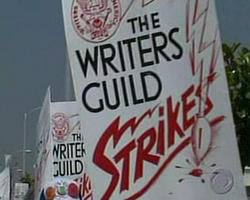
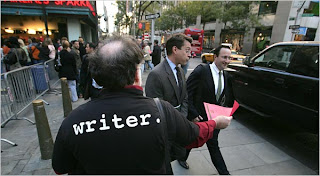
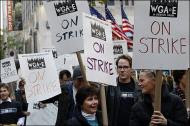

Presumably, the WGA would be interested in conveying their side of the argument for the national news media, a capacity that increases as the writing improves. Pithy slogans, especially concerning the topic at hand, would certainly serve the organization better than simply "On Strike" paired with a cheesy lightning bolt/pen (note the illustration's better than the writing). The three signs pictured here seem to be making up the vast majority of them, mass-produced by the Guild.
Thus the puzzle. It only takes one person to make a good slogan that thousands can use. With over 10,000 in its membership, why didn't some of them come up with something better? They are writers, after all; this should be second nature, at least to a few. And it's not like they didn't know the strike was coming; the picture of the man in the clearly written shirt is a member passing out material three days ago. Even if you claim that they just have a bunch of generic signs "just in case" it begs the question, why aren't the generic signs interesting? You'd think their potential for reuse would make them more likely to be pithy, not less.
Strikes are costly, not just for the studios but for the writers. It's in their best interest to sway public support to their side in order to encourage their employers to fold sooner. Perhaps this is evidence that the studios really are paying them more than they contribute. Maybe they don't deserve any new media revenue.
Saturday, November 03, 2007
Calling India
A student sent me this video after our class on outsourcing and trade. I made the claim that one reason, perhaps the core reason, why people don't like international trade is for what are ultimately racist attitudes. It's about "us" versus "them." Protectionists make ultimately flawed economic justifications which are often inconsistent with other opinions they have about the economy.
I hasten to point out that there are some good reasons for a company to hire from it's native population. Cultural differences, for example, can be costly for customers to interact with (i.e. discerning through accents). However, people in practice seem to be unwilling to pay the higher price needed to ensure that common cultural ground.
The line between racism and issues of quality is a hard one to draw, but the video has clear examples of both.
HT: Ritu Joshi
Wednesday, October 31, 2007
Who's To Blame
There's been a lot of talk lately on sub-prime mortgage rates and massive number of defaults that currently plaguing banks. Despite their problems, people are quick to blame banks and demand a bail out for the loans.
On NPR a few days ago, I heard a commentator note that it doesn't seem fair virtually no banks will go under while countless lose their home, as if it's solely the bank's fault. Missing is that banks are failing because people have default--not the other way around. A lot of people tried to buy something they couldn't afford. They didn't investigate if they could afford it. They are now paying that price.
It's certainly sad to see people think they could have something only to have it taken away from them. In some ways it's sadder than if they never had the chance in the first place. But there was no con artistry here. Just some banks offering people a way to become homeowners and many on both sides not asking tough questions. Both are shouldering the blame, as they should. Don't cheapen it by treating one of them as a victim when it's really just a bunch of bad financial decisions.
Saturday, October 27, 2007
Family Feud
It often astonishes me how it is that libertarianism can cause such a visceral reaction, especially when people seem to misunderstand what it's about. My brother, who to his credit does step up to the plate every so often on L3, wrote in a thread:
Libertarians do not believe that anything the private sector does is good. That's absurd. There are a myriad of problems that crop up, from corporate corruption to lead paint in toys. No reasonable person would claim the private sector is a bastion of perfection--nothing is that grand.
The question we must ask ourselves is not what is perfect but what is more likely to be punished for error: markets or government. In a free market, firms that don't deliver what people want go away. Fraudulent companies go bankrupt. Lead toys don't sell. In government, failed agencies stick around. That is not to say that some bad firms last longer than one would think or some agencies don't improve thanks to public outcry. And indeed, there are some things government does that is quite good. But for any given circumstance, the free market check is much more reliable and robust than a bureaucratic check.
A common criticism I get is that I live in academia and thus am not in touch with the real world, a strange criticism to be sure. Setting aside the fact that most academics are strictly not libertarians, my discipline--economics--is dedicated to understanding how the real world works. There's certainly something to be said for putting theory to practice but what you gain in experience you lose in perspective. People outside the ivory tower complain that the free market doesn't help one particular group (a group they are usually connected with) and thus is bad. I welcome such opinions, but I beg everyone to understand that creating a wealthy society can't be just about them; it's about everyone.
Thus I encourage you to engage in the conversation. If you read a post that makes you laugh, stop and ask if that feeling is justified. If you have constructive criticism, feel free to comment. I'll be happy to explain my argument. And who knows: I could be wrong. It's been known to happen.
My brother, David, is a libertarian and I find his blog http://lawlegislationandlunacy.blogspot.com/ to be filled with garbage centered around the idea "anything Government does is Bad and anything Private Enterprise does is Good". He's also graduate student in economics and hasn't spent much time in the real world. As much as I've seen libertarianism is a nice-sounding theory that degrades into abuses of power when it comes in contact with reality.This is very disturbing. I don't necessarily mind my brother's tone (I'm used to it) but this blog is over two years old and he still doesn't understand what a libertarian is. This seems like a good opportunity to clarify a few things.
PS He doesn't get much traffic on his site so everyone please go there and comment on his blogs. At the least, they can be worth a laugh.
Libertarians do not believe that anything the private sector does is good. That's absurd. There are a myriad of problems that crop up, from corporate corruption to lead paint in toys. No reasonable person would claim the private sector is a bastion of perfection--nothing is that grand.
The question we must ask ourselves is not what is perfect but what is more likely to be punished for error: markets or government. In a free market, firms that don't deliver what people want go away. Fraudulent companies go bankrupt. Lead toys don't sell. In government, failed agencies stick around. That is not to say that some bad firms last longer than one would think or some agencies don't improve thanks to public outcry. And indeed, there are some things government does that is quite good. But for any given circumstance, the free market check is much more reliable and robust than a bureaucratic check.
A common criticism I get is that I live in academia and thus am not in touch with the real world, a strange criticism to be sure. Setting aside the fact that most academics are strictly not libertarians, my discipline--economics--is dedicated to understanding how the real world works. There's certainly something to be said for putting theory to practice but what you gain in experience you lose in perspective. People outside the ivory tower complain that the free market doesn't help one particular group (a group they are usually connected with) and thus is bad. I welcome such opinions, but I beg everyone to understand that creating a wealthy society can't be just about them; it's about everyone.
Thus I encourage you to engage in the conversation. If you read a post that makes you laugh, stop and ask if that feeling is justified. If you have constructive criticism, feel free to comment. I'll be happy to explain my argument. And who knows: I could be wrong. It's been known to happen.
Tuesday, October 23, 2007
The Myth of the Inept Law
Every single state in the Union is filled with strange laws, some frighteningly intrusive. To those that simply say "no big deal, these laws are rarely enforced" consider the court case Samples v. Moore from Georgia, 1987.
Ms. Samples and Mr. Moore have been cohabitating for 14 years. When they decided to start living together, they made a straight-forward agreement: they would use her money to provide living expenses and he would save his money for their mutual early retirement. However, he moved out and is now living with another woman. Ms. Samples believes he was playing her the whole time, living off her and saving his money for himself. Fraud is at play.
In order to seal the deal, Samples agreed to start having sex with him. In fact, she indicated that this was a tipping point for him to go along with the agreement. But as it turns out, premarital sex in Georgia is (was?) illegal and "a contract to do an illegal or immoral thing is void." The judge threw out the case.
Even if no police officer enforces it, a law on the books can still ruin your life.
Thursday, October 18, 2007
Barking Up the Wrong Rain Forest
Robert Naiman at the Huffington Post has misplaced fears in free trade. Citing the upcoming trade agreement with Peru, Naiman writes the agreement "would give U.S. oil companies powerful new rights to exploit Peru's Amazonian rain forest...Indigenous leaders in Peru have rejected the agreement."
If the problem is the government will give US companies rain forest that others agree on, then the fundamental problem is government owned land, not free trade. If the indigenous people owned the land, then they could decide if they wished to lease or sell it to others. With free trade, they could get more money for what they would be willing to sell, allowing them to enhance their life in other ways.
Free trade is not the problem. A lack private property is.
Monday, October 15, 2007
Incentives Matter
In the 1970s union leaders were concerned about the stress that air traffic controllers were under. They asserted that a sign of stress was if a controller nearly caused a collision. So a policy was enacted that if a controller had 2 or more near misses in a month then the worker would have a two week paid vacation. This graph illustrates the effects of the policy:


Thursday, October 11, 2007
Creative Destruction
Via Freakonomics, here is a list of industries that are predicted to not be around in 10 years, or have a greatly diminished presence.
It's sad when people lose their jobs, but the reasons for the loss of the industry are because life has changed for the better and the industries are no longer necessary. For instance, film manufacturing has been plummeting, but yet society is better off with the elimination of those jobs as people prefer digital cameras.
It's sad when people lose their jobs, but the reasons for the loss of the industry are because life has changed for the better and the industries are no longer necessary. For instance, film manufacturing has been plummeting, but yet society is better off with the elimination of those jobs as people prefer digital cameras.
Tuesday, October 09, 2007
The Poor Shall Inherit the Earth
Russ Roberts recalls his excellent interview with Thomas McCraw about his recent biography of Joseph Schumpeter. Schumpeter was a great, insightful economists who grasped the essential elements of capitalism.
Roberts quotes Schumpeter, saying
Roberts quotes Schumpeter, saying
Queen Elizabeth owned silk stockings. The capitalist achievement does not typically consist in providing more silk stockings for queens but in bringing them within reach of factory girls in return for steadily decreasing amounts of effort.People often forget that the most money in capitalism is in pleasing the masses, not only the rich or well-to-do. It is certainly a victory a great feat that Philo Farnsworth invented the television. Cynics might comment, though, that only the rich could afford them. Which is why it is far more grand, far more impressive, that capitalism made them commonplace. That is the great success story: not the creation of wonders but the process of making those wonders so common, they are mundane.
Monday, October 08, 2007
The Way Things Were
Maryland State Delegate Justin Ross on today's Kojo Nnamdi show proudly proclaimed that we should do "whatever it takes" to curtail the violence and gangs that accompany drug dealing in poor urban neighborhoods. Thus, Ross concluded, we should discourage rap music.
If Ross really wanted to get rid of drug violence, he should look into a cause far more responsible than a catchy tune. Like Prohibition in the 1920s and 30s, the ban on drugs makes the black market (and its related gangs) the only alternative. Without normal police protection, it should be no wonder the drug trade is so violent. Lift the ban on drugs and the drug violence will disappear. If Ross is truly dedicated to "whatever it takes," he should be happy to comply.
If Ross really wanted to get rid of drug violence, he should look into a cause far more responsible than a catchy tune. Like Prohibition in the 1920s and 30s, the ban on drugs makes the black market (and its related gangs) the only alternative. Without normal police protection, it should be no wonder the drug trade is so violent. Lift the ban on drugs and the drug violence will disappear. If Ross is truly dedicated to "whatever it takes," he should be happy to comply.
Tuesday, October 02, 2007
Bordering on Efficient
Sometimes the slow pace of government work can be a good thing.
Mike Madden writes of the failing attempts to restrict border crossing. While satisfying the isolationists that something is being done about immigration, people continue to cross over into the States. A trial system of cameras, sensors, and other equipment was supposed to be ready by now, but the "virtual fence" still has glitches. Some of this certainly due to adapting the new technology but it's hard to believe none can be blamed on good ol' reliable government waste.
Mike Madden writes of the failing attempts to restrict border crossing. While satisfying the isolationists that something is being done about immigration, people continue to cross over into the States. A trial system of cameras, sensors, and other equipment was supposed to be ready by now, but the "virtual fence" still has glitches. Some of this certainly due to adapting the new technology but it's hard to believe none can be blamed on good ol' reliable government waste.
Subscribe to:
Posts (Atom)
