It’s greedy, absurd, and morally indefensible for talented people born in favorable circumstances to be dedicating their lives to accumulating huge sums of money in order to engage in lavish consumption....While I was writing this post, I took a break from waxing indignant about multi-millionaires buying their third houses to donate some money to UNICEF.If, like me, you're a regular reader of Yglesias's blog, you might know he posts more often than the prolific Tyler Cowen, often scooping people who could have posted on items he already posted on. Just as the wealthy hoard money, Yglesias is hoarding blog posts. With so many struggling blogs out there, he should take his own advice e-mail their bloggers with his latest discoveries so they have a chance to be well read as well. To paraphrase Yglesias, becoming obscenely knowledgeable in the Internet world and then hoarding your information is, itself, morally wrong.
Tuesday, April 27, 2010
Matthew Yglesias Is Hoarding the Internet


Matthew Yglesias, in a two (or more?) part series (I here; II here) calls high salaries inherently immoral:
Tuesday, April 20, 2010
Show Me the Broccoli (Ads)!
Matthew Yglesias asks, "Where are the Broccoli Ads?"
Couldn't all fruits and vegetables have packaging? In theory, sure, but such foods spoil more easily (they are often sprayed with water to keep them crisp, something packaging would prevent). Note that Express salad mix is a mix, not just a head of lettuce in bag so there's good reason to give up a bit of freshness for the convenience (their ads also underline how fresh their mix is). Many customers like to investigate such foods before buying them. If you package your food, that makes it harder to inspect and customers might think you're hiding something.
So why don't we see ads brought to us by broccoli farmers? I've seen ads for why natural gas is so great and high fructose corn syrup isn't as bad as we think it is. Surely there's a national association of broccoli growers out there to wanting to get people off the sugar stuff.
And there is (unfortunately I couldn't embed the video).
Why is it that nobody’s marketing broccoli and bananas? This stuff is sold in stores, in exchange for money. Presumably there are for-profit enterprises out there with a vested interest in selling more.In contrast to candy bars and potato chips, most fruits and vegetables have no packaging and thus no easily identifiable brand name. An ad for Bob's Broccoli will probably help Betty's Broccoli sales since it's not clear which is which. Advertising for healthy foods becomes a public good and, thus, under-provided. Note that some vegetables do advertise--Express Salad Mixes keep popping up--but these vegetables have packaging.
Couldn't all fruits and vegetables have packaging? In theory, sure, but such foods spoil more easily (they are often sprayed with water to keep them crisp, something packaging would prevent). Note that Express salad mix is a mix, not just a head of lettuce in bag so there's good reason to give up a bit of freshness for the convenience (their ads also underline how fresh their mix is). Many customers like to investigate such foods before buying them. If you package your food, that makes it harder to inspect and customers might think you're hiding something.
So why don't we see ads brought to us by broccoli farmers? I've seen ads for why natural gas is so great and high fructose corn syrup isn't as bad as we think it is. Surely there's a national association of broccoli growers out there to wanting to get people off the sugar stuff.
And there is (unfortunately I couldn't embed the video).
Sunday, April 18, 2010
Drug Legalization and the Urban Poor
Gary Becker calls for better schools and better teachers, writing
Kids drop out for lots of different reasons. But since the problem is so common in poor neighborhoods, where jobs and education are scarce, of course the few financially successful people in those neighborhoods are going to have a big impact. And those individuals are drug lords, people who have made a handsome profit off the black market. It's easy to look up to them and admire them. And it's easy to learn the trade since all drug lords need a large company--er, gang--to support the enterprise so they have a financial incentive to teach them well (or by fear or force). And I guarantee you, they don't require a high school education. One should not be surprised that, in a world where the choice is between learning from a poorly trained teacher with no obvious financial rewards and learning from a gangster who's involved in your daily life and will pay you for "on-the-job" training, more than a few students take the latter. Yeah, there's danger of getting arrested (though from what I gather that's more of a badge of honor) and being killed, but the payoffs are some of the best the kids can choose from and that means a lot when money is so scarce.
The best longer-term solution to the [income] inequality problem is to reduce the fraction of Americans who dropout of high school...This drop out fraction has been stagnant for the past several decades at about 30% for males, and a somewhat lower but still high percent for females. This is almost surely the highest fraction of high school dropouts among rich countries, and is heavily concentrated among children from African-Americans and Hispanic families. In large cities, often less than half of all the children enrolled in public schools end up graduating.No doubt better teachers (and better incentives for teachers) would reduce drop-out rates. But let's not ignore a much simpler and (economically) cheaper way to reduce the number of drop-outs: legalize narcotics. This isn't merely about the money saved from enforcement, imprisonment, and judiciary costs. It's primarily about the choices kids face.
Kids drop out for lots of different reasons. But since the problem is so common in poor neighborhoods, where jobs and education are scarce, of course the few financially successful people in those neighborhoods are going to have a big impact. And those individuals are drug lords, people who have made a handsome profit off the black market. It's easy to look up to them and admire them. And it's easy to learn the trade since all drug lords need a large company--er, gang--to support the enterprise so they have a financial incentive to teach them well (or by fear or force). And I guarantee you, they don't require a high school education. One should not be surprised that, in a world where the choice is between learning from a poorly trained teacher with no obvious financial rewards and learning from a gangster who's involved in your daily life and will pay you for "on-the-job" training, more than a few students take the latter. Yeah, there's danger of getting arrested (though from what I gather that's more of a badge of honor) and being killed, but the payoffs are some of the best the kids can choose from and that means a lot when money is so scarce.
Thursday, April 15, 2010
Following the Money
Mark Thoma has a cool chart about where your tax dollars go. When people want to fix the federal budget, they generally cite foreign aid or pork barrel spending or government wages or corporate welfare to cut. But these are all very small parts of the budget (they are in the "other" part of the graph...a total of 4%).

Suppose you're a congressman. You want to cut the budget? You might want to start with Medicare, Medicaid, or CHIPS which are health insurance for the elderly, poor, and children respectively. That will upset a lot of your constituents and I'm sure you're hear about it in the next election when your opponent tells the district you hate some of America's most vulnerable citizens. OK so you can cut Social Security instead, but that will only upset a smaller group of people with even greater fervor. Maybe you could cut the safety net expenses, but that won't be politically smart during a recession. Military's high, but a lot of this is concentrated in major contracts and military bases: a mighty large group of people to upset and has the public sympathy of defending the nation.
In other words, there's no easy way to cut the budget. The reason why these are the big areas of the budget is because they concern people with a lot of public sympathy, sympathy they were able to transform into payments. And it's that sympathy which secure those payments now. If they didn't have that public support (such as from Reagan's famed stories of "welfare queens" which promoted welfare reform), then things would be different. The best way to cut the budget is if hundreds of thousands of elderly people were using their social security checks to fund terrorism.
Tuesday, April 06, 2010
Should We Tax Happiness?
A new study suggests that a good part of income (for cricket players) comes from luck. Home field advantage matters a lot in cricket (apparently), scout show up randomly, and a good debut has a lasting impact on your career. If you happen to be on your home turf when the scout shows up, you're be in a better long-term position than your opponents. (The study was able to separate out performance from the field and performance from skill.) Matthew Yglesias argues that this is evidence for "Progressive taxes and more and better public services."
This leads to an intriguing question: should we tax happiness? The goal of public services (in this context) to the help the worst off and we use progressive taxes to fund those services, ethically justified because the wealthy didn't "earn" 100% of what they made. And because taxing someone because they got something by luck is justified in the area of salary, then taxing someone because got something else by luck must be equally justified.
Before I go further, two points. One is that this is not a serious policy proposal. Measuring happiness is very hard to do, made even more so since you'll be taxing people based on information that's completely subjective. I have no idea how you would do it nor do I care to figure it out. It's just a discussion to check for consistency. Second, yes generic happiness and wealth are functionally the same thing. Yes, the happiness research disagrees with me on this, partly because of issues with happiness research and the difficulty of measurement. All I'm saying is that when you take money away from people, you make them less happy and when you give them money they are more happy. The two are, on the margin, interchangeable (so no comments about how taxing income takes away what people didn't earn but taxing happiness doesn't collect "happiness" for the government to consume).
With that out the way, consider your own happiness. Most notable in my happiness is my relationship with my girlfriend, Tanya. I love her a great deal and she's by far the most serious relationship I've had. We met somewhat by chance, via match.com. (I call this is by chance because I was thinking about leaving the site having gone on so many dead-end dates and she had recently joined it.) According to Yglesias, this is grounds for a tax on my happiness. Most happiness that comes from social interaction is very similar to the cricket story: if you happen on a good opening conversation (performance) with the right person (scout), it can scale into something truly astounding. The question becomes, is this a stupid idea because it's impractical or because the whole notion of taxing happiness inequalities is silly? My vote is the latter as, I wager, it would be for most people.
Sunday, April 04, 2010
The Political Incentives of Being a Jerk
For as long as I can remember, Republicans act like dicks and Democrats act like wusses and for my more partisan friends, those qualities are endemic to their ideological opponents. Republicans are heartless: they hate poor people, gays, atheists, blacks, Jews, Muslims, and the suffering masses. It's no wonder they don't compromise and spread fear and misinformation to the electorate. And Democrats are bleeding hearts: they want subsidies for nice-sounding idea that comes across their desk and throw away the realities of the world for a fantasy worker's paradise. It's no wonder they have no backbone.
But when you add some economics, it's a strange story. Why is there no one willing to break the mold: a Republican who wishes to act even a little dovish to attract some swing support or a Democrat who's just a bit quicker to be hawkish? Such is only the stuff of fiction. The two parties must be locked in this equilibrium for some reason.
Via Matthew Yglesias, I've found strong evidence that the Democrats are a much bigger tent party than Republicans. Because Democrats have to please a larger variety of voters, they have to be more willing to compromise and just don't have that much wiggle room when it comes to policy. Knowing this, Republicans have a strong incentive to be political bullies. This isn't a value judgement; it's a law of nature. If you know your opponents don't have a lot of flexibility, you make demands (especially since there's more than a little overlap between the two parties). Thus even with majorities in both chambers of Congress and a Democratic president, Republicans can hamper or even dislodge major policy changes. It's still a bit of a miracle that health care reformed passed but it's not surprising it took as long as it did.
Saturday, April 03, 2010
The True Cost of the Soda Tax
Monica Potts argues that a soda tax isn't regressive even though lower income families spend more of their money (as a percent) on groceries compared to higher income families:
People buy soda for the same reason they buy anything else: it's the best value given the price. Yes, I'm sure if you increase the price people will buy less of it but they will shift to options that, when you consider costs and benefits, are less desirable. Even if they end up spending the same amount of money on groceries they are worse off than before the tax, by definition. They can only be made equally happy if they spend more.
This point deserves stress. The standard cannot be "if people are spending the same amount as before, then they are largely unaffected." That's a nonsense comparison. You must weigh the costs (including not just money but time, risk, etc) and the total benefits. Or, if you can, hold everything else equal.
But that assumes lower-income families won't substitute something else, or just stop buying soda...If lower-income families are drinking a lot of soda, it's only because it's disproportionately cheap compared with healthier foods and drinks.I really doubt that last statement's true since water's far cheaper and healthier than soda.
People buy soda for the same reason they buy anything else: it's the best value given the price. Yes, I'm sure if you increase the price people will buy less of it but they will shift to options that, when you consider costs and benefits, are less desirable. Even if they end up spending the same amount of money on groceries they are worse off than before the tax, by definition. They can only be made equally happy if they spend more.
This point deserves stress. The standard cannot be "if people are spending the same amount as before, then they are largely unaffected." That's a nonsense comparison. You must weigh the costs (including not just money but time, risk, etc) and the total benefits. Or, if you can, hold everything else equal.
Wednesday, March 31, 2010
Mankiw on Taxes
Greg Mankiw proposes we re-think measuring tax burdens. We generally measure them by calculating taxes, adjusted for GDP.
There's a reason why Mankiw focused on the countries he did: institutions. Japan, Italy, US, and the UK have similar economic systems (similar compared to the rest of the world). Mindlessly treating North Korea as the same as South Korea makes the same mistakes economists made decades ago when we wondered why all countries weren't converging to the same GDP. But the Solow model's predictions only work when countries are institutionally similar: "conditional convergence." Comparing Solvakia and Spain about tax revenue misses the point.
Looking at taxes as a percentage of GDP may mislead us into thinking we can increase tax revenue more than we actually can. For some purposes, a better statistic may be taxes per person, which we can compute using this piece of advanced mathematics:Brad Delong and Matthew Yglesias says this implies that North Korea is a wonderful tax haven and Slovakia could stand much higher tax rates.
Taxes/GDP x GDP/Person = Taxes/Person
Here are the results for some of the largest developed nations:
France: .461 x 33,744 = 15,556.
Germany: .406 x 34,219 = 13,893.
UK: .390 x 35,165 = 13,714.
US: .282 x 46,443 = 13,097.
Canada: .334 x 38,290 = 12,789.
Italy: .426 x 29,290 = 12,478.
Spain: .373 x 29,527 = 11,014.
Japan: .274 x 32,817 = 8,992
The bottom line: The United States is indeed a low-tax country as judged by taxes as a percentage of GDP, but as judged by taxes per person, the United States is in the middle of the pack.
There's a reason why Mankiw focused on the countries he did: institutions. Japan, Italy, US, and the UK have similar economic systems (similar compared to the rest of the world). Mindlessly treating North Korea as the same as South Korea makes the same mistakes economists made decades ago when we wondered why all countries weren't converging to the same GDP. But the Solow model's predictions only work when countries are institutionally similar: "conditional convergence." Comparing Solvakia and Spain about tax revenue misses the point.
Tuesday, March 30, 2010
Logic 101
Menzie Chinn comments on Robert Samuelson's concerns about the true budget impact of PPACA:
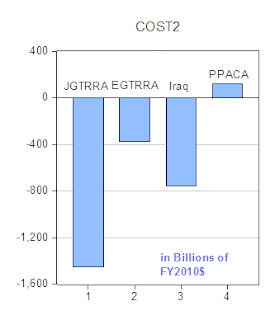
The bottom line is that the CBO scoring system, like most systems, can be gamed.
Here is where Mr. Samuelson dismisses the entire budgeting process in Washington:Actually the logical implication is that the CBO scoring for the health care bill is nonsense and you shouldn't make graphs like this one (JGTRRA is the second Bush tax cut and EGTRRA is the first).But the CBO estimate is misleading, because it must embody the law's many unrealistic assumptions and gimmicks. Benefits are phased in "so that the first 10 years of [higher] revenue would be used to pay for only six years of spending" increases, a former CBO director, Douglas Holtz-Eakin, wrote in the New York Times on March 20. Holtz-Eakin also noted the $70 billion of premiums for a new program of long-term care that reduce present deficits but will be paid out in benefits later. Then there's the "doc fix" -- higher Medicare reimbursements under separate legislation that would cost about $200 billion over a decade.The logical implication based upon this argument: Might as well close up CBO.

The bottom line is that the CBO scoring system, like most systems, can be gamed.
Sunday, March 28, 2010
Priorities on GW
Robert Stavins wonders who killed cap-and-trade and argues that
U.S. public support on this issue has decreased significantly, as has been validated by a number of reliable polls, including from the Gallup Organization. Indeed, in January of this year, a Pew Research Center poll found that “dealing with global warming” was ranked 21st among 21 possible priorities for the President and Congress.A quick glance confirms this--global warming is not a top priority--but that's not a perfect measure. It could be a somewhat high priority on everyone's list which would mean it's still pretty damn important. Scroll down on the Pew link and you'll find that GW has never been that high as a top priority (topping 38% in 2007, when they started asking about it). It looks like GW was just edged out due to recent events; people haven't stopped caring. I wouldn't call it dead yet.
Saturday, March 27, 2010
Krugman on Reform
Paul Krugman has a smart insight about financial (or any) reform. Straightforward reform only needs mediocre regulators. Highly specialized and nuanced reform requires smart regulators to implement right. Get the so-so regulators with complex reform and you'll get something far worse than no reform at all.
That doesn’t make financial reform useless. But it is a worry, since you can’t count on always having smart, well-intentioned people doing the regulating.Always? How about ever?
Wednesday, March 24, 2010
Obamacare and Entrepreneurship
With legislation as sweeping as the recent health care reform, lots of interesting questions boil to the surface. For one, will the reform be good for entrepreneurship or bad for it? Two commentators at Megan McArdle give conflicting reports, one arguing that it's good and the other that it's bad.
On one hand, entrepreneurs tend to be younger people and younger people tend not to buy health insurance even if they can afford it. The reform makes people buy insurance (though the penalty for not doing so is somewhat low) and will subsidize those who make little enough to purchase it. Thus there are those who have to buy it but make enough so they will get little or no government help. A forced expense will take money away from the all-important start-up capital.
On the other hand, those with a pre-existing condition (since you can't deny someone based on if they have a pre-existing condition) can now leave their employer's health plan and strike out on their own, confident they can get the health insurance they need. Untethered, we could see more entrepreneurship.
Which effect is more powerful depends on various questions: How important is a few to several hundred dollars a month for a new business? How common are people with pre-existing conditions? Are people with pre-existing conditions more or less likely to start a business (unlikely but if it's true it would probably be the most important variable)? I don't know the answer to any of these, but I suspect the bad outweighs the good.
Bryan Caplan, however, points out another possible confounding issue:
This could push it to being good for entrepreneurship as companies can pay the fine and neither has health insurance until the employee gets sick (in which case they might get a subsidy).
It's not an easy thing to sort out.
On one hand, entrepreneurs tend to be younger people and younger people tend not to buy health insurance even if they can afford it. The reform makes people buy insurance (though the penalty for not doing so is somewhat low) and will subsidize those who make little enough to purchase it. Thus there are those who have to buy it but make enough so they will get little or no government help. A forced expense will take money away from the all-important start-up capital.
On the other hand, those with a pre-existing condition (since you can't deny someone based on if they have a pre-existing condition) can now leave their employer's health plan and strike out on their own, confident they can get the health insurance they need. Untethered, we could see more entrepreneurship.
Which effect is more powerful depends on various questions: How important is a few to several hundred dollars a month for a new business? How common are people with pre-existing conditions? Are people with pre-existing conditions more or less likely to start a business (unlikely but if it's true it would probably be the most important variable)? I don't know the answer to any of these, but I suspect the bad outweighs the good.
Bryan Caplan, however, points out another possible confounding issue:
If preliminary summaries of Obamacare are true, it looks like individual health insurance will soon be a better deal than employer-provided health insurance. In the individual market, you can now wait until you're really sick to buy insurance: "Heads I win, tails I break even." Firms won't have that gimme - and it seems more valuable than premiums' tax deductibility. Admittedly, Obamacare imposes a small penalty on individuals who don't buy insurance, and a moderate penalty on firms that don't provide it. But it still seems like it will be in the financial self-interest of many firms and their workers to get rid of insurance, and split the (cash savings minus penalties).
This could push it to being good for entrepreneurship as companies can pay the fine and neither has health insurance until the employee gets sick (in which case they might get a subsidy).
It's not an easy thing to sort out.
Monday, March 15, 2010
Health Care Profitability
Everyone's talking about how profitable health insurance companies are (notably on tonight's Daily Show) but the secret is they're not that profitable compared to other industries. The large numbers shot around about increased profits are absolute dollars, not relative to their revenue, and tell us nothing about how profitable an industry actually is. Profit margin (which adjusts for revenue) is a much better measure. And health insurance performs quite bad compared other industries. I got the data from Yahoo Finance; here's the most recent quarter.
Note, REIT is healthcare facilities, not health insurance nor hospitals. According to Yahoo, these companies are in finance...basically real estate for health-related services. Healthcare plans (including Aetna, Wellpoint, Universal Americacore, etc) is number 88. Home health care was 55. Hospitals rank 100 (out of 215).
I thank Mark Perry who did a table for August of 2009. (Insurance companies dropped by two ranks since then.)
Note, REIT is healthcare facilities, not health insurance nor hospitals. According to Yahoo, these companies are in finance...basically real estate for health-related services. Healthcare plans (including Aetna, Wellpoint, Universal Americacore, etc) is number 88. Home health care was 55. Hospitals rank 100 (out of 215).
| Rank | Industry | Profit Margin |
| 1 | Closed-End Fund - Foreign | 38.3 |
| 2 | REIT - Healthcare Facilities | 25.2 |
| 3 | Drug Manufacturers - Major | 22.2 |
| 4 | Publishing - Periodicals | 21.8 |
| 5 | Cooper | 20.9 |
| 6 | Application Software | 20.6 |
| 7 | Cigarettes | 19.2 |
| 8 | Internet Information Providers | 18.7 |
| 9 | Healthcare Information Providers | 16.8 |
| 10 | REIT - Industrial | 16.6 |
| 11 | Agricultural Chemicals | 16.4 |
| 12 | Long Distance Carriers | 15.1 |
| 13 | Networking & Communication Devices | 14.4 |
| 14 | Beverages - Brewers | 13.8 |
| 15 | Personal Products | 13.4 |
| 16 | Oil & Gas Drilling & Exploration | 12.8 |
| 17 | Information & Delivery Services | 12.6 |
| 18 | Beverages - Wineries & Distillers | 12.3 |
| 19 | Air Services, Other | 12.3 |
| 20 | Railroads | 12.2 |
| 21 | Diversified Investments | 11.8 |
| 22 | Gold | 11.6 |
| 23 | Drug Manufacturers - Other | 11.1 |
| 24 | Technical & System Software | 10.9 |
| 25 | Biotechnology | 10.7 |
| 26 | Shipping | 10.5 |
| 27 | Education & Training Services | 10.3 |
| 28 | Medical Instruments & Supplies | 10.2 |
| 29 | Beverages - Soft Drinks | 10.1 |
| 30 | Wireless Communications | 9.9 |
| 31 | Industrial Metals & Minerals | 9.9 |
| 32 | Telecom Services - Domestic | 9.6 |
| 33 | Steel & Iron | 9.5 |
| 34 | REIT - Residential | 9.3 |
| 35 | Processed & Packaged Goods | 9.2 |
| 36 | Electric Utilities | 9.2 |
| 37 | Business Software & Services | 9.2 |
| 38 | Foreign Regional Banks | 8.9 |
| 39 | Personal Services | 8.7 |
| 40 | Semiconductor - Specialized | 8.6 |
| 41 | CATV Systems | 8.6 |
| 42 | Restaurants | 8.5 |
| 43 | Diversified Computer Systems | 8.5 |
| 44 | Regional - Southwest Banks | 8.3 |
| 45 | Diversified Utilities | 8.2 |
| 46 | Cleaning Products | 8.1 |
| 47 | Medical Laboratories & Research | 7.9 |
| 48 | General Entertainment | 7.7 |
| 49 | Gas Utilities | 7.7 |
| 50 | Publishing - Books | 7.6 |
| 51 | Personal Computers | 7.6 |
| 52 | Oil & Gas Equipment & Services | 7.4 |
| 53 | Investment Brokerage - Regional | 7.4 |
| 54 | Toys & Games | 7.3 |
| 55 | Home Health Care | 7.2 |
| 56 | Textile - Apperel Footwear & Accessories | 7.0 |
| 57 | Waste Management | 6.9 |
| 58 | Conglomerates | 6.7 |
| 59 | Accident & Health Insurance | 6.7 |
| 60 | Aerospace/Defence Products & Services | 6.6 |
| 61 | Major Integrated Oil & Gas | 6.5 |
| 62 | Telecom Services - Foreign | 6.4 |
| 63 | Oil & Gas Piplines | 6.4 |
| 64 | Food - Major Diversified | 6.4 |
| 65 | Business Services | 6.4 |
| 66 | Auto Parts Stores | 6.2 |
| 67 | Sporting Activities | 5.8 |
| 68 | Medical Appliances & Equipment | 5.8 |
| 69 | Entertainment - Diversified | 5.8 |
| 70 | Photographic Equipment & Supplies | 5.7 |
| 71 | REIT - Retail | 5.6 |
| 72 | Drug Delivery | 5.6 |
| 73 | Tobacco Products, Other | 5.5 |
| 74 | Diversified Communication Services | 5.4 |
| 75 | Specialty Eateries | 5.3 |
| 76 | Industrial Electrical Equipment | 5.3 |
| 77 | Small Tools & Accessories | 5.1 |
| 78 | Semiconductor - Broad Line | 5.1 |
| 79 | REIT - Office | 5.1 |
| 80 | Pollution & Treatment Controls | 5.1 |
| 81 | Drugs - Generic | 5.1 |
| 82 | Insurance Brokers | 5.0 |
| 83 | Management Services | 4.9 |
| 84 | Research Services | 4.7 |
| 85 | Consumer Services | 4.7 |
| 86 | Confectioners | 4.7 |
| 87 | Information Technology Services | 4.4 |
| 88 | Health Care Plans | 4.4 |
| 89 | Auto Parts Wholesale | 4.3 |
| 90 | Packaging & Containers | 4.1 |
| 91 | Security & Protection Services | 3.9 |
| 92 | Cement | 3.9 |
| 93 | Chemicals - Major Diversified | 3.8 |
| 94 | Industrial Equipment Wholesale | 3.7 |
| 95 | Industrial Equipment & Components | 3.7 |
| 96 | Home Improvement Stores | 3.7 |
| 97 | General Contractors | 3.5 |
| 98 | Aerospace/Defense - Major Diversified | 3.5 |
| 99 | Housewares & Accessories | 3.4 |
| 100 | Hospitals | 3.4 |
I thank Mark Perry who did a table for August of 2009. (Insurance companies dropped by two ranks since then.)
Monday, March 08, 2010
Peltzman on Germs
Slate columnist Darshak Sanghavi blames hand sanitizers' fundamental approach for their lack of effect on flu prevention.
Sam Peltzman discovered that increased safety standards on cars don't reduce accident fatalities. Because cars are safer, people feel safer and drive more recklessly. Similarly, hand sanitizer makes people feel braver and expose themselves to more germs. On net, there's no change, but it's not Purell's fault.
To begin, the influenza virus mostly spreads via tiny droplets in the air (for example, from sneezes)—not by dirty hands or surfaces—which limits the role of Purell. It probably wouldn't matter even if flu transferred though hand contact, which is how most cold viruses spread...The average child touches his or her mouth and nose every three minutes, and both adults and children come in contact with as many as 30 different objects every minute. Even hospitals can't get staff to use Purell before seeing patients; it's impossible for day care staff, parents, or teachers to wash a child's hands 20 times each hour.But what about adults? For that, I immediately thought of the Peltzman Effect.
Sam Peltzman discovered that increased safety standards on cars don't reduce accident fatalities. Because cars are safer, people feel safer and drive more recklessly. Similarly, hand sanitizer makes people feel braver and expose themselves to more germs. On net, there's no change, but it's not Purell's fault.
Sunday, March 07, 2010
Tattletales and Signaling Theory
You learn lots of important things in kindergarten. Don't lie. Don't cut in line. Always say "please" and "thank you." Share your toys. Don't tattle. These are all good lessons, but the last one doesn't really make sense. Tattletales inform proper authorities of people who broke the rules. If the rules are just, exposing violators of those rules should also be just. If it's not good to point out that little Suzy cut in line, how can one say it's bad to cut in line? And yet, if you're hosting a party and a guest came to you to rat out another guest because she jumped in front of everyone at the buffet table, you'll probably have a lower opinion of the informant, not the accused.
It gets even more confusing because it's not a hard fast rule. "Tattling" on a murderer or a thief is generally considered an act of bravery. Same thing goes with exposing corrupt politicians or companies doing unethical accounting or illegal polluting. We call them whistle blowers and put them on the cover of Time Magazine. Context matters a lot: during the 2009 snow storm I, like so many others, were stranded at the Dulles Airport. A woman cut in line for rebooking (a line I was waiting in for two hours). It took us a while to figure out she was cutting and not asking a humdrum question and while no one protested, we wish we had. (Why we didn't is another story entirely.)
My best guess to explain this asymmetry is signaling theory. Signaling is economics speak for "actions speak louder than words." It's about using demonstrative actions to show people you have some quality. Saying you're a trustworthy person doesn't mean much. But if you fess up to something you did wrong, you can signal you're a trustworthy person and people are more likely to believe you. Tattletales interfere with that signaling system.
Suppose I cut in line at a buffet to get the last Swedish meatball. If I sneak away to devour my ill-gotten gains in peace, those who witnessed it will look down on me for my selfishness and rudeness. But suppose I admit to everyone that I cut in line and apologize. I've put myself out there, subjecting myself to the will of the mob. By admitting dishonesty, everyone would look down on me. Someone might lay claim to my meatball. But it's also possible that everyone would laugh it off and they'll go away thinking "that David fellow is an honest guy; he didn't have to admit to such a minor offense but he did and that says a lot."
Now I'm not saying that a good way to gain people's trust is to swipe something and then fess up. The whole point is you're putting yourself at risk to be worse off than if you said nothing and it certainly doesn't work if you follow up every heart-felt apology with another act of rudeness. But it shows that there's value in not exposing a violator because doing so denies them the opportunity to signal honesty. If a third party tells everyone I cut in line, then me stepping up to admit it doesn't mean anything. Thus, we discourage tattletales because they mess up our signaling system.
This signaling system doesn't always work. When the expected costs of signaling are unconditionally greater than the expected benefits, we don't expect anyone to signal so we tolerate, no, celebrate, tattlers. From murderers to emergency situation line jumpers, whistle blowers end up just getting rid of the creeps.
Saturday, February 27, 2010
Six Percent and the Secrets of Real Estate
Several years back, Alex Tabarrok pointed out the mystery of real estate commission. No matter where you go, or what's being sold, real estate agents take 6% of the home's selling price (typically, 3% goes to them and 3% goes to the the agency they work for). This is bizarre: why would agents in Montana be charged the same percent as agents in California, where homes are much more expensive? Is the increase in work to sell a home really so perfectly proportional to its price? Seems unlikely.
I ran into a real estate agent on the train while traveling to New Haven, CT on Thursday and asked her about it. She insists it's not true. Even before the crash, commission's negotiable: she's done 4% or 5% for some buys and she's charged 7% for major sales (such as if selling the home requires that she rents a helicopter and takes aerial photographs). If she's selling a home and finds a buyer willing to be represented by her, she takes a smaller commission on each (though she gets more overall; 4% twice is more than 6% once). "Everything's negotiable," she says. That's reassuring.
While she's been in the business since the mid 1990s, this is just one data point. Still, with so much freedom of entry and variation across real estate markets, I'm more likely to believe that this 6% level is more urban legend than industry practice.
Thursday, February 11, 2010
Pictures From Snowmageddon
I normally don't do personal stuff here but the pictures from the twin blizzards are pretty interesting (and should be convincing to those knowledgeable of Midwestern winters that if I complain about the snow, it's not because I've gone soft).
The first shots are from the first blizzard. In this shot, I've already dug out the back area (which took about an hour). Yes, I actually had to do some digging to confirm the car was mine (the snow was originally hiding the plate and my IHS bumper sticker).


There is, of course, some economics in this post. For one, I note a similar mystery that Bryan Caplan pointed out. For example, here's the milk section at the local supermarket I visited today (note the soy milk, way at the end, is pretty well stocked).

Bryan thinks it's strange that the brand name stuff is grabbed more than the off brand. As staple products, if people like them five times as much, why isn't there five times as many of it? Several days into the storms, I still found other strange juxtapositions.


Some of this might have been due to constant restocking but based on Caplan's observations (and others that went out right before the storm concur), it's equally possible that this is not the case.
It also highlights the problem of inflexible prices, especially during a crisis. It's probably due to price-gouging laws, which exist is most, if not all, states. Luckily when I went today, I was able to get everything I needed (but only because the nearby Wal-Mart just restocked its milk).
Friday, February 05, 2010
Ryanair: Cheap, Reliable, and Safe
Ryanair ranks in the bottom 10 of 581 companies on ethics (based on social responsibility, environmental awareness, etc), compiled by Geneva-based Covalence. Henry at Crooked Timber notes that Ryanair is unique among its low ranked brethren: it seems to covet its slimly image.
Ryanair is trying to attract well-informed consumers who will see the add-on charges beforehand and adjust for it; they end up with a very cheap airfare (it's apparently an inexpensive way to travel) and no surprises. Ill-informed consumers end up footing the bill. This is a nifty argument but I don't see it holding in equilibrium, especially when you're issuing press releases about charging for using the bathroom. Something like that is likely to get out to even the poorly informed consumer.
Ryanair is signalling safety. Since they are inexpensive, the company is showing where they get revenue from thus customers aren't afraid that they got a deal because the firm skimped on safety checks. But it seems that the safety regulations which govern air travel would put customers' mind at ease. At the same time, you could argue the fear is that they cut corners in other ways, such as paying their flight attendants very little which would result in rude service.
Ryanair is signally honesty and reliability. When you travel, there's a lot of stress so when you discover some small fee it seems like a much bigger problem than it is. By outlining all their add-on costs before you pack your bags, they're cutting out uncertainty (and the fear of uncertainty). Yeah, you have to pay to use the bathroom, but since you knew about it ahead of time, it doesn't seem as bad as if you discovered it after drinking six glasses of water. Since everyone knows companies spin the truth in commercials, blatantly not spinning it sends a strong signal that "this is all you will have to deal with."
What I like about this last argument is that it bears a striking resemblance to Domino's "sorry we had horrible pizza but now it's good" campaign. Some commentators laugh at it, replaying old commercials touting the flavor of Domino's "cardboard." But no one really cares; every pizza chain says their pizza is great. But Domino's admitting a lot of people didn't like and now we're fixing it speaks volumes. Down right honesty is often an under appreciated business practice.
The company prides itself not only on being perceived as having no social conscience, but as having a reputation for screwing its customers as systematically and mercilessly as possible. Which other airline’s CEO would announce that he wanted to charge passengers to use the toilet as a publicity stunt? Clearly, Ryanair thinks that this reputation is a money spinner for them (it is quite deliberately cultivated), and they have indeed made quite a lot of money. But why (if they are right) would a reputation for shafting your customers be a commercial asset for a consumer-oriented business in a relatively competitive sector? The standard economic account doesn’t seem to provide much insight. Help me out here.There are many sloppy explanations, but three good ones stand out.
Ryanair is trying to attract well-informed consumers who will see the add-on charges beforehand and adjust for it; they end up with a very cheap airfare (it's apparently an inexpensive way to travel) and no surprises. Ill-informed consumers end up footing the bill. This is a nifty argument but I don't see it holding in equilibrium, especially when you're issuing press releases about charging for using the bathroom. Something like that is likely to get out to even the poorly informed consumer.
Ryanair is signalling safety. Since they are inexpensive, the company is showing where they get revenue from thus customers aren't afraid that they got a deal because the firm skimped on safety checks. But it seems that the safety regulations which govern air travel would put customers' mind at ease. At the same time, you could argue the fear is that they cut corners in other ways, such as paying their flight attendants very little which would result in rude service.
Ryanair is signally honesty and reliability. When you travel, there's a lot of stress so when you discover some small fee it seems like a much bigger problem than it is. By outlining all their add-on costs before you pack your bags, they're cutting out uncertainty (and the fear of uncertainty). Yeah, you have to pay to use the bathroom, but since you knew about it ahead of time, it doesn't seem as bad as if you discovered it after drinking six glasses of water. Since everyone knows companies spin the truth in commercials, blatantly not spinning it sends a strong signal that "this is all you will have to deal with."
What I like about this last argument is that it bears a striking resemblance to Domino's "sorry we had horrible pizza but now it's good" campaign. Some commentators laugh at it, replaying old commercials touting the flavor of Domino's "cardboard." But no one really cares; every pizza chain says their pizza is great. But Domino's admitting a lot of people didn't like and now we're fixing it speaks volumes. Down right honesty is often an under appreciated business practice.
Thursday, February 04, 2010
The Myth of Magic Medicare
Insurance companies are greedy. Everything its CEOs work for is to make as much profit as possible. They are hesitant to do anything that increases their revenues, and anxious to adopt anything which decreases their costs. Until today, I didn't think anyone would disagree with this until tonight, when Congressman Anthony Weiner went on The Daily Show.
Congressman Weiner argues that Medicare should be expanded to all citizens, citing its very low administration costs (about 3% of its total payouts) as a way to save money. Insurance companies, by contrast, have about 12% overhead.
What magic has Medicare mastered to keep its overhead so low, magic that continues to allude our greedy insurance companies? It's not economies of scale. Medicare has about 45 million customers, while AIG covers 74 million. Even if you adjust for the fact that AIG covers people worldwide while Medicare only works within the US, such a massive difference in overhead is hard to explain with just economies of scale. After you measure your customers in the millions, those efficiency gains from volume tend to disappear. Otherwise we'd have far fewer insurance companies (I counted 31 health insurance companies in the US from this Wikipedia list with 27 confirmed as currently active). It's hard to think of another argument which could possibly justify this vast difference in overhead between the public and private sectors. I wonder how Rep. Weiner explains it; perhaps insurance companies don't care as much about profits as we thought. Or government is far more cut throat than anyone possibly imagined. Or maybe the folks at Medicare has some sort of genie/manager.
Now you could argue that Medicare doesn't have to worry about paying for advertisers nor state taxes. That's a lot better but 9 percentage points for TV commercials and taxes is hard to believe. There are two other explanations which justify this difference and neither of them help Weiner's argument.
First, Medicare covers only those over 65. Since the elderly, on average, need more medical assistance than the rest of us, the payouts in relation to administration costs drastically increase. It's not that Medicare has some secret which keeps overhead low; its payouts are just biased upward.
Second, Medicare spends very little money investigating the claims it accepts. And medical insurance fraud is a big problem. Just because you're spending less money, doesn't mean it's actually saving money.
Monday, February 01, 2010
How the Middleman Can Save You Money
Tonight's Daily Show featured Austan Goolsbee of the Council of Economic Advisers to the President. He argued in favor of the government taking over lending to students and cutting the middleman (various financial intermediaries) to save money. Cutting the middleman is a time-honored way to try to boost efficiency but it doesn't always work. Middlemen exist for a reason. In this case, they provide specialized knowledge and an incentive for efficiency since they keep the profits and suffer the losses (most of the time anyway).
This isn't simply a matter of buying your mattress directly from the factory (though, even there the middleman probably has better customer relations). Lending money is hard because because you have to avoid the twin pitfalls of those who can't pay you back and those who won't pay you back (aka adverse selection and moral hazard). People still default on loans despite various inventive mechanisms banks developed over the years to avoid these pitfalls; mistakes are easy to commit.
But it's even easier when you're not fighting for your life. No matter how well trained a government employee is, they are much less likely to get fired for approving a lot of loans which later default than for an employee at a for-profit company.
It still might be cheaper for the government to provide this service directly (though I'm skeptical). But it's not simply a matter of pocketing the middleman's cut.
Subscribe to:
Posts (Atom)

