I was recently told that the balancing the U.S. budget is like balancing a family budget. If you're spending too much, cutting out a lot of little things can make a big difference. In the conversation, cutting back on the EPA was a theme.
The EPA budget in 2011 was about $8.5 billion. The Federal government spent $3,630 billion that year and brought in $2,314 billion. This is a deficit of $1,316 billion. So if we to eliminate--not merely scale back but completely remove--the EPA, we are shaving off a little more than 0.6% of the deficit.
Let's put that in perspective. Suppose your household make $50,000 a year (after taxes) but you spend about $78,435 a year (this keeps our household income and expenses in proportion to the Federal government: here our deficit is $28,435). Our EPA equivalent is an expense of $170.61. You're spending more than $28,000 a year than you earn and some people are arguing you can solve your problem by three fewer video games.
Yes, yes, I know. The argument is that if we do enough of these little cuts (and keep in mind, I'm eliminating the EPA, not just cutting it back), it adds up into a significant effect. Forget the fact that there aren't enough little cuts to use until you run into the politically tough stuff (Medicare, Social Security, defense). The household analogy is fundamentally flawed beyond that.
Imagine you attempted the same strategy but you needed everyone's approval before you made changes. You can't cut your cellphone budget unless your talkative daughter approves. The video game budget adjustments need approval from your kids. Hell, even your dog has to approve adjustments to how many new toys he gets.
Now spending your time and effort taking away a few video games seems really dumb. In fact, it might be better to spend more on video games just so the kids won't complain when you dip into their college fund (which is a really big expense and can solve the problem by itself).
Like a household budget, our budget needs to be balanced. But there's where the analogy stops because to change the Federal budget, you have to get approval from folks who are about as forward thinking as teenagers and as thoughtful as a family dog.
Tuesday, February 26, 2013
Thursday, February 21, 2013
The Scarce Resource of Political Capital


A couple of days ago I participated in a round table discussion on the state of the economy. It was organized by the office of Representative David McKinley and included local business leaders and political actors. Two of Bethany's best students were there as well, about 12 overall.
While the main purpose of the meeting was sequestration, the businessmen wanted to express concerns about the EPA, making sure the congressman was aware of the barriers it sets up. The EPA's smothering them and, by extension, job creation. I emphasized regime uncertainty: the only way we're going to get the investment needed to bring job growth back up is for Congress to strike some kind of deal. There's too much uncertainty in the market. Everyone agreed, but I don't think people really got it.
Everyone seemed to believe that McKinley could do both: help strike a budget deal and weaken the EPA (and do other things, too). But he can't. He only has so much political capital to spend and making these things happen requires getting a lot of people on board. McKinely's a Republican so reigning in the EPA will upset some Democrats which will make it harder to strike a deal. And since he's a member of the Tea Party Caucus, increasing taxes is politically tricky, too. A common Sophie's choice in politics: what the country wants or what the constituents want. (Oh wait, that's not a good analogy; they will side with their constituents almost every time.)
This is why I like pork. If you think of it solely as a project (e.g. a bridge to no where), then yes, it's wasteful. No one seemed to like pork at the round table discussion and I regret I didn't defend it because pork makes things easier. If EPA deregulation and politically stable is what you buy with political capital, pork is a way to earn it.
Pork is cheap. Giving every Representative a $5 million pet project would cost a little less than $2.2 billion dollars. If that gives us a budget deal, we get stability and economic growth: that's worth hundreds of billions of dollars. Yes, it might take more than $5 million to get cooperation from some, but others won't require any pork. It's a good deal.
Political capital's a scarce resource. Like the money Congress is fighting over, you can't have everything. But if you sleep with the pigs, you might get enough to make everyone satisfied.
While the main purpose of the meeting was sequestration, the businessmen wanted to express concerns about the EPA, making sure the congressman was aware of the barriers it sets up. The EPA's smothering them and, by extension, job creation. I emphasized regime uncertainty: the only way we're going to get the investment needed to bring job growth back up is for Congress to strike some kind of deal. There's too much uncertainty in the market. Everyone agreed, but I don't think people really got it.
Everyone seemed to believe that McKinley could do both: help strike a budget deal and weaken the EPA (and do other things, too). But he can't. He only has so much political capital to spend and making these things happen requires getting a lot of people on board. McKinely's a Republican so reigning in the EPA will upset some Democrats which will make it harder to strike a deal. And since he's a member of the Tea Party Caucus, increasing taxes is politically tricky, too. A common Sophie's choice in politics: what the country wants or what the constituents want. (Oh wait, that's not a good analogy; they will side with their constituents almost every time.)
This is why I like pork. If you think of it solely as a project (e.g. a bridge to no where), then yes, it's wasteful. No one seemed to like pork at the round table discussion and I regret I didn't defend it because pork makes things easier. If EPA deregulation and politically stable is what you buy with political capital, pork is a way to earn it.
Pork is cheap. Giving every Representative a $5 million pet project would cost a little less than $2.2 billion dollars. If that gives us a budget deal, we get stability and economic growth: that's worth hundreds of billions of dollars. Yes, it might take more than $5 million to get cooperation from some, but others won't require any pork. It's a good deal.
Political capital's a scarce resource. Like the money Congress is fighting over, you can't have everything. But if you sleep with the pigs, you might get enough to make everyone satisfied.
Friday, January 11, 2013
James Buchanan (1919-2013)
Nobel laureate and Father of Public of Choice James Buchanan passed away at the age of 93. He was a titan of a thinker and a tireless defender of liberty. He will be missed.
Here is Tyler Cowen, Alex Tabarrok, Robert Higgs, Arnold Kling, Don Bordeaux, Russ Roberts, David Henderson, and additional remembrances compiled by Don Bordeaux.
Pete Boettke posts a video of a panel discussion with Buchanan from a conference held in his honor, Don Bordeaux discusses Buchanan's thoughts on public debt (in two parts), and here is Buchanan's Nobel lecture.
Here is Tyler Cowen, Alex Tabarrok, Robert Higgs, Arnold Kling, Don Bordeaux, Russ Roberts, David Henderson, and additional remembrances compiled by Don Bordeaux.
Pete Boettke posts a video of a panel discussion with Buchanan from a conference held in his honor, Don Bordeaux discusses Buchanan's thoughts on public debt (in two parts), and here is Buchanan's Nobel lecture.
Monday, December 03, 2012
Two Krugmans Enter, One Krugman Leaves
Paul Krugman likes to contradict himself but never have I seen it happen within a single column. Writing on health care costs, he states:
That's not the only issue with today's column--the claim that private firms apparently have no incentive to reduce costs is equally strange and the point that an underfunded voucher system won't work is equally obvious (since it's underfunded!)--but those are for another post.
But even as Republicans demand “entitlement reform”, they are dead set against anything like that. Bargaining over drug prices? Horrors!I agree, being able to bargain over drug prices is a good thing. Makes sense: being able to bargain and not blindly accept forced prices is a hallmark of free-markets. But later he writes:
If they were serious about deficits, they’d be willing to consider policies that might actually work; instead, they cling to free-market fantasies that have failed repeatedly in practice.Ah, but you might say that the goal is to allow the government more bargaining power and since the government increasingly has monopsony power (like a monopoly but there're few buyers rather than few sellers), it's not a free-market. In other words, Krugman tells us that monopsonies are actually desirable, which is endorsing a law which states only Microsoft gets to hire engineers. Even non-economists should understand why that's a bad idea.
That's not the only issue with today's column--the claim that private firms apparently have no incentive to reduce costs is equally strange and the point that an underfunded voucher system won't work is equally obvious (since it's underfunded!)--but those are for another post.
Thursday, November 29, 2012
I'm Not a Grinch; I Just Don't Like Negative Externalities
I don't remember how it came up, but I couldn't help myself. And when it started, I couldn't stop. Today I told my managerial class that I don't like Christmas. Or, more accurately, the Christmas season. They were surprised, and so of course I had to tell them why. But my hatred for the season really stems for a hatred of any negative externality people blissfully ignore, things people don't think are externalities.
A negative externality is when something imposes a cost onto others. We are familiar with examples: pollution, cigarette smoke, screaming/crying babies, traffic. Basically anything someone does which makes people who had nothing to do with the transaction worse off. I buy power from the power company, but neither of us pay the cost of the pollution which poisons the water downstream from the power plant.
We're all well aware of these problems and there are attempts to correct for them. But what I find endless annoying are those negative externalties which so many refuse to acknowledge. And that brings me to the Christmas season.
Christmas Season. For one month, everything becomes about Christmas. I must endure the decorations, the constant Christmas references in all media, the music on the radio, the Christmas theme in virtually every article, the extra traffic, and, most of all, the cheeriness of everyone who assumes you are as excited about the season as they are. Don't get me wrong: there are things I've found enjoyable. I like time with the family, I like my neighbor's Christmas cookies she bakes every year, I like the time off from work. But if we were to at least diversify the season for a month, I would welcome the change.
Sports. If you like sports, that's fine, but shut up about it. Don't be surprised when other people think slaying dragons is more interesting than watching football. Don't think me a fool because I don't know if the Raiders and the Cubs play the same game. Don't run around screaming and honking horns when the team you like wins. Or loses. (I really don't understand what motivates you.)
Dogs. Again, I don't hate dogs as much as the externalities they create. And really, I don't like how dog-lovers don't understand how inconsiderate they can be when they assume no one cares about these externalities. Dogs are not angels: they bark, they smell, their "kisses" are slobber. Dog poop, even when I see it to avoid it (which isn't always) stinks. Not to mention, they bite (and yes, they do bite; they of course don't bite you because you're the one who feeds them).
I am well aware that all of these things are better existing than not; the total annoyance they create is probably outweighed by the total joy they create. Benefits probably exceed costs, including the external, and in my book that's the thumbs up even if I'm not a fan.
But, for the love of all that is good and holy (religion: that's another one; not everyone's religious you know) stop assuming everyone's like you. I'm not excited that Christmas is coming, I don't want to pet your dog, and no, I didn't watch the #%$%^ game last night.
A negative externality is when something imposes a cost onto others. We are familiar with examples: pollution, cigarette smoke, screaming/crying babies, traffic. Basically anything someone does which makes people who had nothing to do with the transaction worse off. I buy power from the power company, but neither of us pay the cost of the pollution which poisons the water downstream from the power plant.
We're all well aware of these problems and there are attempts to correct for them. But what I find endless annoying are those negative externalties which so many refuse to acknowledge. And that brings me to the Christmas season.
Christmas Season. For one month, everything becomes about Christmas. I must endure the decorations, the constant Christmas references in all media, the music on the radio, the Christmas theme in virtually every article, the extra traffic, and, most of all, the cheeriness of everyone who assumes you are as excited about the season as they are. Don't get me wrong: there are things I've found enjoyable. I like time with the family, I like my neighbor's Christmas cookies she bakes every year, I like the time off from work. But if we were to at least diversify the season for a month, I would welcome the change.
Sports. If you like sports, that's fine, but shut up about it. Don't be surprised when other people think slaying dragons is more interesting than watching football. Don't think me a fool because I don't know if the Raiders and the Cubs play the same game. Don't run around screaming and honking horns when the team you like wins. Or loses. (I really don't understand what motivates you.)
Dogs. Again, I don't hate dogs as much as the externalities they create. And really, I don't like how dog-lovers don't understand how inconsiderate they can be when they assume no one cares about these externalities. Dogs are not angels: they bark, they smell, their "kisses" are slobber. Dog poop, even when I see it to avoid it (which isn't always) stinks. Not to mention, they bite (and yes, they do bite; they of course don't bite you because you're the one who feeds them).
I am well aware that all of these things are better existing than not; the total annoyance they create is probably outweighed by the total joy they create. Benefits probably exceed costs, including the external, and in my book that's the thumbs up even if I'm not a fan.
But, for the love of all that is good and holy (religion: that's another one; not everyone's religious you know) stop assuming everyone's like you. I'm not excited that Christmas is coming, I don't want to pet your dog, and no, I didn't watch the #%$%^ game last night.
A Very Interesting Sentence
Within two or three decades the difference between automated driving and human driving will be so great you may not be legally allowed to drive your own car...From The New Yorker
Wednesday, October 31, 2012
Let People Sell Kidneys!
In 2011, 35,031 people were added to the wait list for a kidney transplant. Only 31,626 were taken off the list that year, growing the waiting list by over 3,000 people.
Of those removed, 16,195 were taken off because they got a new kidney. However, 4,959 were taken off because they died and an additional 2,506 were taken off because they became too sick to either survive the surgery or have a new kidney make the difference (it's not clear from the source which one, or both, is the case).
About half of the individuals who are waiting for a new kidney are between the ages of 50 and 64. Their median wait time (between 2003 and 2004, the most recent years available) is 1,627 days or 4.45 years.
Dialysis cost about $75,000 per patient per year. That's $3,375,000 per patient.
Even if the market price for a kidney was $100,000, that would save not only millions of dollars per patient but, by getting kidneys faster, save thousands of lives. Every. Single. Year.
Data on kidney wait list found here.
Of those removed, 16,195 were taken off because they got a new kidney. However, 4,959 were taken off because they died and an additional 2,506 were taken off because they became too sick to either survive the surgery or have a new kidney make the difference (it's not clear from the source which one, or both, is the case).
About half of the individuals who are waiting for a new kidney are between the ages of 50 and 64. Their median wait time (between 2003 and 2004, the most recent years available) is 1,627 days or 4.45 years.
Dialysis cost about $75,000 per patient per year. That's $3,375,000 per patient.
Even if the market price for a kidney was $100,000, that would save not only millions of dollars per patient but, by getting kidneys faster, save thousands of lives. Every. Single. Year.
Data on kidney wait list found here.
Tuesday, October 16, 2012
Sweet Thoughts
Friend and economist Brian Hollar made a tongue and cheek reference to claims that eating chocolate helps you win the Nobel Prize. Per capita chocolate consumption correlates strongly with per capita Laureates. Yes, yes, yes, we're all aware of the "correlation is not causation" platitude--though I wonder if half the people who say truly understands it--and it probably applies here.
But there's probably such a story here. Not that winning Nobels cause people eat chocolate but wealthier nations eat chocolate and have more Laureates. Wealthier countries, after all, have better nutrition and caloric intake (which helps the brain develop), are safer (so smart/driven people are less likely to die young), and allow greater specialization (so smart/driven people don't get stuck doing menial labor rather than expanding the boundaries of knowledge). Moreover, wealthier countries have the capital equipment that's so helpful when doing revolutionary work. Switzerland has the highest per-capita in Laureates. Switzerland also has CERN.
The heteroskedastic nature of the best fit line supports this theory: chocolate-starved countries have few Nobels but chocolate-rich ones have either many or (relatively) few. When you're wealthy, there's a lot of different things you can spend your money on. (I assume if there was a Nobel for engineering, Germany would be higher.)
This is all pretty straight forward; this post is largely a record so I can remember to use this example in class when I teach research methods next year. Still, it's a fun exercise.
Thursday, September 27, 2012
Billionaires Per 10 Million
The US tops the list of countries with the most billionaires but who cares about the raw numbers? I'm much more interested in the number of billionaires per person. Or per ten million people in this case. That makes it easier (though some countries on this list don't have ten million people...but that just highlights how billionaire-friendly they are). Here's where I got my countries by population data. I removed Hong Kong's population from China's as I assume that their billionaires weren't included in China's billionaire count.
| Country | Billionaires per 10m |
| Hong Kong | 91.4 |
| Switzerland | 71.3 |
| United Kingdom | 22.6 |
| Germany | 16.8 |
| United States | 15.3 |
| Canada | 11.4 |
| Russia | 6.8 |
| Brazil | 2.5 |
| China | 1.1 |
| India | 0.9 |
Friday, September 21, 2012
A World Without Greed
Suppose we lived in a world without gravity. How would we feel about that? (For now, ignore the fact that without gravity our atmosphere and oceans would dissipate, suffocating all life on earth.)
How we feel depends on what we're talking about. No one could fall to their death and flying around would be really easy. Launches to space could happen almost accidentally. But at the same time liquids would get in all sorts of electronics and ruin them. Hydroelectric dams won't work. Plumbing, irrigation, and natural gas lines would fail. Assemblies lines would be chaos. Drinking would be hard.
Our civilization is built with gravity in mind. This counts not just preventing the bad stuff that comes with gravity (we have rails to prevent falls) but leveraging its reliable existence into something that benefits us. The constant gravitational pull lets us generate enormous quantities of power very cheaply. We'd be fools to ignore it.
Why then are we so reluctant to build our world assuming greed is as consistent as gravity? Why do we often assume that we live in a world without greed, where teachers, politicians, labor unions, and even companies will not act in their best interest? It is particularly tragic because we could rely on that consistent force of nature (and if you've ever seen a plant turn its leaves to light, you've seen greed as a force of nature) to transform that force into something productive.
Instead of relying on benevolent governments to determine the best way to reduce pollution, tax pollution and give people the incentive to find the best solution.
Instead of relying on good feelings to ensure we have good teachers, let there be a marketplace for education so the good teachers are rewarded and the bad ones are punished.
Instead of forcing experience and credentials to ensure everything from doctors to hairdressers make a quality product at a low price, remove barriers of entry and allow consumer sovereignty and competition to encourage a better world.
Instead of capping liability damages and relying on a regulatory agency to make sure firms don't skimp on safety, let's instead make sure that the firm will swallow the full cost of its carelessness.
If you think it's hard to change laws, you are absolutely right. But it's as impossible to repeal greed as it is to repeal gravity. Best to learn to live with it.
How we feel depends on what we're talking about. No one could fall to their death and flying around would be really easy. Launches to space could happen almost accidentally. But at the same time liquids would get in all sorts of electronics and ruin them. Hydroelectric dams won't work. Plumbing, irrigation, and natural gas lines would fail. Assemblies lines would be chaos. Drinking would be hard.
Our civilization is built with gravity in mind. This counts not just preventing the bad stuff that comes with gravity (we have rails to prevent falls) but leveraging its reliable existence into something that benefits us. The constant gravitational pull lets us generate enormous quantities of power very cheaply. We'd be fools to ignore it.
Why then are we so reluctant to build our world assuming greed is as consistent as gravity? Why do we often assume that we live in a world without greed, where teachers, politicians, labor unions, and even companies will not act in their best interest? It is particularly tragic because we could rely on that consistent force of nature (and if you've ever seen a plant turn its leaves to light, you've seen greed as a force of nature) to transform that force into something productive.
Instead of relying on benevolent governments to determine the best way to reduce pollution, tax pollution and give people the incentive to find the best solution.
Instead of relying on good feelings to ensure we have good teachers, let there be a marketplace for education so the good teachers are rewarded and the bad ones are punished.
Instead of forcing experience and credentials to ensure everything from doctors to hairdressers make a quality product at a low price, remove barriers of entry and allow consumer sovereignty and competition to encourage a better world.
Instead of capping liability damages and relying on a regulatory agency to make sure firms don't skimp on safety, let's instead make sure that the firm will swallow the full cost of its carelessness.
If you think it's hard to change laws, you are absolutely right. But it's as impossible to repeal greed as it is to repeal gravity. Best to learn to live with it.
Thursday, September 06, 2012
Ethics Are Incentives
It is not enough to know what's the right thing to do; one must also have the incentive to. If your back is to the wall, you'll do unethical things (even if you may justify it as ethical while you're doing it). But it is hard to blame people for doing bad things if they are just responding to incentives. Consider this passage from Nothing to Envy describing life in North Korea during the famine.
...[Hunger] targets the most innocent, the people who would never steal food, lie, cheat, break the law, or betray a friend. It was a phenomenon that the Italian writer Primo Levi identified after emerging from Auschwitz, when he wrote that he and his fellow survivors never wanted to see one another again after the war because they had all done something of which they were ashamed.If you refuse to give a starving child your food when you are starving, are you really a bad person?
As [North Korean] Mrs. Song would observe a decade later, when she thought back on all the people she knew who died during those years in Chongjin, it was the "simple and kindhearted people who did what they were told--they were the first to die."
Thursday, August 30, 2012
A True Coasean
In India, Rajesh Shah opened a menswear shop called "Hitler." Naturally the local Jewish community is rather upset and demand that he changes the name.
Mr. Shah's response?
If the Jewish community really wants the name changed, they can pay for it, Mr. Shah said. “I have spent too much on branding for my shop,” he said.Ronald Coase would be proud.
Wednesday, August 01, 2012
Yeah I Like Free Stuff, Too
Today marks the beginning of additional provisions from the Affordable Health Care Act. Lauded as a victory for gender equal rights, insurers are now required to cover birth control.
Why gender equal rights? Because insurers have long covered Viagra. Men get coverage for their sex stuff; shouldn't women? If that's as sophisticated as you're going to get, yes it seems unfair. But you're being way too sloppy.
This isn't about religion. It's about cost.
As of 2012, 15 pills cost $332.58; that's sex every other day...in practice it's probably much cheaper.
The price for a month of birth control varies widely: from $15 to $80. Let's take the average (note I'm not adjusting for frequency of purchase for each price since I don't have that information): $47.50 a month.
Now we know the costs, how often is each cost used?
For men over the age of 40, 6.3% of men use some form of ED medication. Since 21.86% of the US is over the age of 40 (as of 2010), 1.38% of Americans use ED drugs.
For women between 15 and 44 who have had sex at least once, 82% have used the pill. As of 2010, that age range is about 20.2% of the population. Let's assume 75% of these women have had sex once (a low estimate, to be sure): that's 15.15%. Multiply that by the 82% who use the pill and we have 12.42% Americans using the pill.
Each month, assuming insurance is footing the whole bill, insurance companies pay $4.67 per person to cover ED drugs. Note this assumes their customer make-up is similar to the US population make-up; unreasonable perhaps but soon it will be required by law.
Each month, assuming insurance is footing the whole bill, insurance companies will pay $5.90 per person to cover the pill.
There are many, many complications to my back-of-the envelope calculations. For one, I'm not sure all firms cover ED drugs but since they will all have to cover contraception, you can bet that $5.90 per person is a low estimate. I also don't know exactly what they will be forced to cover--perhaps other contraception besides the pill--so that 82% might be too low.
On the other hand, you could argue that it's too high, since the number comes from a survey asking if you've "ever" used it. And you could point to the health benefits of birth control, too.
But at the end of the day, health insurance companies are profit maximizers and they can run these numbers much more accurately than I can. If they felt they could cover pills without losing money, I'm sure they would have. But they don't; we have to assume it's for a good reason.
Why gender equal rights? Because insurers have long covered Viagra. Men get coverage for their sex stuff; shouldn't women? If that's as sophisticated as you're going to get, yes it seems unfair. But you're being way too sloppy.
This isn't about religion. It's about cost.
As of 2012, 15 pills cost $332.58; that's sex every other day...in practice it's probably much cheaper.
The price for a month of birth control varies widely: from $15 to $80. Let's take the average (note I'm not adjusting for frequency of purchase for each price since I don't have that information): $47.50 a month.
Now we know the costs, how often is each cost used?
For men over the age of 40, 6.3% of men use some form of ED medication. Since 21.86% of the US is over the age of 40 (as of 2010), 1.38% of Americans use ED drugs.
For women between 15 and 44 who have had sex at least once, 82% have used the pill. As of 2010, that age range is about 20.2% of the population. Let's assume 75% of these women have had sex once (a low estimate, to be sure): that's 15.15%. Multiply that by the 82% who use the pill and we have 12.42% Americans using the pill.
Each month, assuming insurance is footing the whole bill, insurance companies pay $4.67 per person to cover ED drugs. Note this assumes their customer make-up is similar to the US population make-up; unreasonable perhaps but soon it will be required by law.
Each month, assuming insurance is footing the whole bill, insurance companies will pay $5.90 per person to cover the pill.
There are many, many complications to my back-of-the envelope calculations. For one, I'm not sure all firms cover ED drugs but since they will all have to cover contraception, you can bet that $5.90 per person is a low estimate. I also don't know exactly what they will be forced to cover--perhaps other contraception besides the pill--so that 82% might be too low.
On the other hand, you could argue that it's too high, since the number comes from a survey asking if you've "ever" used it. And you could point to the health benefits of birth control, too.
But at the end of the day, health insurance companies are profit maximizers and they can run these numbers much more accurately than I can. If they felt they could cover pills without losing money, I'm sure they would have. But they don't; we have to assume it's for a good reason.
Friday, July 13, 2012
Post Hoc Ergo Non Propter Hoc
Ever hear of post hoc ergo propter hoc? It's a Latin phrase describing a logical fallacy: "after therefore because of." But of course just because one thing follows another doesn't mean one caused the other.
It's a common mistake, especially in macroeconomics where it's so hard to determine causation. Yesterday Paul Krugman reminded me of a relative: "post hoc ergo non propter hoc" or "after therefore not because of this" (this was assembled via Google Translate so its Latin might be off). Here he is questioning calls for lower taxes on the wealthy:
Macroeconomics is very, very hard, especially when you draw on history. JFK's America was very different than our own: trade, technology, local and global politics, demographics, etc. etc. All of which have major economic implications. To say nothing of the fact that we are actually much wealthier now than we were 50 years ago.
When John F. Kennedy was elected president, the top 0.01 percent was only about a quarter as rich compared with the typical family as it is now — and members of that class paid much higher taxes than they do today. Yet somehow we managed to have a dynamic, innovative economy that was the envy of the world. The superrich may imagine that their wealth makes the world go round, but history says otherwise.No where does he say why taxes on the wealthy shouldn't have hamper economic growth. Indeed, he seems to argue that it would enhance it!
Macroeconomics is very, very hard, especially when you draw on history. JFK's America was very different than our own: trade, technology, local and global politics, demographics, etc. etc. All of which have major economic implications. To say nothing of the fact that we are actually much wealthier now than we were 50 years ago.
Tuesday, July 03, 2012
There Is No Such Thing As Wrongful Abandonment
Alex Tabarrok rightly defends a company's ability to fire someone for virtually any reason noting there are no restrictions on the reasons why a person can quit their job. Some might be skeptical of this analogy: being unexpectedly fired causes immense financial harm to the employee. Unexpectedly quitting causes no such harm to the firm.
Both are only true sometimes. If you've saved smartly and adjust your consumption, being fired won't be financially devastating. It's why folks like Suze Orman suggest you have 8 months expenses in liquidity at all times. Sadly, few people meet this benchmark; sometimes it is their fault, sometimes not.
It's harder to see the risk of an employee quitting, but it can be immense. If the employee is working on a project, leaving the company will cause the project to stall or even fail. Just as a person can be overly reliant on their job, a company can be overly reliant on a particular project, whether it's creating a new product, securing a big account, or reworking its internal structure to cut costs. Again, it's foolish to put too many eggs in one basket but sometimes that's all you can do.
Even if an employee isn't crucial to some project, quitting creates costs for the employer. They have to go through reams of CVs. They have interview applicants. They have to pay for background checks, fill out paperwork, take days to train the new guy, all while other employees work extra hard to fill the gap.
If an employee leaves for a silly reason, no one sues anyone. It never seems to cross anyone's mind. We have laws against "wrongful termination" but not against "wrongful abandonment." This is a good thing--my point is we shouldn't have laws against either--but one must wonder, even hope, that if we had more firms suing on the grounds of the latter on the basis of equal treatment, we'd have fewer opportunities to do either.
Both are only true sometimes. If you've saved smartly and adjust your consumption, being fired won't be financially devastating. It's why folks like Suze Orman suggest you have 8 months expenses in liquidity at all times. Sadly, few people meet this benchmark; sometimes it is their fault, sometimes not.
It's harder to see the risk of an employee quitting, but it can be immense. If the employee is working on a project, leaving the company will cause the project to stall or even fail. Just as a person can be overly reliant on their job, a company can be overly reliant on a particular project, whether it's creating a new product, securing a big account, or reworking its internal structure to cut costs. Again, it's foolish to put too many eggs in one basket but sometimes that's all you can do.
Even if an employee isn't crucial to some project, quitting creates costs for the employer. They have to go through reams of CVs. They have interview applicants. They have to pay for background checks, fill out paperwork, take days to train the new guy, all while other employees work extra hard to fill the gap.
If an employee leaves for a silly reason, no one sues anyone. It never seems to cross anyone's mind. We have laws against "wrongful termination" but not against "wrongful abandonment." This is a good thing--my point is we shouldn't have laws against either--but one must wonder, even hope, that if we had more firms suing on the grounds of the latter on the basis of equal treatment, we'd have fewer opportunities to do either.
Thursday, June 28, 2012
The Real Health Care Surprise
I was surprised this morning AHCA was upheld. When the whole Supreme Court thing started, I thought sure it would be upheld but the Intrade predictions (bouyed by the hearings, commentaries, etc.) changed my mind. Here's the Intrade chart as of today:
 For those who don't know, Intrade creates these tickets where are worth $10 if some event happens and $0 if it doesn't. By seeing how much people are willing to pay for the ticket, we estimate how likely an event it. Rather than rely on predictions of people who lose little-to-nothing if they are wrong, prediction markets like Intrade make people put their money where their mouth is.
Thus Intrade is usually very accurate, predicting presidential elections, economic conditions and academy award winners very accurately. This morning, a ticket that the SC would rule the mandate unconstitutional was going for $7, or a 70% chance they will do just that. But Intrade was very, very wrong. Why? Two theories.
Few Decision Makers. It's very hard to predict anything that a very small number of people decide. Here, there were really only two decision-makers. In fact, most thought it was just one--Justice Kennedy--who indeed sided with conservatives. But no one predicted Justice Roberts would switch sides. Like a sample size that's too small, it's really hard to predict what will happen when so few determine the outcome.
Sample Bias. Go ahead and try to set up an account. If you try to get starting money via a card from your American bank account, you'll see this message:

Thus Intrade is usually very accurate, predicting presidential elections, economic conditions and academy award winners very accurately. This morning, a ticket that the SC would rule the mandate unconstitutional was going for $7, or a 70% chance they will do just that. But Intrade was very, very wrong. Why? Two theories.
Few Decision Makers. It's very hard to predict anything that a very small number of people decide. Here, there were really only two decision-makers. In fact, most thought it was just one--Justice Kennedy--who indeed sided with conservatives. But no one predicted Justice Roberts would switch sides. Like a sample size that's too small, it's really hard to predict what will happen when so few determine the outcome.
Sample Bias. Go ahead and try to set up an account. If you try to get starting money via a card from your American bank account, you'll see this message:
If your credit or debit card was issued by a US bank then unfortunately you will not be able to use this card to fund your account. This not the decision of Intrade but due to regulations in the US that restrict what US residents can do with their cards.So that puts a bias on who uses Intrade and it makes sense that non-Americans wouldn't be very good at predicting what our highest court does, especially since American's can't seem to predict it, either. It is worth noting that every expert, not just Intrade, was surprised by how the Supremes ruled.
Friday, June 15, 2012
The Schizophrenic Keynesian
From Robert Reich:
Yes, Reich's article is about long term growth (he credit our long run problems with inequality). Stimulus is about short term growth; it's not like he's saying there's nothing we can do in the short term.
The major reason this recovery has been so anemic is not ...as some liberals contend, because the Obama administration hasn’t spent enough on a temporary Keynesian stimulus. The answer is in front of our faces. It’s because American consumers, whose spending is 70 percent of economic activity, don’t have the dough to buy enough to boost the economyWait, wait, wait. The whole theory behind the stimulus package--any stimulus package--is to put money in the hands of consumers.
Yes, Reich's article is about long term growth (he credit our long run problems with inequality). Stimulus is about short term growth; it's not like he's saying there's nothing we can do in the short term.
What to do? There’s no simple answer in the short term except to hope we stay in first gear and don’t slide backwards.Okay, Okay. Maybe Reich isn't a Keynesian. It's not like he advocated for the stimulus back in 2011, only criticizing it for its meager size.
The economy is in crisis. People are hurting. So government must act, and act quickly. It’s irresponsible at a time like this to suggest that government should simply close down.I have no idea what Keynesians believe anymore.
But a jeer because the jobs plan he presented isn’t nearly large enough or bold enough to make a major dent in unemployment, or to restart the economy.
Tuesday, May 01, 2012
Every Time I Read the News, I Want to Plan a Trip to Europe
But then I look at the exchange rate numbers.
Let me explain. An exchange rate is the price of one currency in terms of another. One U.S. can buy 0.62 British pounds or 81.4 Japanese yen. The more currency you can buy, the less valuable the currency. A weak currency is good if you're traveling. Imagine being able to turn one dollar into two or three of four. Yes, some stuff will cost two or three or four times as much, but on the whole it doesn't completely cancel out the exchange rate.
So when I read about Greece protesting austerity measures, Spain re-entering recession, and France about to elect a member of the Socialist party, I naturally think this will lead to fewer people wanting to do business in Europe. This should make the Euro less valuable, which means it's cheaper to buy, which means it's cheaper to vacation there. I think about where I'd like to visit.
But then I look at the exchange rate numbers.
 I structured the "% change" such that if it's negative, it indicates a falling value (because you can buy more). All values are in dollar terms (one dollar buys you 0.76 euros). "Before" refers to this time last year. All data are from the April 28 Economist.
Yes, the Euro's value fell by about 10%, but virtually everyone's falling in value which indicates that it's a stronger dollar, not a weaker Euro, which is driving the change. You can look at the British pound and note that it only fell by 1.64%; Switzerland fell by 3.41%. These are European countries so the Euro-crisis effect is roughly the difference between them. That seems reasonable, but still: a U.S. still can't buy a single Euro?
This is really evidence of the strength of German economy. If the Euro breaks up, expect Italy to be much cheaper and Germany more expensive. If France has issues (and The Economist is quite worried about that, for what it's worth), the other major economic pillar of the Euro-zone will stumble. It may be the beginning of the end of the Zone. Intrade predicts a 57.6% chance that one country will abandon the Euro by December of 2014.
Lesson: plan the Germany trip for the near future and delay other visits to the continent for about five years.
I structured the "% change" such that if it's negative, it indicates a falling value (because you can buy more). All values are in dollar terms (one dollar buys you 0.76 euros). "Before" refers to this time last year. All data are from the April 28 Economist.
Yes, the Euro's value fell by about 10%, but virtually everyone's falling in value which indicates that it's a stronger dollar, not a weaker Euro, which is driving the change. You can look at the British pound and note that it only fell by 1.64%; Switzerland fell by 3.41%. These are European countries so the Euro-crisis effect is roughly the difference between them. That seems reasonable, but still: a U.S. still can't buy a single Euro?
This is really evidence of the strength of German economy. If the Euro breaks up, expect Italy to be much cheaper and Germany more expensive. If France has issues (and The Economist is quite worried about that, for what it's worth), the other major economic pillar of the Euro-zone will stumble. It may be the beginning of the end of the Zone. Intrade predicts a 57.6% chance that one country will abandon the Euro by December of 2014.
Lesson: plan the Germany trip for the near future and delay other visits to the continent for about five years.

Thursday, April 19, 2012
The Oncoming Trit Bubble
About a week ago, I found myself back in a game I hadn't played in years: EVE Online, an MMORPG. It has the most sophisticated economy I've seen in a game with tens of thousands of people buying and selling hundreds of goods.
On April 24th, EVE will alter the rules of the game (a "patch" as they call it) which will radically change the economy. Basically it means players will have to create more things themselves, rather than just getting it from killing computer characters. This increased focus on player production (and it is already quite focused) will increase the demand for the game key mineral: tritanium, or trit.
When the patch notes came out earlier this month, trit prices exploded, along with veldspar (an ore that's refined into trit) and hulks (a ship that's really good at mining veldspar). (All screen shots were taken on April 19 at about 19:45 EVE time, or 3:45 EST, in the game region of Verge Vendor.)
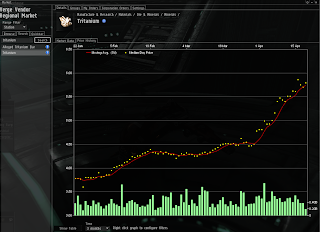
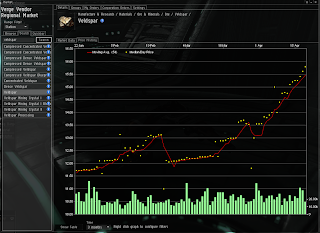
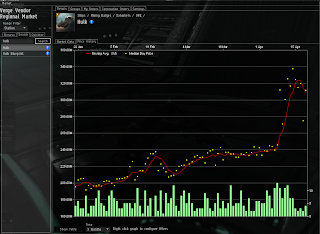
(That recent dip in hulks is interesting; I'll get to that in a sec.)
As predicted by basic economics, the price is rising. If the demand shifts out (more people want something), the price will rise. This is why I, and many people in EVE, are mining. Prices are really high. But a friend of mine who plays insists I shouldn't sell my veldspar now. I should sell it after the patch is released because then the price is even higher.
But if the price is over-inflated, as I think it is, then this is a horrible decision. I should sell while the price is high. Like a house in 2007, get out while the getting's good.
It's hard to tell if something is a bubble or not. Is this price increase just the beginning? Or are people holding on to the veldspar and trit because everyone assumes the price will rise, only to find it dropping when they want to sell. I'm inclined to believe the latter for the following reasons:
Elasticity. This is the measure of how sensitive the supply and demand curves are to price changes. It's really easy to mine veldspar. Thus the supply of veldspar is elastic: a small change in price will radically increase how much people will bring to market. This price increase will be small.
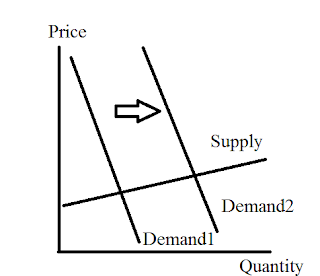
But the price increase isn't small. It's gone from from 4.50 to 5.75, a 27.8% increase. The price is probably too high.
Quantity. According to the little model up there, quantity should be off the charts. But the amount of trit sold (seen as the green bars) is (slightly) falling. Hulk sales, on the other hand, saw a jump in quantity when the patch was first release. They're the first thing you'd buy if you're a semi-experienced player (thus able to fly one and can afford one) and want to respond to veldspar prices. But we're not seeing veldspar and trit quantities rising. People are holding onto them. And now that the hulks have been bought, quantity's fallen and price is beginning to, as well. (Though I don't want to read too much into a short-run dip in a price.)
The Winner's Curse. Estimations are normally distributed. Some people will overestimate the future price of trit and others will underestimate it. The person who over estimates the most will pay the most. They will win the bid and they will regret it. Prices are driven by the winning bid so things will seem more valuable than they are. And this is made worse because...
Prices are correlated. EVE uses an English auction: if you're buying you place your bid and the high bid will buy the auction. You can up your bid if you want. But people tend to use other people's prices as information. If someone keeps outbidding me, then I might think that they know something important I don't so I outbid them. They then use my bid to think I know something they don't so they outbid me. Around and around we go until we wise up and the market crashes.
This prediction comes with caveats. (1) I may know that the supply curve is elastic, but I don't know how elastic. I may know the demand will shift, but I don't know how far. It's entirely possible that a 27.8% increase is modest and this is just the beginning. (2) If players can't sell their trit at a price they want, they will probably just hold on it. You don't have to pay a store fee after all. Thus prices might not crash. But if they don't, quantity sold will.
So I could be wrong--I'm not selling all my veldspar now--but I'm selling most of it. In less than a week, I'm going to look either really smart or really dumb. C'est la vie.
On April 24th, EVE will alter the rules of the game (a "patch" as they call it) which will radically change the economy. Basically it means players will have to create more things themselves, rather than just getting it from killing computer characters. This increased focus on player production (and it is already quite focused) will increase the demand for the game key mineral: tritanium, or trit.
When the patch notes came out earlier this month, trit prices exploded, along with veldspar (an ore that's refined into trit) and hulks (a ship that's really good at mining veldspar). (All screen shots were taken on April 19 at about 19:45 EVE time, or 3:45 EST, in the game region of Verge Vendor.)


(That recent dip in hulks is interesting; I'll get to that in a sec.)
As predicted by basic economics, the price is rising. If the demand shifts out (more people want something), the price will rise. This is why I, and many people in EVE, are mining. Prices are really high. But a friend of mine who plays insists I shouldn't sell my veldspar now. I should sell it after the patch is released because then the price is even higher.
But if the price is over-inflated, as I think it is, then this is a horrible decision. I should sell while the price is high. Like a house in 2007, get out while the getting's good.
It's hard to tell if something is a bubble or not. Is this price increase just the beginning? Or are people holding on to the veldspar and trit because everyone assumes the price will rise, only to find it dropping when they want to sell. I'm inclined to believe the latter for the following reasons:
Elasticity. This is the measure of how sensitive the supply and demand curves are to price changes. It's really easy to mine veldspar. Thus the supply of veldspar is elastic: a small change in price will radically increase how much people will bring to market. This price increase will be small.

But the price increase isn't small. It's gone from from 4.50 to 5.75, a 27.8% increase. The price is probably too high.
Quantity. According to the little model up there, quantity should be off the charts. But the amount of trit sold (seen as the green bars) is (slightly) falling. Hulk sales, on the other hand, saw a jump in quantity when the patch was first release. They're the first thing you'd buy if you're a semi-experienced player (thus able to fly one and can afford one) and want to respond to veldspar prices. But we're not seeing veldspar and trit quantities rising. People are holding onto them. And now that the hulks have been bought, quantity's fallen and price is beginning to, as well. (Though I don't want to read too much into a short-run dip in a price.)
The Winner's Curse. Estimations are normally distributed. Some people will overestimate the future price of trit and others will underestimate it. The person who over estimates the most will pay the most. They will win the bid and they will regret it. Prices are driven by the winning bid so things will seem more valuable than they are. And this is made worse because...
Prices are correlated. EVE uses an English auction: if you're buying you place your bid and the high bid will buy the auction. You can up your bid if you want. But people tend to use other people's prices as information. If someone keeps outbidding me, then I might think that they know something important I don't so I outbid them. They then use my bid to think I know something they don't so they outbid me. Around and around we go until we wise up and the market crashes.
This prediction comes with caveats. (1) I may know that the supply curve is elastic, but I don't know how elastic. I may know the demand will shift, but I don't know how far. It's entirely possible that a 27.8% increase is modest and this is just the beginning. (2) If players can't sell their trit at a price they want, they will probably just hold on it. You don't have to pay a store fee after all. Thus prices might not crash. But if they don't, quantity sold will.
So I could be wrong--I'm not selling all my veldspar now--but I'm selling most of it. In less than a week, I'm going to look either really smart or really dumb. C'est la vie.
Sunday, April 15, 2012
Too Many Stars
Imagine there are two types of jobs in the world: stars and support. Stars are the jobs where you're the center of attention. They are the decision-makers, the bosses (or at least appear to be): CEOs, professional athletes, entrepreneurs, newscasters. Support are all those jobs that make the stars' job possible: administrative assistants, janitors, supply chain management. Support is logistics.
We tend to romanticize stars. People often dream of being the Most Important Person in the Room, the one who orders others around and makes the Big Decisions. College encourages students to be leaders: "training future leaders" is common theme in mission statements. While grading senior projects (which are typically a detailed business proposal), students seem to prefer starting a high-end specialty store rather than something more humdrum, even if the humdrum one makes more sense.
And so good support is hard to find: advertising over supply chain management, boutiques over discounts, cooks over waiters, researchers over teachers, Apple over Wal-Mart, etc. It even happens in online video games (where the main goal is killing stuff): damage dealers are a dime a dozen but players interested in keeping their allies alive are a bitch to find.
We have too many people dreaming of becoming stars and it's incredibly wasteful. Think of all of the people who would be great at "mediocre" roles but instead are instead wasting their time trying to be actors or entrepreneurs. Being a star has more prestige and for good reason--don't get me wrong, stars are important--but we place too much emphasis on stars. We rarely think of training and encouraging good support and that should change. It's not the generals who win wars; it's the logistics.
We tend to romanticize stars. People often dream of being the Most Important Person in the Room, the one who orders others around and makes the Big Decisions. College encourages students to be leaders: "training future leaders" is common theme in mission statements. While grading senior projects (which are typically a detailed business proposal), students seem to prefer starting a high-end specialty store rather than something more humdrum, even if the humdrum one makes more sense.
And so good support is hard to find: advertising over supply chain management, boutiques over discounts, cooks over waiters, researchers over teachers, Apple over Wal-Mart, etc. It even happens in online video games (where the main goal is killing stuff): damage dealers are a dime a dozen but players interested in keeping their allies alive are a bitch to find.
We have too many people dreaming of becoming stars and it's incredibly wasteful. Think of all of the people who would be great at "mediocre" roles but instead are instead wasting their time trying to be actors or entrepreneurs. Being a star has more prestige and for good reason--don't get me wrong, stars are important--but we place too much emphasis on stars. We rarely think of training and encouraging good support and that should change. It's not the generals who win wars; it's the logistics.
Subscribe to:
Posts (Atom)
