During our class break in macroeconomics on Wednesday, I faced a classic economic problem: Should I buy Starbursts, knowing I'd be paying for flavors I didn't like, or go hungry but retain 85 cents? Standing with me in front of the vending machine, Michael Thomas chirped up and offered to shoulder the burden. He paid me 35 cents in exchange for whatever flavors I didn't want.
This was quite gutsy on his part, for I could have easily discovered all the flavors looked appealing. Luckily for him, about half--eight total--weren't for me, so I passed them on. We were both satisfied with our decisions.
Walking back into class Michael's girlfriend noticed our gains. "Oh candy!" she said. Michael reflexively passed her a Starburst and she happily consumed it. I stopped in my tracks as Michael crossed the room to sit down.
She and I discussed the events that just happened, particularly the exchange between her and her boyfriend. She didn't see anything at all wrong with it. About halfway through this conversation, she promptly stood up and declared she wanted more candy. Seconds later she returned with two Starbursts. She gave one to Brian, who was sitting next to her and also not seeing the connection between what transpired and taxes.
If you don't see it either, then considered what Michael told me after I asked him why he gave up his hard-earned candy: "My life is easier if she's happy." Ah, there's the rub. Most women reading this might think he's talking about nice things she does for him, but most men know he referring to all the ways she can make his life harder, but holds back if she's happy.
Taxes are the same way. I could choose not to pay them, but I will find government will make my life harder as a response. When I pay them I'll find my money distributed to others, just like the Starburst that went to Brian. And when I comply with the enforced rules, I give the rule-makers every reason to tighten their grip; on a whim, her "tax rate" increased from 12.5% to 37.5%!
Keen readers will quickly note that unlike governments, you can opt out of a relationship. Yet many people can change citizenship and even more can move within a country, escaping local injustices. Economists usually don't focus on that option because it's unreasonable to require people to uproot their entire lives just to escape a transfer payment. (Note that when those costly demands escape the costs of moving, people try to, despite the risks. The curreny debate over immigration is an obvious example, as are the countless who brave the Caribbean to leave Cuba.) Similarly, as relationships move forward, it becomes more costly to end them, so the tolerable level of extortion increases. Marriages are thus potentially the most oppressive of relationships, a theory justified by countless testimonies of married folk.
The couple have been seeing each other for some time now (I want to say six months, but I don't know the exact number). It would be costy to end it. She knows this so she exploits it with some annoying, but not tremendously burdensome, punishment. While early in the relationship, Michael would have handed her candy to demonstrate he's a good guy (and thus get something out of it), he now does it out of fear of reprisal. Michael is living under tryanny.
I suppose it's reasoning like this which explains why my longest relationship was three months.
Friday, March 31, 2006
Tuesday, March 28, 2006
Dare To Be Different


Mike just sent me a link to this article on Slate. Nice to see Mason's victories have a nice tie in to our economics department. Looks like they are not so disjointed as I originally thought.
Saturday, March 25, 2006
V For Values
Abdul Rahman is currently on trial in Afghanistan for converting to Christianity. The death penalty is a virtual certainty and the people, we are told, are calling for his head.
Paradoxically, Said Mirhossain Nasri (top cleric at Hossainia Mosque) defended execution over exiling. "If he is allowed to live in the West, then others will claim to be Christian so they can too." Here's a crazy idea: maybe the reason people want to leave the country is because they could die for things like converting from Islam.
V For Vendetta references a similar time. It opens with the Gunpowder Plot of 1605, when Guy Fawkes tried to blow up Parliment in defiance of the king's criminalization of Catholicism.
A less obvious parallel is the movie's commentary on people in charge. Just as the new Afghan government is made up of those who were terrorized by the Taliban, a Big Brother-type character in this future dystopia is played by John Hurt, who portrayed protagonist Winston in a movie adaptation of 1984.
Laws beget laws. Those once under the thumb of tyranny struggle to "liberate the people" and impose a new ideal onto everyone else. They quickly forget that their exiled masters never thought themselves as tyrants nor do they recognized how quickly they become the very thing they fought against.
Paradoxically, Said Mirhossain Nasri (top cleric at Hossainia Mosque) defended execution over exiling. "If he is allowed to live in the West, then others will claim to be Christian so they can too." Here's a crazy idea: maybe the reason people want to leave the country is because they could die for things like converting from Islam.
V For Vendetta references a similar time. It opens with the Gunpowder Plot of 1605, when Guy Fawkes tried to blow up Parliment in defiance of the king's criminalization of Catholicism.
A less obvious parallel is the movie's commentary on people in charge. Just as the new Afghan government is made up of those who were terrorized by the Taliban, a Big Brother-type character in this future dystopia is played by John Hurt, who portrayed protagonist Winston in a movie adaptation of 1984.
Laws beget laws. Those once under the thumb of tyranny struggle to "liberate the people" and impose a new ideal onto everyone else. They quickly forget that their exiled masters never thought themselves as tyrants nor do they recognized how quickly they become the very thing they fought against.
Wednesday, March 22, 2006
Patriot Games
I know very little about basketball and you'd have to pay me to be excited about us being the "sweet sixteen." In fact, I can't remember another time when my interest level was so little compared to everyone around me. Ok, I care a little that Mason was on the cover Sports Illustrated and more people know who we are now, but I have zero interest in the simple fact of Mason's standing.
Yet I am surrounded by those that do care and they care an awful lot. So much so, that they are externalizing the costs of them caring, of which I am in part bearing.
-A housemate of mine keeps talking about the upcoming game and wants to talk about it with me.
-Yesterday, my coworkers had a hard time talking about little else, of which I had to hear and exhibited an opportunity cost of conversation.
-Outside the office, the past two games are playing on a really large screen, which I, again, have to hear.
-The campus is now blanketed with posters about the team's standing and I don't care.
There have also been some annoying demand curve shifts.
-When Jeremy and I went to lift yesterday, the weight room was abnormally crowded, making it more costly for me to do the workout I want. (We attributed the sudden rise in gym attendence to "sports fever.")
-It was harder for me to find a good parking spot at the field house (where the weight room is located) because about 30 people were there, camping in line for tickets.
-While trying to find a spot, I had to navigate around a TV van parked in the road, as well as some campers playing football.
-There's a big line for "Sweet 16" T-shirts, spilling out of the bookstore and into the main area of the Johnson Center, making it more crowded.
And then there's one that's a bit of both.
-The topic is crowding out virtually all normal radio conversation; I would almost certainly enjoy the opportunity cost more.
I really hope we loose on Friday.
Yet I am surrounded by those that do care and they care an awful lot. So much so, that they are externalizing the costs of them caring, of which I am in part bearing.
-A housemate of mine keeps talking about the upcoming game and wants to talk about it with me.
-Yesterday, my coworkers had a hard time talking about little else, of which I had to hear and exhibited an opportunity cost of conversation.
-Outside the office, the past two games are playing on a really large screen, which I, again, have to hear.
-The campus is now blanketed with posters about the team's standing and I don't care.
There have also been some annoying demand curve shifts.
-When Jeremy and I went to lift yesterday, the weight room was abnormally crowded, making it more costly for me to do the workout I want. (We attributed the sudden rise in gym attendence to "sports fever.")
-It was harder for me to find a good parking spot at the field house (where the weight room is located) because about 30 people were there, camping in line for tickets.
-While trying to find a spot, I had to navigate around a TV van parked in the road, as well as some campers playing football.
-There's a big line for "Sweet 16" T-shirts, spilling out of the bookstore and into the main area of the Johnson Center, making it more crowded.
And then there's one that's a bit of both.
-The topic is crowding out virtually all normal radio conversation; I would almost certainly enjoy the opportunity cost more.
I really hope we loose on Friday.
Friday, March 17, 2006
See David Loot
I would just like to extend my thank yous to all the taxpayers out there. I spent part of this break exploring some of the museums and monuments the DC area has to offer, provided free of charge to anyone who enters.
This is a classic example of transfer payments from most of the US to museum-and-monument-attending residents (and their visiting counterparts). Oh sure you could say anyone gets in free (even foreigners who don't pay US taxes) so it's fair, but that's like defending a thief who steals money, hides it halfway across the country and e-mails the location of the goods to the original owner.
In other words it's still wrong, but I went anyway.
This is a classic example of transfer payments from most of the US to museum-and-monument-attending residents (and their visiting counterparts). Oh sure you could say anyone gets in free (even foreigners who don't pay US taxes) so it's fair, but that's like defending a thief who steals money, hides it halfway across the country and e-mails the location of the goods to the original owner.
In other words it's still wrong, but I went anyway.
Tuesday, March 14, 2006
Slumlord of the Rings
Last night I added another wikipedia article, slumlord. I was amazed it wasn't already there. And I have to pat myself on the back: I did a pretty good job keeping POV on this topic.
I have no problems with slumlords; they provide a valuable service. Slumlords keep rent prices low by not spending the money to fix a property. Those that have the least amount to spend on housing (the poor and students) have a place to live thanks, in part, to slumlords.
Ironically, the people who tend to hate slumlords tend to dislike gentrification. The former makes it easier for the poor to afford housing and the latter makes it harder. Not that I have anything against gentrification, either (one man's trash is another man's fabulous townhouse). In fact, they need each other. If a neighborhood gentrifies, the poor that live there need to move. If every other place is forced to be neat and clean, they have no where to live. Slumlords sell them a roof over their heads they can afford.
I have no problems with slumlords; they provide a valuable service. Slumlords keep rent prices low by not spending the money to fix a property. Those that have the least amount to spend on housing (the poor and students) have a place to live thanks, in part, to slumlords.
Ironically, the people who tend to hate slumlords tend to dislike gentrification. The former makes it easier for the poor to afford housing and the latter makes it harder. Not that I have anything against gentrification, either (one man's trash is another man's fabulous townhouse). In fact, they need each other. If a neighborhood gentrifies, the poor that live there need to move. If every other place is forced to be neat and clean, they have no where to live. Slumlords sell them a roof over their heads they can afford.
Friday, March 10, 2006
PETA's Thought Police
The office I work in gets regular copies of The Chronicle of Higher Education, a weekly newspaper documenting recent news in academia. One article this week caught my eye: Undercover Among the Cages.
It's common knowledge that PETA doesn't like it when other people experiment on animals. Now, thanks to advances in hidden camera technology, PETA sympathizers are increasingly inflitrating research labs. They record how the animal subjects are treated in an effort to encourage more government enforcement of the morality laws surrounding lab animal welfare.
Not once does the article question the ethical bedrock of what PETA is doing, even when it metnions the inflitration Columbia University (a private organization) in 2003. Instead it frames the spying as investigative journalism. To be clear, investigative journalism tries to demonstrate when an organization cheats (like scams and rip-offs) people. What PETA is doing is violating people's rights to privacy and liberty to push their own agenda.
This is not dissimilar to the illegal wire-tappings the Bush administration is engaging in: both of them steal away privacy to impose their will, their version of ethics, onto others. Big Brother is watching you.
It's common knowledge that PETA doesn't like it when other people experiment on animals. Now, thanks to advances in hidden camera technology, PETA sympathizers are increasingly inflitrating research labs. They record how the animal subjects are treated in an effort to encourage more government enforcement of the morality laws surrounding lab animal welfare.
Not once does the article question the ethical bedrock of what PETA is doing, even when it metnions the inflitration Columbia University (a private organization) in 2003. Instead it frames the spying as investigative journalism. To be clear, investigative journalism tries to demonstrate when an organization cheats (like scams and rip-offs) people. What PETA is doing is violating people's rights to privacy and liberty to push their own agenda.
This is not dissimilar to the illegal wire-tappings the Bush administration is engaging in: both of them steal away privacy to impose their will, their version of ethics, onto others. Big Brother is watching you.
Wednesday, March 08, 2006
Shafting the Space Elevator
Colleague and friend Brian Hollar commented yesterday concerning the possibility of a space elevator: a robotic machine that runs up and down a teather with one end anchored on earth and the other anchored to an object in orbit.
Brian thinks the idea is very promising, quoting Business 2.0's comparison of the idea: "The space elevator is where the PC was in the 1960s: The theory is solid, the materials exist, and people in garages are starting to tinker with the next step."
But the biggest hurdle to the space elevator is that NASA has latched on to it. The elevator is destined to be expensive (estimates start at about five billion USD) adding to the already high likelihood that it'll make a lot of headlines. This is more of a weakness than a boon. When NASA projects make headlines before they are complete, the project becomes a political pawn. The focus changes, the budget fluctuates, projects are added on and taken off, rivalries and infighting overcome the goals and, if you're lucky enough to finish what you started, it'll be a shadow of what it was supposed to be. The ISS is the first example that comes to mind.
Don't get me wrong; there are some things NASA's starting to do right. Following the X-Prize lead, it's offering annual prizes for those that solve certain technology obstacles the elevator faces. But the prize money is tiny ($50,000 for each of the two elevator-related prizes) and while one has thus far received an impressive following (19 teams this year for the tether prize), the other is proceeding lacklusterly (4 teams last year, only two so far this year).
NASA's core problem with its approach on this strategy is that it's missing the whole point of the prize system. The idea is to encourage novel solutions of achieving goals, not to simply outsource your R&D department. By stating how NASA would like to get into space (the elevator), that strategy is embodied in the rules and hampers engineers from using their own ideas. For example, the tether prize states all tethers must form a closed loop, weigh a maximum of 2 grams, have an inner circumference of 2m long, +/- 1cm, and can be no wider than 200mm.
The goal isn't to get into space with an elevator; the goal is to get into space cheaply.
Brian thinks the idea is very promising, quoting Business 2.0's comparison of the idea: "The space elevator is where the PC was in the 1960s: The theory is solid, the materials exist, and people in garages are starting to tinker with the next step."
But the biggest hurdle to the space elevator is that NASA has latched on to it. The elevator is destined to be expensive (estimates start at about five billion USD) adding to the already high likelihood that it'll make a lot of headlines. This is more of a weakness than a boon. When NASA projects make headlines before they are complete, the project becomes a political pawn. The focus changes, the budget fluctuates, projects are added on and taken off, rivalries and infighting overcome the goals and, if you're lucky enough to finish what you started, it'll be a shadow of what it was supposed to be. The ISS is the first example that comes to mind.
Don't get me wrong; there are some things NASA's starting to do right. Following the X-Prize lead, it's offering annual prizes for those that solve certain technology obstacles the elevator faces. But the prize money is tiny ($50,000 for each of the two elevator-related prizes) and while one has thus far received an impressive following (19 teams this year for the tether prize), the other is proceeding lacklusterly (4 teams last year, only two so far this year).
NASA's core problem with its approach on this strategy is that it's missing the whole point of the prize system. The idea is to encourage novel solutions of achieving goals, not to simply outsource your R&D department. By stating how NASA would like to get into space (the elevator), that strategy is embodied in the rules and hampers engineers from using their own ideas. For example, the tether prize states all tethers must form a closed loop, weigh a maximum of 2 grams, have an inner circumference of 2m long, +/- 1cm, and can be no wider than 200mm.
The goal isn't to get into space with an elevator; the goal is to get into space cheaply.
Tuesday, March 07, 2006
Ah! I've Been Tagged!
Steve Horowitz just tagged me a few minutes ago and since it's more fun than studying econometrics, let's run with it.
Four jobs I’ve had
1. Dishwasher/Busboy
2. Teaching assistant (microeconomics)
3. College scene shop worker (building sets for plays)
4. "Team member" at Jo-Ann Fabrics and Crafts (a very manly job, I must add)
Four movies I can watch over and over
1. The Count of Monte Cristo
2. Snatch
3. Indiana Jones and the Last Crusade
4. Star Trek 6: The Undiscovered Country
Four places I’ve lived
1. Davenport, IA
2. Fairfax, VA
3. Beloit, WI
4. Istanbul, Turkey
Four TV shows I love
1. Firefly
2. Southpark
3. The West Wing
4. Battlestar Galactica
Four highly regarded and recommended TV shows I haven’t seen (much of)
1. Desperate Housewives
2. Grey's Anatomy
3. 24
4. House
Four places I’ve vacationed
1. Rome
2. Alaska
3. Orlando, Florida
4. Barcelona
Four of my favorite dishes
1. Spaghetti with meatballs
2. Chicken and garlic calzone
3. Fudge brownie with vanilla ice cream and hot chocolate sauce
4. Chicken Caesar salad
Four sites I visit daily
1. Wikipedia
2. Google News
3. At least one blog of a professor or peer
4. Gmail
Four places I’d rather be right now
1. An empty tropical beach, reading
2. Roaming the streets of Paris, eating crepes
3. Sitting around with old friends from Beloit, catching up
4. Sitting around with old friends from Beloit, pretending to be people far cooler than we could ever be.
Four new bloggers I’m tagging
1. Jason Briggeman
2. Capital Freedom
3. Jeremy Horpedahl
4. Michael Thomas
Four jobs I’ve had
1. Dishwasher/Busboy
2. Teaching assistant (microeconomics)
3. College scene shop worker (building sets for plays)
4. "Team member" at Jo-Ann Fabrics and Crafts (a very manly job, I must add)
Four movies I can watch over and over
1. The Count of Monte Cristo
2. Snatch
3. Indiana Jones and the Last Crusade
4. Star Trek 6: The Undiscovered Country
Four places I’ve lived
1. Davenport, IA
2. Fairfax, VA
3. Beloit, WI
4. Istanbul, Turkey
Four TV shows I love
1. Firefly
2. Southpark
3. The West Wing
4. Battlestar Galactica
Four highly regarded and recommended TV shows I haven’t seen (much of)
1. Desperate Housewives
2. Grey's Anatomy
3. 24
4. House
Four places I’ve vacationed
1. Rome
2. Alaska
3. Orlando, Florida
4. Barcelona
Four of my favorite dishes
1. Spaghetti with meatballs
2. Chicken and garlic calzone
3. Fudge brownie with vanilla ice cream and hot chocolate sauce
4. Chicken Caesar salad
Four sites I visit daily
1. Wikipedia
2. Google News
3. At least one blog of a professor or peer
4. Gmail
Four places I’d rather be right now
1. An empty tropical beach, reading
2. Roaming the streets of Paris, eating crepes
3. Sitting around with old friends from Beloit, catching up
4. Sitting around with old friends from Beloit, pretending to be people far cooler than we could ever be.
Four new bloggers I’m tagging
1. Jason Briggeman
2. Capital Freedom
3. Jeremy Horpedahl
4. Michael Thomas
Friday, March 03, 2006
March's Most Random Wikipedia Page Is...
Ok I don't plan to do this every month, but List of sets of unrelated songs with identical titles should win something.
Congratulations Wikipedia!
For achieving its one millionth article on the first of March.
Not surprisingly, the landmark article--Jordanhill railway station--is probably one of the fastest growing articles about a mundane topic, achieving 31 discussion topic and citing 21 references within the first three days of its creation.
Just another example of how decentralized order can create wonders central planners could never dream of.
Not surprisingly, the landmark article--Jordanhill railway station--is probably one of the fastest growing articles about a mundane topic, achieving 31 discussion topic and citing 21 references within the first three days of its creation.
Just another example of how decentralized order can create wonders central planners could never dream of.
Wednesday, March 01, 2006
Pickpocketed At the Pump
Way back in August, I commented that the imposed price ceilings of Hawaii gas would actually cause the retail price to rise (because the law only pertains to wholesale gas prices). After checking data at Hawaiigasprices.com, it appears my logic was sound.
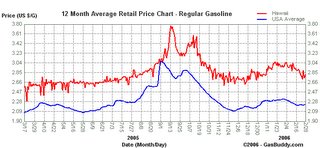
Note that before the law came into effect on September 1, Hawaii gas prices were about 38-57 cents higher than the US average. After September 1, prices were about 57-78 cents higher. (Note the two expections shortly after Katrina, where the difference goes from 95 cents to 38 cents.)
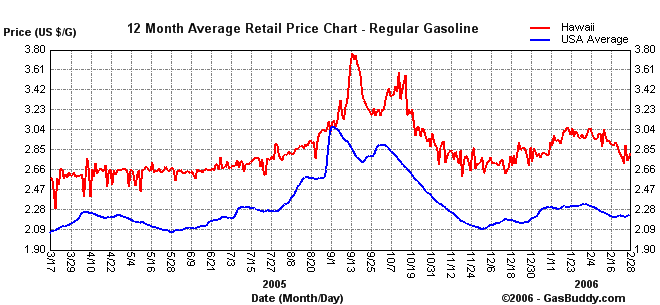
Note that before the law came into effect on September 1, Hawaii gas prices were about 38-57 cents higher than the US average. After September 1, prices were about 57-78 cents higher. (Note the two expections shortly after Katrina, where the difference goes from 95 cents to 38 cents.)
Tuesday, February 28, 2006
Give Trade a Chance
A random walk along the Internet today led me to a disdainful look at Thomas Friedman, which led me to his Wikipedia entry, which led me to a criticism piece entitled, "FLATMAN I'm sorry, but the world's still round."
I have mixed feelings about Friedman: I don't agree with him that America needs to compete to maintain it's hold on high tech sectors nor do I feel that the US needs to maintain a dominance in finance. No one thing is the key to prosperity; that's what globalization is for in the first place.
He has some interesting takes how globalization changes cultural norms, though. And while he might put too much stock in the idea of trade as a universally peaceful solution (a la the Golden Arches Theory of Conflict Prevention) it conveys a powerful point. Take this criticism of the theory, penned by Siddharth Varadarajan: "cross investment and extensive trade relations have never prevented countries from going to war against each other."
That's quite a claim, especially since he's citing historical evidence. Especially since we tend not to study times war almost broke out (and we really don't study potential wars that never had a chance to break out, like the US invading Canada anytime in the past fifty or so years). It's hard to measure trade's impact on peace and while I don't think it prevents all conflict, it's even more absurd to claim it prevents none.
I have mixed feelings about Friedman: I don't agree with him that America needs to compete to maintain it's hold on high tech sectors nor do I feel that the US needs to maintain a dominance in finance. No one thing is the key to prosperity; that's what globalization is for in the first place.
He has some interesting takes how globalization changes cultural norms, though. And while he might put too much stock in the idea of trade as a universally peaceful solution (a la the Golden Arches Theory of Conflict Prevention) it conveys a powerful point. Take this criticism of the theory, penned by Siddharth Varadarajan: "cross investment and extensive trade relations have never prevented countries from going to war against each other."
That's quite a claim, especially since he's citing historical evidence. Especially since we tend not to study times war almost broke out (and we really don't study potential wars that never had a chance to break out, like the US invading Canada anytime in the past fifty or so years). It's hard to measure trade's impact on peace and while I don't think it prevents all conflict, it's even more absurd to claim it prevents none.
Sunday, February 26, 2006
Newtonian Time
Taking a little study break, I added an article about Newtonian time to Wikipedia. Newtonian time is a facet of neo-classical economics and because of its rigidity, it assumes away endogenous change. Austrians openly reject the idea of Newtonian time and embrace real time instead, which is an article I'll write later.
Wow, this is what I do for my break? I'm going to go watch American Dad.
Wow, this is what I do for my break? I'm going to go watch American Dad.
Checking for Fallacies
Way back when, Mike and I came up with the idea of The Fallacy of the Unclaimed Dollar. I doubt this idea is new, but the fallacy goes a little something like this: If something hasn't happened yet, it's probably a bad idea. The name comes from a joke economists like to tell each other about a professor refusing to pick up a dollar bill because if it was really there, someone would have picked it up by now.
(Side Note: I actually want to change the name to Fallacy of the Unclaimed Fortune, but for consistency's sake, let's keep with the original name.)
It's recently occured to me that Austrians may be committing this fallacy despite our focus on the ongoing process of market change, that circumstances aren't predetermined. At the very least, we get dangerously close to commiting this fallacy when we dismiss a government agency as inefficent because "if it was a good idea, the private sector would have done it."
Granted, that's just the tip of the iceberg for arguments against Agency X (the government isn't spending their own money; they don't have a strong vested interest in being effective or efficent; they lack the relevant knowledge to accomplish such a task and on and on and on). And far be it from me to suggest a rationale for government agencies. But if we are to be scientists and if we are to avoid the intellectual traps of lazy or simplistic arguments, we should be prepared to move past this standard claim and acknowledge this is not a sufficient argument for everything.
(Side Note: I actually want to change the name to Fallacy of the Unclaimed Fortune, but for consistency's sake, let's keep with the original name.)
It's recently occured to me that Austrians may be committing this fallacy despite our focus on the ongoing process of market change, that circumstances aren't predetermined. At the very least, we get dangerously close to commiting this fallacy when we dismiss a government agency as inefficent because "if it was a good idea, the private sector would have done it."
Granted, that's just the tip of the iceberg for arguments against Agency X (the government isn't spending their own money; they don't have a strong vested interest in being effective or efficent; they lack the relevant knowledge to accomplish such a task and on and on and on). And far be it from me to suggest a rationale for government agencies. But if we are to be scientists and if we are to avoid the intellectual traps of lazy or simplistic arguments, we should be prepared to move past this standard claim and acknowledge this is not a sufficient argument for everything.
Wednesday, February 22, 2006
Dirty Deeds Done With Dogs
In an attempt to stave off the apparent orgy of dog-fighting going on Scotland, new anti-animal fighting laws will be going into effect shortly. The new laws punishes anyone engaging in activities related to the fights (including distributing tapes of them) with severe penalties of up to 12,000 pounds and up to a year in prison.
I really don't have a problem with dog-fighting, and not just because I'm a cat person. My main source of skepticism comes from the supporters of bills like these who then gladly eat bacon, chicken and humanity's other "animal friends."
I don't know how a feel about animal torture in general; my heart says it's wrong but my head can't figure out a reason and having "bad feelings" isn't enough to infringe on another's liberties. I do know that with all the crazy injustices going on the world, focusing on a small part of the population watching dogs fight is an absurd waste of one's time. I guess perspective is the first thing you loose when you live in a prosperous society.
I really don't have a problem with dog-fighting, and not just because I'm a cat person. My main source of skepticism comes from the supporters of bills like these who then gladly eat bacon, chicken and humanity's other "animal friends."
I don't know how a feel about animal torture in general; my heart says it's wrong but my head can't figure out a reason and having "bad feelings" isn't enough to infringe on another's liberties. I do know that with all the crazy injustices going on the world, focusing on a small part of the population watching dogs fight is an absurd waste of one's time. I guess perspective is the first thing you loose when you live in a prosperous society.
Sunday, February 19, 2006
O Brother, What Art Thou Thinking?
Last week Mike guest posted about labor laws and spawned a 10-comment (!) debate on the subject. I thought about responding to some criticisms via comment but since I don't have much of anything to write about just now, I thought I'd turn it into a post.
In the comments section, I wrote that employers should be able to fire employees for whatever reason they want. And yes, that includes for reasons of race, marriage status, religion and every other distinction you can think of. Why? Consider the reasons an employer would do this: 1) because he's a jerk in which case it's his lose and 2) because the customer wants it in which case why punish the employer? Before you argue, ask yourself if you'd like to see Denzel Washington as a Nazi or William H. Macy as Martin Luther King. It's an extreme case, but the basic ideas are constant.
My brother correctly pointed out that firms do not fire people on a whim and they have a vested interest in seeing them work out. Yet he paradoxically thinks it's a good idea to require firms to have "proof of ineptitude" before firing someone. If the firm has a vested interest in seeing the employee do well, then why do you need a law requiring the firm not fire employees that could do well? (Consider this article I wrote about Donald Trump and his hiring practices for The Apprentice.)
Labor laws like these are layered in truthiness. For example, my brother also cites that he's been in the "real world" for about nine years and implies I'm detatched from it's realities. But his experience is a weakness as much as a strength because he's only been on the labor side. Not surprisingly, he thinks labor should be protected from management citing the "human cost." Feelings as opposed to facts.
The fact of the matter is if you start favoring one group, you punish another and usually several others. I may have been in the "ivory tower" for most of my life but it's not like I've been studying English literature. Economics is the study of choice and it's chiefly concerned with creating a better world; the conclusions I have made have not been arrived at lightly. And for the record, I've worked jobs myself. I've had good employers and bad employers; I've seen good employees and bad employees. The world is not so uniform you can ethically make a law that favors one side; laws are good for issues of homogeneity, not diversity.
In the comments section, I wrote that employers should be able to fire employees for whatever reason they want. And yes, that includes for reasons of race, marriage status, religion and every other distinction you can think of. Why? Consider the reasons an employer would do this: 1) because he's a jerk in which case it's his lose and 2) because the customer wants it in which case why punish the employer? Before you argue, ask yourself if you'd like to see Denzel Washington as a Nazi or William H. Macy as Martin Luther King. It's an extreme case, but the basic ideas are constant.
My brother correctly pointed out that firms do not fire people on a whim and they have a vested interest in seeing them work out. Yet he paradoxically thinks it's a good idea to require firms to have "proof of ineptitude" before firing someone. If the firm has a vested interest in seeing the employee do well, then why do you need a law requiring the firm not fire employees that could do well? (Consider this article I wrote about Donald Trump and his hiring practices for The Apprentice.)
Labor laws like these are layered in truthiness. For example, my brother also cites that he's been in the "real world" for about nine years and implies I'm detatched from it's realities. But his experience is a weakness as much as a strength because he's only been on the labor side. Not surprisingly, he thinks labor should be protected from management citing the "human cost." Feelings as opposed to facts.
The fact of the matter is if you start favoring one group, you punish another and usually several others. I may have been in the "ivory tower" for most of my life but it's not like I've been studying English literature. Economics is the study of choice and it's chiefly concerned with creating a better world; the conclusions I have made have not been arrived at lightly. And for the record, I've worked jobs myself. I've had good employers and bad employers; I've seen good employees and bad employees. The world is not so uniform you can ethically make a law that favors one side; laws are good for issues of homogeneity, not diversity.
Friday, February 17, 2006
A Wee Bit of Culture
Prometheus is by far my favorite figure in Greek mythology. Defiant. Intelligence. A bit of a wise ass but also the patron of human civilization. Like the authors that wrote of him (notably Lord Byron and Percy Bysshe Shelly), he recognized the grand potential of free minds and free societies.
I stumbled on this poem about Prometheus, written by Lord Byron and published in 1816. Comparing Prometheus to the human spirit Byron wrote,
I stumbled on this poem about Prometheus, written by Lord Byron and published in 1816. Comparing Prometheus to the human spirit Byron wrote,
And a firm will, and a deep sense,
Which even in torture can descry
Its own concenter'd recompense,
Triumphant where it dares defy
Wednesday, February 15, 2006
Facts and Theories
At its most basic, good economics is about two things: good theory and good data. Some will say it's more about the data and some will emphasize the theory but a good economist combines both into a coherent explanation about the world around us. If your theory can't be supported by the data, you better rethink your theory. Yet if your data says one thing but you can't construct an explanation that's consistent with accepted truths, there's something probably wrong with your data.
That reality came to head Friday night when an AU student and I got into a discussion about income data. He pointed to the old claims that the rich are getting richer and the poor are getting poorer. Remembering an IHS seminiar Steve Horwitz spoke at a few years ago, I pointed to data that said the poor were getting richer, too.
He responded that the data--which tracks a family's income over time--is flawed because poor people move more than other people, so you don't count them and there's a sampling bias. He, who has been studying income data for ten years, noted stasticians have come up with a weight to adjust for this and when applied, the poor are getting poorer. (Note that according to the data 95% of the lowest quintile move up from it at least one quintile, suggesting that must have been one hell of a weight to make such a drastic change. Perhaps poor people are literal nomads...)
I've never heard of this weight, so I let it go and gave him the benefit of the doubt. "So what's your explanation, then?" I asked. His theory was quite....elaborate.
He noted that the rich are more likely to save than the poor. Seems reasonable. So, he said, the rich put their money in a bank and live off the interest and the wealth stays at the top. I insisted we follow the money beyond that. So we agreed that the bank could then take all of that money and lend it to a corporation which then could give it all to their highest paid inwhich the whole cycle could start over again.
Now to fully grasp this AU student's theory, replace every "could" with "always" because that's the only way the money could stay at the top. He insisted that all you need is that higher liklihood for savings but, as I tried to explain, that doesn't work. Money leaks out and spreads around; it moves between classes, industries and countries. It's a medium of exchange--that's why we have it.
I also wanted to point out that even if this "100% always" theory held, it still wouldn't mean the data's telling a good story. Companies don't give millions to CEOs just because they feel like--they do it as a reward for making the company more efficient which means society just got richer. I avoided that point, however, as I suspected the conversation would quickly devolve into conspiratorial claims that the rich focus on keeping the downtrodden poor.
Still, the bias claim was new to me so I e-mail Steve Horwitz about it. He responded quite quickly and suggested the burden of proof rests on the AU student. The PSID data is highly respected and widely used; what special ability allows for him to know how much to reweight the data? I'm not sure how I feel about this; it seems pretty straightforward to run surveys and ask people how many times they've moved in the past five or ten years, even if you include complications such as students moving from college to home.
But Steve offered an even better bit of evidence that the poor have gotten richer over the past thirty years: They have more stuff. Even if there's more debt, are they really "poorer" if that debt means having AC, cable and a washer and dryer? They clearly don't think so.
If your theory is sloppy, then your data probably is too, especially when your data contradicts accepted truths.
That reality came to head Friday night when an AU student and I got into a discussion about income data. He pointed to the old claims that the rich are getting richer and the poor are getting poorer. Remembering an IHS seminiar Steve Horwitz spoke at a few years ago, I pointed to data that said the poor were getting richer, too.
He responded that the data--which tracks a family's income over time--is flawed because poor people move more than other people, so you don't count them and there's a sampling bias. He, who has been studying income data for ten years, noted stasticians have come up with a weight to adjust for this and when applied, the poor are getting poorer. (Note that according to the data 95% of the lowest quintile move up from it at least one quintile, suggesting that must have been one hell of a weight to make such a drastic change. Perhaps poor people are literal nomads...)
I've never heard of this weight, so I let it go and gave him the benefit of the doubt. "So what's your explanation, then?" I asked. His theory was quite....elaborate.
He noted that the rich are more likely to save than the poor. Seems reasonable. So, he said, the rich put their money in a bank and live off the interest and the wealth stays at the top. I insisted we follow the money beyond that. So we agreed that the bank could then take all of that money and lend it to a corporation which then could give it all to their highest paid inwhich the whole cycle could start over again.
Now to fully grasp this AU student's theory, replace every "could" with "always" because that's the only way the money could stay at the top. He insisted that all you need is that higher liklihood for savings but, as I tried to explain, that doesn't work. Money leaks out and spreads around; it moves between classes, industries and countries. It's a medium of exchange--that's why we have it.
I also wanted to point out that even if this "100% always" theory held, it still wouldn't mean the data's telling a good story. Companies don't give millions to CEOs just because they feel like--they do it as a reward for making the company more efficient which means society just got richer. I avoided that point, however, as I suspected the conversation would quickly devolve into conspiratorial claims that the rich focus on keeping the downtrodden poor.
Still, the bias claim was new to me so I e-mail Steve Horwitz about it. He responded quite quickly and suggested the burden of proof rests on the AU student. The PSID data is highly respected and widely used; what special ability allows for him to know how much to reweight the data? I'm not sure how I feel about this; it seems pretty straightforward to run surveys and ask people how many times they've moved in the past five or ten years, even if you include complications such as students moving from college to home.
But Steve offered an even better bit of evidence that the poor have gotten richer over the past thirty years: They have more stuff. Even if there's more debt, are they really "poorer" if that debt means having AC, cable and a washer and dryer? They clearly don't think so.
If your theory is sloppy, then your data probably is too, especially when your data contradicts accepted truths.
Tuesday, February 14, 2006
Labor Laws
This is Mike, Guest Posting here. More like homecoming, but I still consider myself a guest. I told the story below to David, who begged me to blog it. I am currently studying Anthropology and Buddhism in Thailand, which gives me an interesting chance to see a lot of economic questions in a slightly different setting. Depending on my reception I may blog some of those too.
A friend of mine from Germany and I had dinner the other night and discussed German labor laws. In Germany it is exceedingly difficult, or at least very costly to fire a person. A very solid foundation of evidence of incompetence and damage to the firm must be laid before even thinking about firing a person, because a lawsuit and a government intervention will speed right in to the rescue. The intent, as is the intent with so many economic policies, is to benefit the poor, oppressed working classes against the evil corporations. The actual effect I leave as an exercise to you. I would suggest as a starting point that the laws benefit the already employed at the expense of the desiring-to-be-employed and the bottom lines of the employers. However, some employers have found an ingenious (if illegal) workaround.
Say an employee is peforming at a level that ought to get him fired but in Germany would not, due to the hassle. A manager at this employee's firm will speak to his counterpart in a competing firm and ask them to hire the employee away, through a headhunter. The employee, excited about being hired away, takes the job at the competitor and begins work there. Meanwhile, the new firm gives him a slight raise, but the raise and the salary are actually paid by the original firm. Why?
Because the labor laws allow a grace period of about a month after hiring in which companies can still fire new employees freely without much difficulty. So after a few weeks feigning due diligence, the new employee is unceremoniously let go, unable to sue his old firm which he left voluntarily and unable to sue his new firm which is exempt from the ruleswas still in the grace period. Apparently entire industries will engage in this kind of trade back and forth, under the table, all to maintain some form of efficiency.
The market finds a way, albiet a little messy. But who loses? That's right, labor.
A friend of mine from Germany and I had dinner the other night and discussed German labor laws. In Germany it is exceedingly difficult, or at least very costly to fire a person. A very solid foundation of evidence of incompetence and damage to the firm must be laid before even thinking about firing a person, because a lawsuit and a government intervention will speed right in to the rescue. The intent, as is the intent with so many economic policies, is to benefit the poor, oppressed working classes against the evil corporations. The actual effect I leave as an exercise to you. I would suggest as a starting point that the laws benefit the already employed at the expense of the desiring-to-be-employed and the bottom lines of the employers. However, some employers have found an ingenious (if illegal) workaround.
Say an employee is peforming at a level that ought to get him fired but in Germany would not, due to the hassle. A manager at this employee's firm will speak to his counterpart in a competing firm and ask them to hire the employee away, through a headhunter. The employee, excited about being hired away, takes the job at the competitor and begins work there. Meanwhile, the new firm gives him a slight raise, but the raise and the salary are actually paid by the original firm. Why?
Because the labor laws allow a grace period of about a month after hiring in which companies can still fire new employees freely without much difficulty. So after a few weeks feigning due diligence, the new employee is unceremoniously let go, unable to sue his old firm which he left voluntarily and unable to sue his new firm which is exempt from the ruleswas still in the grace period. Apparently entire industries will engage in this kind of trade back and forth, under the table, all to maintain some form of efficiency.
The market finds a way, albiet a little messy. But who loses? That's right, labor.
Subscribe to:
Posts (Atom)
