NPR's The Diane Rehm Show today discussed the advantages of having a Hispanic woman (Sonia Sotomayor) on the Supreme Court. Because she'll be able to draw on a "wider palette" of experience, they say, she'll be a valuable asset and necessary resource.
Just because she had different experiences doesn't mean she has more, and certainly not ones more applicable to cases. Just because she'll be more empathic to women's issues or Hispanic culture doesn't mean she'll be more fair or that the court as a whole will be more fair. Yes, she can add something others can't, but in that endeavor aspects of a case can become more important than they should be. No net gain is obvious.
We are all merely the sum of our experiences so any fair judge would recognize that. This is what expert testimony is for. By expecting the justices to capture all that we are by their demographics alone, we hurt ourselves. Prioritizing gender or race (or sexual preference, or religion, or the presence of a disability, etc) requires us to narrow our field of search. It could well deny us someone far more accomplished, and fair, than whoever is left after we apply whatever parameters we happen to be prioritizing at the time.
Tuesday, May 26, 2009
Wednesday, May 20, 2009
Waxman-Markey-Dobbs


The DC area gets policy advertisements, ones I never remember getting when I lived in Iowa or Wisconsin. Perhaps that's just because of population density, but I have feeling the "company" of this company town has a lot to do with it. Lately I hear a lot about the Waxman-Markey bill, a bill supporting cap and trade for carbon emissions. If cap and trade is better or worse than a carbon tax is debatable and I'm not sure on my position, but the arguments put forth looks like they were authored by Lou Dobbs.
China's making energy efficient lightbulbs and has other "green" industries, jobs they "took" from Americans. According to the ad, the bill will let us take those jobs back. If this the best argument for the bill (and it might be; Tyler Cowen reveals the benefits are hard to find), then we got a big problem. As Don Boudreaux likes to say, costs are not benefits. By forcing the costs of production higher (reflected by the fact that firms will produce these things in the more expensive US without additional gain), the economy becomes poorer, not wealthier. If jobs were wealth, the best thing the government could do is not eliminate trade, but eliminate technology.
China's making energy efficient lightbulbs and has other "green" industries, jobs they "took" from Americans. According to the ad, the bill will let us take those jobs back. If this the best argument for the bill (and it might be; Tyler Cowen reveals the benefits are hard to find), then we got a big problem. As Don Boudreaux likes to say, costs are not benefits. By forcing the costs of production higher (reflected by the fact that firms will produce these things in the more expensive US without additional gain), the economy becomes poorer, not wealthier. If jobs were wealth, the best thing the government could do is not eliminate trade, but eliminate technology.
Sunday, May 10, 2009
My Students On Opportunity Costs
In the first exam for my international economic policy class, I asked my students the following infamous question:
You won a free ticket to see an Eric Clapton concert (which has no resale value). Bob Dylan is performing on the same night and is your next-best alternative activity. Tickets to see Dylan cost $40. On any given day, you would be willing to pay up to $50 to see Dylan. Assume there are no other costs of seeing either performer. Based on this information, what is the opportunity cost of seeing Eric Clapton?Only a quarter of them answered it correctly (note this is slightly better than the quarter from the survey because my multiple choice had a "none of the above" option). But there were complaints that the question was confusing, particularly on the topic of if you already bought the ticket or not. So for the final, I repeated the question with a few tweaks:
You won a free ticket to Germany (which has no resale value). A plane for France is leaving at the same time and is your next-best alternative activity. You value the ticket to France at $600 and could buy it for $550. Assume there are no other costs of visiting either country. What is the opportunity cost of going to Germany?I'm pleased to say that the class did much better but given that I repeated the same question, reworded it to make it clearer, and discussed the question in the wake of the first exam, that's expected. That 52% still got it wrong is not. I doubt it's me (though it could be) and recalling that so many economists got the original question incorrect, maybe there's something about opportunity costs that's more counter-intuitive than we give credit.
Friday, May 08, 2009
The Blessed Death of Newspapers
Gideon Yago appeared on MSNBC arguing "there's no question we need the newspapers," going so far to suggest that the government subsidize the failing medium. Commentators joked that the death of the printed word marks a golden age for corrupt politician.
Yago mistakes the death of one medium with the death of all media. The reason newspapers are doing poorly is because other sources, notably the Internet, do the job so much better. New technology changes things, but people still want investigative journalism. The method changes but the content will ultimately be the same, because preferences on content haven't changed. The fourth estate is not limited to the screaming Jamesons and inquisitive Lois Lanes of the comic book world. The legions of writers and bloggers that parade the Internet do it, too, but in a form superior to newspapers in virtually every way. Yago might as well said the end of the horse drawn carriage is the end of travel. Quite the opposite, actually.
Yago mistakes the death of one medium with the death of all media. The reason newspapers are doing poorly is because other sources, notably the Internet, do the job so much better. New technology changes things, but people still want investigative journalism. The method changes but the content will ultimately be the same, because preferences on content haven't changed. The fourth estate is not limited to the screaming Jamesons and inquisitive Lois Lanes of the comic book world. The legions of writers and bloggers that parade the Internet do it, too, but in a form superior to newspapers in virtually every way. Yago might as well said the end of the horse drawn carriage is the end of travel. Quite the opposite, actually.
Tuesday, May 05, 2009
Exam Question
I hope my international economics students can answer the following:
Consider the recent movie X-Men Origins: Wolverine and then answer the following:
a. Using the graph illustrating the market for the movie, indicate the areas of rent, consumer surplus, and deadweight loss. (3 points)
b. What characteristic does this product have which explains why the marginal cost is zero? (One word would suffice…provided it’s the right word, of course.) (1 point)
c. If the movie could be illegally downloaded, who along the demand curve should download it to maximize efficiency? (You may indicate your answer on the graph, but make sure you clearly distinguish it from other things you’ve indicated on the graph.) (2 points)
d. Many people who saw this movie were disappointed. What type of asymmetric information problem does this represent? Why do you say so? (Think about when the problem occurred in relation to when the transaction occurred.) (2 points)
e. Suppose people had perfect information about the quality of the movie (assume the demand curve before this point reflected estimated benefit which, as noted in (d), is too high). Recalling your answer in part (c), would the optimal number of illegal downloads increase, decrease, or stay the same? Why? (2 points)
Monday, April 27, 2009
Tabarrok At TED
My dissertation chair, Alex Tabarrok, gives an inspiring talk at TED on growth and the future. Watch, won't you?
Wealth in Sweden
An episode of the Daily Show last week paints Sweden as a wealthy country thanks to it's government interventions. Sweden is certainly wealthy by international standards, but is it wealthier than the US? The simple data say yes, but reality is more complicated.
Sweden's GDP per capita is $52,789 compared with the US's $46,859, but that's in nominal dollars and doesn't adjust for how much you can buy with the money.
When we adjust, the Sweden's wealth changes radically: GDP per capita falls to $37,245: a 30% drop! (The United States numbers don't change since these are in dollar amounts.) In other words, while the Swedes get paid more than Americans, everything they buy costs much more and, on net, they are poorer.
Note this underestimates the wealth difference. Technology spillovers from America to Sweden is much larger than the reverse but these wealth effects from technology (which are quite large) aren't included in the data. Much of the Swede's wealth comes from technological innovation abroad not social safety nets, though nailing down exact numbers is quite difficult.
Sweden's GDP per capita is $52,789 compared with the US's $46,859, but that's in nominal dollars and doesn't adjust for how much you can buy with the money.
When we adjust, the Sweden's wealth changes radically: GDP per capita falls to $37,245: a 30% drop! (The United States numbers don't change since these are in dollar amounts.) In other words, while the Swedes get paid more than Americans, everything they buy costs much more and, on net, they are poorer.
Note this underestimates the wealth difference. Technology spillovers from America to Sweden is much larger than the reverse but these wealth effects from technology (which are quite large) aren't included in the data. Much of the Swede's wealth comes from technological innovation abroad not social safety nets, though nailing down exact numbers is quite difficult.
Saturday, April 25, 2009
A Third Way: Healthcare
A friend of mine works multiple part time jobs and has a pre-existing medical condition. Not surprisingly, he supports government subsidized (though not free) health care for people like him: working full time but without benefits. Companies don't want to provide benefits and often fire a full time person to hire a pair of part time people: same work and pay, but no costs of benefits. But this firing/hiring trend is common in every recession: it seems strange to create a permanent agency to solve a temporary problem. Still, the multiple part-time jobs is a permanent fixture in the economy and is worth thinking about.
My knowledge of tax law is somewhat lacking, but my understanding is that firms give benefits instead of an equivalent amount in cash because (a) tax laws make benefits cheaper and (b) people prefer that warm feeling of someone watching out for them over cold hard cash. Besides, matters of mortality is not something people like to think about so there's benefit in having someone else handle it. But part time workers aren't paid enough for the worker to be willing to take such an income hit in exchange for benefits. Moreover, tax laws wouldn't motivate the employer and minimum wage laws would prevent people from working for just benefits.
It seems we're stuck. Either provide subsidized health care and suffer all the inefficiencies that come with moral hazard or let the working poor suffer and with it the costs of delayed care.
But suppose we re-wrote the tax laws so firms would get tax breaks for benefits of part time workers and created an exception for the minimum wage laws (or just got rid of them) allowing people to be paid an equivalent amount in benefits. That way someone working multiple jobs would have one job where they're paid exclusively (or partly) in benefits and other jobs they get cash normally.
There's surely additional complexities because I'm not familiar with all the details of the tax code. But it has the advantage of giving people access to greater health care without running into the strong case of moral hazard that spawns comes from universal health care. The only hitch is that a lot of politicians hung their hat on universal health as the only reasonable solution so a compromise in the tax code probably won't be enough satisfy their constituents.
My knowledge of tax law is somewhat lacking, but my understanding is that firms give benefits instead of an equivalent amount in cash because (a) tax laws make benefits cheaper and (b) people prefer that warm feeling of someone watching out for them over cold hard cash. Besides, matters of mortality is not something people like to think about so there's benefit in having someone else handle it. But part time workers aren't paid enough for the worker to be willing to take such an income hit in exchange for benefits. Moreover, tax laws wouldn't motivate the employer and minimum wage laws would prevent people from working for just benefits.
It seems we're stuck. Either provide subsidized health care and suffer all the inefficiencies that come with moral hazard or let the working poor suffer and with it the costs of delayed care.
But suppose we re-wrote the tax laws so firms would get tax breaks for benefits of part time workers and created an exception for the minimum wage laws (or just got rid of them) allowing people to be paid an equivalent amount in benefits. That way someone working multiple jobs would have one job where they're paid exclusively (or partly) in benefits and other jobs they get cash normally.
There's surely additional complexities because I'm not familiar with all the details of the tax code. But it has the advantage of giving people access to greater health care without running into the strong case of moral hazard that spawns comes from universal health care. The only hitch is that a lot of politicians hung their hat on universal health as the only reasonable solution so a compromise in the tax code probably won't be enough satisfy their constituents.
Tuesday, April 21, 2009
I Think I'm Getting Soft In My Old Age
I've decided to offer my students some extra credit. Here it is:
This extra credit is worth three points, added to your final grade (for perspective, this is the equivalent of 60 points added to a homework assignment). You must answer it in 75 words or less. If you use anything more than that, even by one word, than it will be worth zero points. Your answer must be typed with few spelling or grammatical errors (if it needs to be stapled, you did something wrong).This assignment is due on May 4, 2009.
“It is through exchange that difference becomes a blessing, not a curse.”
—Jonathon Sacks, The Dignity of Difference, 2002
This quote opens our syllabus and captures a subtle theme of the course. What’s the theme? (There are probably multiple answers to this question.) In answering this question, you better off using information from at least one of the following podcasts, preferably two. Indicate via footnote which podcast(s) you use; these references do not count to your word limit. You might want to listen to more than you intend to use; some of these podcasts are better for answering this question than others.
Leamer on Outsourcing and Globalization
Brook on Vermeer's Hat and the Dawn of Global Trade
Bernstein on the History of Trade
Munger on Middlemen
Boudreaux on the Economics of "Buy Local"
Fifteen Lawyers On a Dead Man's Chest
Pirates portrayed in popular media were not the kind of heroes we make them out to be today. Like the modern Somali pirates, they disrupted trade and threatened fortunes. They murdered, raped, and stole. They burned ships and killed innocent people. Centuries ago, pirates would occasionally be acting on the behalf of a government, acting as a Crown thug rather than the rugged rogue we think of them as. Perhaps their only endearing quality is that some were made up of sailors dodging the English draft.
Cyber piracy is different story entirely, highlighted by the Pirate Bay Trial. Internet pirates download and/or view copyrighted material without paying for it. Studios argue that they are stealing media and more than one commercial depicts it as the same as swiping a CD from a store. But that's not quite true.
Granted, it is possible that downloading illegally is effectively the same as taking a hard copy. Taking a hard copy is always denying the company revenue, even if you would never buy it because your theft denies someone else from buying that particular CD. But downloading a file copies it, leaving the original in tact. Your consumption of it does not deny someone else from consuming it. The company loses revenue only if you pirated instead of paying for it. If you were never going to buy it (you value it less than the price but more than zero), the studio/actors/retail store/etc lose nothing. There are no distorted incentives and no real theft.
In an ideal world, only those who download for few are those who wouldn't have paid in the first place. But I know of no way to reasonably get to that world for it requires each consumer to honestly determine what they are willing to pay for, act accordingly, and, when appropriate, resist the romantic call of a pirate's life.
Cyber piracy is different story entirely, highlighted by the Pirate Bay Trial. Internet pirates download and/or view copyrighted material without paying for it. Studios argue that they are stealing media and more than one commercial depicts it as the same as swiping a CD from a store. But that's not quite true.
Granted, it is possible that downloading illegally is effectively the same as taking a hard copy. Taking a hard copy is always denying the company revenue, even if you would never buy it because your theft denies someone else from buying that particular CD. But downloading a file copies it, leaving the original in tact. Your consumption of it does not deny someone else from consuming it. The company loses revenue only if you pirated instead of paying for it. If you were never going to buy it (you value it less than the price but more than zero), the studio/actors/retail store/etc lose nothing. There are no distorted incentives and no real theft.
In an ideal world, only those who download for few are those who wouldn't have paid in the first place. But I know of no way to reasonably get to that world for it requires each consumer to honestly determine what they are willing to pay for, act accordingly, and, when appropriate, resist the romantic call of a pirate's life.
On Solow On Posner On the Economy
Nobel Laurette Robert Solow wrote a review of Richard Posner's new book about the economy. In a surprising move, Posner blames market failure--not government failure--for the recent problems. In an unsurprising move, Solow agrees with him. I don't.
Both point out that the market is not perfect and there's no denying it. You'll be hard pressed to find any economist who thinks businesses, and even whole markets, make mistakes. But the temporary or systematic failure of a firm, or the temporary failure of many firms (i.e. the market) does not mean there are inherent problems with the system. On the motivations of engaging in investments investors knew little about, Solow writes
Imperfections and information asymmetries always exist. People understand that and people adapt to it. They don't adapt instantly and they don't do it perfectly, but they adapt as well as they can. Solow and Posner seem to agree unless we're talking about regulators. One cannot point to information asymmetry as a key problem and then call for non experts to correct it.
That is not to say regulation never has its place, but the issue is one of costs and benefits. What is less costly to society: the costs of establishing and maintaining the regulation plus the good opportunities regulation renders impossible or the occasional, but vary painful, market corrections that come with no regulation. The answer is not obvious, especially when you consider that people will adapt to the rules. There are many ways around regulation (creating a false sense of security), many ways to game the system (making regulation more costly), and many reasons to embrace prudence when you know one's going to save you if you screw up. The essential mechanism of market self-correction doesn't go away when errors get big, though the additional time it takes to fix itself (increased by uncertainty in the political climate) might fool even famous judges and Nobel Laurettes that it disappears completely.
Both point out that the market is not perfect and there's no denying it. You'll be hard pressed to find any economist who thinks businesses, and even whole markets, make mistakes. But the temporary or systematic failure of a firm, or the temporary failure of many firms (i.e. the market) does not mean there are inherent problems with the system. On the motivations of engaging in investments investors knew little about, Solow writes
Why did I do such a risky and, as it turned out, stupid thing? Well, it had worked in the past, and made a lot of money for many people. If I had backed off, others would probably have continued to make money for a while. I would have looked like a fool, and very likely an unemployed fool.Add "until now." And lots of banks didn't do it: Pittsburgh National, Wells Fargo, JP Morgan Chase, and Bank of America (the last one did, but only after the crisis begun). Now they look like geniuses. Believing firms are so mindless, myopic, and systematically prone to being duped violates basic economic principles of rationality.
Imperfections and information asymmetries always exist. People understand that and people adapt to it. They don't adapt instantly and they don't do it perfectly, but they adapt as well as they can. Solow and Posner seem to agree unless we're talking about regulators. One cannot point to information asymmetry as a key problem and then call for non experts to correct it.
That is not to say regulation never has its place, but the issue is one of costs and benefits. What is less costly to society: the costs of establishing and maintaining the regulation plus the good opportunities regulation renders impossible or the occasional, but vary painful, market corrections that come with no regulation. The answer is not obvious, especially when you consider that people will adapt to the rules. There are many ways around regulation (creating a false sense of security), many ways to game the system (making regulation more costly), and many reasons to embrace prudence when you know one's going to save you if you screw up. The essential mechanism of market self-correction doesn't go away when errors get big, though the additional time it takes to fix itself (increased by uncertainty in the political climate) might fool even famous judges and Nobel Laurettes that it disappears completely.
Sunday, April 19, 2009
On Coase and Income
I hope my international economic policy students can answer this:
Economist Ronald Coase argued that in cases where one person involuntarily harms another through their actions, (also known as a negative externality, such as a factory emitting smog on a community), that the group who should change their action is the one who is the least cost avoider (for example is it less costly for the factory to move than the community). How does income inequality create a negative externality? In the case of income inequality, who is the least cost avoider? Justify your answer.
Tuesday, April 14, 2009
Thin Film of Life
This one ranks high as my favorite YouTube video:
Consider the words Carl Sagan used: "a thin film of life." Exactly how thin are we talking about? I did a simple calculation and it's quite humbling.
Suppose we consider the thickness of the film of human life on Earth to range from the Dead Sea to Mount Everest (the lowest and highest point on land, respectively). That comes to 9,226 meters. The average diameter of the planet is 12,742,000 meters: a ratio of 1:1,381. In other words, if we inflated a beach ball four feet across (large by beach ball standards) and painted it, the thickness of the paint would encompass the whole of human civilizations: every monument, empire, family, and philosophy (save satellites and other space artifacts, of course). A thin film, indeed.
Consider the words Carl Sagan used: "a thin film of life." Exactly how thin are we talking about? I did a simple calculation and it's quite humbling.
Suppose we consider the thickness of the film of human life on Earth to range from the Dead Sea to Mount Everest (the lowest and highest point on land, respectively). That comes to 9,226 meters. The average diameter of the planet is 12,742,000 meters: a ratio of 1:1,381. In other words, if we inflated a beach ball four feet across (large by beach ball standards) and painted it, the thickness of the paint would encompass the whole of human civilizations: every monument, empire, family, and philosophy (save satellites and other space artifacts, of course). A thin film, indeed.
Friday, April 10, 2009
On Reputation
Recently (in no small part to EconTalk's new book club starting with the Theory of Moral Sentiments) I've been given thought to if people should speak bad of others and if a person owns their reputation. The impulse seems to be that of course they do. It is their reputation, isn't it? Do they not have a right to know if someone speaks ill of them and to prevent harm to their reputation?
But calling it "my" or "her" or "their" reputation is really a semantic shorthand, much like "my" job or "my" girlfriend. We do not say it to convey possession, but rather relation. It is fundamentally not the same thing as my book, my computer, or my wallet.
The fact that a person's reputation can be harmed (and thus the person herself) should not be considered, either. A firm can (and is) harmed by their competition, but no one says McDonald's owns Burger King. Similarly, a critic who gives a negative review of a movie is thus not controlled by the movie's studio. Just because something can harm you, doesn't mean you own it.
Your reputation is the sum of what others think about you. To say you own your reputation is to say you own others' thoughts which is clearly nonsense. You don't own your reputation. Others do.
This is not a green light to spread lies. Lying is a violation of implicit contract between the listener and the talker--regardless of if a reputation is actually harmed (I'm told many things about many people I don't believe). But if reputation is harmed through expression of fact (including opinion presented as opinion), it's hard to claim the subject of conversation has a case of being wronged.
Smith advocated against harming another's reputation but has a valid function. People get bad reputations for reasons, most of which are justified. Spreading opinions can prevent disasters for others later (again, assuming there are no lies involved). Far from being malicious, speaking bad of someone actually helps people.
But calling it "my" or "her" or "their" reputation is really a semantic shorthand, much like "my" job or "my" girlfriend. We do not say it to convey possession, but rather relation. It is fundamentally not the same thing as my book, my computer, or my wallet.
The fact that a person's reputation can be harmed (and thus the person herself) should not be considered, either. A firm can (and is) harmed by their competition, but no one says McDonald's owns Burger King. Similarly, a critic who gives a negative review of a movie is thus not controlled by the movie's studio. Just because something can harm you, doesn't mean you own it.
Your reputation is the sum of what others think about you. To say you own your reputation is to say you own others' thoughts which is clearly nonsense. You don't own your reputation. Others do.
This is not a green light to spread lies. Lying is a violation of implicit contract between the listener and the talker--regardless of if a reputation is actually harmed (I'm told many things about many people I don't believe). But if reputation is harmed through expression of fact (including opinion presented as opinion), it's hard to claim the subject of conversation has a case of being wronged.
Smith advocated against harming another's reputation but has a valid function. People get bad reputations for reasons, most of which are justified. Spreading opinions can prevent disasters for others later (again, assuming there are no lies involved). Far from being malicious, speaking bad of someone actually helps people.
Sunday, March 29, 2009
Quota Question
I hope my international economic policy students can answer the following:
Sketch a standard supply and demand graph, illustrating the market for imported cars from Japan. Suppose the government set a consumption quota on imported cars from Japan well below the equilibrium quantity. Identify the areas of deadweight loss and the price of imported cars from Japan. Also indicate the area of rent and indicate who (as specifically as possible) the rent goes to.
Tuesday, March 24, 2009
Striving for Specificity
In homework three, I give my students a little history lesson:
A student notes that the rule should be that all power plants purchase clean coal. It's certainly a step in the right direction, but not likely to be a good, lasting solution. Whenever you discover a law encourages people to do X when Y is more efficient, the proper response is not to require people to do Y. Just because it's specific, doesn't mean it's going to be smart. Institutional and technological change might make X better later, or a third option, Z, better than Y. The goal is not to force people down a particular road but to encourage them to the road that's most efficient at any given time. In other words, taxing the emissions (with all that calculation problems that brings along) is a much smarter solution. It not only deters the essence of what we dislike, it encourages new ways to solve the problem. Striving for specificity, no matter how smart it might seem in the short run, is ultimately a recipe for centralization and encourages the delusion that "just the right static requirements" are better than the competing efforts of countless millions.
According to amendments to the Clean Air Act of 1970, new coal power plants have to install scrubbers to reduce the carbon and ash of their emissions. Environmental groups called this amendment a great victory for clean air. The scrubbers, which are about as large as the power plant itself, consume a great deal of power (10% the plant generates) and are very expensive to operate. There are two basic types of coal in the United States that could be mined for such power plants: “dirty” coal (which has a high carbon and ash content, mined in the east) and “clean” coal (which has a low carbon and ash content, mined in the west). The latter is slightly more expensive, but does not need to be scrubbed (and is in fact cleaner than scrubbed emissions from dirty coal).The punchline to all of this is that power plants buy dirty coal instead of clean coal since scrubbers have to be installed regardless. In the end, we get dirtier air (scrubbed dirty coal is dirtier than unscrubbed clean coal), the opposite of what the Clean Air Act was suppose to do. In a podcast about this topic, Bruce Yandle notes that environmentalists, scrubber makers, dirty coal miners, and railroad companies (who specialized in that kind of coal transport) celebrated at the regulation. Strange bedfellows, indeed.
A student notes that the rule should be that all power plants purchase clean coal. It's certainly a step in the right direction, but not likely to be a good, lasting solution. Whenever you discover a law encourages people to do X when Y is more efficient, the proper response is not to require people to do Y. Just because it's specific, doesn't mean it's going to be smart. Institutional and technological change might make X better later, or a third option, Z, better than Y. The goal is not to force people down a particular road but to encourage them to the road that's most efficient at any given time. In other words, taxing the emissions (with all that calculation problems that brings along) is a much smarter solution. It not only deters the essence of what we dislike, it encourages new ways to solve the problem. Striving for specificity, no matter how smart it might seem in the short run, is ultimately a recipe for centralization and encourages the delusion that "just the right static requirements" are better than the competing efforts of countless millions.
Saturday, March 14, 2009
Hands and Heads
Here's the latest PhD comic, published yesterday:
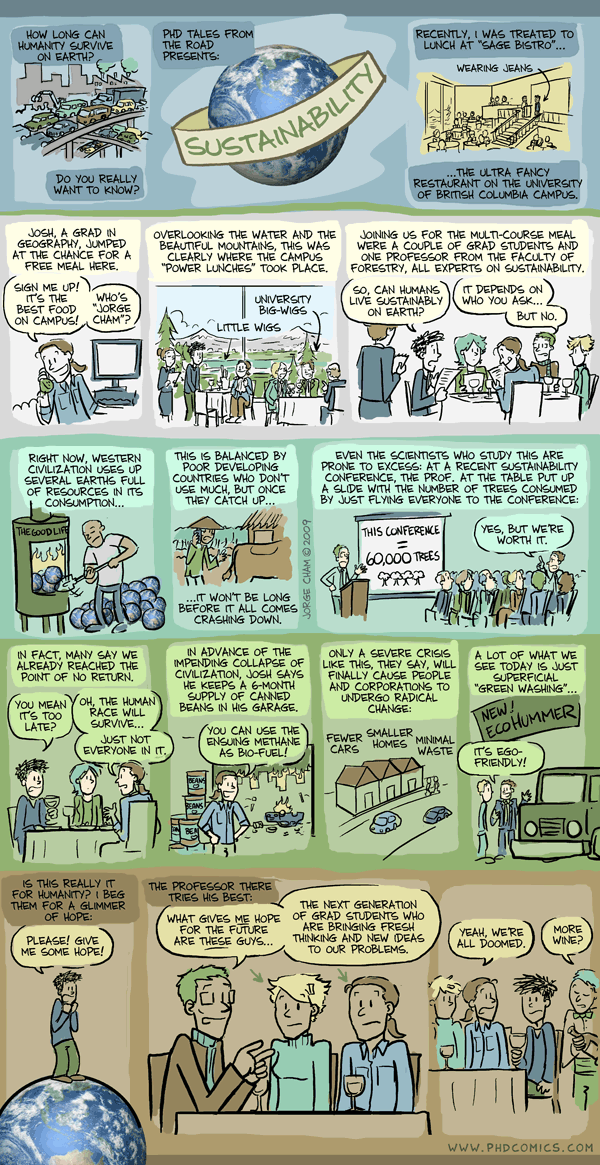
The author, notably, did not consult an economist on the issue of sustainability, just foresters. And in doing so, we miss half of the evidence of what's going on when it comes to long term economic development. We are told people are just mouths and stomachs: they just consume and more people or development means more consumption. End of story. But people are also hands and heads: we produce and (most critically) we invent.
Which is the bigger factor? The evidence suggests that, certainly, in the short run consumption matters more. More consumption raises the price of goods (meaning they are more scarce). But the long run results (the sustainability concern) favors production. Goods (adjusted for inflation) keep getting cheaper. That short run boast in prices generates the incentive to ration, find substitutes, and ultimately develop new technology. People say it's different now, especially with energy (one of our most fundamental inputs). We've reached some peak that we can never return from. Armageddon is always just around the corner.
Humanity faced an energy shortage since our conception as a species. We sought it in plants, rivers, wind, fire, and a menagerie of animals. We built waterwheels, windmills, stoves, ships, sails, yokes, collars, carts, and harnesses in pursuit of of more efficient sources of energy. We dug mines all over the planet. Wood begot peat begot coal begot oil begot gas begot uranium. Now we seek it from the inner depths of out planet (geothermal) to the distant reaches of space (solar) and one theme permeates this unending quest of one of our most precious of resources: energy is cheaper. What new trend could have possibly emerged that makes them think it's suddenly different now?
Next time, Mr. Cham, I suggest you ask someone versed in both consumption and production. Next time, ask an economist.
The author, notably, did not consult an economist on the issue of sustainability, just foresters. And in doing so, we miss half of the evidence of what's going on when it comes to long term economic development. We are told people are just mouths and stomachs: they just consume and more people or development means more consumption. End of story. But people are also hands and heads: we produce and (most critically) we invent.
Which is the bigger factor? The evidence suggests that, certainly, in the short run consumption matters more. More consumption raises the price of goods (meaning they are more scarce). But the long run results (the sustainability concern) favors production. Goods (adjusted for inflation) keep getting cheaper. That short run boast in prices generates the incentive to ration, find substitutes, and ultimately develop new technology. People say it's different now, especially with energy (one of our most fundamental inputs). We've reached some peak that we can never return from. Armageddon is always just around the corner.
Humanity faced an energy shortage since our conception as a species. We sought it in plants, rivers, wind, fire, and a menagerie of animals. We built waterwheels, windmills, stoves, ships, sails, yokes, collars, carts, and harnesses in pursuit of of more efficient sources of energy. We dug mines all over the planet. Wood begot peat begot coal begot oil begot gas begot uranium. Now we seek it from the inner depths of out planet (geothermal) to the distant reaches of space (solar) and one theme permeates this unending quest of one of our most precious of resources: energy is cheaper. What new trend could have possibly emerged that makes them think it's suddenly different now?
Next time, Mr. Cham, I suggest you ask someone versed in both consumption and production. Next time, ask an economist.
Thursday, March 05, 2009
Corn Laws and the Ironies of History
In the 1840s, England's Corn Laws (corn being a generic term for wheat, barely, and rye) were under a hot debate. The Laws issued a series of tariffs ensuring bread prices stay two to three times higher than they were 100 years ago. But as the Industrial Revolution pushed forward, mill owners knew cheaper food was crucial to feed their employees. There thus arose a battle between the landed aristocracy, arguing mercantilism and questioning this "new" economy, and manufacturers, citing Adam Smith and the logic of free trade. Thankfully the latter, led by Richard Cobden, won the day.
Manufacturing, once a great advocate of free trade, now in the West is its enemy. And if Lou Dobbs, a vocal opponent of free trade on the grounds that it hurts factories, lived a century and a half ago, he would be raging against the very sector he so persistently defends today.
Manufacturing, once a great advocate of free trade, now in the West is its enemy. And if Lou Dobbs, a vocal opponent of free trade on the grounds that it hurts factories, lived a century and a half ago, he would be raging against the very sector he so persistently defends today.
Sunday, March 01, 2009
Fixed Exchange Rates
I hope my 385 students can answer the following:
True or False:
If a currency with a fixed exchange rate is undervalued, its central bank will have to buy the domestic currency to maintain the fixed rate.
What Vegas Can Teach You About the Recession
In last week's EconTalk, economist Allan Meltzer argued one of the main reason for our current financial mess is the Fed's policy of too big to fail. If a large financial institution collapses, it will harm countless other institutions and hamstring the the market as a whole. By preventing disaster and saving these companies, the Fed saves the economy. Knowing that in the worse case scenario someone will help you out, these banks then took riskier chances than they otherwise would. Thus the mess we're in now. In a world of superheroes, there are more extreme athletes.
Some are skeptical of this relationship, made evident by the fact that this is not at the forefront of the popular debate (the much more vague and non-scientific "animal spirits" is). But suppose you went to a conference in Las Vegas and your company agreed to reimburse you for any gambling losses you suffered during the trip. It's obvious that you would gamble more. And you would take bigger risks. Why wouldn't you?
You could point out that the companies are worse off than those that didn't take the housing gamble (such as JP Morgan Chase, Pittsburgh National, Wells Fargo). But they are better off than if the Fed hadn't intervened at all. If the company compensates you only half or a third of what you lost from gambling, you would still gamble more but not as much as full compensation. Regardless, this policy would immediately prove to be a terrible idea. But that's the rule in place at the Fed now.
Some are skeptical of this relationship, made evident by the fact that this is not at the forefront of the popular debate (the much more vague and non-scientific "animal spirits" is). But suppose you went to a conference in Las Vegas and your company agreed to reimburse you for any gambling losses you suffered during the trip. It's obvious that you would gamble more. And you would take bigger risks. Why wouldn't you?
You could point out that the companies are worse off than those that didn't take the housing gamble (such as JP Morgan Chase, Pittsburgh National, Wells Fargo). But they are better off than if the Fed hadn't intervened at all. If the company compensates you only half or a third of what you lost from gambling, you would still gamble more but not as much as full compensation. Regardless, this policy would immediately prove to be a terrible idea. But that's the rule in place at the Fed now.
Subscribe to:
Posts (Atom)
