According to a study, New York City's new laws requiring calorie counts on fast food restaurants doesn't appearing to be having any net effect on food purchases. One would think this law would get people to steer clear of fast food, but it's easy to see why, in practice, this doesn't make any bit of difference.
Like smoking, the unhealthiness of fast food is common knowledge. Telling them exactly how many calories are in X, Y, and Z change anything because they're not seen as relevant (ignoring that a high calorie count isn't the same thing as being unhealthy). If you already know a Big Mac is bad for you, knowing it has 576, not 500, calories isn't going to change your decision.
It's too costly to calculate everything down to such fine nuance. Instead, people think in broad categories. Now, if estimated calorie count was off by a factor of 2 or 10, we'd see some real movement. But, on the margin, this information adds virtually nothing. People are good at estimating calories by themselves.
Wednesday, October 07, 2009
Saturday, September 26, 2009
Not All Yale Students Are Hippies


Tanya and I are at some coffee shop in New Haven and I noticed on patron has a quote attributed to John Maynard Keynes on her laptop:
Capitalism is the extraordinary belief that the nastiest of men, for the nastiest of reasons, will somehow work for the benefit of all.Apparently, this quote isn't from Keynes, but it's a good sentence nonetheless and reminds me of this quote from F.A. Hayek's The Fatal Conceit:
The curious task of economics is to demonstrate to men how little they really know about what they imagine they can design.(It occurs to me this person might think the quote is sarcastic but I hope not. That would ruin my title.)
Friday, September 18, 2009
Incentives to Inquire
Students don't like asking questions. For a while, I thought it was simply because they are shy and need to be enticed out of their shell (I still believe this, but less so now) so I require participation for the grade. An undergraduate friend of mine told me of another reason:
It's tempting to solve this issue by just over-booking each lecture, but it makes you look disorganized. It also creates the risk of having material constantly spilling over to the next lecture until you get backed up at the end of the semester and your homework and exam assignments get out of whack.
So my solution I will be trying out in the future is to create one or two five-minute "widgets" at the end of each lecture. Short extensions on the topic we covered, but small enough that if we don't cover them I don't feel a big loss. When the semester begins, I let them know the rules: if we finish before we get the widgets, then I assume they have mastered the nuances of this lecture and we can further their understanding with applications (which will be now be on the exam). If we don't get to them, they won't be tested over them. Therefore, students are incentivized to ask questions, filling in the time by furthering their understanding of the material in order to avoid a larger exam. Since I have the power to veto questions, I can't imagine I'll be bogged down with filler inquiries in an attempt to game the system. I hope there aren't any unintended consequences I haven't thought of.
We know the professor only has so much material planned for a lecture. If we get it all done before time is up, they have to let us out early. But whenever anyone asks a question or asks to elaborate, that pushes the time we get to leave, back.This is a problem. Most students don't understand the first time around or will forget if they don't talk about the subject matter. And there's a lost life lesson in the importance of speaking up. The reality is doubly a problem for my style since I make the lecture notes available online before each class.
It's tempting to solve this issue by just over-booking each lecture, but it makes you look disorganized. It also creates the risk of having material constantly spilling over to the next lecture until you get backed up at the end of the semester and your homework and exam assignments get out of whack.
So my solution I will be trying out in the future is to create one or two five-minute "widgets" at the end of each lecture. Short extensions on the topic we covered, but small enough that if we don't cover them I don't feel a big loss. When the semester begins, I let them know the rules: if we finish before we get the widgets, then I assume they have mastered the nuances of this lecture and we can further their understanding with applications (which will be now be on the exam). If we don't get to them, they won't be tested over them. Therefore, students are incentivized to ask questions, filling in the time by furthering their understanding of the material in order to avoid a larger exam. Since I have the power to veto questions, I can't imagine I'll be bogged down with filler inquiries in an attempt to game the system. I hope there aren't any unintended consequences I haven't thought of.
Tuesday, September 08, 2009
On Racism and Income In America
During a heated discussion with my girlfriend the other day, I brought up the graph below from a post I saw on Marginal Revolution. It's summary data from an adoption study when primarily Korean children were adopted by American families of various incomes between 1970 and 1980. Now in their 20s and 30s, the graph summarizes their parents income (presumably at the time of adoption, hopefully adjusted for inflation) along the x-axis and the child's average income along the y-axis.
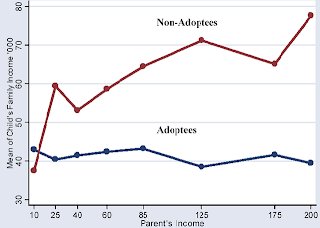
This, I said, is a very interesting study: adopted kids did about the same (on average) regardless of who brought them up. But when they are the natural kids of the parents, they do better on average. Since it's reasonable to say other effects are constant across incomes (such as how parents treat an adopted child), the data suggests that genetics play a critical role in determining income and that the wealthy are not wealthy simply because their parents were. (Note there is still a high level of income mobility in the data: 10K a year parents averaged almost 40K a year kids; 200K a year parents averaged only about 78K a year kids...though the latter point could be argued by wealthier kids opting for jobs with fewer financial awards and more non-pecuniary benefits.)
Tanya didn't agree on a few levels, for one arguing that it suggests low black incomes are low because blacks are stupid. But the study doesn't say that environmental factors don't influence future prospects (though I am admittedly surprised to see how uncorrelated adopted incomes were with their parents) nor was it a perfect study. Since adoption agencies are ethically bound to make sure the couple could provide for the child before adoption, the selection bias would overestimate the success at the lower levels of income.
Tanya was also concerned about effects embedded in the adoption. Since the kids were Korean, they were clearly adopted. Thus, she argues, issues of racism and the stigma of being adopted washed out and overshadowed any advantage wealthier kids had. Sure, this exists, but I'm not convinced these factors are so strong it would wash away all environmental advantages. Yes, the children grew up in the 70s and 80s, where racial tension was likely stronger compared to now, but such tension tends to lean toward the Afro-American and (to a lesser degree) Hispanic populations, not Southeast Asians.
Really, I have don't know how much racism is in America. Most people don't know. Of course, it still exists and minorities will have first hand experience with it. But that doesn't mean it's common. Similarly, most white people I know (myself included), are good people and most scared of a misunderstanding being mistaken for racism. That does not mean most white are not racists. And surveys done on the issue are going to have major credibility issues about the honesty of people's responses. I can say with confidence that black incomes are rising, interracial couples are more common, and companies are very concerned with being thought of as inclusive; at least things seem to be getting better.

This, I said, is a very interesting study: adopted kids did about the same (on average) regardless of who brought them up. But when they are the natural kids of the parents, they do better on average. Since it's reasonable to say other effects are constant across incomes (such as how parents treat an adopted child), the data suggests that genetics play a critical role in determining income and that the wealthy are not wealthy simply because their parents were. (Note there is still a high level of income mobility in the data: 10K a year parents averaged almost 40K a year kids; 200K a year parents averaged only about 78K a year kids...though the latter point could be argued by wealthier kids opting for jobs with fewer financial awards and more non-pecuniary benefits.)
Tanya didn't agree on a few levels, for one arguing that it suggests low black incomes are low because blacks are stupid. But the study doesn't say that environmental factors don't influence future prospects (though I am admittedly surprised to see how uncorrelated adopted incomes were with their parents) nor was it a perfect study. Since adoption agencies are ethically bound to make sure the couple could provide for the child before adoption, the selection bias would overestimate the success at the lower levels of income.
Tanya was also concerned about effects embedded in the adoption. Since the kids were Korean, they were clearly adopted. Thus, she argues, issues of racism and the stigma of being adopted washed out and overshadowed any advantage wealthier kids had. Sure, this exists, but I'm not convinced these factors are so strong it would wash away all environmental advantages. Yes, the children grew up in the 70s and 80s, where racial tension was likely stronger compared to now, but such tension tends to lean toward the Afro-American and (to a lesser degree) Hispanic populations, not Southeast Asians.
Really, I have don't know how much racism is in America. Most people don't know. Of course, it still exists and minorities will have first hand experience with it. But that doesn't mean it's common. Similarly, most white people I know (myself included), are good people and most scared of a misunderstanding being mistaken for racism. That does not mean most white are not racists. And surveys done on the issue are going to have major credibility issues about the honesty of people's responses. I can say with confidence that black incomes are rising, interracial couples are more common, and companies are very concerned with being thought of as inclusive; at least things seem to be getting better.
Wednesday, September 02, 2009
The Burden of the Pre-existing Condition
If you were born with Asperger syndrome, should people be forced to date you? Most of you would probably say "no." It's a good answer: why should people be punished for something that isn't their fault? So why do so many believe health insurance companies should be required to accept applicants with pre-existing conditions? (Before you respond with "I don't want to date someone who doesn't want to date me," remember Asperger syndrome severely limits your ability to read social cues; you won't be able to tell they are with you only by force.)
It's not even that insurance companies won't cover pre-existing conditions. It's that they won't cover them at a particular price: a low price. In the end there are those randomly burdened with a condition that's expensive to care for and they don't want to pay for it (at least all of it). But that does not translate into forcing someone else to cover the costs.
And no, insurance companies are not sitting on lots of excess cash. Record profits are not the same thing as high profits (and even if they were, proposing a permanent change based on temporary conditions is very reckless way to make policy). Because they are barely profitable, forcing their costs up with such reforms will force prices up and making it too expensive for someone who could otherwise get it. Now we are forcing our neighbor to carry the burden of our condition. Where's the justice in that?
It's not even that insurance companies won't cover pre-existing conditions. It's that they won't cover them at a particular price: a low price. In the end there are those randomly burdened with a condition that's expensive to care for and they don't want to pay for it (at least all of it). But that does not translate into forcing someone else to cover the costs.
And no, insurance companies are not sitting on lots of excess cash. Record profits are not the same thing as high profits (and even if they were, proposing a permanent change based on temporary conditions is very reckless way to make policy). Because they are barely profitable, forcing their costs up with such reforms will force prices up and making it too expensive for someone who could otherwise get it. Now we are forcing our neighbor to carry the burden of our condition. Where's the justice in that?
Tuesday, August 18, 2009
The Value of Life
Ask most people how much they value their life and they will inevitably say "an infinite amount." That's what my girlfriend told me the other day (generated from a conversation I've forgotten the origins of). "This cannot possibly be true," I said. "You take risks."
Mathematically, here's how it works. The expected cost of any activity under uncertainty is the likelihood of the event times the cost if the event occurred. A fifty percent chance of losing $200 means that the expected cost is $100. For any activity there is a probability you will die, or lose that life you value at an infinite amount. Thus, it's an infinite cost no matter what you multiply it by, no matter how risky the activity is. Since you have to do something to stay alive, you should always choose the least risky activity, no matter how much you might value the alternative because of the costs of that activity are infinite.
That people value their life only because they value what they can do with it doesn't change the math. In life, there are always options. You can watch TV or skydive: both are valuable to you and while the former might be more fun after 8 hours of TV a day, it is still too costly. But people still skydive.
They also show their finite value of their own life in other ways. People speed, jaywalk, ignore check engine lights, confront rude people (who might kill them out of anger), forget to check smoke detectors, travel to foreign countries, and eat unhealthy food. When we change our estimations of how dangerous (or safe) an activity is, we change our behavior. But if we valued our life infinitely, that shouldn't change anything (as the costs would come out the same regardless of the probability of death). Clearly, the costs to risking your life are lower than you might think.
Mathematically, here's how it works. The expected cost of any activity under uncertainty is the likelihood of the event times the cost if the event occurred. A fifty percent chance of losing $200 means that the expected cost is $100. For any activity there is a probability you will die, or lose that life you value at an infinite amount. Thus, it's an infinite cost no matter what you multiply it by, no matter how risky the activity is. Since you have to do something to stay alive, you should always choose the least risky activity, no matter how much you might value the alternative because of the costs of that activity are infinite.
That people value their life only because they value what they can do with it doesn't change the math. In life, there are always options. You can watch TV or skydive: both are valuable to you and while the former might be more fun after 8 hours of TV a day, it is still too costly. But people still skydive.
They also show their finite value of their own life in other ways. People speed, jaywalk, ignore check engine lights, confront rude people (who might kill them out of anger), forget to check smoke detectors, travel to foreign countries, and eat unhealthy food. When we change our estimations of how dangerous (or safe) an activity is, we change our behavior. But if we valued our life infinitely, that shouldn't change anything (as the costs would come out the same regardless of the probability of death). Clearly, the costs to risking your life are lower than you might think.
Wednesday, August 12, 2009
Milk, Cheese, and the Myth of Retail Collusion
This week's Economist told the story of falling wholesale milk prices which are bringing EU farmers to call for lower milk production quotas. Some farmers blame supermarkets for the lower prices, noting that they sell milk at about the same price but buy it from farmers at a significantly reduced price.
Falling consumer demand (especially given the recession) isn't the explanation EU farmers give, and it certainly doesn't seem to explain the inconsistency at the supermarket. But the Economist linked them, though they didn't say how. The short version is: it's all about the cheese.
Cheese demand has fallen a lot, especially within the EU. Unlike milk, people buy a lot less cheese when their incomes fall. But cheese is made from milk and in the wholesale market, all cheese is milk (since cheese-makers are buying it to turn into cheese). In other words, grocers who want milk for milk compete with cheese-makers who want milk for cheese. But people want less cheese so there's less demand for wholesale milk.
Just as more cheese-makers bid up the price of milk (and a growing China bids up the price for gas down the street), fewer cheese-makers means there's downward pressure on prices. Grocers, then, are getting their milk on the cheap. But the market for milk-at-the-store changed very little. So we see grocers getting cheap milk, selling it at about the same price, and it's all thanks to consumer demand, not colluding grocers.
Falling consumer demand (especially given the recession) isn't the explanation EU farmers give, and it certainly doesn't seem to explain the inconsistency at the supermarket. But the Economist linked them, though they didn't say how. The short version is: it's all about the cheese.
Cheese demand has fallen a lot, especially within the EU. Unlike milk, people buy a lot less cheese when their incomes fall. But cheese is made from milk and in the wholesale market, all cheese is milk (since cheese-makers are buying it to turn into cheese). In other words, grocers who want milk for milk compete with cheese-makers who want milk for cheese. But people want less cheese so there's less demand for wholesale milk.
Just as more cheese-makers bid up the price of milk (and a growing China bids up the price for gas down the street), fewer cheese-makers means there's downward pressure on prices. Grocers, then, are getting their milk on the cheap. But the market for milk-at-the-store changed very little. So we see grocers getting cheap milk, selling it at about the same price, and it's all thanks to consumer demand, not colluding grocers.
Sunday, August 02, 2009
Collusion and Commons
I hope my micro students can answer the following:
How is collusion between firms like a tragedy of the commons? In answering this question, make sure to define tragedy of the commons, reference positive and negative externalities, and summarize the incentives of individual firms.
Thursday, July 30, 2009
On the Economics of Sidewalks
Today on the Kojo Nnamdi Show, DC residents debated the pros and cons of adding sidewalks to northwest neighborhoods that still lack them. Well, it was mostly pros, from making walking easier to complying with Americans With Disabilities act. The cons were concerned with losing what country-feel they had in the metro area and that few people actually use sidewalks that are installed.
But no one mentioned another problem with adding sidewalks, not surprising because the pros are unlikely aware of it and the cons wouldn't want to admit it: adding sidewalks increase foot traffic and make life harder on those that live there. In economic jargon, sidewalk traffic externalizes costs on surrounding residents.
Sidewalks make walking cheaper and so, no doubt, you'll get more foot traffic. That means more dog walkers, and the increased risk of the dog walker not cleaning up after her animal when he does his business. That means more children running around, and the higher likelihood of noise and damage from particularly active kids. It means more people lingering in a driveway, trampling lawns or flowers, and risk seeing you while being intimate with loved ones (sometimes you forget to close the drapes).
It sounds so selfish, but why should local residents bear the cost of other's enjoyment? The common theme when people called in is that they moved to those areas because the lack of sidewalks made it feel more rural. They were looking for one thing: isolation.
Note: For the record, I'm in favor of the sidewalks only because, in my estimation, the costs externalized onto residents with the sidewalks are likely lower than the costs which must be suffered by people because there are no sidewalks to use.
But no one mentioned another problem with adding sidewalks, not surprising because the pros are unlikely aware of it and the cons wouldn't want to admit it: adding sidewalks increase foot traffic and make life harder on those that live there. In economic jargon, sidewalk traffic externalizes costs on surrounding residents.
Sidewalks make walking cheaper and so, no doubt, you'll get more foot traffic. That means more dog walkers, and the increased risk of the dog walker not cleaning up after her animal when he does his business. That means more children running around, and the higher likelihood of noise and damage from particularly active kids. It means more people lingering in a driveway, trampling lawns or flowers, and risk seeing you while being intimate with loved ones (sometimes you forget to close the drapes).
It sounds so selfish, but why should local residents bear the cost of other's enjoyment? The common theme when people called in is that they moved to those areas because the lack of sidewalks made it feel more rural. They were looking for one thing: isolation.
Note: For the record, I'm in favor of the sidewalks only because, in my estimation, the costs externalized onto residents with the sidewalks are likely lower than the costs which must be suffered by people because there are no sidewalks to use.
Saturday, July 25, 2009
The Good, the Bad, and Healthcare
Critics of government backed health care seem schizophrenic: on one hand, they argue government run health care will be really awful. On the other hand, they argue it will crowd out private health care if the two compete. How can it be so bad no one will want it but so good everyone will abandon all other options?
The two seem to be mutually exclusive and on some level they are. For example, the post office competes with FedEx all the time for package delivers. Sometimes people use one, sometimes the other. No doubt that the existence of competition improved the government system, though how much better is not obvious.
There is an area, though, where the government system is quite low quality but people still attend it: public schools. Ignore your personal experiences for the moment. People complain a lot more about public schools than they do about private ones. And while I seem to remember some data that, like FedEx, private schools improve their government counterpart, again the degree is difficult to pin down.
How is this possible? How are public schools so popular but so bad? There's lots of possible reasons but one reason sticks out: it's really cheap. In fact, baring fees and supplies, it's free. Those costs are then burdened onto everyone else and the public subsidizes a low quality service. There is some value to public schools, of course, which is why people still send their kids there. Everyone else, including private schools, indirectly pays for a product they either don't value that much or compete with. So is the nature of taxes.
Health care risks walking down the same path. In fact, it already has. Medicare and Medicaid, by law, buy hospital services at about 20% less than the cost to the hospital. It is one of the reasons why everyday objects, like Tylenol, run several dollars a pill. Hospitals have to make up the difference somewhere. Adopting this policy for everyone follows depressingly close to Bastiat's take on government: "Government is the great fiction through which everybody endeavors to live at the expense of everybody else." A great fiction indeed.
The two seem to be mutually exclusive and on some level they are. For example, the post office competes with FedEx all the time for package delivers. Sometimes people use one, sometimes the other. No doubt that the existence of competition improved the government system, though how much better is not obvious.
There is an area, though, where the government system is quite low quality but people still attend it: public schools. Ignore your personal experiences for the moment. People complain a lot more about public schools than they do about private ones. And while I seem to remember some data that, like FedEx, private schools improve their government counterpart, again the degree is difficult to pin down.
How is this possible? How are public schools so popular but so bad? There's lots of possible reasons but one reason sticks out: it's really cheap. In fact, baring fees and supplies, it's free. Those costs are then burdened onto everyone else and the public subsidizes a low quality service. There is some value to public schools, of course, which is why people still send their kids there. Everyone else, including private schools, indirectly pays for a product they either don't value that much or compete with. So is the nature of taxes.
Health care risks walking down the same path. In fact, it already has. Medicare and Medicaid, by law, buy hospital services at about 20% less than the cost to the hospital. It is one of the reasons why everyday objects, like Tylenol, run several dollars a pill. Hospitals have to make up the difference somewhere. Adopting this policy for everyone follows depressingly close to Bastiat's take on government: "Government is the great fiction through which everybody endeavors to live at the expense of everybody else." A great fiction indeed.
Thursday, July 16, 2009
Fundamental Mistakes
Never before have I seen so many basic errors in such a short amount of time when Douglas Rushkoff went on the Colbert Report to promote his book, Life, Inc. The errors are too numerous to address each one, but two stand out as particularly sloppy.
First he claims that pursuing supposedly noneconomic avenues, such as having friends or taking walks, are drains on the GNP. "[Corporations] crowd out every kind of activity." Instead, people are forced to "support the economy with consumption we don't want or need." Most firm would love it if that were true. If they could control people's lives, they wouldn't have to work so hard to stay competitive. But trade, as my students recently learned, is mutually beneficial. What world does Rushkoff live in where people are forced to buy things they don't want?
In an attempt to criticize measuring wealth through spending, he argued that "if everyone got cancer tonight, that's good for the economy" because people would spend more money. But no one actually familiar with how economists measure wealth would make such a juvenile confusion. GDP and GNP are proxies, convenient estimations because capturing everything is impractical or impossible. We are fully aware that there is more to wealth than what we can count and changes like the one Rushkoff sarcastically propose are nothing more than playing voodoo with the numbers.
First he claims that pursuing supposedly noneconomic avenues, such as having friends or taking walks, are drains on the GNP. "[Corporations] crowd out every kind of activity." Instead, people are forced to "support the economy with consumption we don't want or need." Most firm would love it if that were true. If they could control people's lives, they wouldn't have to work so hard to stay competitive. But trade, as my students recently learned, is mutually beneficial. What world does Rushkoff live in where people are forced to buy things they don't want?
In an attempt to criticize measuring wealth through spending, he argued that "if everyone got cancer tonight, that's good for the economy" because people would spend more money. But no one actually familiar with how economists measure wealth would make such a juvenile confusion. GDP and GNP are proxies, convenient estimations because capturing everything is impractical or impossible. We are fully aware that there is more to wealth than what we can count and changes like the one Rushkoff sarcastically propose are nothing more than playing voodoo with the numbers.
Thursday, July 09, 2009
In Praise of Passive Investment
As regulators ponder making it harder for speculators to invest in oil, University of Maryland law professor Michael Greenberg backed such acts against "passive" investing on WTOP radio yesterday. He correctly identifies them as having "no interest in actively controlling these assets, just hoping to make a buck when their prices rise."
I wonder when Greenberg will take arms against other forms of passive investing:
-The university which offers financial aid to smarter or more driven students, betting that their attendance will yield more donations long after they graduate.
-The company which helps pay for its employee's education, hoping the employee will remain with the company even after a minimum staying period.
-The firm which gives its employees on-the-job-training, familiarizing them with a system they could apple elsewhere.
-The patron of the arts who supports a starving artist in the hopes they will be a success later.
In each case, the person hasn't actually become valuable yet, just like the oil that investors jump on (or off of). Speculators (who bet the price will rise) will buy oil now and cash out when it's more valuable. Passive investors in human capital do the same thing.
I wonder when Greenberg will take arms against other forms of passive investing:
-The university which offers financial aid to smarter or more driven students, betting that their attendance will yield more donations long after they graduate.
-The company which helps pay for its employee's education, hoping the employee will remain with the company even after a minimum staying period.
-The firm which gives its employees on-the-job-training, familiarizing them with a system they could apple elsewhere.
-The patron of the arts who supports a starving artist in the hopes they will be a success later.
In each case, the person hasn't actually become valuable yet, just like the oil that investors jump on (or off of). Speculators (who bet the price will rise) will buy oil now and cash out when it's more valuable. Passive investors in human capital do the same thing.
Wednesday, July 08, 2009
Voting Three Times A Day
Robert Kenner's new movie, Food, Inc., argues that food is too cheap and, thanks to health-related issues from diabetes, will end up being more expensive in the long run. While Kenner is lacking in his rationality (it's hard to make the argument that it's bad to give people more options in the form of cheaper food) he recognizes that consumers are the key to the problem. When he appeared on The Daily Show last week, he reminded Jon Stewart that the consumer "votes three times a day." If consumers want healthier food, they will demand it and producers will provide. They will have to if they want to stay in business. But most Americans aren't demanding these things, even those who know all the messy origins. At the end of the day, people vote for fat and that's their choice.
Monday, June 29, 2009
iPods Are Not Cylons
While cleverly defending copyright law, identifying those against it as having a "bias to the collective," Mark Helprin on this week's EconTalk falls victim to his own collectivist leanings. He argues that many people succumb to "perverse adaptation." People adapt to technology instead of technology adapting to them. Helprin invokes images of commuters staring at their blackberries and consumers demanding things faster and faster as examples.
Human beings require time for reflection...We require stillness and the ability to absorb things rather than just being hooked up to a machine and made into bundles of tropisms. [Emphasis added]But those who don't are not dead. We do not require these things. We may require them to accomplish certain goals, goals Helprin places high value on, but we do not require them in the absolute sense. We choose to not do them. Technology does not leap in our lap and hook into us like a drone from the Matrix. Those people who Helprin paints as so grey are people who always wanted to move faster; technology simply allows them to do it. It's not that technology has enslaved us. Helprin simply believes that if people don't like the same things he does, there's something wrong with them. Such an attitude is the hallmark of the collective mindset.
Pay Grades in the Extralegal Sector
In Peter Leeson's new book, The Invisible Hook, Leeson notes the pay grade was quite flat (pirate captains were paid twice as much as the lowest member of the crew, compared to merchant captains of that same era which were paid five or six times as much). He argues it's to encourage solidarity, discouraging envy and encouraging unanimous approval to continue on their plundering ways (a skewed system would encourage those at the top to stop and those at the bottom to keep going, thus creating tension).
But the same could be said of drug dealers, who have a very skewed pay scale. As Steven Levitt and Stephen Dubner note, the top drug dealers earns about 100 times that of the lowest earner. But gangs of this sort don't show the lack of harmony or disloyalty that should be plagued by Leeson's explanation. So how do we reconcile these two different worlds?
The key difference between a pirate ship and a drug-dealing gang is the level of entanglement with their surroundings. A pirate ship is basically a floating island and because it's so isolated, it's relatively easy for anyone to see how the game is played. A gang, on the other hand, is entangled with the larger surroundings. There's a lot of activity members don't see and many critical relations with those outside the gang that most don't have. In other words, the lowly sailor is a closer substitute to his captain than a lowly drug dealer is to his top boss. While a rebellious sailor might be able to handle captaining competently, a rebellious drug dealer would likely not have the same level of success. This also explains why pirates elected their captain while dealers autocratically promote from below (thus why the higher ups are paid so much: to encourage lower ranks to work harder on the chance they can be promoted).
But the same could be said of drug dealers, who have a very skewed pay scale. As Steven Levitt and Stephen Dubner note, the top drug dealers earns about 100 times that of the lowest earner. But gangs of this sort don't show the lack of harmony or disloyalty that should be plagued by Leeson's explanation. So how do we reconcile these two different worlds?
The key difference between a pirate ship and a drug-dealing gang is the level of entanglement with their surroundings. A pirate ship is basically a floating island and because it's so isolated, it's relatively easy for anyone to see how the game is played. A gang, on the other hand, is entangled with the larger surroundings. There's a lot of activity members don't see and many critical relations with those outside the gang that most don't have. In other words, the lowly sailor is a closer substitute to his captain than a lowly drug dealer is to his top boss. While a rebellious sailor might be able to handle captaining competently, a rebellious drug dealer would likely not have the same level of success. This also explains why pirates elected their captain while dealers autocratically promote from below (thus why the higher ups are paid so much: to encourage lower ranks to work harder on the chance they can be promoted).
Tuesday, June 23, 2009
Franchise Laws of the Automaker Apocalypse
Imagine for a moment that television studios by law had to continue making shows they would normally cancel. Or fast food chains had to make menu items that few people buy. Imagine we still lived in a world of New Coke, Arch Deluxe, and Cavemen. Well wake up because when it comes to cars, that's the world we live in.
As Mike Munger and Russ Roberts discuss in the latest EconTalk, car franchises long ago lobbied local governments to pass laws handing dealers a string of advantages over the corporate office. In the vast majority of states, two dealers can't sell the same model within fifty miles of each other (stories that the franchises are too densely packed aren't true), corporate must make a strong effort to advertise each brand, only dealers can unilaterally terminate the dealership agreement (unless the dealer does a very poor job selling), and corporate must keep supplying the dealership with a minimum number of cars. Dealerships did this because each franchise is based around one model of car. But it also means that any model GM, Chrysler, or Ford make is a model they can never get rid of (though they can re-imagine it).
There's lots of problems the American automobile industry has (and the podcast goes into more detail) but I found these laws most shocking. They also explain a lot (such as why foreign makers focus on a few good brands). Paradoxically, it was the domestic dealers that brought down the Big Three; the only way out of these dead-end dealerships is bankruptcy.
As Mike Munger and Russ Roberts discuss in the latest EconTalk, car franchises long ago lobbied local governments to pass laws handing dealers a string of advantages over the corporate office. In the vast majority of states, two dealers can't sell the same model within fifty miles of each other (stories that the franchises are too densely packed aren't true), corporate must make a strong effort to advertise each brand, only dealers can unilaterally terminate the dealership agreement (unless the dealer does a very poor job selling), and corporate must keep supplying the dealership with a minimum number of cars. Dealerships did this because each franchise is based around one model of car. But it also means that any model GM, Chrysler, or Ford make is a model they can never get rid of (though they can re-imagine it).
There's lots of problems the American automobile industry has (and the podcast goes into more detail) but I found these laws most shocking. They also explain a lot (such as why foreign makers focus on a few good brands). Paradoxically, it was the domestic dealers that brought down the Big Three; the only way out of these dead-end dealerships is bankruptcy.
Saturday, June 20, 2009
How Obama Got People to Be Less Afraid of Being Republican
Robin Hanson proposes that Obama's election makes the public more conservative. No, the story isn't that Americans are secretly racist and have suddenly come to terms with their racism. Quote psychology experiments,
People care what others think of them, even if those others are strangers. We care about it so much, we say we believe things we don't believe. If we value the truth on an issue low enough, ewe even fool ourselves into believing things we'd normally conclude are false. (Bryan Caplan calls this rationally irrationality.) In essence, we are paid (in the form of social capital) to conform.
The reason why we care so much about we others think of us is that we care what others think. We like to associate with people who are like us, a trend easily seen in grade school, high school, college, and beyond. This isn't merely shared interest but political opinion and values; constantly arguing with someone about politics gets exhausting for most people. It also makes it easier to talk to people since there's more common ground and you don't have to police your offhand comments or jokes.
There are lots of issues, though, and it's inefficient to list off your opinion on all of them. This is why we use labels (to the annoyance of some), such as Democratic, Republican, Libertarian, Populist, Christian, Muslim, Atheist, Jew, Protectionist, Free-trader, etc. In a single word, we convey a body of opinions to potential friends or mates. This is why it is normal for dating sites to post a person's political affiliation: it's a cheap way to convey important information.
But it's not perfect. Some issues are more important to some people than others and individuals are more diverse than the label's official or perceived hierarchy of priorities. We want to connect with people that share what we care about, starting with top priorities. People will then adopt most of the views of one group, including views they don't believe, to signal that they believe things that they find very important and distinguish themselves from the group that seems (rightly or wrongly) to disagree with them, even if they secretly agree with that group on less important issues. When an event convinces people that most agree with what you find to be really important, you will more accurately express your view of the less important things since you are less afraid of being mistaken for some other group.
To illustrate, consider two parties: D (Democratic) and R (Republican). Also consider two issues: A (being for racial equality) and B (being for less gun control). ~A means, then, that a group is perceived as being against racial equality and ~B means that a group is perceived as being against less gun control (or in favor for more gun control). Before Obama, one could argue that the public views the parties as so:
D (A, ~B)
R (~A, B)
Consider a person who has the preference of (A, B), but cares much more about A than B. In other words, he'd rather spend time with a person who's restricting gun ownership and is racially tolerate than a racist gun nut. U(A, ~B) > U(~A, B) (U stands for utility, economic lingo for satisfaction.) Thus, he will adopt policies of both racial tolerance and gun control to better signal that he's a Democrat, making it more likely he'll spend time with his preferred type of person. He might even start believing B, since he'll have to argue the point at parties and it's easier to argue something if you fool yourself into believing it's true. (This is where the rational irrationality comes in.)
But suddenly, Obama is elected president and it starts to look less like ~B is a staple of group R. If so many Americans were racist, it's hard to believe a black man could win (especially since he got 52.9%). Thus, the public perceives racism as being uncommon enough that it isn't a defining attribute of a major political party. At worst, the public's opinion on the stance is uncertain and the perception changes to this:
D (A, ~B)
R (?, B)
Now back to our hypothetical (A, B). No longer concerned with openly believing B will attract ~A people, he expresses his B opinion (or overturns his previous ~B opinion). He is no longer afraid of being mistaken for R.
In practice, there are more than two issues and people might still call themselves Democrats out of habit, fear of losing current friends, or because there's still enough about the party they like. But, in time, more will be willing to. In the meantime, expressing the secondary opinion will be more common. So, here's the punchline: Obama's election made Americans, and by extension moderate Republicans, seem less racist. Thus more people are willing to be seem as (or mistaken for) a Republican.
People were more willing to express potentially prejudiced attitudes when their past behavior had given them a bit of credentials as a nonpredjudiced person.Bizarrely, Hanson cites recent polls that Americans are more in favor of gun control, less in favor of legalized abortion, and fewer people believing global warming is the result of human activity as evidence of this theory. What does racial issues such as affirmative action have to do with climatology?
People care what others think of them, even if those others are strangers. We care about it so much, we say we believe things we don't believe. If we value the truth on an issue low enough, ewe even fool ourselves into believing things we'd normally conclude are false. (Bryan Caplan calls this rationally irrationality.) In essence, we are paid (in the form of social capital) to conform.
The reason why we care so much about we others think of us is that we care what others think. We like to associate with people who are like us, a trend easily seen in grade school, high school, college, and beyond. This isn't merely shared interest but political opinion and values; constantly arguing with someone about politics gets exhausting for most people. It also makes it easier to talk to people since there's more common ground and you don't have to police your offhand comments or jokes.
There are lots of issues, though, and it's inefficient to list off your opinion on all of them. This is why we use labels (to the annoyance of some), such as Democratic, Republican, Libertarian, Populist, Christian, Muslim, Atheist, Jew, Protectionist, Free-trader, etc. In a single word, we convey a body of opinions to potential friends or mates. This is why it is normal for dating sites to post a person's political affiliation: it's a cheap way to convey important information.
But it's not perfect. Some issues are more important to some people than others and individuals are more diverse than the label's official or perceived hierarchy of priorities. We want to connect with people that share what we care about, starting with top priorities. People will then adopt most of the views of one group, including views they don't believe, to signal that they believe things that they find very important and distinguish themselves from the group that seems (rightly or wrongly) to disagree with them, even if they secretly agree with that group on less important issues. When an event convinces people that most agree with what you find to be really important, you will more accurately express your view of the less important things since you are less afraid of being mistaken for some other group.
To illustrate, consider two parties: D (Democratic) and R (Republican). Also consider two issues: A (being for racial equality) and B (being for less gun control). ~A means, then, that a group is perceived as being against racial equality and ~B means that a group is perceived as being against less gun control (or in favor for more gun control). Before Obama, one could argue that the public views the parties as so:
D (A, ~B)
R (~A, B)
Consider a person who has the preference of (A, B), but cares much more about A than B. In other words, he'd rather spend time with a person who's restricting gun ownership and is racially tolerate than a racist gun nut. U(A, ~B) > U(~A, B) (U stands for utility, economic lingo for satisfaction.) Thus, he will adopt policies of both racial tolerance and gun control to better signal that he's a Democrat, making it more likely he'll spend time with his preferred type of person. He might even start believing B, since he'll have to argue the point at parties and it's easier to argue something if you fool yourself into believing it's true. (This is where the rational irrationality comes in.)
But suddenly, Obama is elected president and it starts to look less like ~B is a staple of group R. If so many Americans were racist, it's hard to believe a black man could win (especially since he got 52.9%). Thus, the public perceives racism as being uncommon enough that it isn't a defining attribute of a major political party. At worst, the public's opinion on the stance is uncertain and the perception changes to this:
D (A, ~B)
R (?, B)
Now back to our hypothetical (A, B). No longer concerned with openly believing B will attract ~A people, he expresses his B opinion (or overturns his previous ~B opinion). He is no longer afraid of being mistaken for R.
In practice, there are more than two issues and people might still call themselves Democrats out of habit, fear of losing current friends, or because there's still enough about the party they like. But, in time, more will be willing to. In the meantime, expressing the secondary opinion will be more common. So, here's the punchline: Obama's election made Americans, and by extension moderate Republicans, seem less racist. Thus more people are willing to be seem as (or mistaken for) a Republican.
Monday, June 15, 2009
Control Breeds Suspicion?
Here's some data from the General Social Survey about how much confidence Americans have in various institutions. These are the averages between 1972 and 2006:
A few interesting things stand out in this survey, most of all the four government institutions: Congress, Executive branch, Supreme Court, and Military. It seems that the more direct control the public has over the institution, the less confidence they have in it. My initial guess is that more direct control means more attempts to grab the voters directly, meaning less believability of claims of neutrality. This would also explain why the press is ranked very low and the two highest are science and medicine--like the judges and soldiers, people see doctors and scientists as being coldly rational necessary for their job. Robin Hanson, though, would have a different opinion as to why people have so much confidence in medicine: we're afraid to be suspicious of them.
| Institution | Percent With "A Great Deal" of Confidence |
| Organized labor | 12.50% |
| Congress | 13.70% |
| Television | 13.80% |
| Press | 16.90% |
| Executive branch | 17.20% |
| Major companies | 25.30% |
| Banks and financial institutions | 27.10% |
| Organized religion | 29.40% |
| Education | 31.10% |
| Supreme Court | 33.00% |
| Military | 38.50% |
| Scientific community | 43.10% |
| Medicine | 48.30% |
Saturday, June 13, 2009
The Profit Motive of Eureka
Yesterday on Morning Joe, Joe Scarborough mixed up his economics. While expressing disgust that a 4% of the world "taking" 25% of its resource output, he proposed that if
There is a big push for new technology and it's been that way since the dawn of human civilization. Only in the past few hundred years has government been laissez-faire enough to let it truly flourish. And look how far we've come so quickly! Technology creates resources far more than it consumes them. It is our greatest source of genuine growth and with so much wealth up for grabs, it instantaneously creates a vast network of entrepreneurs far more focused than Scarborough could ever imagine.
....we control the next wave of energy, we will own the 21st Century...in America we have eight of the top ten research universities on the planet. Why not tap into that and really have a focused effort to create the next wave of energy resources....Those in the developed world do not take resources; they buy them. And they can afford so much because they produce so much, notably the technology that Scarborough wishes to see. Since private investors and inventors are creating the next waves of technology, his insistence of an American focused effort can only mean some sort of central government planning. This deadly pair--economic nationalism and government centralization--is truly wasteful. Technology becomes harder to produce under such large bureaucracies, especially when you restrain where in the world you can draw your inputs for discovery from.
There is a big push for new technology and it's been that way since the dawn of human civilization. Only in the past few hundred years has government been laissez-faire enough to let it truly flourish. And look how far we've come so quickly! Technology creates resources far more than it consumes them. It is our greatest source of genuine growth and with so much wealth up for grabs, it instantaneously creates a vast network of entrepreneurs far more focused than Scarborough could ever imagine.
Monday, June 08, 2009
Too Cool For Grammar School
One of my mother's pet peeves is improper grammar, most potently using the phrase "I should have went" instead of the correct phrase "I should have gone." A couple of day ago, she read me an opinion piece by someone who shared her frustration, arguing grammar mistakes (even in casual conversation) demonstrate sloppy thinking, laziness, and a disrespect for the English language. I conceded that for instances such as job interviews, this makes sense: good grammar signals intelligence and etiquette. But something about the story didn't sit well with me and I let it go.
Later, I realized bad grammar is also an example of countersignaling. When you can send multiple signals, you are best to eschew weak signals and stick with strong ones, demonstrating that you are not be confused with those who are merely adequate (as average candidates will send the weak signals in case the strong ones aren't as strong as they think). This is why you don't put that part time job from high school on your post-college resume.
Good grammar is a weak signal (with the exception of, perhaps, English professors). By making (purposely or not) common grammar mistakes, people can show they are so qualified, they don't need obsess over the nuances of the English language. This, of course, does not work with rare mistakes. "I is interested in working with you" will not get you the job.
Later, I realized bad grammar is also an example of countersignaling. When you can send multiple signals, you are best to eschew weak signals and stick with strong ones, demonstrating that you are not be confused with those who are merely adequate (as average candidates will send the weak signals in case the strong ones aren't as strong as they think). This is why you don't put that part time job from high school on your post-college resume.
Good grammar is a weak signal (with the exception of, perhaps, English professors). By making (purposely or not) common grammar mistakes, people can show they are so qualified, they don't need obsess over the nuances of the English language. This, of course, does not work with rare mistakes. "I is interested in working with you" will not get you the job.
Subscribe to:
Posts (Atom)
