Saturday, June 20, 2009

How Obama Got People to Be Less Afraid of Being Republican

Robin Hanson proposes that Obama's election makes the public more conservative. No, the story isn't that Americans are secretly racist and have suddenly come to terms with their racism. Quote psychology experiments,
People were more willing to express potentially prejudiced attitudes when their past behavior had given them a bit of credentials as a nonpredjudiced person.
Bizarrely, Hanson cites recent polls that Americans are more in favor of gun control, less in favor of legalized abortion, and fewer people believing global warming is the result of human activity as evidence of this theory. What does racial issues such as affirmative action have to do with climatology?

People care what others think of them, even if those others are strangers. We care about it so much, we say we believe things we don't believe. If we value the truth on an issue low enough, ewe even fool ourselves into believing things we'd normally conclude are false. (Bryan Caplan calls this rationally irrationality.) In essence, we are paid (in the form of social capital) to conform.

The reason why we care so much about we others think of us is that we care what others think. We like to associate with people who are like us, a trend easily seen in grade school, high school, college, and beyond. This isn't merely shared interest but political opinion and values; constantly arguing with someone about politics gets exhausting for most people. It also makes it easier to talk to people since there's more common ground and you don't have to police your offhand comments or jokes.

There are lots of issues, though, and it's inefficient to list off your opinion on all of them. This is why we use labels (to the annoyance of some), such as Democratic, Republican, Libertarian, Populist, Christian, Muslim, Atheist, Jew, Protectionist, Free-trader, etc. In a single word, we convey a body of opinions to potential friends or mates. This is why it is normal for dating sites to post a person's political affiliation: it's a cheap way to convey important information.

But it's not perfect. Some issues are more important to some people than others and individuals are more diverse than the label's official or perceived hierarchy of priorities. We want to connect with people that share what we care about, starting with top priorities. People will then adopt most of the views of one group, including views they don't believe, to signal that they believe things that they find very important and distinguish themselves from the group that seems (rightly or wrongly) to disagree with them, even if they secretly agree with that group on less important issues. When an event convinces people that most agree with what you find to be really important, you will more accurately express your view of the less important things since you are less afraid of being mistaken for some other group.

To illustrate, consider two parties: D (Democratic) and R (Republican). Also consider two issues: A (being for racial equality) and B (being for less gun control). ~A means, then, that a group is perceived as being against racial equality and ~B means that a group is perceived as being against less gun control (or in favor for more gun control). Before Obama, one could argue that the public views the parties as so:

D (A, ~B)
R (~A, B)

Consider a person who has the preference of (A, B), but cares much more about A than B. In other words, he'd rather spend time with a person who's restricting gun ownership and is racially tolerate than a racist gun nut. U(A, ~B) > U(~A, B) (U stands for utility, economic lingo for satisfaction.) Thus, he will adopt policies of both racial tolerance and gun control to better signal that he's a Democrat, making it more likely he'll spend time with his preferred type of person. He might even start believing B, since he'll have to argue the point at parties and it's easier to argue something if you fool yourself into believing it's true. (This is where the rational irrationality comes in.)

But suddenly, Obama is elected president and it starts to look less like ~B is a staple of group R. If so many Americans were racist, it's hard to believe a black man could win (especially since he got 52.9%). Thus, the public perceives racism as being uncommon enough that it isn't a defining attribute of a major political party. At worst, the public's opinion on the stance is uncertain and the perception changes to this:

D (A, ~B)
R (?, B)

Now back to our hypothetical (A, B). No longer concerned with openly believing B will attract ~A people, he expresses his B opinion (or overturns his previous ~B opinion). He is no longer afraid of being mistaken for R.

In practice, there are more than two issues and people might still call themselves Democrats out of habit, fear of losing current friends, or because there's still enough about the party they like. But, in time, more will be willing to. In the meantime, expressing the secondary opinion will be more common. So, here's the punchline: Obama's election made Americans, and by extension moderate Republicans, seem less racist. Thus more people are willing to be seem as (or mistaken for) a Republican.
Monday, June 15, 2009

Control Breeds Suspicion?

Here's some data from the General Social Survey about how much confidence Americans have in various institutions. These are the averages between 1972 and 2006:
InstitutionPercent With "A Great Deal" of Confidence
Organized labor12.50%
Congress13.70%
Television13.80%
Press16.90%
Executive branch17.20%
Major companies25.30%
Banks and financial institutions27.10%
Organized religion29.40%
Education31.10%
Supreme Court33.00%
Military38.50%
Scientific community43.10%
Medicine48.30%
A few interesting things stand out in this survey, most of all the four government institutions: Congress, Executive branch, Supreme Court, and Military. It seems that the more direct control the public has over the institution, the less confidence they have in it. My initial guess is that more direct control means more attempts to grab the voters directly, meaning less believability of claims of neutrality. This would also explain why the press is ranked very low and the two highest are science and medicine--like the judges and soldiers, people see doctors and scientists as being coldly rational necessary for their job. Robin Hanson, though, would have a different opinion as to why people have so much confidence in medicine: we're afraid to be suspicious of them.

Saturday, June 13, 2009

The Profit Motive of Eureka

Yesterday on Morning Joe, Joe Scarborough mixed up his economics. While expressing disgust that a 4% of the world "taking" 25% of its resource output, he proposed that if
....we control the next wave of energy, we will own the 21st Century...in America we have eight of the top ten research universities on the planet. Why not tap into that and really have a focused effort to create the next wave of energy resources....
Those in the developed world do not take resources; they buy them. And they can afford so much because they produce so much, notably the technology that Scarborough wishes to see. Since private investors and inventors are creating the next waves of technology, his insistence of an American focused effort can only mean some sort of central government planning. This deadly pair--economic nationalism and government centralization--is truly wasteful. Technology becomes harder to produce under such large bureaucracies, especially when you restrain where in the world you can draw your inputs for discovery from.

There is a big push for new technology and it's been that way since the dawn of human civilization. Only in the past few hundred years has government been laissez-faire enough to let it truly flourish. And look how far we've come so quickly! Technology creates resources far more than it consumes them. It is our greatest source of genuine growth and with so much wealth up for grabs, it instantaneously creates a vast network of entrepreneurs far more focused than Scarborough could ever imagine.

Monday, June 08, 2009

Too Cool For Grammar School

One of my mother's pet peeves is improper grammar, most potently using the phrase "I should have went" instead of the correct phrase "I should have gone." A couple of day ago, she read me an opinion piece by someone who shared her frustration, arguing grammar mistakes (even in casual conversation) demonstrate sloppy thinking, laziness, and a disrespect for the English language. I conceded that for instances such as job interviews, this makes sense: good grammar signals intelligence and etiquette. But something about the story didn't sit well with me and I let it go.

Later, I realized bad grammar is also an example of countersignaling. When you can send multiple signals, you are best to eschew weak signals and stick with strong ones, demonstrating that you are not be confused with those who are merely adequate (as average candidates will send the weak signals in case the strong ones aren't as strong as they think). This is why you don't put that part time job from high school on your post-college resume.

Good grammar is a weak signal (with the exception of, perhaps, English professors). By making (purposely or not) common grammar mistakes, people can show they are so qualified, they don't need obsess over the nuances of the English language. This, of course, does not work with rare mistakes. "I is interested in working with you" will not get you the job.

Tuesday, May 26, 2009

All That We Are

NPR's The Diane Rehm Show today discussed the advantages of having a Hispanic woman (Sonia Sotomayor) on the Supreme Court. Because she'll be able to draw on a "wider palette" of experience, they say, she'll be a valuable asset and necessary resource.

Just because she had different experiences doesn't mean she has more, and certainly not ones more applicable to cases. Just because she'll be more empathic to women's issues or Hispanic culture doesn't mean she'll be more fair or that the court as a whole will be more fair. Yes, she can add something others can't, but in that endeavor aspects of a case can become more important than they should be. No net gain is obvious.

We are all merely the sum of our experiences so any fair judge would recognize that. This is what expert testimony is for. By expecting the justices to capture all that we are by their demographics alone, we hurt ourselves. Prioritizing gender or race (or sexual preference, or religion, or the presence of a disability, etc) requires us to narrow our field of search. It could well deny us someone far more accomplished, and fair, than whoever is left after we apply whatever parameters we happen to be prioritizing at the time.

Wednesday, May 20, 2009

Waxman-Markey-Dobbs

The DC area gets policy advertisements, ones I never remember getting when I lived in Iowa or Wisconsin. Perhaps that's just because of population density, but I have feeling the "company" of this company town has a lot to do with it. Lately I hear a lot about the Waxman-Markey bill, a bill supporting cap and trade for carbon emissions. If cap and trade is better or worse than a carbon tax is debatable and I'm not sure on my position, but the arguments put forth looks like they were authored by Lou Dobbs.

China's making energy efficient lightbulbs and has other "green" industries, jobs they "took" from Americans. According to the ad, the bill will let us take those jobs back. If this the best argument for the bill (and it might be; Tyler Cowen reveals the benefits are hard to find), then we got a big problem. As Don Boudreaux likes to say, costs are not benefits. By forcing the costs of production higher (reflected by the fact that firms will produce these things in the more expensive US without additional gain), the economy becomes poorer, not wealthier. If jobs were wealth, the best thing the government could do is not eliminate trade, but eliminate technology.

Sunday, May 10, 2009

My Students On Opportunity Costs

In the first exam for my international economic policy class, I asked my students the following infamous question:
You won a free ticket to see an Eric Clapton concert (which has no resale value). Bob Dylan is performing on the same night and is your next-best alternative activity. Tickets to see Dylan cost $40. On any given day, you would be willing to pay up to $50 to see Dylan. Assume there are no other costs of seeing either performer. Based on this information, what is the opportunity cost of seeing Eric Clapton?
Only a quarter of them answered it correctly (note this is slightly better than the quarter from the survey because my multiple choice had a "none of the above" option). But there were complaints that the question was confusing, particularly on the topic of if you already bought the ticket or not. So for the final, I repeated the question with a few tweaks:
You won a free ticket to Germany (which has no resale value). A plane for France is leaving at the same time and is your next-best alternative activity. You value the ticket to France at $600 and could buy it for $550. Assume there are no other costs of visiting either country. What is the opportunity cost of going to Germany?
I'm pleased to say that the class did much better but given that I repeated the same question, reworded it to make it clearer, and discussed the question in the wake of the first exam, that's expected. That 52% still got it wrong is not. I doubt it's me (though it could be) and recalling that so many economists got the original question incorrect, maybe there's something about opportunity costs that's more counter-intuitive than we give credit.

Friday, May 08, 2009

The Blessed Death of Newspapers

Gideon Yago appeared on MSNBC arguing "there's no question we need the newspapers," going so far to suggest that the government subsidize the failing medium. Commentators joked that the death of the printed word marks a golden age for corrupt politician.

Yago mistakes the death of one medium with the death of all media. The reason newspapers are doing poorly is because other sources, notably the Internet, do the job so much better. New technology changes things, but people still want investigative journalism. The method changes but the content will ultimately be the same, because preferences on content haven't changed. The fourth estate is not limited to the screaming Jamesons and inquisitive Lois Lanes of the comic book world. The legions of writers and bloggers that parade the Internet do it, too, but in a form superior to newspapers in virtually every way. Yago might as well said the end of the horse drawn carriage is the end of travel. Quite the opposite, actually.

Tuesday, May 05, 2009

Exam Question

I hope my international economics students can answer the following:
Consider the recent movie X-Men Origins: Wolverine and then answer the following:

a. Using the graph illustrating the market for the movie, indicate the areas of rent, consumer surplus, and deadweight loss. (3 points)

b. What characteristic does this product have which explains why the marginal cost is zero? (One word would suffice…provided it’s the right word, of course.) (1 point)

c. If the movie could be illegally downloaded, who along the demand curve should download it to maximize efficiency? (You may indicate your answer on the graph, but make sure you clearly distinguish it from other things you’ve indicated on the graph.) (2 points)

d. Many people who saw this movie were disappointed. What type of asymmetric information problem does this represent? Why do you say so? (Think about when the problem occurred in relation to when the transaction occurred.) (2 points)

e. Suppose people had perfect information about the quality of the movie (assume the demand curve before this point reflected estimated benefit which, as noted in (d), is too high). Recalling your answer in part (c), would the optimal number of illegal downloads increase, decrease, or stay the same? Why? (2 points)

Monday, April 27, 2009

Tabarrok At TED

My dissertation chair, Alex Tabarrok, gives an inspiring talk at TED on growth and the future. Watch, won't you?

Wealth in Sweden

An episode of the Daily Show last week paints Sweden as a wealthy country thanks to it's government interventions. Sweden is certainly wealthy by international standards, but is it wealthier than the US? The simple data say yes, but reality is more complicated.

Sweden's GDP per capita is $52,789 compared with the US's $46,859, but that's in nominal dollars and doesn't adjust for how much you can buy with the money.

When we adjust, the Sweden's wealth changes radically: GDP per capita falls to $37,245: a 30% drop! (The United States numbers don't change since these are in dollar amounts.) In other words, while the Swedes get paid more than Americans, everything they buy costs much more and, on net, they are poorer.

Note this underestimates the wealth difference. Technology spillovers from America to Sweden is much larger than the reverse but these wealth effects from technology (which are quite large) aren't included in the data. Much of the Swede's wealth comes from technological innovation abroad not social safety nets, though nailing down exact numbers is quite difficult.

Saturday, April 25, 2009

A Third Way: Healthcare

A friend of mine works multiple part time jobs and has a pre-existing medical condition. Not surprisingly, he supports government subsidized (though not free) health care for people like him: working full time but without benefits. Companies don't want to provide benefits and often fire a full time person to hire a pair of part time people: same work and pay, but no costs of benefits. But this firing/hiring trend is common in every recession: it seems strange to create a permanent agency to solve a temporary problem. Still, the multiple part-time jobs is a permanent fixture in the economy and is worth thinking about.

My knowledge of tax law is somewhat lacking, but my understanding is that firms give benefits instead of an equivalent amount in cash because (a) tax laws make benefits cheaper and (b) people prefer that warm feeling of someone watching out for them over cold hard cash. Besides, matters of mortality is not something people like to think about so there's benefit in having someone else handle it. But part time workers aren't paid enough for the worker to be willing to take such an income hit in exchange for benefits. Moreover, tax laws wouldn't motivate the employer and minimum wage laws would prevent people from working for just benefits.

It seems we're stuck. Either provide subsidized health care and suffer all the inefficiencies that come with moral hazard or let the working poor suffer and with it the costs of delayed care.

But suppose we re-wrote the tax laws so firms would get tax breaks for benefits of part time workers and created an exception for the minimum wage laws (or just got rid of them) allowing people to be paid an equivalent amount in benefits. That way someone working multiple jobs would have one job where they're paid exclusively (or partly) in benefits and other jobs they get cash normally.

There's surely additional complexities because I'm not familiar with all the details of the tax code. But it has the advantage of giving people access to greater health care without running into the strong case of moral hazard that spawns comes from universal health care. The only hitch is that a lot of politicians hung their hat on universal health as the only reasonable solution so a compromise in the tax code probably won't be enough satisfy their constituents.

Tuesday, April 21, 2009

I Think I'm Getting Soft In My Old Age

I've decided to offer my students some extra credit. Here it is:
This extra credit is worth three points, added to your final grade (for perspective, this is the equivalent of 60 points added to a homework assignment). You must answer it in 75 words or less. If you use anything more than that, even by one word, than it will be worth zero points. Your answer must be typed with few spelling or grammatical errors (if it needs to be stapled, you did something wrong).

“It is through exchange that difference becomes a blessing, not a curse.”
—Jonathon Sacks, The Dignity of Difference, 2002

This quote opens our syllabus and captures a subtle theme of the course. What’s the theme? (There are probably multiple answers to this question.) In answering this question, you better off using information from at least one of the following podcasts, preferably two. Indicate via footnote which podcast(s) you use; these references do not count to your word limit. You might want to listen to more than you intend to use; some of these podcasts are better for answering this question than others.

Leamer on Outsourcing and Globalization
Brook on Vermeer's Hat and the Dawn of Global Trade
Bernstein on the History of Trade
Munger on Middlemen
Boudreaux on the Economics of "Buy Local"
This assignment is due on May 4, 2009.

Fifteen Lawyers On a Dead Man's Chest

Pirates portrayed in popular media were not the kind of heroes we make them out to be today. Like the modern Somali pirates, they disrupted trade and threatened fortunes. They murdered, raped, and stole. They burned ships and killed innocent people. Centuries ago, pirates would occasionally be acting on the behalf of a government, acting as a Crown thug rather than the rugged rogue we think of them as. Perhaps their only endearing quality is that some were made up of sailors dodging the English draft.

Cyber piracy is different story entirely, highlighted by the Pirate Bay Trial. Internet pirates download and/or view copyrighted material without paying for it. Studios argue that they are stealing media and more than one commercial depicts it as the same as swiping a CD from a store. But that's not quite true.

Granted, it is possible that downloading illegally is effectively the same as taking a hard copy. Taking a hard copy is always denying the company revenue, even if you would never buy it because your theft denies someone else from buying that particular CD. But downloading a file copies it, leaving the original in tact. Your consumption of it does not deny someone else from consuming it. The company loses revenue only if you pirated instead of paying for it. If you were never going to buy it (you value it less than the price but more than zero), the studio/actors/retail store/etc lose nothing. There are no distorted incentives and no real theft.

In an ideal world, only those who download for few are those who wouldn't have paid in the first place. But I know of no way to reasonably get to that world for it requires each consumer to honestly determine what they are willing to pay for, act accordingly, and, when appropriate, resist the romantic call of a pirate's life.

On Solow On Posner On the Economy

Nobel Laurette Robert Solow wrote a review of Richard Posner's new book about the economy. In a surprising move, Posner blames market failure--not government failure--for the recent problems. In an unsurprising move, Solow agrees with him. I don't.

Both point out that the market is not perfect and there's no denying it. You'll be hard pressed to find any economist who thinks businesses, and even whole markets, make mistakes. But the temporary or systematic failure of a firm, or the temporary failure of many firms (i.e. the market) does not mean there are inherent problems with the system. On the motivations of engaging in investments investors knew little about, Solow writes
Why did I do such a risky and, as it turned out, stupid thing? Well, it had worked in the past, and made a lot of money for many people. If I had backed off, others would probably have continued to make money for a while. I would have looked like a fool, and very likely an unemployed fool.
Add "until now." And lots of banks didn't do it: Pittsburgh National, Wells Fargo, JP Morgan Chase, and Bank of America (the last one did, but only after the crisis begun). Now they look like geniuses. Believing firms are so mindless, myopic, and systematically prone to being duped violates basic economic principles of rationality.

Imperfections and information asymmetries always exist. People understand that and people adapt to it. They don't adapt instantly and they don't do it perfectly, but they adapt as well as they can. Solow and Posner seem to agree unless we're talking about regulators. One cannot point to information asymmetry as a key problem and then call for non experts to correct it.

That is not to say regulation never has its place, but the issue is one of costs and benefits. What is less costly to society: the costs of establishing and maintaining the regulation plus the good opportunities regulation renders impossible or the occasional, but vary painful, market corrections that come with no regulation. The answer is not obvious, especially when you consider that people will adapt to the rules. There are many ways around regulation (creating a false sense of security), many ways to game the system (making regulation more costly), and many reasons to embrace prudence when you know one's going to save you if you screw up. The essential mechanism of market self-correction doesn't go away when errors get big, though the additional time it takes to fix itself (increased by uncertainty in the political climate) might fool even famous judges and Nobel Laurettes that it disappears completely.

Sunday, April 19, 2009

On Coase and Income

I hope my international economic policy students can answer this:
Economist Ronald Coase argued that in cases where one person involuntarily harms another through their actions, (also known as a negative externality, such as a factory emitting smog on a community), that the group who should change their action is the one who is the least cost avoider (for example is it less costly for the factory to move than the community). How does income inequality create a negative externality? In the case of income inequality, who is the least cost avoider? Justify your answer.

Tuesday, April 14, 2009

Thin Film of Life

This one ranks high as my favorite YouTube video:

Consider the words Carl Sagan used: "a thin film of life." Exactly how thin are we talking about? I did a simple calculation and it's quite humbling.

Suppose we consider the thickness of the film of human life on Earth to range from the Dead Sea to Mount Everest (the lowest and highest point on land, respectively). That comes to 9,226 meters. The average diameter of the planet is 12,742,000 meters: a ratio of 1:1,381. In other words, if we inflated a beach ball four feet across (large by beach ball standards) and painted it, the thickness of the paint would encompass the whole of human civilizations: every monument, empire, family, and philosophy (save satellites and other space artifacts, of course). A thin film, indeed.

Friday, April 10, 2009

On Reputation

Recently (in no small part to EconTalk's new book club starting with the Theory of Moral Sentiments) I've been given thought to if people should speak bad of others and if a person owns their reputation. The impulse seems to be that of course they do. It is their reputation, isn't it? Do they not have a right to know if someone speaks ill of them and to prevent harm to their reputation?

But calling it "my" or "her" or "their" reputation is really a semantic shorthand, much like "my" job or "my" girlfriend. We do not say it to convey possession, but rather relation. It is fundamentally not the same thing as my book, my computer, or my wallet.

The fact that a person's reputation can be harmed (and thus the person herself) should not be considered, either. A firm can (and is) harmed by their competition, but no one says McDonald's owns Burger King. Similarly, a critic who gives a negative review of a movie is thus not controlled by the movie's studio. Just because something can harm you, doesn't mean you own it.

Your reputation is the sum of what others think about you. To say you own your reputation is to say you own others' thoughts which is clearly nonsense. You don't own your reputation. Others do.

This is not a green light to spread lies. Lying is a violation of implicit contract between the listener and the talker--regardless of if a reputation is actually harmed (I'm told many things about many people I don't believe). But if reputation is harmed through expression of fact (including opinion presented as opinion), it's hard to claim the subject of conversation has a case of being wronged.

Smith advocated against harming another's reputation but has a valid function. People get bad reputations for reasons, most of which are justified. Spreading opinions can prevent disasters for others later (again, assuming there are no lies involved). Far from being malicious, speaking bad of someone actually helps people.

Sunday, March 29, 2009

Quota Question

I hope my international economic policy students can answer the following:
Sketch a standard supply and demand graph, illustrating the market for imported cars from Japan. Suppose the government set a consumption quota on imported cars from Japan well below the equilibrium quantity. Identify the areas of deadweight loss and the price of imported cars from Japan. Also indicate the area of rent and indicate who (as specifically as possible) the rent goes to.

Tuesday, March 24, 2009

Striving for Specificity

In homework three, I give my students a little history lesson:
According to amendments to the Clean Air Act of 1970, new coal power plants have to install scrubbers to reduce the carbon and ash of their emissions. Environmental groups called this amendment a great victory for clean air. The scrubbers, which are about as large as the power plant itself, consume a great deal of power (10% the plant generates) and are very expensive to operate. There are two basic types of coal in the United States that could be mined for such power plants: “dirty” coal (which has a high carbon and ash content, mined in the east) and “clean” coal (which has a low carbon and ash content, mined in the west). The latter is slightly more expensive, but does not need to be scrubbed (and is in fact cleaner than scrubbed emissions from dirty coal).
The punchline to all of this is that power plants buy dirty coal instead of clean coal since scrubbers have to be installed regardless. In the end, we get dirtier air (scrubbed dirty coal is dirtier than unscrubbed clean coal), the opposite of what the Clean Air Act was suppose to do. In a podcast about this topic, Bruce Yandle notes that environmentalists, scrubber makers, dirty coal miners, and railroad companies (who specialized in that kind of coal transport) celebrated at the regulation. Strange bedfellows, indeed.

A student notes that the rule should be that all power plants purchase clean coal. It's certainly a step in the right direction, but not likely to be a good, lasting solution. Whenever you discover a law encourages people to do X when Y is more efficient, the proper response is not to require people to do Y. Just because it's specific, doesn't mean it's going to be smart. Institutional and technological change might make X better later, or a third option, Z, better than Y. The goal is not to force people down a particular road but to encourage them to the road that's most efficient at any given time. In other words, taxing the emissions (with all that calculation problems that brings along) is a much smarter solution. It not only deters the essence of what we dislike, it encourages new ways to solve the problem. Striving for specificity, no matter how smart it might seem in the short run, is ultimately a recipe for centralization and encourages the delusion that "just the right static requirements" are better than the competing efforts of countless millions.

Saturday, March 14, 2009

Hands and Heads

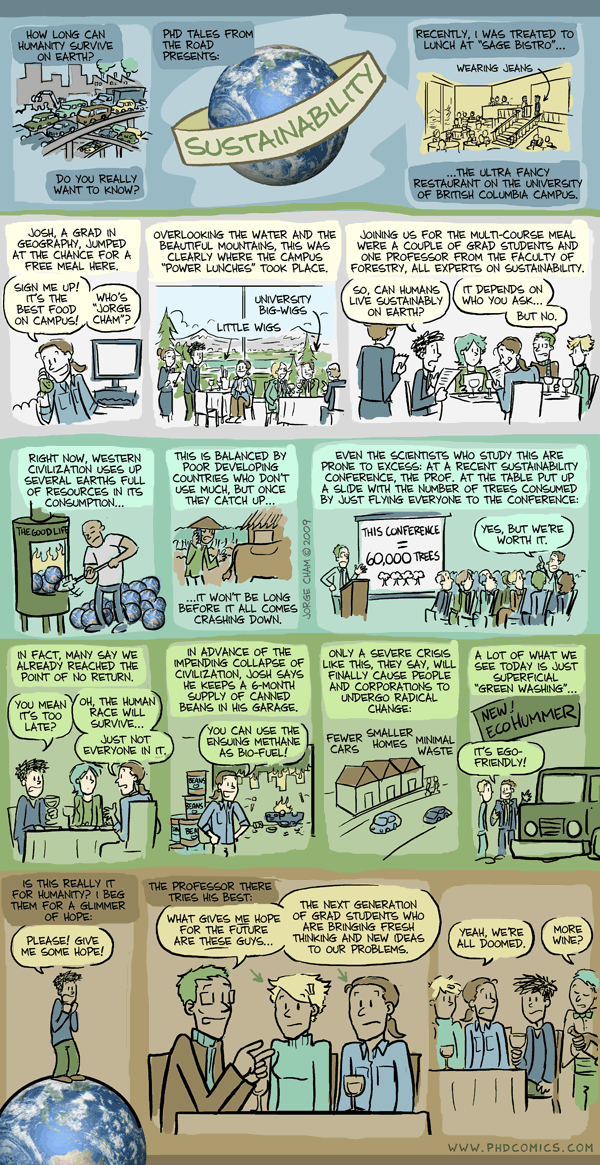
Here's the latest PhD comic, published yesterday:

The author, notably, did not consult an economist on the issue of sustainability, just foresters. And in doing so, we miss half of the evidence of what's going on when it comes to long term economic development. We are told people are just mouths and stomachs: they just consume and more people or development means more consumption. End of story. But people are also hands and heads: we produce and (most critically) we invent.

Which is the bigger factor? The evidence suggests that, certainly, in the short run consumption matters more. More consumption raises the price of goods (meaning they are more scarce). But the long run results (the sustainability concern) favors production. Goods (adjusted for inflation) keep getting cheaper. That short run boast in prices generates the incentive to ration, find substitutes, and ultimately develop new technology. People say it's different now, especially with energy (one of our most fundamental inputs). We've reached some peak that we can never return from. Armageddon is always just around the corner.

Humanity faced an energy shortage since our conception as a species. We sought it in plants, rivers, wind, fire, and a menagerie of animals. We built waterwheels, windmills, stoves, ships, sails, yokes, collars, carts, and harnesses in pursuit of of more efficient sources of energy. We dug mines all over the planet. Wood begot peat begot coal begot oil begot gas begot uranium. Now we seek it from the inner depths of out planet (geothermal) to the distant reaches of space (solar) and one theme permeates this unending quest of one of our most precious of resources: energy is cheaper. What new trend could have possibly emerged that makes them think it's suddenly different now?

Next time, Mr. Cham, I suggest you ask someone versed in both consumption and production. Next time, ask an economist.

Thursday, March 05, 2009

Corn Laws and the Ironies of History

In the 1840s, England's Corn Laws (corn being a generic term for wheat, barely, and rye) were under a hot debate. The Laws issued a series of tariffs ensuring bread prices stay two to three times higher than they were 100 years ago. But as the Industrial Revolution pushed forward, mill owners knew cheaper food was crucial to feed their employees. There thus arose a battle between the landed aristocracy, arguing mercantilism and questioning this "new" economy, and manufacturers, citing Adam Smith and the logic of free trade. Thankfully the latter, led by Richard Cobden, won the day.

Manufacturing, once a great advocate of free trade, now in the West is its enemy. And if Lou Dobbs, a vocal opponent of free trade on the grounds that it hurts factories, lived a century and a half ago, he would be raging against the very sector he so persistently defends today.

Sunday, March 01, 2009

Fixed Exchange Rates

I hope my 385 students can answer the following:

True or False:
If a currency with a fixed exchange rate is undervalued, its central bank will have to buy the domestic currency to maintain the fixed rate.

What Vegas Can Teach You About the Recession

In last week's EconTalk, economist Allan Meltzer argued one of the main reason for our current financial mess is the Fed's policy of too big to fail. If a large financial institution collapses, it will harm countless other institutions and hamstring the the market as a whole. By preventing disaster and saving these companies, the Fed saves the economy. Knowing that in the worse case scenario someone will help you out, these banks then took riskier chances than they otherwise would. Thus the mess we're in now. In a world of superheroes, there are more extreme athletes.

Some are skeptical of this relationship, made evident by the fact that this is not at the forefront of the popular debate (the much more vague and non-scientific "animal spirits" is). But suppose you went to a conference in Las Vegas and your company agreed to reimburse you for any gambling losses you suffered during the trip. It's obvious that you would gamble more. And you would take bigger risks. Why wouldn't you?

You could point out that the companies are worse off than those that didn't take the housing gamble (such as JP Morgan Chase, Pittsburgh National, Wells Fargo). But they are better off than if the Fed hadn't intervened at all. If the company compensates you only half or a third of what you lost from gambling, you would still gamble more but not as much as full compensation. Regardless, this policy would immediately prove to be a terrible idea. But that's the rule in place at the Fed now.

Wednesday, February 25, 2009

The Economics of Alien Conquest

My cousin, Brendon, and his girlfriend, Jenna, were in town this weekend. Both of them read my blog and Jenna told me I'm clearly knowledgeable about what I'm talking about, but still wrong. That response in itself deserves a post, which I may or may not get around to. Still, it would be fun to deviate a bit away from controversial topics and I thought of alien invasion. If aliens invaded, what would be their motivation?

Natural resources is a favorite Hollywood staple. Aliens will destroy our planet to take our stuff, likely minerals (Independence Day comes to mind but the physical land might be valuable, too (in The Day the Earth Stood Still, alien invaders attempted to terraformed our planet).

This is quite possibly the least likely reason aliens would go through the trouble of global conquest. The universe is filled with minerals and other resources that no one's using and are much easier to get to than stuff on an occupied planet. Maybe other extraterrestrials make harvesting Vega asteroids difficult, but even in the boundaries of our solar system there's still quite a lot to draw on.

Unless aliens are after biomass (i.e. living things). Perhaps there's some technology or feeding requirement that requires biomass (or they just want us as slaves), and Earth is the best place to get it. Lots of biomass with little ability to defend it. In that case, the best strategy probably wouldn't be a messy mass attack on the resource you're trying to harvest. Aliens would likely be much more insidious with probably a pathogen--killing everyone or knocking us all out while leaving the bodies around for collection later.

Racism is a likely motivation. This pops up in a lot of Sci-Fi television shows (Star Trek, Stargate, Babylon 5). A similar train of thought is a concern for humanity and a fear of what will happen if we're allowed to continue to live. Given many humans mistakenly fall into one of these two categories, I'd like it's a reasonable motivation for aliens to kill us.

Technology is a justification that's rarely explored. This is understandable but not for the reasons you probably think. Most assume that if aliens know how to travel faster than light, they are clearly more advanced than us on all other levels. That is far from certain, especially since an alien brain will probably not be wired the same way as a human one. As Richard Dawkins suggests, it is entirely possible there's a group of extraterrestrial life who intuitively understand the theory of relativity but have difficulties grasping principles of air resistance and other "slow" speed phenomena.

But it would be rather clear that the easiest way to get technology is to trade for it, not to take it by force. If such aliens were interested in our technology, they would more likely be peaceful. The one exception to this rule is if they discover it's easier to kill us than to learn a single human language. That would certainly be a sad state of affairs for us.

Then there's the possibility that aliens need to build a intergalactic superhighway along a path that intersects with Earth's orbit. That's a bit unlikely given how big space is ("Really big," according to Douglas Adams) but it could still be true. And if galactic eminent domain is as potent as our terrestrial version, then considered us conquered.

Wednesday, February 18, 2009

Politics As Usual

Alex Tabarrok ran some numbers, breaking the stimulus plan down by state. Below is the relation of infrastructure spending per person versus the unemployment rate. The red line is the best fit line for all the data points. Note it's sloping down.

The basic logic of a stimulus package is that government will create jobs, people spend the money, which creates more jobs, which allow people to spend the money again, etc, increasing money's "velocity." But here we see the states with the least unemployment get the most money and with the most unemployment get the least money (with some outliers). I can think of three explanations. Here they are in decreasing likelihood.

Shut up. This relationship is because congress members are using the package to send money to their home district/state. Those with the most political clout/understanding get the most money. This package really isn't about helping the whole economy but about boasting one region at the expense of another in order to get re-elected.

Oops. The government made a mistake. Some numbers got mixed up and checks are being sent to the wrong states. Granted, it's a pretty big mistake and one must wonder how an institution which make such mistakes will rationally plan us out of this mess.

Holier Than Thou. We missed something and the U.S. government knows what's going on but this graph doesn't capture all we need to know. If it did, everything will fit together very logically. This is possible, but no where near as likely as the other two.

Tuesday, February 17, 2009

Most Interesting Sentence I Read Today

From this week's Economist:
Indeed, some say the Few learnt [Irving] Fisher too well: from 2001 to 2004, to contain the deflationary shock waves of the tech-stock collapse, it kept interest rates low and thus helped to inflate a new bubble, in property.
A concise reminder that artificially fixing one sector one sector of the economy has unintended consequences in other sectors. One must wonder where the new holes will appear in the aftermath of the $787 billion stimulus package.

Wednesday, February 11, 2009

Krugman on the Virtues of Protectionism

When I read Paul Krugman, I first think "that's crazy! He's insane." Then I read it again and that usually (but not always) becomes "that's interesting, but it still wrong." Reading Krugman's February 1st article (spawning a nifty debate here, then here, then here) led me to the typical reaction.

I'm still reading through the responses, but Krugman's basic argument is that fiscal stimulus benefits other countries in addition to the one doing the stimulating (for now, let us assume Keynesian economics works the way Keynesian insist it does). The country being directly stimulated imports from other countries, which help their economy. But these economies share none of the debt generated by the stimulus package. Thus the funding country gets a smaller benefit than they should and we have too few economic recovery acts. Short term protectionism internalizes the benefits to those that are paying for it, thus we get more such packages when we need them.

It's a clear argument but to see why it doesn't work, let's follow the money. Suppose the exporting foreign country is Japan. They now have (say) American dollars. What do they do with this crazy American money? They can't spend it in their country. There are two things they can do with it.

(1) They can import from America. This means that money Keynesians want to stay in the US will come back. It's just adding another step. Instead of Government to Domestic Market, it's Government to Foreign Market to Domestic Market.

(2) They can invest in America. Instead of buying goods, they buy companies (or just capital). Again, the money comes back into the economy, but now there are two steps before it enters domestic consumption (Foreign market to Domestic Company to Domestic Market). Again, it's a wash.

You could argue time is an issue but money moves pretty quickly, especially in the era of Internet and telecommunication satellites. And, because the government's buying international, it's going to get a better deal which will help in the long run (when this huge debt will have to pay off). It's hard to imagine that extra delay is really such a huge problem.

An implicit assumption of Krugman's argument is that exports are inherently good for an economy and imports are not. But that's completely wrong. While Krugman might paint my argument as grounded in theology and not economics, the case for free trade is so strong, and for protectionism so weak, such interpretations are closer to being grounded in laws of economics as irrefutable as gravity or motion.

Saturday, February 07, 2009

Economics, the Law, and Treasure Hunting

Last week, deep-sea explorers announced they found the shipwreck of the original HMS Victory which sank in 1744. This is certainly a victory for the decedents of her captain (as the location of the ship demonstrates it sank due to a storm, not mistakes on the captain's part). But that is not the interesting part of the rest of us: it's the treasure.

Well, the legal battle for the treasure is what's interesting as the treasure is mostly large bronze cannons of historic significance. There also might be as much as four tons of gold, but that's just a theory. Due to the decay of the site, we're a long way off from a good estimation of value.

But that hasn't stopped the British government from claiming "dibs," though the site's in international waters. Lost for over 250 years, the government argues they never explicitly gave up sovereignty of the ship and its contents.
If it really is the HMS Victory, "her remains are sovereign immune," the British Ministry of Defense (MOD) said in a statement on its blog Monday.

"The wreck remains the property of the Crown. We have not waived our rights to it. This means that no intrusive action may be taken without the express consent of the United Kingdom."
They also want a cut of what's found, though the exact size is under negotiation (but you can bet it'll be a sizable one).

Safe to say, it creates a mess for the people who found the ship to sort out. It also cuts on their profit margin. This is where law and economics can help. The boringly named field of law and economics uses economics to better form the law so it encourages efficiency.

In this case, the law allowing a country to claim sovereignty on a wreck someone else found makes it less profitable for other people to find and recover wrecks. Thus more ships sit at the bottom of the ocean, slowly decaying into nothing. There are few examples so illustrative of waste as that one. Granted, there's a good argument for claiming sovereignty on a ship that sank last week. It takes time to find wrecks and if somebody just stumbles upon it in the meantime and gets to claim it all, that would have its own unintended consequences on how willing people are to use ships (or even build them in the first place). But that argument doesn't spill over to a quarter of a millennium. This looks a lot more like theft then maintaining sovereignty. I hope the British government aren't looking for any other important ships, of their own sake.

Stimulus Package May Prove Flaccid

A friend showed me this video:


Brilliant.

HT: Mike Mills

Monday, February 02, 2009

The Illusion of the Pay Gap

The first homework of the semester informs my students that one of the reasons men get paid more than women is because women can get pregnant. Because contracts promising to not get pregnant are illegal, hiring women is riskier for employers. An employee could take several months leave with relatively little warning. What a coincidence that President Obama's first bill addresses the same issue, but ignores the explanation.

Insisting that employers pay women less for malevolent reasons, Mr. Obama made it easier to make pay discrimination suits. Notes CNN,
companies will need to meticulously document pay decisions and retain detailed employment records, legal experts say. In this, small companies may be at a disadvantage - few have access to the attorneys and human-resources professionals that will help larger businesses comply with the newly expanded law.
A strange thing to do in rough economic times.

Risk of pregnancy isn't the only reasons for pay gap. Women tend to enter less technical jobs. Part of that is a natural tendency; for whatever reason, women are less likely to enter the sciences and, save economics, more likely to enter the social sciences. Go to any college math class and I bet you'll see mostly men (no going to an all-women school; that's cheating).

The other reason for the draw to the less technical is, you guessed it, pregnancy. Technical jobs have a high degree of obsolescence, meaning you have to stay on top of the latest developments to keep pace. But when you leave the job market for months at a time to care for a newborn, this is really hard to do. Hence women become secretaries, not engineers.

Biology's a sneaky thing and even seeps in after the children are born. Women also tend to work part-time, since women are still the gender that tends to take of kids. Being restricted to part-time adds additional restrictions to where they can work; again, these places that accept part-time employment tend to be paid less. Fringe benefits are usually off the table as well.

The nice thing about this story is it's easily testable. Simply look at groups where the biology issue isn't relevant and control for education. Thomas Sowell from Economic Facts and Fallacies:
Among college-educated, never-married individuals with no children who worked full-time and were from 40 to 64 years old--that is, beyond the child-bearing years--men averaged $40,000 a year in income, while women averaged $47,000. (p70)
Women are paid 17.5% more than men! Maybe we'll see that new legislation end the tyranny of male bosses upon his fellow man.

Tuesday, January 20, 2009

The Law of One Strange Price

Tyler Cowen at Marginal Revolution is rightly skeptical of macroeconomic explanation that rely on one strange price, including interest rates, tax rates, and the price of T-bills compared to cash. But it's only partly true. Yes, one screwy price is unlikely to mess with the whole economy (even for systematic prices such as interest rates and taxes). But it can if it's screwy enough. If the minimum wage was $100 an hour, there would be a major macroeconomic downturn thanks to that law alone.

The question becomes what is likely to be so out of whack. Interest rates and T-bills are traded on the market, checked and rechecked every day. If there is a systematic error, it's either short lived or relatively small. Taxes are checked as well (by voters), but that happens only every couple of years, if at all. They're also checked in a political process where the "right" tax is determined and spent by lawmakers acting on the voters behalf, instead the voters themselves. Most prices aren't so strange to mess up an economy by themselves. But if one is, I bet it's a tax.

Life Follows Death

During his inaugural address, President Obama rightly reminded us that it is the risk takers that ensure a better tomorrow. Yet he paradoxically argued that the current economic slowdown is the fault of greed and the market needs a "watchful eye." One cannot have both. Risk takers have to fail; otherwise it would not be risk. Pointing to mistakes as evidence of too much risk, of a need to remove bad decisions, necessarily curtails the capacity to make the right ones. We cannot have growth without bankruptcy nor more than we can have evolution without extinction.

The Smell of the Marble

Millions are gathering in the National Mall this morning to bear witness to the swearing in of Barack Obama. There's anticipation in the air that Mr. Obama is something unique and new. A different kind of politician.

He's certainly different (Joe Scarborough mentioned this morning that Obama is less prone to the sin of pride, which undos so many politicians). But the incentives of office haven't changed. Norris Cotton, a New Hampshire senator from the fifties to the seventies, warned colleagues of smelling of the marble, as in the white marble that covers DC. "And when you can smell it, you'll like it. And you'll be ruined for life." Great unchecked power leads to abuse and despite the Constitution's efforts, much of the power in Washington is unchecked.

This goes double for the presidency, whose role has expanded over the centuries but is now joined with a sympathetic congress. It's entirely possible that Mr. Obama, bending to expectations that he's a different kind of politician, will rise above such abuses. But the hero worship is strong and the people euphoric. Unless we become much more scrutinizing, he'll smell the marble.

Friday, January 09, 2009

Traffic Patterns and the Left Lane

Frustrated in DC traffic, a friend of mine wondered why, in the States, people drive in the city about as much in the left lane as in the right while in Europe, the left lane is traditionally held exclusively for people going very fast and passing. This is an excellent question and I think I have the solution.

Americans have low car taxes, free parking, few tolls, and relatively cheap gas. Not surprisingly, we have more cars compared to our European counterparts and traffic is thus much worse. With crowded streets, drivers learn it's far better to drive in the left lane if they're planning to turn left, even if the turn isn't for miles. No one wants to miss a turn because they never could claim a spot in the correct lane. Thus people drive in one lane as easily as they drive in the other.

The same can be said of interstate traffic, though the story's slightly different. With so many cars on the road, there's greater likelihood that the right lane will have an unusually slow driver. Constantly passing in and out of the right lane to avoid these drivers might induce the faster car to simply stick with the left lane, even though an even faster car will likely be stuck behind it soon. Thus we see very fast cars weaving through traffic, blazing a sort of third lane.

Monday, December 15, 2008

The Illusion of Irrationality: Free Is Fun

A friend loaned me his copy of Predictably Irrational, by Dan Ariely. Ariely's a behavior economist, exploring all the ways people don't react in quite the same ways theory predicts. It's a fascinating area of research, a blending of economics and psychology. The book itself is well written and the content makes you think. But it goes way too far.

Because people don't act as theory predicts, Ariely proclaims they are irrational. In reality, the theory doesn't capture all the elements in play (or Ariely's not acknowledging they do). For example, Ariely dedicates chapter three to how people will get something just because it's free, even if it's not the better deal. They'll choose the free $10 gift certificate over a $20 gift certificate which costs seven dollar (effectively choosing $10 over $13). But people like getting things for free. Even if it's not really free, even if we know it's not really free.

Ironically, Ariely said it best: "FREE! gives us such an emotional charge that we perceive what is being offered as immensely more valuable than it really is." (p54) If it gives us that emotional charge, it really is more valuable. People also gamble though few will think they actually come out ahead. The joy comes from those few times you win. That joy, that emotional charge of getting something for nothing, is valuable to people and they'll gladly pay for it in the form of a lost opportunity.

My theory is easily testable (though expensive). Start by offering the $10 gift certificate versus $20 certificate for $7. Then increase that value from $20 to $30 then $40 then $50, steadily increasing the (opportunity) cost of the indulgent from $3 to $13 to $23 to $33. I'll bet you'll see more people start grabbing for their wallets, rationally determining that the joy of FREE! isn't worth the cost.

Sunday, December 14, 2008

Comma Marries And

Writing out lists in writing is rather straight forward, but a simple mistake makes the list confusing. One of the easiest ways to keep it clear is to be consistent with commas. Consider the following sentence:
My favorite types of yogurt are orange creme, pineapple, strawberry and banana and vanilla.
Are there three flavors? Four? Two? Is strawberry and banana one flavor or is banana and vanilla one flavor? It's not clear. It's also awkward because the reader doesn't know when to finish the sentence. Now consider the same sentence with one more comma.
My favorite types of yogurt are orange creme, pineapple, strawberry and banana, and vanilla.
Much clearer, isn't it? A friend of mine once told me that commas separate each idea in a sentence as if they were the gaps between cars of a train. It's a pause to signal a slight change in thought. Don't treat it like a period (i.e. watch sentence length) but use it right in a list.

Thursday, December 11, 2008

Questionable Writing

It's natural for people to ask questions in their writing, likely because those very questions are running through the writer's mind as they type. I saw this style many times while grading rough drafts my students submitted last week. It's not inherently bad writing. But like quoting, it should be used sparingly with two rules in mind.

1. If you're going to ask a question, ask only one and then immediately answer it. If it has a long answer (i.e. it introduces a section), then answer it in a way that summarizes the section. Asking a whole bunch of questions at once confuses the reader and wastes her time. It also robs you of authority; the reader might ask "Why is he asking so many questions? Does he not know the answer?"

2. You can also ask several questions to illustrate the extent of the difference of alternatives, alternating between one side and the other. Make sure you summarize at the end, of course. Virigina Postrel does this very well in her book The Future and Its Enemies:
How we feel about the evolving future tells us who we are as individuals and as a civilization: Do we search for stasis--a regulated, engineered world? Or do we embrace dynamism--a world of constant creation, discovery, and competition? Do we value stability and control, or evolution and learning? Do we declare with Appelo that "we're scared of the future" and join Adams in decrying technology as "a killing thing"? Or do we see technology as an expression of human creativity and the future as inviting? Do we think that progress requires a central blueprint, or do we see it as a decentralized, evolutionary process? Do we consider mistakes permanent disasters, or the correctable by-products of experimentation? Do we crave predictability, or relish surprise? These two poles, stasis and dynamism, increasingly define our political, intellectual, and cultural landscape. The central question of our time is what to do about the future. And that question creates a deep divide. (p xiv) [Original Emphasis]

Wednesday, December 10, 2008

Newsflash: Big Plans Are Complicated

Commerce Secretary Carlos Gutierrez commented on CNBC today arguing if the government loan goes though, the government will only manage the big involving their balance sheet. He insists politicians are capable of doing this well.
What we're talking about here is not the running of the auto company. We're saying someone who can evaluate whether they are making the tough calls and whether they are restructuring and whether the numbers suggest they are making the tough calls...We're talking about a big picture of what needs to be done to restructure these companies based on what the executives will bring forward.
This is a lot like saying "I'm not going to tell you how to drive because I'm not an expert. But I will tell you how to make your Civic do tricks out of a James Bond movie." These big picture changes are immensely complicated, filled with nuanced information no one in Congress or the Commerce Department has. They are precisely the things outsiders should not micromanage.

Sunday, December 07, 2008

Quote With Caution: Leading and Following

With my development students feverishly working on their final drafts, I want to take some time passing on some writing advice. Today we discuss quoting.

While I've mentioned it before, it's worth repeating. There's only two reasons to quote: (a) convincing the reader that someone believes something (usually something the quoted may not freely admit) and (b) repeating an idea illustrated so well, you can't possibly say it better.

But knowing when to quote is not the same as knowing how to quote. I've witnessed many papers where the writer will quote without comment. Their lead in will be bland and their follow up will be nonexistent. I read phrases such as "Paul Collier says," "Jared Diamond writes," "William Easterly argues," with barely a hint of what they are going to say.

Instead, try something more tailored. Paraphrase the author's idea in the context of the subject of the paper. Then, indicate to the reader why you are bothering to quote. (i.e. "Friedman said it best: 'If you put the federal government in charge of the Sahara Desert, in 5 years there'd be a shortage of sand.'")

Other times, the writer will quote and simply move on. If you going to bother quoting, add context to the quotation. Comment on it (but don't repeat yourself from the lead in). Reference an idea or phrase from within the quote and connect it back to your paper. Quotes are supposed to complement your writing, not replace it.

Saturday, December 06, 2008

Don't Celebrate Yet

A surprising 61% of Americans oppose the Detroit bailout of the big three (Ford, GM, and Chrysler). This is hard to explain, given the populace's distaste for seeing big employers go under.

I wish I could say the results are due to people understanding growth doesn't come from preserving failures. Or a realization that there are some things Americans shouldn't do. But while the big picture's the same, the reasoning's likely much more nuanced. Quick depreciation of American cars, declining sales in SUVs, and the rise of the foreign-made hybrid are everyday examples of a poorly performing sector of the economy. Now if only people would take the essence of the argument and apply it consistently.

Paradoxically, the results are also low. Despite the repeated failures of the auto industry, despite the everyday logic that if something doesn't perform you shouldn't work to preserve it, despite the fundamental reality that letting something go away allows us to do something else, nearly forty percent of Americans are not against a bailout.

And then things make sense again.

Monday, November 24, 2008

The Forgotten Charity

Amity Shlaes recalls the last great act of banker, industrialist, and art collector Andrew Mellon in The Forgotten Man:
By giving largely, generously, completely, and entirely, he would demonstrate that the private man could be as good a servant to the public as the government official was...Mellon's gift would show the value of leaving art--or capital--to accumulate and compound in the shadows, untaxed. The National Gallery would be an object lesson that the high taxers could not forget.
One of the finest collections of Western art in the world, and the main building which houses it, was originally the gift of a "robber baron" who gave so selfishly that it doesn't even bear his name. And so, alongside the monuments to presidents and memorials to wars, among the lawmakers and tourists, in the shadow of the Capitol building, rests a silent dedication to low taxes.

Friday, November 21, 2008

The Siren's Song of Manufacturing

Today on Morning Joe Pat Buchanan mourned the decline of the manufacturing sector, whose members now (supposedly) work at Wal-Mart. Forget that over the past thirty years median individual income rose about 40%. Even if they were becoming nurses and lawyers (and they are), Buchanan still prefers manufacturing cars, toys, and electronics in America, by American firms.

Manufacturing is no more important than farming, customer support, or mining. The key is never one sector. The key to American prosperity (among other things) is trade. Freer trade opens the plethora of human ingenuity to more people at steadily decreasing amounts of effort. Alaskans get bananas year round. Nevadans get free tech support. Indianans get toys under the tree. Just because we can't point to a single area where everyone works doesn't mean they can't find good jobs, obtain consumer goods, or live a fuller life. Freer trade means all these things are more common, not less.

Tuesday, November 18, 2008

Burn, Baby, Burn

With the world financial system still in turmoil (and Japan joining the recession ranks), governments hear the public cry for action. It's a knee-jerk call with little forethought. People mistaken the current economy as a burning building: clearly, something has to be done. This analogy makes a series of errors, assuming the government could fix the problem, knows how to fix the problem, and wants to fix the problem in a way that actually works (instead of just claiming it works).

If you insist on the analogy, we should wonder if the fire's too hot to suffocate. We should wonder if the buckets contain water or kerosene. We should wonder if the firefighters wish to get burned putting it out or stay away and roast marshmallows. But most of all, we should wonder if if the building should just burn down.

The financial sector is really large. Arguably too large. At the very least, many firms made some big errors. Saving the company that's a proven failure is not a recipe for long term growth. Ditto for Detroit, who focused on SUVs while gas prices climbed. The same goes for virtually any struggling industry, especially its old and unimaginative players. They made a mistake, honest or not, and now they're dead weight.

Forest fires occur naturally. As forests age, dry undergrowth covers the ground and old trees block out all light. Nothing new grows. It takes only a bolt of lightning to ignite the old structure and wipe it away in a cruel immolation. This is the only way new life can flourish and the forest can ultimately survive.

Let the ancients burn.

Saturday, November 15, 2008

Slipperly Logic

After noting the fall of oil prices, a friend of mine suggests oil companies could have "gotten away" with higher prices longer. When prices rise, it's a conspiracy in the greedy pursuit of profits. When they fall, it's still a greedy pursuit of profits?

Supposedly, prices fall because colluding firms want to assuage calls for regulation and taxes. Anyone even remotely familiar with commercials, advertising low prices, knows how sloppy that argument is. There's no evidence of sustained collusion, because there's no way to enforce such deals. Prices rose due to sudden demand and are falling because this competitive industry is finally catching up.

This is not a new story. From Amity Shlaes' The Forgotten Man. In 1934,
[Harold Ickes] had discovered that at numerous points oil was being extracted clandestinely and illegally, outside his NIRA [National Industrial Recovery Act] production quotas, and sold at prices that undercut the policy to force prices upward. He was outraged and opened a campaign against the oil bootleggers, describing them as possessed of a "sly animal cunning." (p 203)
No wonder oil CEOs are paid so much. It's not fun being the villain no matter what you do.

Wednesday, November 12, 2008

Google > CDC

The U.S. Centers for Disease Control and Prevention (CDC) publishes flu data, but with a lag to allow for the data to arrive. Google decided to track the searches for flu, and gets numbers similar to the CDC, but only without the lag. Thus if you want to know the current flu situation, you are better off with Google than the CDC.

No, You Can't

Lawmakers from all fifty states are being bombarded with requests for tickets to Obama's inauguration. When the norm is several hundred tickets each, some report several thousand requests. Questions arise as to how to divvy them up. Lottery systems seems most likely. A market does not.

Legislation looms to make scalping these tickets illegal. It seems like we should ensure that everyone should have an equal chance to get them, that we should combat those who would order a dozen, only to sell them for personal profit. But an a world of different preferences, a forced lottery system is more unjust than scalping tickets. The person who's mildly interested has the same chance as the die-hard fan. Without a market, there's no way to correct the randomization if the former wins. (Frankly, I'm surprised they aren't going by first come, first serve basis. That would solve a lot of problems. But part of the issue is the offices don't know how many tickets they are getting.)

Auctioning the tickets is not perfect, either. The curious but wealthy are preferred over the enthusiastic but poor. Without a prohibitively costly interview system, it's not possible to make it perfect. But denying trade makes it strictly worse.

Saturday, November 08, 2008

Tyranny of the Electoral System

Missouri's still counting and recounting but the absurdity of our electoral system is still clear. Ignoring the Show Me State, here are the results:


Candidate% of Popular Vote% of Electoral Votes
Obama52.6%69.3%
McCain46.1%30.7%

The spread between Obama and McCain jumps from 6.5 points to almost six times that amount (38.6). A large part of this discrepancy is because the plurality of the state gets all the state's votes. But it brings to bear another strange aspect of the electoral college: Pennsylvania has 25 times as many people as Wyoming, but only 7 times the electoral votes. Iowa has a fourth of the people Illinois has but only a third of the votes. In other words, the system disproportionately favors low populations states. (This was a major issue in 2000, when Gore received the popular vote but lost the election.)

People argue rural areas have to get extra voice. Otherwise the candidates would never pay attention to them and spend all their time in major cities. So what? Majorities always have a greater say than minority opinions. But no one says that gays, immigrants, and Jews should get extra votes. The only difference is these minorities (mostly farmers) are concentrated geographically. I'm sympathetic to the idea of giving the outside opinion extra muscle in order to curb the tyranny of the majority. But it's not clear why that minority has to have their own state before they get such an ability. Because we lack consistency, part of the minority becomes party of the majority and the bullying continues.

Tuesday, November 04, 2008

We Stand Together, Like It or Not

My mother used to tell me "if you don't vote, you can't complain." When I was younger, I remember nodding in agreement. Now, as an avid nonvoter, I failure to understand her arguments. You could say I've "learned" less over the years if you consider such reasoning knowledge. But it's not.

The fallacy assumes defection is a practical option. If three people vote to go see a movie, and one of them offers no opinion, that person still chooses to see what the others decide. We all recognize if silent Carl goes to High School Musical 3 with his friends, he is in little position to complain about which movie to see. If he didn't want to see it, why did he go? The same could be said of those voters who went along with the decision. If they wanted to see Saw V, we would wonder why they followed the majority.

But our process isn't like seeing a movie. It's more like being trapped in a plane and people voting on the destination. If the choices are between Alaska and the Yukon, and the majority votes for Alaska, we can understand why the Yukoners complain. But we can also understand why those that like the tropics, and don't bother choosing between two bad choices, complain. We would only be surprised if the Alaskaners protested the result once we arrived.

It turns out those with the least credibility to complain are those that voted for the winner, which is usually most of the voters.

First Time Voting

Like Alex Tabarrok, I voted for the first time today. It took about 45 minutes, and my voting precinct is close enough that I jogged there after I woke up. I realize my vote counts for nothing but now when people talk about voting I know what they are talking about.

Friday, October 31, 2008

New Orleans Goes Third World

Earlier this month 20/20 ran a "Politically Incorrect Guide to Politics." This segment stood out:

Students of my class (or those familiar with Hernando de Soto's Mystery of Capital) should see the parallels. He discovered that the reason developing countries have trouble growing is because of a stifling bureaucracy preventing people from establishing legitimate businesses and securing property.

Friday, October 24, 2008

Favorite Quote on the Bailout

I've read a lot about the bailout, but by far my favorite quote is this from Ron Hart:

Is there better irony than an imprudent Washington "investing" about a trillion dollars of debt funded tax money into the banking system and telling them how to run a business?

The same federal government confiscated the Mustang Ranch bordello in Nevada in the 90s and then promptly ran it into bankruptcy. If the feds cannot make a profit in a monopoly business of selling sex and booze, my guess is the complexities of banking will totally perplex them—especially when they have to follow the convoluted regulations they themselves impose.


HT Reason

Tuesday, October 21, 2008

The Speculators That Can't Be

History's a fickle mistress. It can teach us a great deal about ourselves and what to expect, but it can also delude us. Exceptions (which are always more memorable than the mundane) distort our view of how the world works. Writer David Liss referenced a speculator friend of Alexander Hamilton (the first United States Secretary of the Treasury) who used his inside knowledge to make quick profits. His actions nearly caused a financial catastrophe in the fledgling union. In light of the current crisis, Liss ponders when we will learn our lesson?

Liss paints speculators as wild-eyed children. They have no concept of the future, a strange attribute for people who make a living estimating what will come to pass. Speculators cannot survive as an occupation the way Liss described them. Not only would our current volatility be the norm, Warren Buffet would be broke.

Wednesday, October 15, 2008

Reality Check from Iowa

A friend of mine insists that because of the recent economic turmoil and unpopular bailout, Democrats do not have a chance at maintaining control over Congress this election cycle. Like me, he prefers a divided government over a united one (and since Obama is the likely winner, this lose of control would be an optimistic note). But politics is one of those areas where people indulge in their irrational hopes.

The Iowa Electronic Markets encourage people to stop, think, and rationally weigh the data. It's basically a betting system. You buy an "asset" for a candidate. If the candidate wins, you get a dollar. If he doesn't you get nothing. People bid against one another for these assets and a value emerges. We can use this value to predict outcomes (and very successfully, too).

Consider the market for the presidential campaign, focusing on the winner take all option (based on who gets the most popular votes).

The blue line represents assets that Obama will get the most votes and the red line represents McCain will. Obama runs at about 85 cents. In others, he has an 85% chance of getting the most votes (though because of electoral math, this is not the same thing as saying he will win).

There's no graph for Congress or either of its chambers yet but here are the current bids (all as the average bid for Democratics gaining seats):

Congress: 0.953
House: 0.921
Senate: 0.949

The markets are not perfect (maybe participants have a systematically different knowledge base) but this is the strongest evidence I've seen of what we'll see on election night. And it looks like the Democratic Party across the board.

Sunday, October 12, 2008

The Futility of Equality

In Russ Roberts' conversation with William Bernstein about inequality last week, Bernstein argued that largely different salaries harm the less wealthy people. In the pursuit of status, the 2nd, 3rd, 4th, placers stress out about their lives. This stress harms their health and shortens their life span. Thus we should engage in redistribution.

It's a clever argument, but I challenge its conclusions (again...see my previous challenge here). I assume Bernstein searches for something less than full equality (where everyone makes the exact same amount) since that would be prohibitively expensive. The alternative is partial distribution, where a few are poorer and several are wealthier.

Redistributing from the wealthy to the poor still creates that ranking system, only with a smaller variance. Instead of being much wealthier, those "on top" of the status ladder are only slightly wealthier. But according to the status theory, that shouldn't matter. A runner up is still a runner up, whether by a little or a lot. They will be just as stressed out, just as prone to an early death. But society will be less opulent because of the incentive distortions. Bernstein's world is strictly worse.

Friday, October 10, 2008

Keep Your Fallacies Straight

Russ Roberts discussed the bailout on Reason.tv, arguing it'll encourage more risk taking in the future. A commentator, Trumpit, accused Prof. Roberts of circular logic:
You state that the bailout will encourage more imprudent risktaking in the future leading to lower standard of living for the next generation. LOL. That's was the cause/reason for the bailout. I took an upper division math class and on the 1st exam the professor drew a big circle to make fun of my circular proof.
Let's take a moment to remember what circular logic is. Also known as begging the question, it occurs when "its conclusion is among its premises...assuming what it's trying to prove." The argument of the bailout goes like this:

1. The Congressional bailout implies imprudent risk taking is cheaper.
2. The financial sector seeks cheapness.
Thus
3. The financial sector will engage in more imprudent risk taking.

It would be circular if the argument was this:

1. The Congressional bailout implies imprudent risk taking is cheaper.
2. The bailout occurred.
Thus
3. Imprudent risk taking is cheaper.

It's not that circular logic is nonsense, it just doesn't say anything interesting.

Tuesday, October 07, 2008

Coase and Inequality

This week Russ Roberts interviews William Bernstein on inequality. Bernstein argues that income inequality has ill effects on poorer people's health--they have a lower quality of life because they know they are on "low" end, they're more likely to stress out, etc. Thus, he says, we should engage in income redistribution.

I find the big weakness to the inequality argument is its policy recommendation. I can see how a few people making lots of money makes others upset/jealous (we hear about it all the time in politics, suggesting people like to hear about how evil wealthy people are). I can also see that such anger leads to stress and leads to unfortunate health effects. In other words, I can see how one person's increasing wealth can externalize a cost onto another.

Since transaction costs are high, let's set aside the Coase Theorem. Instead, who's the least cost avoider? (Remove the wealth or remove the sadness and either way we have no problem so what's cheaper to remove?) If we ask the rich to make less money, we would lose those the benefits that the person would contribute to society. If we ask the poor to take a breath and let it slide, we likely lose much less for what we get. In other words the conclusion should not be redistribution but people dealing with it on their own terms. Bernstein should be telling people to pick up yoga, not pick pockets.

Monday, October 06, 2008

Definitions Are Not Clothes; Stop Trying To Change Them

This week's Economist quotes Nicolas Sarkozy in their report on Europe's schadenfreude concerning America's economic woes. "The idea that markets are always right was a mad idea."

A doubly bizarre claim. Sarkozy ignores that American financial markets are hardly laissez-faire as he forgets that no one claims markets are always right. It's really easy to denounce a system when you redefine it to suit your ends. It's doubly easy when you then try to redefine reality, too.

Tuesday, September 30, 2008

Balance Be Not for Kagame

During class conversation today, I felt it necessary to describe the compensating wage differential (stressful/tedious jobs are paid well and relaxing/rewarding jobs are paid poorly). I then promptly forgot why I brought it up.

I now remember. I described Paul Kagame's (Rwanda's president) desire to turn his country into a sort of Switzerland of Africa, notably a sophisticated banking center. We agreed this was a long shot but it's longer than most think. It reminded me that so many developing countries (and developed countries) wish to jump into the high end sectors. Medical plazas, software companies, financial services--industries that are prestigious and clean. Societies, and thus governments, put so much value on these services, we shouldn't be surprised that they are over supplied (part of the reason the financial sectors have been taking a beating lately).

Thus the wage differential. If a job is cool, lots of people will want to do it, depressing the wages it offers. If a sector is hip, so many will jump into it and shrink its returns. I wish we'd stop treating development (and growth) as if the whole world could get a job as ice cream taste-testers.

Wednesday, September 24, 2008

Strangest Sentence I've Heard Today

A friend of mine from college told me the following over AIM:
i certainly don't think communism can work on any kind of national scale, but socialized assistance programs, like medicine, education, welfare, and social security, ensure that even the poorest people have access to liveable standard of care - of course, the state has to dedicate itself to making that standard liveable
What is communism on a national scale other than a systematic interference with everyone in a country? You have to admire an intellect that can be so inconsistent and not go crazy.

Monday, September 15, 2008

The Elusive Quest for Price Gouging

Anti-price gouging laws are notoriously vague, a fact Florida reminds us of this week. It issued subpoenas to four gas station companies on the basis of price gouging, or according to Florida state law, "an unjustified increase in price" during a state emergency.

What's "justifiable" in this context is not something laws can determine. If a firm increases its price, that consumers determine if it's reasonable by virtue of their actions (and their continued patronage). If an increase is truly arbitrary, then competitors will keep prices lower to get all the business. This argument doesn't work if there's no competition (and no chance for it) but because Florida issued subpoenas to four companies we don't have that problem here.

Markets are not made up of faceless CEOs and wild-eyed Wall Streeters. Markets are more ephemeral than that. They are composed of the interactions of countless millions, each competing with some to appease others. Markets are ecologies, not dictatorships.

Keep Your Favorites To Yourself

The lack of media coverage over the Paralympics induced NPR to comment why they received so little attention compared to the Olympics. One caller blamed corporations, not the lack of demand. Corporations set the agenda and since they don't sponsor these games, they don't show them even though we want to see them.

If this was true, if we really are empty vessels to be filled, then why don't companies sponsor the Paralympics and then cover it? We'd watch something we want to watch and they'd get more airtime for sponsors. This doesn't happen because what matters most is viewership. This is why if a basketball game runs over, it cuts into sitcoms after it. This is why most shows get canceled after the first season. This is why we have any sort of entertainment at all and not corporations force-feeding us an endless stream of ads.

This caller likely replaced their preferences for the desires of everyone else. Just because your preference isn't popular doesn't mean it's because of some secret cabal is holding you and your brethren back. Maybe you just like unpopular stuff.

Friday, September 12, 2008

Wisdom of the Crowds

RT gives Disaster Movie 0% with 53 critics reporting.

Wednesday, September 10, 2008

Of Human Design

Mike recently directed me to a blog by a mutual vegetarian friend from college, Adam. The language is harsh: eating meat is oppression and so forth. What lovely serendipity that we covered prehistory in my development class today.

The roots of human civilization lie in what Jared Diamond calls "farmer power," or the development of food stuffs so other people can specialize in non-farming professions (soldiers, inventors, traders, etc). Critical to this was the domestication of animals for purposes of food and labor (the aforementioned oppression). Over generations brain power and survival techniques (such as good eyesight) were severely diminished. In other words, they are not natural in any normal sense of the word. Indeed they are less natural than a wooden table, since at least the wood retains original DNA. Domesticated animals are a new species.

Adam posted a few videos from Waking Life, an independent philosophical film. One character argues "the gap between, say, Plato or Nietzsche and the average human is greater than the gap between that chimpanzee and the average human," a rather strange claim given history. The average human purposefully domesticated plant and animal species, something no other animal has done. That's an astonishingly large leap from a chimpanzee.

A great departure from their wild ancestors, modern farm animals are basically bags of meat with scarcely a glimmer of intellect. They were bred to be property, and non-sentient at that (save for the most encompassing definition of sentient). Even by their cousin's standards they are stupid. Of all the oppressions of the world, meat-eating hardly seems like a worthy one to fight.

Thursday, September 04, 2008

Markets in Everything: Cancer Sniffing Dogs

The Economist recently had a story of how doctors have smelled patients breath as a way to test for sickness. It's inprecise and can't detect everything, so Carolyn Willis outsourced the smelling of sickness to dogs.
One of the first practitioners of the field of olfactory diagnosis, Carolyn Willis of Amersham Hospital in Britain, decided to contract the job out to dogs. They, she reckoned, have the necessary nasal apparatus to sniff out illness, and there was already some anecdotal evidence that they could, indeed, smell people with cancer. It worked. For the past four years her sniffer dogs have been diagnosing bladder cancer. She is now training them to detect prostate cancer and skin cancer as well.

Wednesday, September 03, 2008

Numbers Are Like Fire: Don't Play With Them

I question the potency of the argument put forth by Obama's chief economist (Laura D'Angelo Tyson) on the Colbert Report last night that the economy performs better under a Democratic president than a Republican one. While glancing at the data suggests such a correlation might be there (my analysis program is currently on the fritz so an eyeballing had to do), too many complications render the explanatory power weak.

Variance Within Presidents A party maintains control of the presidency for a minimum span of four years (even if the sitting president resigns of leaves office, his VP maintains the party "dynasty") though several do so for eight, sometimes more. But GDP growth fluctuates a great deal within such a span of time, sometimes going negative. Since our dependent variable doesn't change nearly as much as growth rates do, we lose a lot of our explanatory power.

Policy Variance The Democratic and Republican parties of today aren't constant. This limits our scale of analysis to a much smaller time frame (I went back to the 1930s) and even then there were changes. Also the politics that defined most the difference between the parties were Cold War issues, not economic ones.

Measurement Issues I used real GDP growth to analyze the relationship; Tyson no doubt used similar data. But this data is flawed because it treats government spending as growth, even when that spending is simply a transfer payment (such as Social Security). I'm currently looking for non-government numbers.

Lag Issues Colbert joked about this but there really are lags in policies, sometimes reaching ten years. Since the presidency oscillated between parties for a while, lagging the variables could result in the opposite conclusion.

Causation Issues Perhaps people are more willing to vote for a Democratic president when times are good. Since more government spending has been a staple of Democrats since FDR (Republicans play a similar game, of course, but to a lesser extent), the public might simply be buying a normal good. Wealthier people are more willing to buy feel-good government programs.

The Theory This is likely the biggest problem with the story. What's the explanation for why a Democratic presidency would fair better for the economy than a Republican one? The one I hear the most is that they help the "little guy", but it's not clear how paying someone because they are poor will incentivize them to be wealthier. Moral hazard issues abound. Their preference to cutting taxes for the non-rich helps, but it's usually paired with a tax increase for the wealthy. Unless you believe the richest tend to only buy and invest in each other, this story doesn't get you far. Income mobility remains quite high in the US, repeating the incentive issues that crop up in "helping the poor."

Monday, September 01, 2008

Cogs In the Machine

Economists are often scoffed at our "dismal" view of the world, that people respond to incentives first and foremost. There are no saviors, no heroes, no Santa Claus. There is no romance to politics except for what we wish was there. Politicians respond based on the choices they have, a constant as universal as gravity. Mr. Obama is not immune to such failings nor does Mr. McCain's "insider" status make him a shadow of Mr. Bush. While they have wishes and goals their actions will always be different than their speeches, a reality long recognized but rarely applied.

There are no good guys and bad guys. There are only people responding to incentives. Mr. Obama wants everyone to believe he'll be an engine of change, a Santa Claus figure that will make everything alright, and he'll surely offer token alterations to convince the populace of exactly that. But we have this world because that's the one that rewards decision makers. The fundamentals won't change because no desire to risk losing office. Only changing the rules of the game will change how the government work and Mr. Obama mentions nothing of such alterations. Believe the stereotype of the two-faced politician because there is nothing new in this election cycle.