Everyone seems to want something from the Government. Corn growers want subsidies on ethanol, drivers want increased spending on roads, the fearful favor dropping bombs on bogeymen.
All the meanwhile, a movement has been building to make it harder for money to buy a candidate - prohibiting "soft" money, outlawing campaign contributions of some sorts by some parties, etc. Since most of this focuses on the money aspect, you can be sure that this is an effort to silence that demographic - and like it or not, rich people get to vote too. You're not going to change the fact that candidates are bought - just changing the currency with which they're traded.
In this case, there seems to be a desire to have the candidates bought and sold with votes - which, on the face, is a smashing notion - that candidates should represent their voting constituency. But the problem with this is that it does nothing to stop the redistribution of money, it just changes some of the names. The corn lobby still gets what it wants.
Let me suggest that the problem is not that candidates are bought and sold, it's that they have the power that makes that profitable. In short, politicians would not be commodifiable in this sense if they couldn't provide any consistent return on investment.
I'm clicking my heels as I write - there's no place like home! So let's all join hands, sing kumbayah, and wish away the power of government to take from Peter and give to Paul. I'm not so nieve as to believe it's going to happen, but I'm sure I won't stop getting pissed off until that day.
We don't just need a new representative in office to change things, we need, ultimately, a new constitution, and a national consensus that has, to my knowledge, never existed. Here's the good news: it can be built, and the political system that we third-way voters chafe under can be used against it. Since most people don't care enough to vote, it takes a FAR smaller consensus than would be necessary under a parliamentary system.
Ain't I all full o'sunshine today?
Tuesday, June 13, 2006
Monday, June 12, 2006
A Honey of a Law


In reading a business guide (From Kitchen to Market, if anyone's interested), I was warned by the author not to attempt to sell honey in 12 ounce jars in California - there, it's strictly forbidden to sell honey in jars of that size. You'd better respect the wisdom of the legislature and use the government-approved 8 and 16-ounce jars for all our good.
Kinda reminds me of a write-up by a nice guy, Jeffrey Snyder, on Wisconsin laws regarding margarine and cheese production. Can you say "unnecessary burden?"
I'm really believing that a government without the will and ability to repeal its own laws (take the recent end of the Spanish-American war, for example) isn't any sort of government at all.
Kinda reminds me of a write-up by a nice guy, Jeffrey Snyder, on Wisconsin laws regarding margarine and cheese production. Can you say "unnecessary burden?"
I'm really believing that a government without the will and ability to repeal its own laws (take the recent end of the Spanish-American war, for example) isn't any sort of government at all.
Friday, June 09, 2006
June's Most Random Wikipedia Page Is....
List of China administrative divisions by highest point. A littled belated this month thanks to my visit home in Iowa, but no less random.
Wednesday, June 07, 2006
Montenegro Independent?
So apparently, the uppity Serbian "partner" state, Montenegro, has decided that the whole south-Slavic state project was, in fact, not in their best interests. Accordingly, they have sought to dissolve the ties that bind. At worst, this could lead to a war. At best, an independent government.
Now taking the cue of the American government's response to a similar dispute a few years back, I'd like to suggest that Serbia engage in a genocidal war of reintegration in order to maintain the status quo. In fact, this seems to be the standard. Bougainville? Chechnya? West Turkestan? Ahem. But I digress.
But playing a brighter note from the dissolution of Czechoslovakia, I'd like to suggest that the parties should simply quietly go their separate ways, and the international community should, as soon as they get around to recognizing any other groups that seek to be free, recognize the state of Montenegro as a sovereign power. And if the Serbs of Montenegro, a sizable minority, wish to in turn form their own state? Good! Let them.
'Nuff said.
Now taking the cue of the American government's response to a similar dispute a few years back, I'd like to suggest that Serbia engage in a genocidal war of reintegration in order to maintain the status quo. In fact, this seems to be the standard. Bougainville? Chechnya? West Turkestan? Ahem. But I digress.
But playing a brighter note from the dissolution of Czechoslovakia, I'd like to suggest that the parties should simply quietly go their separate ways, and the international community should, as soon as they get around to recognizing any other groups that seek to be free, recognize the state of Montenegro as a sovereign power. And if the Serbs of Montenegro, a sizable minority, wish to in turn form their own state? Good! Let them.
'Nuff said.
Lock up yer daughters!
I remember a year ago watching on television - O'Reilly on Foxnews, to be precise - righteous outrage about a new book for young adults dealing with something called a "rainbow party." The subject matter involves participants attempting to see how much of their lipstick they can get on the genitals of a boy at said party, and this idea - of young girls engaging in oral sex - brought on some fury from O'Reilly and other commentators.
But hold on here - I understand the idea behind these broadcasts - you want to inform parents about potentially irresponsible activity your children could be getting into. But how many young girls first LEARNED about this notion from the broadcast itself? Maybe I'm fooling myself, maybe lots more than I'd imagine, but in my mind, I bet lots.
And remember, to do something intentionally, you first need to have the idea to do it. This may be a bit dated, but I read a blog post today that made me remember it (maybe this one http://syntaxofthings.typepad.com/
? I visit hundreds of blogs a day, sadly).
So I think Mr. O caught himself in a cross-purpose, and ended up doing more damage than good. Can I test that? Nah. I think the point is good enough. Reporting can influence behavior, so report responsibly, if you really care about what you're saying.
And in other news, learn Russian, meet babes!
But hold on here - I understand the idea behind these broadcasts - you want to inform parents about potentially irresponsible activity your children could be getting into. But how many young girls first LEARNED about this notion from the broadcast itself? Maybe I'm fooling myself, maybe lots more than I'd imagine, but in my mind, I bet lots.
And remember, to do something intentionally, you first need to have the idea to do it. This may be a bit dated, but I read a blog post today that made me remember it (maybe this one http://syntaxofthings.typepad.com/
? I visit hundreds of blogs a day, sadly).
So I think Mr. O caught himself in a cross-purpose, and ended up doing more damage than good. Can I test that? Nah. I think the point is good enough. Reporting can influence behavior, so report responsibly, if you really care about what you're saying.
And in other news, learn Russian, meet babes!
Tuesday, June 06, 2006
Apologies
To anyone confused as to why brand-new posts are appearing days down in the pile, I'm sorry for that - it's entirely due to carelessness and my inexperience with the eBlogger interface.
Francophobia
I'm recently pissed off by the French government attempting to censor international media - and they say they, unlike the US, respect borders. Their current schtick involves Yahoo!, and access to racist material. French Law bans free thought and discourse, and as a corrolary, democracy. I'd like to say that's someone else's problem, but we're all in the same boat when it comes to freedom.
I don't think selling swasticas makes you a free country, but when anyone else gets to decide what you can and can't say, based on an arbitrary judgement of what constitutes racism, discrimination, hurt feelings, etc., you're no longer living in a free country, you're living in Candyland, where the gum-drop mountains offer a grand backdrop to the soda-pop sea.
And the French I talk to seem to think it's all pretty much well and OK - so much for liberal ideology, huh? But then, they call Chirac a flaming conservative. Just goes to show you what happens when a prolitical spectrum gets unhinged from its moorings. They tell me the French hate themselves as much as anyone else, and love to complain - glad to hear someone else tell it.
Man, is THIS what getting your clocks cleaned in every war in the last century does to a country?
I don't think selling swasticas makes you a free country, but when anyone else gets to decide what you can and can't say, based on an arbitrary judgement of what constitutes racism, discrimination, hurt feelings, etc., you're no longer living in a free country, you're living in Candyland, where the gum-drop mountains offer a grand backdrop to the soda-pop sea.
And the French I talk to seem to think it's all pretty much well and OK - so much for liberal ideology, huh? But then, they call Chirac a flaming conservative. Just goes to show you what happens when a prolitical spectrum gets unhinged from its moorings. They tell me the French hate themselves as much as anyone else, and love to complain - glad to hear someone else tell it.
Man, is THIS what getting your clocks cleaned in every war in the last century does to a country?
Selfish Virtue
Time and time again, I read on supposedly liberal rags how we must work to reign in the selfish impulses given free reign in our capitalist system. I don't really think saying it again is going to help, especially since I doubt many Al Gore cheerleaders are reading these posts. On the other hand, if I say enough things like Democrats, Social Justice (tm), fair-trade, living wage, and so forth, some of them are absolutely bound to surf on in, right?
Ahem. Anyway, allow me to coin a word and beat a dead horse at the same time: such umbrigificating remarks both ignore the fact that we're about as close to capitalism as the Chinese Communists are, and makes the assumption that greed and selfishness leads only to bad things.
Leaving aside the invisible hand argument, it's worth bearing in mind that being selfish is essentially doing what you want, action that is consistent with your personality (i.e. not insanity, accident, and certainly not coercion). If I give to a charity that gives food to orphans, that's perfectly within the free-market sense of selfishness.
Selfish business too can result in actions that harm the profit motive for the sake of less tangible capital - maybe selling fuel-efficient cars gets you great publicity. Maybe it pleases the CEO and chairmen of the board. Who knows, it's not important, except to say that all of these things are every bit as selfish as Uncle Scrooge, try as you might to paint them all rosey and cover them with butterflies and sparkly glitter. Someone is getting something, and "gettin'" is the essece of selfishness, from money to love to satisfaction.
And I'm not even going into the "the US is an evil capitalist oppressor" argument, since that's too stupid to bear reason. We're one of the most over-regulated nations on the planet, and here in Russia, I actually feel FREER and LESS regulated.
Laws here are blissfully ignored, and even the enforcers don't seem to care. Under a sign on the streetcorner prohibiting the peddling of merchandise (mostly done by old women, trying to supplement their pensions), you'll find dozens of goods for sale, from potatoes and herbs to sunflower seeds and knit sweaters. No automobiles on the beachfront? Tell that to the dozens of cars parked there.
Is it good? Well, it does undermine the "rule of law", which I can't say is entirely bad, but it's definitely a breath of fresh air, a place where being a little bad doesn't get you damned to a hot place (heck, it's already Siberia - I mean, this is where the sent exiles, where can you be exiled FROM here?).
On a slightly tangential rant, in light of this burden or regulation, I sincerely hope that our government is so excellent in the creation of new laws that it excessively burdens the people living under it, leading to a collapse and eventual rebuilding (i.e. perestroika, from "pere", through, or re-, and "stroit", to build).
But whatever they case, I'm going to keep writing things like that until they take away my right to say it (I've a few months at least, right?).
Ahem. Anyway, allow me to coin a word and beat a dead horse at the same time: such umbrigificating remarks both ignore the fact that we're about as close to capitalism as the Chinese Communists are, and makes the assumption that greed and selfishness leads only to bad things.
Leaving aside the invisible hand argument, it's worth bearing in mind that being selfish is essentially doing what you want, action that is consistent with your personality (i.e. not insanity, accident, and certainly not coercion). If I give to a charity that gives food to orphans, that's perfectly within the free-market sense of selfishness.
Selfish business too can result in actions that harm the profit motive for the sake of less tangible capital - maybe selling fuel-efficient cars gets you great publicity. Maybe it pleases the CEO and chairmen of the board. Who knows, it's not important, except to say that all of these things are every bit as selfish as Uncle Scrooge, try as you might to paint them all rosey and cover them with butterflies and sparkly glitter. Someone is getting something, and "gettin'" is the essece of selfishness, from money to love to satisfaction.
And I'm not even going into the "the US is an evil capitalist oppressor" argument, since that's too stupid to bear reason. We're one of the most over-regulated nations on the planet, and here in Russia, I actually feel FREER and LESS regulated.
Laws here are blissfully ignored, and even the enforcers don't seem to care. Under a sign on the streetcorner prohibiting the peddling of merchandise (mostly done by old women, trying to supplement their pensions), you'll find dozens of goods for sale, from potatoes and herbs to sunflower seeds and knit sweaters. No automobiles on the beachfront? Tell that to the dozens of cars parked there.
Is it good? Well, it does undermine the "rule of law", which I can't say is entirely bad, but it's definitely a breath of fresh air, a place where being a little bad doesn't get you damned to a hot place (heck, it's already Siberia - I mean, this is where the sent exiles, where can you be exiled FROM here?).
On a slightly tangential rant, in light of this burden or regulation, I sincerely hope that our government is so excellent in the creation of new laws that it excessively burdens the people living under it, leading to a collapse and eventual rebuilding (i.e. perestroika, from "pere", through, or re-, and "stroit", to build).
But whatever they case, I'm going to keep writing things like that until they take away my right to say it (I've a few months at least, right?).
Sunday, June 04, 2006
OpenEnglish
Welcome back, readers!
I'd like to present a new proposal: opensourcing language under a general-public use license. Let's start with English. I'll release the basic software, and you can go ahead and modify it any which-way you like, and go ahead and release your edition at will.
I think that the more people realize that language isn't something owned, not controlled by a "regulatory body" like the French would like to imagine, the sooner the concept of "le cheeseburger" will be accepted quietly, rather than ranting and fighting about something that's likely as meaningless as the word's referrent.
Cultural imperialism? No, cultural indifference, and cultural equality, at least on the playing field of government. Hands off, don't touch. Need I say more?
I'd like to present a new proposal: opensourcing language under a general-public use license. Let's start with English. I'll release the basic software, and you can go ahead and modify it any which-way you like, and go ahead and release your edition at will.
I think that the more people realize that language isn't something owned, not controlled by a "regulatory body" like the French would like to imagine, the sooner the concept of "le cheeseburger" will be accepted quietly, rather than ranting and fighting about something that's likely as meaningless as the word's referrent.
Cultural imperialism? No, cultural indifference, and cultural equality, at least on the playing field of government. Hands off, don't touch. Need I say more?
Day Care
Over at Amitai Etzioni's blog, I noticed a link to this page. I'm not planning on dropping my baby off at day care - nor am I dumping the job on my wife. We're going to work together with the baby, as long as possible.
I'm not sure if it's a bad decision to use day care centers, but the page linked to certainly thinks so (makes me wonder what Arch-Authoritarian Amitai thinks himself of it all). What does pique my interest is that while in exile in Mongolia (another story), I had conversations with some Australian girls who, when I noted that a cousin of mine left in daycare is a little odd, were quick to strongly defend the institution.
Yes, it's great that women can work. But I'm not sure if it's great to leave a baby with strangers in a germ-farm. Men can stay home and care for baby too, as well as women. Yes, it hurts careers, but is a career the only thing you're after? For the moment, I'm content to earn considerably less money if I can be with my family as much as possible, confident that we can adjust our living to below our means, and that we're surrounded by loving, caring people who won't let us starve and die.
I'm not sure if it's a bad decision to use day care centers, but the page linked to certainly thinks so (makes me wonder what Arch-Authoritarian Amitai thinks himself of it all). What does pique my interest is that while in exile in Mongolia (another story), I had conversations with some Australian girls who, when I noted that a cousin of mine left in daycare is a little odd, were quick to strongly defend the institution.
Yes, it's great that women can work. But I'm not sure if it's great to leave a baby with strangers in a germ-farm. Men can stay home and care for baby too, as well as women. Yes, it hurts careers, but is a career the only thing you're after? For the moment, I'm content to earn considerably less money if I can be with my family as much as possible, confident that we can adjust our living to below our means, and that we're surrounded by loving, caring people who won't let us starve and die.
The Problem with Poverty...
...is because all those damn poor people are lazy, and don't want to work!
Heh. OK, you're reading. Good.
What I really want to say is how I strongly dislike the attitude of the professors at my college towards measures of poverty that were absolute rather than relative. While it's always true that an element of poverty is going to consist of making significantly less than the average member of your society, I don't think it's fair to neglect the fact that there's a real (not theoretical) difference between eating enough to maintain your bodyweight and not.
Other dimensions that relative analyses don't even touch on, EVER as far as I've seen, include how you feel about your status. Do you call yourself poor? How do you feel about it? Why are you so? If you blame someone else for it, why? In a very real sense, being poor is a state of mind, especially once the nutritional aspect is taken care of.
And ultimately, this sort of analysis is what lead to Marx's identification of the Proletariat as the down-trodden. They certainly may have been in his time and place, and may be still, but it's undeniable that even many poor Americans enjoy luxuries that the Pharoahs couldn't have imagined, and moreover, may not be upset with their lives.
I wouldn't advocate eliminating a relative standard of poverty - especially as it measures things like the Tantalus Effect - resentment and wanting that people have due to exposure to things they can't obtain. But is it the only basis of poverty? If I'm making 200 dollars a month, that makes me unbelievably poor in the US - but I'm in Russia.
Here, that's above-average. Does that make Russian people poorer than Americans? In a way, yes - we can't afford to travel internationally with such wanton abandon, and going to Western countries definitely places a burden on our cashflow. But what I would count as most significant is the fact that many people here, despite making very little money by international standards, live comfortable lives.
A girl I talked to a few days ago said: "Go to America? Why?" Read: Russia is not a prison that all people are seeking to escape from. Some, absolutely, but believe me, the same is true of America.
So remember that making assumptions on the basis of raw income, and even standards of life, aren't entirely justified. To make these kind of assumptions just exhibits a paternalistic attitude that is fraught with problems of its own.
Heh. OK, you're reading. Good.
What I really want to say is how I strongly dislike the attitude of the professors at my college towards measures of poverty that were absolute rather than relative. While it's always true that an element of poverty is going to consist of making significantly less than the average member of your society, I don't think it's fair to neglect the fact that there's a real (not theoretical) difference between eating enough to maintain your bodyweight and not.
Other dimensions that relative analyses don't even touch on, EVER as far as I've seen, include how you feel about your status. Do you call yourself poor? How do you feel about it? Why are you so? If you blame someone else for it, why? In a very real sense, being poor is a state of mind, especially once the nutritional aspect is taken care of.
And ultimately, this sort of analysis is what lead to Marx's identification of the Proletariat as the down-trodden. They certainly may have been in his time and place, and may be still, but it's undeniable that even many poor Americans enjoy luxuries that the Pharoahs couldn't have imagined, and moreover, may not be upset with their lives.
I wouldn't advocate eliminating a relative standard of poverty - especially as it measures things like the Tantalus Effect - resentment and wanting that people have due to exposure to things they can't obtain. But is it the only basis of poverty? If I'm making 200 dollars a month, that makes me unbelievably poor in the US - but I'm in Russia.
Here, that's above-average. Does that make Russian people poorer than Americans? In a way, yes - we can't afford to travel internationally with such wanton abandon, and going to Western countries definitely places a burden on our cashflow. But what I would count as most significant is the fact that many people here, despite making very little money by international standards, live comfortable lives.
A girl I talked to a few days ago said: "Go to America? Why?" Read: Russia is not a prison that all people are seeking to escape from. Some, absolutely, but believe me, the same is true of America.
So remember that making assumptions on the basis of raw income, and even standards of life, aren't entirely justified. To make these kind of assumptions just exhibits a paternalistic attitude that is fraught with problems of its own.
Saturday, June 03, 2006
Property Rights
Reading blogs around the web, I found that a recent Mises.org article touched on zoning laws, and how they amount to theft. I’ll heartily agree with that in principle, but the whole discussion raised a few questions in my mind.
First, who owned the land the towns are built on before they existed, and how did it come to them? Second, covenants are mentioned as private solutions to limit future use of a scarce commodity, and I wonder what some of the potential consequences of this could be.
Towns seem to be mostly created through incorporation in a superior legislative body to facilitate tax collection, provide services, etc. Property owners, in theory, would incorporate in the same manner as a business, choosing to organize themselves and choose a board of trustees.
My first note would be that the process is likely to be democratic, i.e. completely indifferent to property rights in the first place. A simple majority would, I suppose, be able to petition said higher legislative body for recognition and a charter, thus vacuuming in any and all dissenters. Of course, since incorporation usually is a great way to get access to state funds, or OPM (Other People’s Money), there are strong incentives to do so.
Nevertheless, this essentially allows legal authority to be exercised over other people’s territory without consent. Of course, the upper levels of government already HAD that authority, else they couldn’t have granted it; the difference may only have been there was less money funding local controls, and less knowledge as to what to do in the first place (not that that stops the US Federal government from building bridges in Alaska).
The point of all this is just that there are no property rights as recognized outside of the laws of the US Government and its creature states. From the parapets of Federal offices to the leering gargoyles of State governments to the lowest stone of the foundation in the towns and neighborhoods, the authority was already in place. If a law is passed saying that you cannot build a building taller than the Capitol in Washington DC, then you may not, because your ownership of the land your structure will be built on is already bought and sold under the watchful eye and heavy hand of its true owner.
We’re the temporal minor authorities given run of a plot we are registered to, but remember, that can change, as I think some recent Eminent Domain cases have ably shown, and as zoning laws constantly remind us.You only have the rights that you take for yourself – if you rely on someone else to give them to you, you’re dependent on them and on their continued good will.
I was going to write a bit about covenants, but found it interesting rather than agitating. So tune in tomorrow and I’ll ramble on a bit about it.
First, who owned the land the towns are built on before they existed, and how did it come to them? Second, covenants are mentioned as private solutions to limit future use of a scarce commodity, and I wonder what some of the potential consequences of this could be.
Towns seem to be mostly created through incorporation in a superior legislative body to facilitate tax collection, provide services, etc. Property owners, in theory, would incorporate in the same manner as a business, choosing to organize themselves and choose a board of trustees.
My first note would be that the process is likely to be democratic, i.e. completely indifferent to property rights in the first place. A simple majority would, I suppose, be able to petition said higher legislative body for recognition and a charter, thus vacuuming in any and all dissenters. Of course, since incorporation usually is a great way to get access to state funds, or OPM (Other People’s Money), there are strong incentives to do so.
Nevertheless, this essentially allows legal authority to be exercised over other people’s territory without consent. Of course, the upper levels of government already HAD that authority, else they couldn’t have granted it; the difference may only have been there was less money funding local controls, and less knowledge as to what to do in the first place (not that that stops the US Federal government from building bridges in Alaska).
The point of all this is just that there are no property rights as recognized outside of the laws of the US Government and its creature states. From the parapets of Federal offices to the leering gargoyles of State governments to the lowest stone of the foundation in the towns and neighborhoods, the authority was already in place. If a law is passed saying that you cannot build a building taller than the Capitol in Washington DC, then you may not, because your ownership of the land your structure will be built on is already bought and sold under the watchful eye and heavy hand of its true owner.
We’re the temporal minor authorities given run of a plot we are registered to, but remember, that can change, as I think some recent Eminent Domain cases have ably shown, and as zoning laws constantly remind us.You only have the rights that you take for yourself – if you rely on someone else to give them to you, you’re dependent on them and on their continued good will.
I was going to write a bit about covenants, but found it interesting rather than agitating. So tune in tomorrow and I’ll ramble on a bit about it.
Wednesday, May 31, 2006
Law, Legislation, and Lunacy
For a pleasant non sequiter, I'd like everyone to amuse themselves with the possible applications of my newfound Russian vocabulary my next time crossing the border. Examples include:
"The enemy commander has been slain!"
"They run like frightened bunnies from the field of battle!"
and of course,
"Attack, lay their settlement under seige!"
If anyone's actually looking to say these things, or one of many more practical phrases curiously missing from my Berlitz guide to Russia, feel free to ask.
Tim
"The enemy commander has been slain!"
"They run like frightened bunnies from the field of battle!"
and of course,
"Attack, lay their settlement under seige!"
If anyone's actually looking to say these things, or one of many more practical phrases curiously missing from my Berlitz guide to Russia, feel free to ask.
Tim
Border Control
Welcome back! I hope weather is better by you than in Irkutsk, where we rang out May with a snowstorm, and rang in June with a rainstorm (I gather the phase change was planned by the central weather commission of the Supreme Soviet... I mean Russian Legislature. Thanks for not snowing us in again, your upper-mongolian Comrades thank you!
But if you've been tuning in, you'll know that I didn't plan on blogging the weather. Come on, I know my life is boring, but that'd be serious, even for me. As advertised, I'm going to say my two bits on immigration, and hopefully I'll piss a few people off (pissed of together with me, not at me or on me). Pissed off people make for regular reader.
First, the context about immigration. I gather that there's a little bit of talking going on stateside with regards to this right now. Some people, like Kim du Toit, seem to want to flush billions of taxpayer dollars down the toilet by building a wall to keep out illegal immigrants. I'm not one of those people, and I'm not even going to say the obvious, that it won't work. I don't care if it would work, and I'm not even going to talk about the economics of it all. I'm going to stick to my principles, and tell you where I'm coming from.
Here it comes: The US has no right, nor does any other country, to keep people out (or in, for that matter).
I've been thinking about this a lot. I was recently stranded in Mongolia on the Russian border, but couldn't cross because my passport had been stolen. After an expensive and lengthy process to fix things, it turns out that the best the US would do to help was to say that I was at least lucky I hadn't been beaten up for it, and that I'm on my own. In short, the Mongols ransomed me, not letting me leave until I paid a fine. While the fine wasn't that bad, the ambassador indicates it could have been anything they wanted, and they said they couldn't and wouldn't do anything about it, even if I were unable to pay. Charming, but in the words of a better man, you're fired.
My aim is to deligitimize the power governments have taken upon themselves in setting border and immigration restrictions. Their basis for this power is even part of the conventional poly-sci definition of a state: an organization that has a monopoly of force in a given geo-political territory. Taking out of their incompetent hands this tool is just as sensible as taking the car keys from a drunk. If you want to talk about how this could change things, just comment away, I'm always happy to chat or post again. But for now, I'm happy just planting that landmine and walking away.
Yours truly,
Tim
But if you've been tuning in, you'll know that I didn't plan on blogging the weather. Come on, I know my life is boring, but that'd be serious, even for me. As advertised, I'm going to say my two bits on immigration, and hopefully I'll piss a few people off (pissed of together with me, not at me or on me). Pissed off people make for regular reader.
First, the context about immigration. I gather that there's a little bit of talking going on stateside with regards to this right now. Some people, like Kim du Toit, seem to want to flush billions of taxpayer dollars down the toilet by building a wall to keep out illegal immigrants. I'm not one of those people, and I'm not even going to say the obvious, that it won't work. I don't care if it would work, and I'm not even going to talk about the economics of it all. I'm going to stick to my principles, and tell you where I'm coming from.
Here it comes: The US has no right, nor does any other country, to keep people out (or in, for that matter).
I've been thinking about this a lot. I was recently stranded in Mongolia on the Russian border, but couldn't cross because my passport had been stolen. After an expensive and lengthy process to fix things, it turns out that the best the US would do to help was to say that I was at least lucky I hadn't been beaten up for it, and that I'm on my own. In short, the Mongols ransomed me, not letting me leave until I paid a fine. While the fine wasn't that bad, the ambassador indicates it could have been anything they wanted, and they said they couldn't and wouldn't do anything about it, even if I were unable to pay. Charming, but in the words of a better man, you're fired.
My aim is to deligitimize the power governments have taken upon themselves in setting border and immigration restrictions. Their basis for this power is even part of the conventional poly-sci definition of a state: an organization that has a monopoly of force in a given geo-political territory. Taking out of their incompetent hands this tool is just as sensible as taking the car keys from a drunk. If you want to talk about how this could change things, just comment away, I'm always happy to chat or post again. But for now, I'm happy just planting that landmine and walking away.
Yours truly,
Tim
Tuesday, May 30, 2006
Law, Legislation, and Lunacy
For your reading pleasure, today's installment will be a brief recount of my experience with the Russian healthcare system. FYI, I'll be writing up a few words on immigration, borders, and more such things by tomorrow.
I know. You're probably snickering at the compound: "Russian healthcare" seemed to me too little more than an oxymoron, even for much of the time when I've been living here. But then, as are so many of our preconceptions and prejudices, they're laid bare for their inadequacy in the face of their subject. I went to the pharmacy to buy medicine, and to the hospital for my wife's sonogram (yes, she's pregnant! Very.), and in both cases, I saw something very different than what I expected to find.
While the characterization of Russia as a backwards country is in many ways accurate with regards to its economic development, the medical system seems to be flourishing. Despite a free alternative being offered by the government, nobody that can afford private medical care makes use of it. The consequence is that there are a number of private clinics offering service and medication for next to nothing, even by Russian standards.
Examples: I pay a $20 co-pay plus insurance and doctor's fees every month for ONE of my medications in the US. Here, I pay about $10 for the exact same product with a Russian-language lable, no insurance fees, no perscription, no overhead, no doctor's fees, nothing. Straight, honest, easy. For another, I paid about the same $10 dollars, even a bit less, for my wife's sonogram. No appointment, no hassle, we just walked in, saw our little baby, got our paperwork, then left.
Why are things like this? For starters, the Russian government realized that they weren't able to take care of people after the USSR let its outer territories go. Consequently, the medical regulations they have are much less prohibitive, and the legal climate much less prone to lawsuit-frenzy. Don't get me wrong, the Russians would love to regulate things more, and the Russian lawyers would wet their pants to have the kinds of opportunities offered in the American system, but for now, things are basically OK - quality medical care is available and relatively inexpensive (even free, if you don't mind standing in lines for hours).
All this just makes me wonder: how much does my medication actually cost in the US, AFTER counting doctor's visits, co-pays, the litigi-mania insurance (for the PRODUCERS), medical insurance costs (for me, the CONSUMER), etc.? I figure that on my insurance rate and number of perscriptions, about 80 dollars a month, give or take. I'm horrified, and I hope lots of other people are too. These kinds of imbalances speak volumes about the ways costs rise when price discrimination become possible.
It's nice to have medical coverage of the quality in the US, but big numbers tend to help people remember the kind of helpful aid drug companies and medical professionals have in the form of government regulations, not to mention the harm done them by insane awards in lawsuits. Allowing people to buy their medicine wherever they want is a great start, and dropping the perscription requirement would be a wonder as well.
But ah, it's very hard to be angry about it when you're not stuck with the costs involved :-P But heck, I'll be back state-side soon enough; and while my return to the "land of the free" will find it anything but free, I'd like to think that filling it back up with people like me helps make it more so.
I know. You're probably snickering at the compound: "Russian healthcare" seemed to me too little more than an oxymoron, even for much of the time when I've been living here. But then, as are so many of our preconceptions and prejudices, they're laid bare for their inadequacy in the face of their subject. I went to the pharmacy to buy medicine, and to the hospital for my wife's sonogram (yes, she's pregnant! Very.), and in both cases, I saw something very different than what I expected to find.
While the characterization of Russia as a backwards country is in many ways accurate with regards to its economic development, the medical system seems to be flourishing. Despite a free alternative being offered by the government, nobody that can afford private medical care makes use of it. The consequence is that there are a number of private clinics offering service and medication for next to nothing, even by Russian standards.
Examples: I pay a $20 co-pay plus insurance and doctor's fees every month for ONE of my medications in the US. Here, I pay about $10 for the exact same product with a Russian-language lable, no insurance fees, no perscription, no overhead, no doctor's fees, nothing. Straight, honest, easy. For another, I paid about the same $10 dollars, even a bit less, for my wife's sonogram. No appointment, no hassle, we just walked in, saw our little baby, got our paperwork, then left.
Why are things like this? For starters, the Russian government realized that they weren't able to take care of people after the USSR let its outer territories go. Consequently, the medical regulations they have are much less prohibitive, and the legal climate much less prone to lawsuit-frenzy. Don't get me wrong, the Russians would love to regulate things more, and the Russian lawyers would wet their pants to have the kinds of opportunities offered in the American system, but for now, things are basically OK - quality medical care is available and relatively inexpensive (even free, if you don't mind standing in lines for hours).
All this just makes me wonder: how much does my medication actually cost in the US, AFTER counting doctor's visits, co-pays, the litigi-mania insurance (for the PRODUCERS), medical insurance costs (for me, the CONSUMER), etc.? I figure that on my insurance rate and number of perscriptions, about 80 dollars a month, give or take. I'm horrified, and I hope lots of other people are too. These kinds of imbalances speak volumes about the ways costs rise when price discrimination become possible.
It's nice to have medical coverage of the quality in the US, but big numbers tend to help people remember the kind of helpful aid drug companies and medical professionals have in the form of government regulations, not to mention the harm done them by insane awards in lawsuits. Allowing people to buy their medicine wherever they want is a great start, and dropping the perscription requirement would be a wonder as well.
But ah, it's very hard to be angry about it when you're not stuck with the costs involved :-P But heck, I'll be back state-side soon enough; and while my return to the "land of the free" will find it anything but free, I'd like to think that filling it back up with people like me helps make it more so.
Monday, May 29, 2006
Back from the Abyss...
Law, Legislation, and Lunacy
Well, OK, let me be straight: I'm still in the abyss. And it's not all that bad. So where'd I go, what I do? I know, you're all dying to know (all 3 people that read me when last I blogged), so I'll make it short and sweet.
I done run off and got married. And boy, I really couldn't have run much farther, since Irkutsk, Russia is about as far from Chicago as you can get. Almost every step I take from the city brings me closer to home (a nice way of looking at it, eh?). But I met a wonderful girl, and we're simply content to share our lives. It takes a little of the edge off, makes it harder to rant and rave, but believe me, staying up until 4 in the morning storming Illyrian fortified cities (Rome: Total War, anyone?) is a helluva whetstone.
I'll just say now that Russia is a very different place than I ever imagined, and it never ceases to amaze me. Usually it's "amazed" as in "horrified", but you'd be surprised by some of the positive things going on here. I'm going to take advantage of my time here to try and share some of my experience with and thoughts about my host nation - where I might someday choose to live out my days!
But that's another post entirely. Until then, this is your respectful blogger,
Tim
Well, OK, let me be straight: I'm still in the abyss. And it's not all that bad. So where'd I go, what I do? I know, you're all dying to know (all 3 people that read me when last I blogged), so I'll make it short and sweet.
I done run off and got married. And boy, I really couldn't have run much farther, since Irkutsk, Russia is about as far from Chicago as you can get. Almost every step I take from the city brings me closer to home (a nice way of looking at it, eh?). But I met a wonderful girl, and we're simply content to share our lives. It takes a little of the edge off, makes it harder to rant and rave, but believe me, staying up until 4 in the morning storming Illyrian fortified cities (Rome: Total War, anyone?) is a helluva whetstone.
I'll just say now that Russia is a very different place than I ever imagined, and it never ceases to amaze me. Usually it's "amazed" as in "horrified", but you'd be surprised by some of the positive things going on here. I'm going to take advantage of my time here to try and share some of my experience with and thoughts about my host nation - where I might someday choose to live out my days!
But that's another post entirely. Until then, this is your respectful blogger,
Tim
Sunday, May 28, 2006
Visualizing Villains
Last night I saw V for Vendetta (again) with some friends. As usual, the film inspires me to poke around online and I came across a quote by Don Feder on Wikipedia, claiming the film is "the most explicitly anti-Christian movie to date."
Really? Even ignoring the "to date" qualifier--which covers a lot of history so I doubt it is true--I fail to understand why it is "anti-Christian." I saw no suggestions that Christ was a bad guy, nor the Bible should be thrown aside. The opposition weren't necessarily cast as Muslims nor Jews nor Atheists (for example, one admits he isn't Muslim even though he has a Koran; he just likes the book and its words for their own sake).
The movie was anti-fascist, anti-totalitarian, anti-big government but not anti-Christian. Christianity was a cloak the antagonist wore to justify their statism. It was an ends, not a means. To claim the movie was anti-Christian is akin to claiming it was anti-guns, because that's what the bad guys were armed with (especially since V relied on knives and explosives).
Everyone wants to be seen as victim, even the worst tyrants. There are few better ways to gather sympathy and power. I suspect it is that motivation that subconsciously drives Feder to make such absurd conclusions. However, it is also possible there are a few in Christianity--a vocal minority to be sure--that may see a world of merged faith and government as a virtuous goal. Those are among the scariest of people. They stand along other power hungry who feel unions or businesses or intellectuals or any one group should stand solely at the helm of the state. Those governments are by its very nature tyrannical and that's what V for Vendetta shouts down.
I'll be visited Iowa for the next week and a half so expect my posting to be less frequent. Thankfully Jenny is here to help pick up the posting in my absence.
Really? Even ignoring the "to date" qualifier--which covers a lot of history so I doubt it is true--I fail to understand why it is "anti-Christian." I saw no suggestions that Christ was a bad guy, nor the Bible should be thrown aside. The opposition weren't necessarily cast as Muslims nor Jews nor Atheists (for example, one admits he isn't Muslim even though he has a Koran; he just likes the book and its words for their own sake).
The movie was anti-fascist, anti-totalitarian, anti-big government but not anti-Christian. Christianity was a cloak the antagonist wore to justify their statism. It was an ends, not a means. To claim the movie was anti-Christian is akin to claiming it was anti-guns, because that's what the bad guys were armed with (especially since V relied on knives and explosives).
Everyone wants to be seen as victim, even the worst tyrants. There are few better ways to gather sympathy and power. I suspect it is that motivation that subconsciously drives Feder to make such absurd conclusions. However, it is also possible there are a few in Christianity--a vocal minority to be sure--that may see a world of merged faith and government as a virtuous goal. Those are among the scariest of people. They stand along other power hungry who feel unions or businesses or intellectuals or any one group should stand solely at the helm of the state. Those governments are by its very nature tyrannical and that's what V for Vendetta shouts down.
I'll be visited Iowa for the next week and a half so expect my posting to be less frequent. Thankfully Jenny is here to help pick up the posting in my absence.
Friday, May 26, 2006
Libertarian Workers Unite!
You know what’s the worst thing about receiving a paycheck? Checking out the line-by-line deductions. What I could do with that money! Actually, I know what I’ll do with the part that I expect to be returned to me next April. But a bit of it I can guarantee will never come back. It’s that 1% stolen by the teaching assistants’ union each month.
Out here in sunny California, the TA union has the legal right to charge nonmembers “their fair share” for services rendered. Never mind that I never voted to allow them this “right.” Never mind that I never asked them to represent me in their collective bargaining efforts. I still have to dish out almost 1 cent for every dollar I earn! And, speaking as a “starving college student,” I need every penny I can get!
Now, I’ve about had it with the union and its marketing team. Those annoying people tout the virtues of their parasite organization but have no response when faced with opposition. One rep couldn’t understand why I couldn’t see that it was “democracy in action” for my paycheck to be raided every month. “Democratic”? What ever happened to freedom? Why should I accept the $20-per-hour rate “agreed” upon when I end up making less since no one seems to care that professors work their TAs over the time limit? I’m tired of the abuse from hypocritical professors who brag about complying with union regulations at the beginning of the school term but somehow forget about them when there’s a time crunch all though finals week.
My solution? Well, it doesn’t look like the TA union can be eliminated very easily. Too many people think that they have to depend on it. So, what’s the next-best-thing? Eliminated the union monopoly! That’s right! All that’s needed is some libertarian students who know something about collective bargaining laws to organize some laissez-faire competition for our “democratic” organization. Platform? Lower pay rate. Enforced work hour limits or overtime pay. Of course, no rep, no fee. No fee, no rep. Any takers?
Out here in sunny California, the TA union has the legal right to charge nonmembers “their fair share” for services rendered. Never mind that I never voted to allow them this “right.” Never mind that I never asked them to represent me in their collective bargaining efforts. I still have to dish out almost 1 cent for every dollar I earn! And, speaking as a “starving college student,” I need every penny I can get!
Now, I’ve about had it with the union and its marketing team. Those annoying people tout the virtues of their parasite organization but have no response when faced with opposition. One rep couldn’t understand why I couldn’t see that it was “democracy in action” for my paycheck to be raided every month. “Democratic”? What ever happened to freedom? Why should I accept the $20-per-hour rate “agreed” upon when I end up making less since no one seems to care that professors work their TAs over the time limit? I’m tired of the abuse from hypocritical professors who brag about complying with union regulations at the beginning of the school term but somehow forget about them when there’s a time crunch all though finals week.
My solution? Well, it doesn’t look like the TA union can be eliminated very easily. Too many people think that they have to depend on it. So, what’s the next-best-thing? Eliminated the union monopoly! That’s right! All that’s needed is some libertarian students who know something about collective bargaining laws to organize some laissez-faire competition for our “democratic” organization. Platform? Lower pay rate. Enforced work hour limits or overtime pay. Of course, no rep, no fee. No fee, no rep. Any takers?
Thursday, May 25, 2006
Our Secret War
Two days ago John Stossel visited Cato to talk about his new book (and sell signed copies along the way). I'm a huge fan of Stossel, him being my earliest introduction to libertarianism, so I gladly went down to the District to listen to him speak. After he was finished, I asked him what Jeremy describes as the "stock Youngberg question" which boils down to "How can libertarians improve our rhetoric so we can better argue the case for liberty?"
On the news channels and radio stations there is a war going on between statism and liberty and liberty is losing. In academia we don't like thinking about it as a war. When professors and students make the case for less government, it really does just boil down to conveying the facts; we are talking to people who, for the most part, want to learn this stuff (or are at least a captive audience).
But outside the ivory tower it sadly boils down to winning and losing, not learning. A wittier argument convinces more people than a right one and I thought of all people, John Stossel, a libertarian journalist, could offer insights to improve our rhetorical arsenal. Facts are not enough when you're trying to convince someone who doesn't want to admit he could be wrong.
Mr. Stossel responded by acknowledging he's always surprised how poorly CEOs argue their case when put in front of a camera. Then he realized he wasn't answering my question so he continued not to answer it: "Just keep doing what you're doing at George Mason."
Recently Mike and I have been discussing how we can be better advocates. (Perhaps creating more posts like Libertarianism in 30 Seconds and Respond Another Day but with comments by people with more experience than us but I'm not sure how we would get this.) Over the summer I plan to add posts on this precise subject and hopefully I'll get company both in both comments and articles.
There's a clear need for better arguments. Our current ones simply state the facts: they are carefully formed, tailored to the conversation and can only change a few people's minds. Statist use broad, straight-forward arguments that do poorly in formal debate but bring countless droves to their banner when in the forum of mass media. In the mainstream debate, we are fighting only with sniper rifles and everyone else has a machine gun. I think it's time we diversify our weaponry.
On the news channels and radio stations there is a war going on between statism and liberty and liberty is losing. In academia we don't like thinking about it as a war. When professors and students make the case for less government, it really does just boil down to conveying the facts; we are talking to people who, for the most part, want to learn this stuff (or are at least a captive audience).
But outside the ivory tower it sadly boils down to winning and losing, not learning. A wittier argument convinces more people than a right one and I thought of all people, John Stossel, a libertarian journalist, could offer insights to improve our rhetorical arsenal. Facts are not enough when you're trying to convince someone who doesn't want to admit he could be wrong.
Mr. Stossel responded by acknowledging he's always surprised how poorly CEOs argue their case when put in front of a camera. Then he realized he wasn't answering my question so he continued not to answer it: "Just keep doing what you're doing at George Mason."
Recently Mike and I have been discussing how we can be better advocates. (Perhaps creating more posts like Libertarianism in 30 Seconds and Respond Another Day but with comments by people with more experience than us but I'm not sure how we would get this.) Over the summer I plan to add posts on this precise subject and hopefully I'll get company both in both comments and articles.
There's a clear need for better arguments. Our current ones simply state the facts: they are carefully formed, tailored to the conversation and can only change a few people's minds. Statist use broad, straight-forward arguments that do poorly in formal debate but bring countless droves to their banner when in the forum of mass media. In the mainstream debate, we are fighting only with sniper rifles and everyone else has a machine gun. I think it's time we diversify our weaponry.
Tuesday, May 23, 2006
Robin Hood Revisited
Today marks the second anniversary of my first post on L3, The Curse of Coercive Recycling. In it I alluded that Robin Hood shouldn't be considered a standard of morality and today seems like an appropriate time to elaborate on that.
Robin Hood is on the surface a quality hero. His main nemesis is the Sheriff of Nottingham who taxes the people into poverty. Paired with his battles with Prince John, Robin Hood appears to be an archetype hero of liberty.
And on the whole I agree but I'm concerned when people sum up his actions as "robbing from the rich and giving to the poor," often confused with what he actually does: rob from the government and give to the poor. The mistaken mantra easily translates into an argument for progressive taxes and the equalization of wealth. Robin Hood becomes a sort of "medieval Che Guevara," as Wikipedia phrases it, not a defender of liberty.
Perhaps it is not Robin Hood that is the problem but the modern interpretation of him. But he is an icon and his character changes as culture molds it. I still think of this green-costumed bandit as a defender of liberty but sadly I doubt the general public feels the same way.
Robin Hood is on the surface a quality hero. His main nemesis is the Sheriff of Nottingham who taxes the people into poverty. Paired with his battles with Prince John, Robin Hood appears to be an archetype hero of liberty.
And on the whole I agree but I'm concerned when people sum up his actions as "robbing from the rich and giving to the poor," often confused with what he actually does: rob from the government and give to the poor. The mistaken mantra easily translates into an argument for progressive taxes and the equalization of wealth. Robin Hood becomes a sort of "medieval Che Guevara," as Wikipedia phrases it, not a defender of liberty.
Perhaps it is not Robin Hood that is the problem but the modern interpretation of him. But he is an icon and his character changes as culture molds it. I still think of this green-costumed bandit as a defender of liberty but sadly I doubt the general public feels the same way.
Monday, May 22, 2006
Respond Another Day
A few days ago I had a conversation with some friends about economics and trade. There was a lot of disagreement and naturally there are some things I wish I said but am not witty enough to think of it at the time. So here's a list of quick retorts if you ever find yourself on the other side of one of these claims as I did on Saturday.
Corporations only care about the immediate future. This is a rather strange argument in world where a firm is legally an immortal entity. Even stranger because all industries engage in investment (notably medicine, real estate, energy, computers). The only reason why we think all firms are so short-sighted is because most of their activity necessarily revolves around certain and immediate (thus urgent) changes in the world around them.
If a firm finds a loophole in the legal structure and uses it to their advantage, the firm should be blamed. So if I find a bag of money on the street with a sign that says "free money" I'm at fault if I pick it up? Paradoxically, the lawmakers who shamelessly created these flawed regulations are the same politicians who celebrate themselves for making laws that give people incentives to do good.
Only governments can reliably aid in a disaster because of their large size. Which is like saying ten people have an easier time agreeing on pizza toppings than two people. Human beings are not mindless ants; the capacity of our society does not increase as our bureaucracy inflates. Many specialized organizations do every day what governments can't.
People should give aid (such as water) away during disasters rather than sell them to ensure the most frail will get what they need. In reality, the strongest will be first in line for water they may or may not need while the weakest will definitely be least likely to lay their claim on the scarce and vital resource. Selling water forces people to prioritize and create the incentive for others to supply more. "Price gouging" merely advocates shaving isn't as important as living.
The only reason companies want to be located in the US is because the liability laws are slanted to their favor. Because the only thing Time Warner cares about is legal shelter in case someone claims TV really did rot their brain. There are hundreds of reasons for companies to leave the US; I find it hard to believe there is only one reason why those thousands (tens of thousands?) stay (to the point that I almost feel silly listing them: educated work force, high quality graduate schools, ease of immigration, favorable labor laws, proximity to financial institutions, stable government, etc etc).
Corporations only care about the immediate future. This is a rather strange argument in world where a firm is legally an immortal entity. Even stranger because all industries engage in investment (notably medicine, real estate, energy, computers). The only reason why we think all firms are so short-sighted is because most of their activity necessarily revolves around certain and immediate (thus urgent) changes in the world around them.
If a firm finds a loophole in the legal structure and uses it to their advantage, the firm should be blamed. So if I find a bag of money on the street with a sign that says "free money" I'm at fault if I pick it up? Paradoxically, the lawmakers who shamelessly created these flawed regulations are the same politicians who celebrate themselves for making laws that give people incentives to do good.
Only governments can reliably aid in a disaster because of their large size. Which is like saying ten people have an easier time agreeing on pizza toppings than two people. Human beings are not mindless ants; the capacity of our society does not increase as our bureaucracy inflates. Many specialized organizations do every day what governments can't.
People should give aid (such as water) away during disasters rather than sell them to ensure the most frail will get what they need. In reality, the strongest will be first in line for water they may or may not need while the weakest will definitely be least likely to lay their claim on the scarce and vital resource. Selling water forces people to prioritize and create the incentive for others to supply more. "Price gouging" merely advocates shaving isn't as important as living.
The only reason companies want to be located in the US is because the liability laws are slanted to their favor. Because the only thing Time Warner cares about is legal shelter in case someone claims TV really did rot their brain. There are hundreds of reasons for companies to leave the US; I find it hard to believe there is only one reason why those thousands (tens of thousands?) stay (to the point that I almost feel silly listing them: educated work force, high quality graduate schools, ease of immigration, favorable labor laws, proximity to financial institutions, stable government, etc etc).
Friday, May 19, 2006
The Four P's of Privacy
This week's Newsweek cover featured a massive phone set atop the White House with the headline "Spying On Your Calls." Micheal Hayden stares ominously at you in the Time cover next to big red letters asking "Does This Man Have Your Number?" The media in general is awash with stories and commentary about domestic spying.
I'm very pleased the reaction has been so strong but was surprised to hear on NPR today reasoning I hoped was long extinct. A reporter visited the National Mall and asked passerbys what they thought of the spying. To my surprise, they were overwhelming in favor it. One man gave the old argument that only people who have something to hide don't want the government to spy on them. This is a very scary line of reasoning, one that I've seen shot down on TV dramas, Hollywood movies and other media outlets, I naively thought it was purged from our culture. So I find it neccessary to summerize four reasons why this argument is a poor one.
Principle. Commonly the most cited argument, many, such as myself, don't think the government should spy on us not because we have something to hide but because it's wrong to do so. Similarly, I'm against the death penalty not because I think being on death row is in my future but because I find the whole idea morally repugnant.
Precedent. Another often repeated argument, this wonders if we allow the government extra ground, it acts as a stepping stone to invade our lives in other ways. We see this issue come up in the realm of the law: if we allow illegally obtained evidence to be used in court, then we've just make warrants meaningless.
Persecution. Closely related to precedent, this reason notes that when government is allowed to enter our private lives, they now have the ability to punish us for activities that have nothing to do with terrorism; for acts that are not wrong, but are illegal. (It also easier to justify making certain acts illegal if legislators know they can use NSA data to enforce them.) What's "wrong" changes from person to person.
Prosaic. This one's new to me; NPR mentioned a Jewish legal scholar that noted when people know they are being watched, they act differently, even if their actions wouldn't be seen as wrong to whoever's watching them. The mere act of spying makes society less diverse, people express themselves less, they take few risks. I wish I could remember the exact word the scholar used, but I think this one works very well.
I'm very pleased the reaction has been so strong but was surprised to hear on NPR today reasoning I hoped was long extinct. A reporter visited the National Mall and asked passerbys what they thought of the spying. To my surprise, they were overwhelming in favor it. One man gave the old argument that only people who have something to hide don't want the government to spy on them. This is a very scary line of reasoning, one that I've seen shot down on TV dramas, Hollywood movies and other media outlets, I naively thought it was purged from our culture. So I find it neccessary to summerize four reasons why this argument is a poor one.
Principle. Commonly the most cited argument, many, such as myself, don't think the government should spy on us not because we have something to hide but because it's wrong to do so. Similarly, I'm against the death penalty not because I think being on death row is in my future but because I find the whole idea morally repugnant.
Precedent. Another often repeated argument, this wonders if we allow the government extra ground, it acts as a stepping stone to invade our lives in other ways. We see this issue come up in the realm of the law: if we allow illegally obtained evidence to be used in court, then we've just make warrants meaningless.
Persecution. Closely related to precedent, this reason notes that when government is allowed to enter our private lives, they now have the ability to punish us for activities that have nothing to do with terrorism; for acts that are not wrong, but are illegal. (It also easier to justify making certain acts illegal if legislators know they can use NSA data to enforce them.) What's "wrong" changes from person to person.
Prosaic. This one's new to me; NPR mentioned a Jewish legal scholar that noted when people know they are being watched, they act differently, even if their actions wouldn't be seen as wrong to whoever's watching them. The mere act of spying makes society less diverse, people express themselves less, they take few risks. I wish I could remember the exact word the scholar used, but I think this one works very well.
Saturday, May 13, 2006
Package Deals
In preparing for my micro final, I'm re-reading Donald Wittman's critique of public choice economics. PC (in its most basic form) claims that the political sector rarely achieves the efficiency of free market economics because of the incentive structure in play.
Wittman disagrees, claiming politics is as efficient as economics. I disagree with him but one claim he makes bears special mention. "Candidate develop reputations. If they have not kept their campaign promises in the past, they are less likely to be reelected or elected to a higher office. In economic markets, a firm's "goodwill" may be capitialized in the value of the firm and ultimately sold." (1397)
Implict in Wittman's reasoning is an astonishing assumption: candidates are not package deals.
In economics, there is not any product that, all at once, promises to make your car run smoother, feed your baby, improve your productivity, clean your air, secures your retirement and educates your child. Yet these (and more) resemble the standard claims of politicians. And while any one of these promises I can check and punish for on a product-by-product level, a candidate asserts to be a master at all of these. It becomes too easy to forget what he's promised to do and impossible to punish him for just that violation.
I'd buy Wittman's argument more if we lived in a world where each politician was only allowed on campaign promise and could only work on that one thing if elected. (Though there would still be other problems with this world.)
Wittman disagrees, claiming politics is as efficient as economics. I disagree with him but one claim he makes bears special mention. "Candidate develop reputations. If they have not kept their campaign promises in the past, they are less likely to be reelected or elected to a higher office. In economic markets, a firm's "goodwill" may be capitialized in the value of the firm and ultimately sold." (1397)
Implict in Wittman's reasoning is an astonishing assumption: candidates are not package deals.
In economics, there is not any product that, all at once, promises to make your car run smoother, feed your baby, improve your productivity, clean your air, secures your retirement and educates your child. Yet these (and more) resemble the standard claims of politicians. And while any one of these promises I can check and punish for on a product-by-product level, a candidate asserts to be a master at all of these. It becomes too easy to forget what he's promised to do and impossible to punish him for just that violation.
I'd buy Wittman's argument more if we lived in a world where each politician was only allowed on campaign promise and could only work on that one thing if elected. (Though there would still be other problems with this world.)
Tuesday, May 09, 2006
Economic Darwinism
A few months ago, Bryan Caplan and I discussed a chapter of Landsburg's Armchair Economist entitled "Why Prices Are Good: Smith Versus Darwin." Landsburg claims there little connection between free markets and evolution. "The outcomes of biological processes are often inefficient, for the simple reason that there is no reason why they should not be." (p75)
Unlike Landsberg (and Caplan), I see no inherent difference between the two. There's inefficiency in ecology, but it also exists in free-markets. And there's reason for both of them not to be as such: the strongest (most efficient) survive.
Prof. Caplan disagrees and recently he illustrates with this post. In The Tawny, Scrawny Lion a lion runs around all day chasing down animals. He eats a lot, but since he spends all day hunting, he stays thin and weak. This is pure deadweight loss, says Prof. Caplan, no doubt recalling the above quote from Landsburg.
I completely agree; it's deadweight loss. And just like a firm that's swapped in inefficiency, this lion is unlikely to reproduce, let alone survive for much longer.
Landsberg complains that the ecosystem has no prices, thus its inefficiency remains. But there are prices in ecology and just like all good prices, they convey relevant information. This lion is being told that there are too many lions in this ecosystem and if he doesn't find greener pastures, he's going to become a textbook example of creative destruction.
Unlike Landsberg (and Caplan), I see no inherent difference between the two. There's inefficiency in ecology, but it also exists in free-markets. And there's reason for both of them not to be as such: the strongest (most efficient) survive.
Prof. Caplan disagrees and recently he illustrates with this post. In The Tawny, Scrawny Lion a lion runs around all day chasing down animals. He eats a lot, but since he spends all day hunting, he stays thin and weak. This is pure deadweight loss, says Prof. Caplan, no doubt recalling the above quote from Landsburg.
I completely agree; it's deadweight loss. And just like a firm that's swapped in inefficiency, this lion is unlikely to reproduce, let alone survive for much longer.
Landsberg complains that the ecosystem has no prices, thus its inefficiency remains. But there are prices in ecology and just like all good prices, they convey relevant information. This lion is being told that there are too many lions in this ecosystem and if he doesn't find greener pastures, he's going to become a textbook example of creative destruction.
Tuesday, May 02, 2006
Look! A Girl!
I would like to welcome Jennifer, who has just promised to join L3. I met Jenny (I really don't know which one she prefers: Jennifer or Jenny) about two or three years ago at an IHS seminar. She just told me she'll be posting sometime next week. I look forward to her insights and commentary.
What Really Matters
While reviewing readings for my upcoming macroeconomics final, I stumbled onto a paper by Ian Dew-Becker and Robert J. Gordon called "Where Did the Productivity Growth Go? Inflation Dynamics and the Distribution of Income." They agrued that between 1966 and 2001, only the top 10% of income earners experienced income growth equal to that of productivity growth. This reality runs counter to general macro theory where productivity growth is the direct cause of the growth of real income per capita. So what happened?
Dew-Becker and Gordon cite downward pressures on wages--deunionization, immigration, free trade--to justify the discrepency. This seems awfully lacking. If free trade decreases net exports, it must increase investments (BP=0). Fewer unions might decrease wages, but they also decrease demand for workers, which increases wages. Immigration might decrease demand, but it saves companies money which increases demand for labor in other areas. Money doesn't disappear.
At the heart of the problem is believing having less money means you become poorer. This is false. Suppose I give everyone in the US $2,500. Has everyone become richer? Nope; inflation rises to compensate (this analysis gets a little strange when you consider trade so let's make a simplifying assumption of a closed economy). Now let's suppose I give everyone in the US a $2500 fridge. Has everyone become richer? You bet they have (expect for that small minority that has absolutely no use for another fridge and despises it taking up so much space). How can this be? Aren't they the same thing?
Not at all. Money is a means to an end. Think of all the things the average American has access to now that they didn't in the 1960s. That fridge is well and beyond this one from the 50s, which features automatic defrosting and balanced humidity as some of its main selling points. We also have computers, cell phones, more colors for paint, iPods, longer lasting durables, etc, etc. In other words, just because the real income is not has high as it "should be" doesn't mean that lower 90% is getting shafted.
Dew-Becker and Gordon cite downward pressures on wages--deunionization, immigration, free trade--to justify the discrepency. This seems awfully lacking. If free trade decreases net exports, it must increase investments (BP=0). Fewer unions might decrease wages, but they also decrease demand for workers, which increases wages. Immigration might decrease demand, but it saves companies money which increases demand for labor in other areas. Money doesn't disappear.
At the heart of the problem is believing having less money means you become poorer. This is false. Suppose I give everyone in the US $2,500. Has everyone become richer? Nope; inflation rises to compensate (this analysis gets a little strange when you consider trade so let's make a simplifying assumption of a closed economy). Now let's suppose I give everyone in the US a $2500 fridge. Has everyone become richer? You bet they have (expect for that small minority that has absolutely no use for another fridge and despises it taking up so much space). How can this be? Aren't they the same thing?
Not at all. Money is a means to an end. Think of all the things the average American has access to now that they didn't in the 1960s. That fridge is well and beyond this one from the 50s, which features automatic defrosting and balanced humidity as some of its main selling points. We also have computers, cell phones, more colors for paint, iPods, longer lasting durables, etc, etc. In other words, just because the real income is not has high as it "should be" doesn't mean that lower 90% is getting shafted.
Pirates of the Coase Theorem
Suppose you buy some land in the Hollywood Hills, knowing its high price is partly justified by the great view the Hills yield (I assume the Hills are below smog level). Imagine now someone else bought some property just downhill from you and plans to build a big shopping mall that will ruin said veiw. What do you do?
If you're Johnny Depp, you sue West Hollywood to stop the construction. Citing environmental quality laws, the Pirates actor is trying to block the Sunset Strip development; the city's best defense is they don't think the actor uses his land enough, as he spends most of his time in France. So what? I can't remember the last I used my Risk board, but that's hardly grounds for anyone to take it from me.
It sounds like the parties could use a hefty dose of the Coase theorem. If you're not familiar with it, all it means in this case is a judge would determine who's right takes presedence (Depp to what he paid for, developers to using their land as they see fit) and then one party could pay the other to forgo their right. There's a lot of really cool implications from the Theorem but all you need to know is whatever the payments are between the parties, the result will be mutually beneficial.
Sadly, it seems to be a lot more fun to sue people than test the theories of Nobel Prize winners. Still, I wonder who has the right to what but my guess is Depp because A) he was there first and B) it's the Hollywood Hills: the view's the main reason why people live there and thus represents a large portion of the price he paid.
If you're Johnny Depp, you sue West Hollywood to stop the construction. Citing environmental quality laws, the Pirates actor is trying to block the Sunset Strip development; the city's best defense is they don't think the actor uses his land enough, as he spends most of his time in France. So what? I can't remember the last I used my Risk board, but that's hardly grounds for anyone to take it from me.
It sounds like the parties could use a hefty dose of the Coase theorem. If you're not familiar with it, all it means in this case is a judge would determine who's right takes presedence (Depp to what he paid for, developers to using their land as they see fit) and then one party could pay the other to forgo their right. There's a lot of really cool implications from the Theorem but all you need to know is whatever the payments are between the parties, the result will be mutually beneficial.
Sadly, it seems to be a lot more fun to sue people than test the theories of Nobel Prize winners. Still, I wonder who has the right to what but my guess is Depp because A) he was there first and B) it's the Hollywood Hills: the view's the main reason why people live there and thus represents a large portion of the price he paid.
Sunday, April 30, 2006
May's Most Random Wikipedia Page Is....
This month we honor RTÉ One On-Air Identity, a page that carefully catalogs the various logos of an Irish television station. For other "ident" chronicles, see here for ABC, here for NBC, here for BBC and here for PBS.
Saturday, April 29, 2006
Into the Mind of a Statist
Taking a break from studying, I decided to watch a Star Trek (Voyager) episode entitled Future's End. The crew are taken back in time due to an accident with a vessel (the Aeon) from the 29th century (fyi, this series of Star Trek takes place in the 24th century). The (far) future vessel is also flung back in time. Both ships end up on earth, which the 29th century vessel crash landing the 60s and the 24th century vessel, Voyager, appearing in the 90s.
Star Trek has a general anti-libertarian bias but this two parter easily stands in the top ten. A local discovered the Aeon which he used to create massive advancements in the computer industry, building an extensive corporate empire. The crew realizes that the digital revolution that swept the 20th century was never supposed to have happened.
We find the CEO getting ready to send the Aeon to travel back into the future so he can get more technology to develop in (our) present. When told he doesn't understand the ship enough to safely travel and if he tries, the entire solar system in the 29th century will be destroyed, he proceeds anyway. "Captain, The future you're talking about, that's 900 years from now. I can't be concerned about that right now. I have a company to run."
While attempting to capture the CEO, two Voyager crew members crash land in Arizona where they are taken by redneck locals. They are clearly libertarian, believing the pair are from "the Beast" (the Federal government). The unnamed leader turns to them at one point and says "The are two forces at work in the world. The drive toward collectivity and the drive toward individuality. You are the former and I am the latter." They are painted as racist, arrogant, paranoid, violent and stupid.
From this episode we can peer into the mind of a statist with chilling clarity. They find libertarians crude and violent at best, dangerous and twisted at worst. So wanting to demonstrate the virtues of solidarity over capitalism, the writers transformed one of the greatest free market victories in recent history (the computer revolution) into cheap thugery.
People tend to clump with others like them; it's only natural. But with that internal association comes the danger of trivalizing the other side or misrepresenting what they complain about. There's a tendency to revel in what they dispise as we (libertarians in particular) remember only how our fellows perceive the display and forget how others will misunderstand it. Sometimes this tactic holds important shock value (such as when I call greed potentially ethical) but often it is counterproductive. One of the major neglected areas of libertarianism is remembering what the counter-argument is so one can better understand and relate to others. This is why I find this Voyager episode so painfully valuable.
Star Trek has a general anti-libertarian bias but this two parter easily stands in the top ten. A local discovered the Aeon which he used to create massive advancements in the computer industry, building an extensive corporate empire. The crew realizes that the digital revolution that swept the 20th century was never supposed to have happened.
We find the CEO getting ready to send the Aeon to travel back into the future so he can get more technology to develop in (our) present. When told he doesn't understand the ship enough to safely travel and if he tries, the entire solar system in the 29th century will be destroyed, he proceeds anyway. "Captain, The future you're talking about, that's 900 years from now. I can't be concerned about that right now. I have a company to run."
While attempting to capture the CEO, two Voyager crew members crash land in Arizona where they are taken by redneck locals. They are clearly libertarian, believing the pair are from "the Beast" (the Federal government). The unnamed leader turns to them at one point and says "The are two forces at work in the world. The drive toward collectivity and the drive toward individuality. You are the former and I am the latter." They are painted as racist, arrogant, paranoid, violent and stupid.
From this episode we can peer into the mind of a statist with chilling clarity. They find libertarians crude and violent at best, dangerous and twisted at worst. So wanting to demonstrate the virtues of solidarity over capitalism, the writers transformed one of the greatest free market victories in recent history (the computer revolution) into cheap thugery.
People tend to clump with others like them; it's only natural. But with that internal association comes the danger of trivalizing the other side or misrepresenting what they complain about. There's a tendency to revel in what they dispise as we (libertarians in particular) remember only how our fellows perceive the display and forget how others will misunderstand it. Sometimes this tactic holds important shock value (such as when I call greed potentially ethical) but often it is counterproductive. One of the major neglected areas of libertarianism is remembering what the counter-argument is so one can better understand and relate to others. This is why I find this Voyager episode so painfully valuable.
Friday, April 28, 2006
Noise Is Golden
I hate loudness. Few things are as intrusive as someone pumping up their stereo to some ungodly level or the sound of screaming kids. But I like freedom, more. If someone wants to run around and do those things in their free time, go for it. Just stay the hell away from me.
What's "loud" is of course a relative term. Just like chemicals, it's the dose that makes the poison. And because it's expensive to establish property rights over the air, we enter into a lot of commons problems. This is why it's not so confusing that Turkey bundled their new environmental laws with banning "noise pollution" with a $150 to $4,500 fine if you break the law.
A lot of these laws seem to stem from reasonable logic. A lot of people like silence. A lot of people like clean water. We get those things from a source no one owns, so a law is made to force everyone to comply. No free riding.
Yet this reasoning carries with it an assumption that we live in a world of black and white, right and wrong. In the real world, what's noise pollution to you is natural to me is too quiet for my Great Aunt Esther. Setting absolute standards for all of society, which is needed for laws due to enforcement reasons, ignores the fact that people are different.
A better solution would be to throw out the law and privatize public places. Those that like it quiet can congregate in Park A, where a local rules set the acceptable decibles very low. Noisy people can go to Park B, where it's fine to be louder. Just as some restaurants have a dress code, some places can have a noise code.
Admittedly there's potentially still spillover, especially if Park A is next door to Park B. But banning "noise pollution" all together suggests those in B are worth less than those in A. Laws tell everyone how to live. At least without the law there's the opportunity to discover a way for both parties to be happy. But I guess some people just can't stand knowing others are having a good time.
What's "loud" is of course a relative term. Just like chemicals, it's the dose that makes the poison. And because it's expensive to establish property rights over the air, we enter into a lot of commons problems. This is why it's not so confusing that Turkey bundled their new environmental laws with banning "noise pollution" with a $150 to $4,500 fine if you break the law.
A lot of these laws seem to stem from reasonable logic. A lot of people like silence. A lot of people like clean water. We get those things from a source no one owns, so a law is made to force everyone to comply. No free riding.
Yet this reasoning carries with it an assumption that we live in a world of black and white, right and wrong. In the real world, what's noise pollution to you is natural to me is too quiet for my Great Aunt Esther. Setting absolute standards for all of society, which is needed for laws due to enforcement reasons, ignores the fact that people are different.
A better solution would be to throw out the law and privatize public places. Those that like it quiet can congregate in Park A, where a local rules set the acceptable decibles very low. Noisy people can go to Park B, where it's fine to be louder. Just as some restaurants have a dress code, some places can have a noise code.
Admittedly there's potentially still spillover, especially if Park A is next door to Park B. But banning "noise pollution" all together suggests those in B are worth less than those in A. Laws tell everyone how to live. At least without the law there's the opportunity to discover a way for both parties to be happy. But I guess some people just can't stand knowing others are having a good time.
Instant Lion
Paradoxically, South African Environmental Affairs and Tourism Minister Marthinus van Schalkwyk will soon be presenting legislation that harms not only the tourism industry, but also the rich animal diversity the country offers.
According to Business Day, the regulation will probably ban "canned hunting," which is just a strange way of saying "breeding animals so people can shoot them later." Sounds like canned hunting is great for the environment. There are clear private property rights established over the animals, prohibiting the tragedy of the commons. Just like sheep, cattle and pigs are unlikely to go extinct, allowing people to raise lions and elephants ensure they never will, either.
The "problem" with the old system was it lacked coherenty. Filled with loopholes and difficult to enforce, they might as well not exist. But like a madman bent on jumping out of a window, the government is now reworking the laws to create "national uniformity." Sameness. Conformity. Solidarity.
It's just tragic.
According to Business Day, the regulation will probably ban "canned hunting," which is just a strange way of saying "breeding animals so people can shoot them later." Sounds like canned hunting is great for the environment. There are clear private property rights established over the animals, prohibiting the tragedy of the commons. Just like sheep, cattle and pigs are unlikely to go extinct, allowing people to raise lions and elephants ensure they never will, either.
The "problem" with the old system was it lacked coherenty. Filled with loopholes and difficult to enforce, they might as well not exist. But like a madman bent on jumping out of a window, the government is now reworking the laws to create "national uniformity." Sameness. Conformity. Solidarity.
It's just tragic.
Wednesday, April 26, 2006
Our Extra States
Brian Hollar recently referenced Alex Tabarrok and Arnold Kling concerning America's number of states. From Tabarrok,
Having fewer people per state can be quite nice: easier for governments to understand the needs of the people, creates more accountablity, creates more competition between states. Of course, it could also be worse; the local knowledge can be used to better control the locals and people are more likely to be compliant.
But that's really another post. Instead I'd like to point out to Brian (and Alex Tabarrok and Arnold Kling) that in a lot of ways, we have more than 50 states. No, I'm not talking about Puerto Rico. I'm talking about cities. NYC, Chicago, Houston, LA, Boston, and so on create a sort of competition between living in the metro area and living outside the city limits.
This may or may not be a good thing. At the same time, some of the most invasive rules come not from DC or your state capital but from the city you reside in. But I'm not sure adding states will change much unless you split parts of a city into federalized units with equal and independent power. Good luck with that.
...in 1789 the United States had 13 states and four million people. If the number of states had grown as fast as the number of people or if w in the United States had about the same amount of federalism as do the contemporary Swiss we would today have about 1000 states.
Having fewer people per state can be quite nice: easier for governments to understand the needs of the people, creates more accountablity, creates more competition between states. Of course, it could also be worse; the local knowledge can be used to better control the locals and people are more likely to be compliant.
But that's really another post. Instead I'd like to point out to Brian (and Alex Tabarrok and Arnold Kling) that in a lot of ways, we have more than 50 states. No, I'm not talking about Puerto Rico. I'm talking about cities. NYC, Chicago, Houston, LA, Boston, and so on create a sort of competition between living in the metro area and living outside the city limits.
This may or may not be a good thing. At the same time, some of the most invasive rules come not from DC or your state capital but from the city you reside in. But I'm not sure adding states will change much unless you split parts of a city into federalized units with equal and independent power. Good luck with that.
Monday, April 24, 2006
War On Drugs Claims More Victims
A plane carrying an anti-narcotics team overran the airstrip and crashed into several buildings earlier today. Among the dead was a three-year-old Afghan girl; a casualty of war.
The Helmand province, where the crash took place, is a hot bed of opium growing, supplying an astonishing 20% of the world's supply. The area is also claimed by Taliban insurgents who no doubt use the drug moeny to fund rather nasty practices, a fact the DEA surely uses to justify their presence in the area.
I have a better way of tearing apart this source of income for the Taliban: make drugs legal. Suppliers in more suitable countries (closer to the demand, better infrastructure) who don't fund terrorism will pop up and at the least the Taliban will have to lower its prices (if that arm of their organization don't disappear altogether). It's worth noting drug lords want drugs to be illegal, just as the mafia loved prohibition: less competition and more profit. That alone is a good sign to end the war on drugs.
And a little girl just might be alive right now, too.
The Helmand province, where the crash took place, is a hot bed of opium growing, supplying an astonishing 20% of the world's supply. The area is also claimed by Taliban insurgents who no doubt use the drug moeny to fund rather nasty practices, a fact the DEA surely uses to justify their presence in the area.
I have a better way of tearing apart this source of income for the Taliban: make drugs legal. Suppliers in more suitable countries (closer to the demand, better infrastructure) who don't fund terrorism will pop up and at the least the Taliban will have to lower its prices (if that arm of their organization don't disappear altogether). It's worth noting drug lords want drugs to be illegal, just as the mafia loved prohibition: less competition and more profit. That alone is a good sign to end the war on drugs.
And a little girl just might be alive right now, too.
Friday, April 21, 2006
Dancing in the Rain
Earlier this week, Lou Dobbs commented on President Hu's visit to the US. In a move that resonated in the minds of economists and non-economists alike, Hu paid a visit to Bill Gates before President Bush.
Like most non-economists Mr. Dobbs groaned at the news. Calling China a "Red Storm Rising," he blamed the US government for allowing manufacturing jobs to go abroad and creating a "...dependency on China for our clothing, computers, consumer electronics and a host of other products..."
Mr. Dobbs is incorrect. The US is not dependent on China for these products no more than I am dependent on McDonald's for lunch. Firms choose to have their goods made there because it's cheapest and if China disappeared, we would still have them; they would just cost more.
Dependency implies the US economy is vunerable which is why this word is so completely inappropriate for describing outsourcing. Opportunities like moving factories to China makes the US economy more resilient, not less. Options can never make a person worse off. "Dependency" would require laws that force firms to produce in the country and no where else. Thankfully, the government isn't demanding people to put all their eggs in one basket.
Storms are violent but helpful things. They nourish the worthy and wash out the decripted so new life can grow and maybe florish. This process of creative destruction is one Mr. Dobbs finds so unfair, if he lived a hundred years ago he would certainly call for trade barriers so people wouldn't leave their farms to build the manufacturing sector he is now so desperate to protect.
Like most non-economists Mr. Dobbs groaned at the news. Calling China a "Red Storm Rising," he blamed the US government for allowing manufacturing jobs to go abroad and creating a "...dependency on China for our clothing, computers, consumer electronics and a host of other products..."
Mr. Dobbs is incorrect. The US is not dependent on China for these products no more than I am dependent on McDonald's for lunch. Firms choose to have their goods made there because it's cheapest and if China disappeared, we would still have them; they would just cost more.
Dependency implies the US economy is vunerable which is why this word is so completely inappropriate for describing outsourcing. Opportunities like moving factories to China makes the US economy more resilient, not less. Options can never make a person worse off. "Dependency" would require laws that force firms to produce in the country and no where else. Thankfully, the government isn't demanding people to put all their eggs in one basket.
Storms are violent but helpful things. They nourish the worthy and wash out the decripted so new life can grow and maybe florish. This process of creative destruction is one Mr. Dobbs finds so unfair, if he lived a hundred years ago he would certainly call for trade barriers so people wouldn't leave their farms to build the manufacturing sector he is now so desperate to protect.
Wednesday, April 19, 2006
The Really Thick Silver Lining
As French car manufacturer Peugeot-Citreon shut down a British plant, cutting 2,500 jobs, the BBC thought it would be informative if they relayed the thoughts of one laid-off worker, Paul Taylor.
Mr. Taylor is 46 and has worked for the plant for seven years. No doubt his whole life is turned upside down, a reality made worse knowing his once-co-workers are in the same position. He's concerned: "Now we have got 2,500 people looking at the same job....It is easier for them to close this plant than a plant in France. They can get away with it here....It is hard to see a future in this industry - manufacturing is dying." He ends his thoughts with "It would be nice to hear something positive."
Ok.
-Because the operations are moving to Eastern Europe, those there will benefit from the new job openings. Families in Eastern Europe grow richer.
-Because it's cheaper to operate there, the company will save money, allowing them to spend it on other things and by definition employ yet more people.
-Either that, or cars will be cheaper, but probably a mixture of the two will happen.
-Society will benefit from the additional services these newly employed people provide.
-2,500 are not looking for "the same job." I doubt you can build a car with over two thousand people who only know how to install windshields. The compeition isn't as bad as he thinks.
-There are now 2,500 smart people hungry to fill new gaps in the economy, contributing something valuable to society along the way. Some of them might retire but I'm confident the rest will find jobs.
-The ease of closing a plant in England as opposed to France is a testiment to progress. Adaptability in a world of constant change ensures society will continue to grow richer, even in unpredictable weather. Capitalism rarely stagnants.
-Manufacture IS dying in most developed countries, just as farming was mostly phased out a hundred years ago. Not a bad deal as most would prefer an air conditioned office to a factory floor to a dirty patch of land as a work environment.
-As long as the UK economy remains adaptable, a new sector(s) will rise up. Adaptability means opportunity.
-In all, there is a small net gain for global society in the short run and a much larger gain in the long run once new jobs are found. That might not matter much to you but your children (and their children) will thank you.
If you don't believe me, ask what you think would happen if UK textile manufacturers couldn't fire expensive workers during the twentieth century. Even if you weren't working a loom, your clothes would cost a lot more.
Mr. Taylor is 46 and has worked for the plant for seven years. No doubt his whole life is turned upside down, a reality made worse knowing his once-co-workers are in the same position. He's concerned: "Now we have got 2,500 people looking at the same job....It is easier for them to close this plant than a plant in France. They can get away with it here....It is hard to see a future in this industry - manufacturing is dying." He ends his thoughts with "It would be nice to hear something positive."
Ok.
-Because the operations are moving to Eastern Europe, those there will benefit from the new job openings. Families in Eastern Europe grow richer.
-Because it's cheaper to operate there, the company will save money, allowing them to spend it on other things and by definition employ yet more people.
-Either that, or cars will be cheaper, but probably a mixture of the two will happen.
-Society will benefit from the additional services these newly employed people provide.
-2,500 are not looking for "the same job." I doubt you can build a car with over two thousand people who only know how to install windshields. The compeition isn't as bad as he thinks.
-There are now 2,500 smart people hungry to fill new gaps in the economy, contributing something valuable to society along the way. Some of them might retire but I'm confident the rest will find jobs.
-The ease of closing a plant in England as opposed to France is a testiment to progress. Adaptability in a world of constant change ensures society will continue to grow richer, even in unpredictable weather. Capitalism rarely stagnants.
-Manufacture IS dying in most developed countries, just as farming was mostly phased out a hundred years ago. Not a bad deal as most would prefer an air conditioned office to a factory floor to a dirty patch of land as a work environment.
-As long as the UK economy remains adaptable, a new sector(s) will rise up. Adaptability means opportunity.
-In all, there is a small net gain for global society in the short run and a much larger gain in the long run once new jobs are found. That might not matter much to you but your children (and their children) will thank you.
If you don't believe me, ask what you think would happen if UK textile manufacturers couldn't fire expensive workers during the twentieth century. Even if you weren't working a loom, your clothes would cost a lot more.
Sunday, April 16, 2006
Greed's Trilemma
Last week I ranted that greed has a bad rap and it some forms (especially in capitialist societies) it is actually quite ethical. In part this argument spawned from a post I did last year about how greed's definition is arbitary and effectively useless in today's society.
Last week's greed rant attracted a bit of response, notably from Brian, engendering a lengthy debate between the two of us (and some others). The biggest criticism I've faced is that I'm turning greed into the same as self-interest in order to make it a good thing. My counter is, again, that greed's definition is arbitary and unless I want to throw aside the wisdom of crowds, that's the only way. I have yet to hear a more satisfying definition.
Thus I turn to you, the reader. In effect, my argument is that defining greed faces a trilemma. There are three elements it should have but we can only pick two. Here are the choices:
1. Congruent with popular use.
2. Contains no arbitrary words.
3. Always undesirable.
We can ignore #1 and call greed "demanding beyond what's earned," which means forcibly taking what you have no right to take, though this would not fit when people refer to "corporate greed," etc. (I admit, this is still a little arbitrary but it's good enough to satisfy 2, though if someone comes up with something better I'll listen.)
We can ignore #2 and refer to the dictionary, knowing that the definition is insufficent because "excessive" is a matter of taste and perspective.
Or we can ignore #3 and admit that greed can be a good thing. I've used definitions of "focused self-interest," a burning desire to want more of X, and "the desire to improve our own welfare regardless of the impact it has on others." (The latter being suggested by Brian, though I showed how such a definition doesn't have to be bad....see the link to Brian's post.)
The question for the reader is: can you break the trilemma?
Last week's greed rant attracted a bit of response, notably from Brian, engendering a lengthy debate between the two of us (and some others). The biggest criticism I've faced is that I'm turning greed into the same as self-interest in order to make it a good thing. My counter is, again, that greed's definition is arbitary and unless I want to throw aside the wisdom of crowds, that's the only way. I have yet to hear a more satisfying definition.
Thus I turn to you, the reader. In effect, my argument is that defining greed faces a trilemma. There are three elements it should have but we can only pick two. Here are the choices:
1. Congruent with popular use.
2. Contains no arbitrary words.
3. Always undesirable.
We can ignore #1 and call greed "demanding beyond what's earned," which means forcibly taking what you have no right to take, though this would not fit when people refer to "corporate greed," etc. (I admit, this is still a little arbitrary but it's good enough to satisfy 2, though if someone comes up with something better I'll listen.)
We can ignore #2 and refer to the dictionary, knowing that the definition is insufficent because "excessive" is a matter of taste and perspective.
Or we can ignore #3 and admit that greed can be a good thing. I've used definitions of "focused self-interest," a burning desire to want more of X, and "the desire to improve our own welfare regardless of the impact it has on others." (The latter being suggested by Brian, though I showed how such a definition doesn't have to be bad....see the link to Brian's post.)
The question for the reader is: can you break the trilemma?
Friday, April 14, 2006
Free Market Gives Us More Free Stuff
Google now offers Google Calander, which is supposed to be quite good (and given Google's reputation, I bet it is). I don't really have a lot of meetings and events to keep track of, but I'm going to use it anyway, just to see.
Some people don't like it when firms give away their product (like Microsoft's Internet Explorer). These are the same people who run up the free sample ladies in grocery stores and kick them in the shins.
Some people don't like it when firms give away their product (like Microsoft's Internet Explorer). These are the same people who run up the free sample ladies in grocery stores and kick them in the shins.
Sunday, April 09, 2006
The Virtues of Capitalism
Deirdre McCloskey kicked off the first annual James Buchannan seminar this past Friday. I've only known McCloskey through the book she wrote on the rhetoric of economics (entitled The Rhetoric of Economics) and naturally assumed this was to be her topic on Friday. It is, after all, one of her most famous and important areas of research.
I was completely wrong: McCloskey instead tackled the virtues of economics and how economists focus too much on "prudence." Prudence is a strange virtue in that it descibes a sort of patience and sound judgement, in other words things that are smart to have in them of themselves. The other virtues are good--if that's the right word--because they help others. Prudence, in its most basic form, helps the actor only.
Economists talk about prudence a lot and we have different names for it. Self interest. Risk-aversion. Rational expectations. The other thing we talk a lot about is greed, much to McCloskey's dismay.
She feels greed is not a dimension of capitialism and capitalism requires all the virtues. Vices have no place in genuine free market activity. I take issue with this. Not only does greed play a fundamental (and moral) role, the flavor of greed economists talk about captures the very virtues McCloskey thinks we are ignoring.
Greed can be quite holy. Most generally it is about desiring a better life (usually for yourself, but it can also be for others). This is Hope. It also must, by definition, include the idea that people believe money (or whatever tickles their fancy) is a means to the end that is the better life. This, for a lack of a better word, is Faith. (We can expand the means framework beyond "money" to explain suicide bombers and so forth, again finding they have faith that their strategy will grant them what they hope for.)
We economists talk about the ethics of greed, we do not say greed is always good. We agree that taking others' stuff by force is not a moral manifestation of the so-call vice. Greed must be the motivation for trade (not theft) for it to be ethical. This is Justice. Greed also generates Courage, for it is what motivates people to take chances and stand up for what they believe in, and Temperance, for those that are too "couragous" don't achieve their desires. Love is perhaps the most closely connected to Greed itself: Love for money, Love for fame, Love for others.
It's just like Quark (from Star Trek: Deep Space Nine) said. "Greed is the purest, most noble of emotions."
I was completely wrong: McCloskey instead tackled the virtues of economics and how economists focus too much on "prudence." Prudence is a strange virtue in that it descibes a sort of patience and sound judgement, in other words things that are smart to have in them of themselves. The other virtues are good--if that's the right word--because they help others. Prudence, in its most basic form, helps the actor only.
Economists talk about prudence a lot and we have different names for it. Self interest. Risk-aversion. Rational expectations. The other thing we talk a lot about is greed, much to McCloskey's dismay.
She feels greed is not a dimension of capitialism and capitalism requires all the virtues. Vices have no place in genuine free market activity. I take issue with this. Not only does greed play a fundamental (and moral) role, the flavor of greed economists talk about captures the very virtues McCloskey thinks we are ignoring.
Greed can be quite holy. Most generally it is about desiring a better life (usually for yourself, but it can also be for others). This is Hope. It also must, by definition, include the idea that people believe money (or whatever tickles their fancy) is a means to the end that is the better life. This, for a lack of a better word, is Faith. (We can expand the means framework beyond "money" to explain suicide bombers and so forth, again finding they have faith that their strategy will grant them what they hope for.)
We economists talk about the ethics of greed, we do not say greed is always good. We agree that taking others' stuff by force is not a moral manifestation of the so-call vice. Greed must be the motivation for trade (not theft) for it to be ethical. This is Justice. Greed also generates Courage, for it is what motivates people to take chances and stand up for what they believe in, and Temperance, for those that are too "couragous" don't achieve their desires. Love is perhaps the most closely connected to Greed itself: Love for money, Love for fame, Love for others.
It's just like Quark (from Star Trek: Deep Space Nine) said. "Greed is the purest, most noble of emotions."
Sunday, April 02, 2006
April's Most Random Wikipedia Page Is...
On Mike's request, I decided to repeat last month's theme post and offer the most random Wikipedia page for April: TLA. Be sure to check out this subsection of the article.
A close runner up was The Gay and Lesbian Kingdom of the Coral Sea Islands, which is quite an extensive article for a country that doesn't exist.
A close runner up was The Gay and Lesbian Kingdom of the Coral Sea Islands, which is quite an extensive article for a country that doesn't exist.
Friday, March 31, 2006
When Women Copy Governments
During our class break in macroeconomics on Wednesday, I faced a classic economic problem: Should I buy Starbursts, knowing I'd be paying for flavors I didn't like, or go hungry but retain 85 cents? Standing with me in front of the vending machine, Michael Thomas chirped up and offered to shoulder the burden. He paid me 35 cents in exchange for whatever flavors I didn't want.
This was quite gutsy on his part, for I could have easily discovered all the flavors looked appealing. Luckily for him, about half--eight total--weren't for me, so I passed them on. We were both satisfied with our decisions.
Walking back into class Michael's girlfriend noticed our gains. "Oh candy!" she said. Michael reflexively passed her a Starburst and she happily consumed it. I stopped in my tracks as Michael crossed the room to sit down.
She and I discussed the events that just happened, particularly the exchange between her and her boyfriend. She didn't see anything at all wrong with it. About halfway through this conversation, she promptly stood up and declared she wanted more candy. Seconds later she returned with two Starbursts. She gave one to Brian, who was sitting next to her and also not seeing the connection between what transpired and taxes.
If you don't see it either, then considered what Michael told me after I asked him why he gave up his hard-earned candy: "My life is easier if she's happy." Ah, there's the rub. Most women reading this might think he's talking about nice things she does for him, but most men know he referring to all the ways she can make his life harder, but holds back if she's happy.
Taxes are the same way. I could choose not to pay them, but I will find government will make my life harder as a response. When I pay them I'll find my money distributed to others, just like the Starburst that went to Brian. And when I comply with the enforced rules, I give the rule-makers every reason to tighten their grip; on a whim, her "tax rate" increased from 12.5% to 37.5%!
Keen readers will quickly note that unlike governments, you can opt out of a relationship. Yet many people can change citizenship and even more can move within a country, escaping local injustices. Economists usually don't focus on that option because it's unreasonable to require people to uproot their entire lives just to escape a transfer payment. (Note that when those costly demands escape the costs of moving, people try to, despite the risks. The curreny debate over immigration is an obvious example, as are the countless who brave the Caribbean to leave Cuba.) Similarly, as relationships move forward, it becomes more costly to end them, so the tolerable level of extortion increases. Marriages are thus potentially the most oppressive of relationships, a theory justified by countless testimonies of married folk.
The couple have been seeing each other for some time now (I want to say six months, but I don't know the exact number). It would be costy to end it. She knows this so she exploits it with some annoying, but not tremendously burdensome, punishment. While early in the relationship, Michael would have handed her candy to demonstrate he's a good guy (and thus get something out of it), he now does it out of fear of reprisal. Michael is living under tryanny.
I suppose it's reasoning like this which explains why my longest relationship was three months.
This was quite gutsy on his part, for I could have easily discovered all the flavors looked appealing. Luckily for him, about half--eight total--weren't for me, so I passed them on. We were both satisfied with our decisions.
Walking back into class Michael's girlfriend noticed our gains. "Oh candy!" she said. Michael reflexively passed her a Starburst and she happily consumed it. I stopped in my tracks as Michael crossed the room to sit down.
She and I discussed the events that just happened, particularly the exchange between her and her boyfriend. She didn't see anything at all wrong with it. About halfway through this conversation, she promptly stood up and declared she wanted more candy. Seconds later she returned with two Starbursts. She gave one to Brian, who was sitting next to her and also not seeing the connection between what transpired and taxes.
If you don't see it either, then considered what Michael told me after I asked him why he gave up his hard-earned candy: "My life is easier if she's happy." Ah, there's the rub. Most women reading this might think he's talking about nice things she does for him, but most men know he referring to all the ways she can make his life harder, but holds back if she's happy.
Taxes are the same way. I could choose not to pay them, but I will find government will make my life harder as a response. When I pay them I'll find my money distributed to others, just like the Starburst that went to Brian. And when I comply with the enforced rules, I give the rule-makers every reason to tighten their grip; on a whim, her "tax rate" increased from 12.5% to 37.5%!
Keen readers will quickly note that unlike governments, you can opt out of a relationship. Yet many people can change citizenship and even more can move within a country, escaping local injustices. Economists usually don't focus on that option because it's unreasonable to require people to uproot their entire lives just to escape a transfer payment. (Note that when those costly demands escape the costs of moving, people try to, despite the risks. The curreny debate over immigration is an obvious example, as are the countless who brave the Caribbean to leave Cuba.) Similarly, as relationships move forward, it becomes more costly to end them, so the tolerable level of extortion increases. Marriages are thus potentially the most oppressive of relationships, a theory justified by countless testimonies of married folk.
The couple have been seeing each other for some time now (I want to say six months, but I don't know the exact number). It would be costy to end it. She knows this so she exploits it with some annoying, but not tremendously burdensome, punishment. While early in the relationship, Michael would have handed her candy to demonstrate he's a good guy (and thus get something out of it), he now does it out of fear of reprisal. Michael is living under tryanny.
I suppose it's reasoning like this which explains why my longest relationship was three months.
Tuesday, March 28, 2006
Dare To Be Different
Mike just sent me a link to this article on Slate. Nice to see Mason's victories have a nice tie in to our economics department. Looks like they are not so disjointed as I originally thought.
Saturday, March 25, 2006
V For Values
Abdul Rahman is currently on trial in Afghanistan for converting to Christianity. The death penalty is a virtual certainty and the people, we are told, are calling for his head.
Paradoxically, Said Mirhossain Nasri (top cleric at Hossainia Mosque) defended execution over exiling. "If he is allowed to live in the West, then others will claim to be Christian so they can too." Here's a crazy idea: maybe the reason people want to leave the country is because they could die for things like converting from Islam.
V For Vendetta references a similar time. It opens with the Gunpowder Plot of 1605, when Guy Fawkes tried to blow up Parliment in defiance of the king's criminalization of Catholicism.
A less obvious parallel is the movie's commentary on people in charge. Just as the new Afghan government is made up of those who were terrorized by the Taliban, a Big Brother-type character in this future dystopia is played by John Hurt, who portrayed protagonist Winston in a movie adaptation of 1984.
Laws beget laws. Those once under the thumb of tyranny struggle to "liberate the people" and impose a new ideal onto everyone else. They quickly forget that their exiled masters never thought themselves as tyrants nor do they recognized how quickly they become the very thing they fought against.
Paradoxically, Said Mirhossain Nasri (top cleric at Hossainia Mosque) defended execution over exiling. "If he is allowed to live in the West, then others will claim to be Christian so they can too." Here's a crazy idea: maybe the reason people want to leave the country is because they could die for things like converting from Islam.
V For Vendetta references a similar time. It opens with the Gunpowder Plot of 1605, when Guy Fawkes tried to blow up Parliment in defiance of the king's criminalization of Catholicism.
A less obvious parallel is the movie's commentary on people in charge. Just as the new Afghan government is made up of those who were terrorized by the Taliban, a Big Brother-type character in this future dystopia is played by John Hurt, who portrayed protagonist Winston in a movie adaptation of 1984.
Laws beget laws. Those once under the thumb of tyranny struggle to "liberate the people" and impose a new ideal onto everyone else. They quickly forget that their exiled masters never thought themselves as tyrants nor do they recognized how quickly they become the very thing they fought against.
Wednesday, March 22, 2006
Patriot Games
I know very little about basketball and you'd have to pay me to be excited about us being the "sweet sixteen." In fact, I can't remember another time when my interest level was so little compared to everyone around me. Ok, I care a little that Mason was on the cover Sports Illustrated and more people know who we are now, but I have zero interest in the simple fact of Mason's standing.
Yet I am surrounded by those that do care and they care an awful lot. So much so, that they are externalizing the costs of them caring, of which I am in part bearing.
-A housemate of mine keeps talking about the upcoming game and wants to talk about it with me.
-Yesterday, my coworkers had a hard time talking about little else, of which I had to hear and exhibited an opportunity cost of conversation.
-Outside the office, the past two games are playing on a really large screen, which I, again, have to hear.
-The campus is now blanketed with posters about the team's standing and I don't care.
There have also been some annoying demand curve shifts.
-When Jeremy and I went to lift yesterday, the weight room was abnormally crowded, making it more costly for me to do the workout I want. (We attributed the sudden rise in gym attendence to "sports fever.")
-It was harder for me to find a good parking spot at the field house (where the weight room is located) because about 30 people were there, camping in line for tickets.
-While trying to find a spot, I had to navigate around a TV van parked in the road, as well as some campers playing football.
-There's a big line for "Sweet 16" T-shirts, spilling out of the bookstore and into the main area of the Johnson Center, making it more crowded.
And then there's one that's a bit of both.
-The topic is crowding out virtually all normal radio conversation; I would almost certainly enjoy the opportunity cost more.
I really hope we loose on Friday.
Yet I am surrounded by those that do care and they care an awful lot. So much so, that they are externalizing the costs of them caring, of which I am in part bearing.
-A housemate of mine keeps talking about the upcoming game and wants to talk about it with me.
-Yesterday, my coworkers had a hard time talking about little else, of which I had to hear and exhibited an opportunity cost of conversation.
-Outside the office, the past two games are playing on a really large screen, which I, again, have to hear.
-The campus is now blanketed with posters about the team's standing and I don't care.
There have also been some annoying demand curve shifts.
-When Jeremy and I went to lift yesterday, the weight room was abnormally crowded, making it more costly for me to do the workout I want. (We attributed the sudden rise in gym attendence to "sports fever.")
-It was harder for me to find a good parking spot at the field house (where the weight room is located) because about 30 people were there, camping in line for tickets.
-While trying to find a spot, I had to navigate around a TV van parked in the road, as well as some campers playing football.
-There's a big line for "Sweet 16" T-shirts, spilling out of the bookstore and into the main area of the Johnson Center, making it more crowded.
And then there's one that's a bit of both.
-The topic is crowding out virtually all normal radio conversation; I would almost certainly enjoy the opportunity cost more.
I really hope we loose on Friday.
Friday, March 17, 2006
See David Loot
I would just like to extend my thank yous to all the taxpayers out there. I spent part of this break exploring some of the museums and monuments the DC area has to offer, provided free of charge to anyone who enters.
This is a classic example of transfer payments from most of the US to museum-and-monument-attending residents (and their visiting counterparts). Oh sure you could say anyone gets in free (even foreigners who don't pay US taxes) so it's fair, but that's like defending a thief who steals money, hides it halfway across the country and e-mails the location of the goods to the original owner.
In other words it's still wrong, but I went anyway.
This is a classic example of transfer payments from most of the US to museum-and-monument-attending residents (and their visiting counterparts). Oh sure you could say anyone gets in free (even foreigners who don't pay US taxes) so it's fair, but that's like defending a thief who steals money, hides it halfway across the country and e-mails the location of the goods to the original owner.
In other words it's still wrong, but I went anyway.
Tuesday, March 14, 2006
Slumlord of the Rings
Last night I added another wikipedia article, slumlord. I was amazed it wasn't already there. And I have to pat myself on the back: I did a pretty good job keeping POV on this topic.
I have no problems with slumlords; they provide a valuable service. Slumlords keep rent prices low by not spending the money to fix a property. Those that have the least amount to spend on housing (the poor and students) have a place to live thanks, in part, to slumlords.
Ironically, the people who tend to hate slumlords tend to dislike gentrification. The former makes it easier for the poor to afford housing and the latter makes it harder. Not that I have anything against gentrification, either (one man's trash is another man's fabulous townhouse). In fact, they need each other. If a neighborhood gentrifies, the poor that live there need to move. If every other place is forced to be neat and clean, they have no where to live. Slumlords sell them a roof over their heads they can afford.
I have no problems with slumlords; they provide a valuable service. Slumlords keep rent prices low by not spending the money to fix a property. Those that have the least amount to spend on housing (the poor and students) have a place to live thanks, in part, to slumlords.
Ironically, the people who tend to hate slumlords tend to dislike gentrification. The former makes it easier for the poor to afford housing and the latter makes it harder. Not that I have anything against gentrification, either (one man's trash is another man's fabulous townhouse). In fact, they need each other. If a neighborhood gentrifies, the poor that live there need to move. If every other place is forced to be neat and clean, they have no where to live. Slumlords sell them a roof over their heads they can afford.
Friday, March 10, 2006
PETA's Thought Police
The office I work in gets regular copies of The Chronicle of Higher Education, a weekly newspaper documenting recent news in academia. One article this week caught my eye: Undercover Among the Cages.
It's common knowledge that PETA doesn't like it when other people experiment on animals. Now, thanks to advances in hidden camera technology, PETA sympathizers are increasingly inflitrating research labs. They record how the animal subjects are treated in an effort to encourage more government enforcement of the morality laws surrounding lab animal welfare.
Not once does the article question the ethical bedrock of what PETA is doing, even when it metnions the inflitration Columbia University (a private organization) in 2003. Instead it frames the spying as investigative journalism. To be clear, investigative journalism tries to demonstrate when an organization cheats (like scams and rip-offs) people. What PETA is doing is violating people's rights to privacy and liberty to push their own agenda.
This is not dissimilar to the illegal wire-tappings the Bush administration is engaging in: both of them steal away privacy to impose their will, their version of ethics, onto others. Big Brother is watching you.
It's common knowledge that PETA doesn't like it when other people experiment on animals. Now, thanks to advances in hidden camera technology, PETA sympathizers are increasingly inflitrating research labs. They record how the animal subjects are treated in an effort to encourage more government enforcement of the morality laws surrounding lab animal welfare.
Not once does the article question the ethical bedrock of what PETA is doing, even when it metnions the inflitration Columbia University (a private organization) in 2003. Instead it frames the spying as investigative journalism. To be clear, investigative journalism tries to demonstrate when an organization cheats (like scams and rip-offs) people. What PETA is doing is violating people's rights to privacy and liberty to push their own agenda.
This is not dissimilar to the illegal wire-tappings the Bush administration is engaging in: both of them steal away privacy to impose their will, their version of ethics, onto others. Big Brother is watching you.
Wednesday, March 08, 2006
Shafting the Space Elevator
Colleague and friend Brian Hollar commented yesterday concerning the possibility of a space elevator: a robotic machine that runs up and down a teather with one end anchored on earth and the other anchored to an object in orbit.
Brian thinks the idea is very promising, quoting Business 2.0's comparison of the idea: "The space elevator is where the PC was in the 1960s: The theory is solid, the materials exist, and people in garages are starting to tinker with the next step."
But the biggest hurdle to the space elevator is that NASA has latched on to it. The elevator is destined to be expensive (estimates start at about five billion USD) adding to the already high likelihood that it'll make a lot of headlines. This is more of a weakness than a boon. When NASA projects make headlines before they are complete, the project becomes a political pawn. The focus changes, the budget fluctuates, projects are added on and taken off, rivalries and infighting overcome the goals and, if you're lucky enough to finish what you started, it'll be a shadow of what it was supposed to be. The ISS is the first example that comes to mind.
Don't get me wrong; there are some things NASA's starting to do right. Following the X-Prize lead, it's offering annual prizes for those that solve certain technology obstacles the elevator faces. But the prize money is tiny ($50,000 for each of the two elevator-related prizes) and while one has thus far received an impressive following (19 teams this year for the tether prize), the other is proceeding lacklusterly (4 teams last year, only two so far this year).
NASA's core problem with its approach on this strategy is that it's missing the whole point of the prize system. The idea is to encourage novel solutions of achieving goals, not to simply outsource your R&D department. By stating how NASA would like to get into space (the elevator), that strategy is embodied in the rules and hampers engineers from using their own ideas. For example, the tether prize states all tethers must form a closed loop, weigh a maximum of 2 grams, have an inner circumference of 2m long, +/- 1cm, and can be no wider than 200mm.
The goal isn't to get into space with an elevator; the goal is to get into space cheaply.
Brian thinks the idea is very promising, quoting Business 2.0's comparison of the idea: "The space elevator is where the PC was in the 1960s: The theory is solid, the materials exist, and people in garages are starting to tinker with the next step."
But the biggest hurdle to the space elevator is that NASA has latched on to it. The elevator is destined to be expensive (estimates start at about five billion USD) adding to the already high likelihood that it'll make a lot of headlines. This is more of a weakness than a boon. When NASA projects make headlines before they are complete, the project becomes a political pawn. The focus changes, the budget fluctuates, projects are added on and taken off, rivalries and infighting overcome the goals and, if you're lucky enough to finish what you started, it'll be a shadow of what it was supposed to be. The ISS is the first example that comes to mind.
Don't get me wrong; there are some things NASA's starting to do right. Following the X-Prize lead, it's offering annual prizes for those that solve certain technology obstacles the elevator faces. But the prize money is tiny ($50,000 for each of the two elevator-related prizes) and while one has thus far received an impressive following (19 teams this year for the tether prize), the other is proceeding lacklusterly (4 teams last year, only two so far this year).
NASA's core problem with its approach on this strategy is that it's missing the whole point of the prize system. The idea is to encourage novel solutions of achieving goals, not to simply outsource your R&D department. By stating how NASA would like to get into space (the elevator), that strategy is embodied in the rules and hampers engineers from using their own ideas. For example, the tether prize states all tethers must form a closed loop, weigh a maximum of 2 grams, have an inner circumference of 2m long, +/- 1cm, and can be no wider than 200mm.
The goal isn't to get into space with an elevator; the goal is to get into space cheaply.
Tuesday, March 07, 2006
Ah! I've Been Tagged!
Steve Horowitz just tagged me a few minutes ago and since it's more fun than studying econometrics, let's run with it.
Four jobs I’ve had
1. Dishwasher/Busboy
2. Teaching assistant (microeconomics)
3. College scene shop worker (building sets for plays)
4. "Team member" at Jo-Ann Fabrics and Crafts (a very manly job, I must add)
Four movies I can watch over and over
1. The Count of Monte Cristo
2. Snatch
3. Indiana Jones and the Last Crusade
4. Star Trek 6: The Undiscovered Country
Four places I’ve lived
1. Davenport, IA
2. Fairfax, VA
3. Beloit, WI
4. Istanbul, Turkey
Four TV shows I love
1. Firefly
2. Southpark
3. The West Wing
4. Battlestar Galactica
Four highly regarded and recommended TV shows I haven’t seen (much of)
1. Desperate Housewives
2. Grey's Anatomy
3. 24
4. House
Four places I’ve vacationed
1. Rome
2. Alaska
3. Orlando, Florida
4. Barcelona
Four of my favorite dishes
1. Spaghetti with meatballs
2. Chicken and garlic calzone
3. Fudge brownie with vanilla ice cream and hot chocolate sauce
4. Chicken Caesar salad
Four sites I visit daily
1. Wikipedia
2. Google News
3. At least one blog of a professor or peer
4. Gmail
Four places I’d rather be right now
1. An empty tropical beach, reading
2. Roaming the streets of Paris, eating crepes
3. Sitting around with old friends from Beloit, catching up
4. Sitting around with old friends from Beloit, pretending to be people far cooler than we could ever be.
Four new bloggers I’m tagging
1. Jason Briggeman
2. Capital Freedom
3. Jeremy Horpedahl
4. Michael Thomas
Four jobs I’ve had
1. Dishwasher/Busboy
2. Teaching assistant (microeconomics)
3. College scene shop worker (building sets for plays)
4. "Team member" at Jo-Ann Fabrics and Crafts (a very manly job, I must add)
Four movies I can watch over and over
1. The Count of Monte Cristo
2. Snatch
3. Indiana Jones and the Last Crusade
4. Star Trek 6: The Undiscovered Country
Four places I’ve lived
1. Davenport, IA
2. Fairfax, VA
3. Beloit, WI
4. Istanbul, Turkey
Four TV shows I love
1. Firefly
2. Southpark
3. The West Wing
4. Battlestar Galactica
Four highly regarded and recommended TV shows I haven’t seen (much of)
1. Desperate Housewives
2. Grey's Anatomy
3. 24
4. House
Four places I’ve vacationed
1. Rome
2. Alaska
3. Orlando, Florida
4. Barcelona
Four of my favorite dishes
1. Spaghetti with meatballs
2. Chicken and garlic calzone
3. Fudge brownie with vanilla ice cream and hot chocolate sauce
4. Chicken Caesar salad
Four sites I visit daily
1. Wikipedia
2. Google News
3. At least one blog of a professor or peer
4. Gmail
Four places I’d rather be right now
1. An empty tropical beach, reading
2. Roaming the streets of Paris, eating crepes
3. Sitting around with old friends from Beloit, catching up
4. Sitting around with old friends from Beloit, pretending to be people far cooler than we could ever be.
Four new bloggers I’m tagging
1. Jason Briggeman
2. Capital Freedom
3. Jeremy Horpedahl
4. Michael Thomas
Friday, March 03, 2006
March's Most Random Wikipedia Page Is...
Ok I don't plan to do this every month, but List of sets of unrelated songs with identical titles should win something.
Congratulations Wikipedia!
For achieving its one millionth article on the first of March.
Not surprisingly, the landmark article--Jordanhill railway station--is probably one of the fastest growing articles about a mundane topic, achieving 31 discussion topic and citing 21 references within the first three days of its creation.
Just another example of how decentralized order can create wonders central planners could never dream of.
Not surprisingly, the landmark article--Jordanhill railway station--is probably one of the fastest growing articles about a mundane topic, achieving 31 discussion topic and citing 21 references within the first three days of its creation.
Just another example of how decentralized order can create wonders central planners could never dream of.
Wednesday, March 01, 2006
Pickpocketed At the Pump
Way back in August, I commented that the imposed price ceilings of Hawaii gas would actually cause the retail price to rise (because the law only pertains to wholesale gas prices). After checking data at Hawaiigasprices.com, it appears my logic was sound.
Note that before the law came into effect on September 1, Hawaii gas prices were about 38-57 cents higher than the US average. After September 1, prices were about 57-78 cents higher. (Note the two expections shortly after Katrina, where the difference goes from 95 cents to 38 cents.)
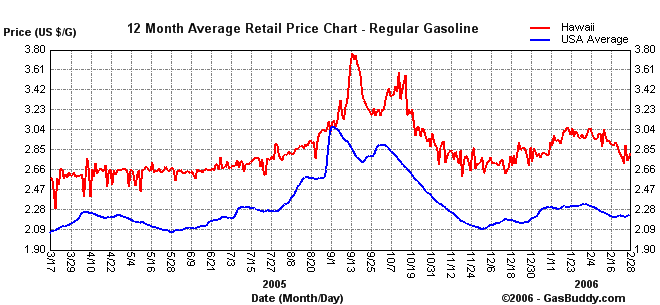
Note that before the law came into effect on September 1, Hawaii gas prices were about 38-57 cents higher than the US average. After September 1, prices were about 57-78 cents higher. (Note the two expections shortly after Katrina, where the difference goes from 95 cents to 38 cents.)
Tuesday, February 28, 2006
Give Trade a Chance
A random walk along the Internet today led me to a disdainful look at Thomas Friedman, which led me to his Wikipedia entry, which led me to a criticism piece entitled, "FLATMAN I'm sorry, but the world's still round."
I have mixed feelings about Friedman: I don't agree with him that America needs to compete to maintain it's hold on high tech sectors nor do I feel that the US needs to maintain a dominance in finance. No one thing is the key to prosperity; that's what globalization is for in the first place.
He has some interesting takes how globalization changes cultural norms, though. And while he might put too much stock in the idea of trade as a universally peaceful solution (a la the Golden Arches Theory of Conflict Prevention) it conveys a powerful point. Take this criticism of the theory, penned by Siddharth Varadarajan: "cross investment and extensive trade relations have never prevented countries from going to war against each other."
That's quite a claim, especially since he's citing historical evidence. Especially since we tend not to study times war almost broke out (and we really don't study potential wars that never had a chance to break out, like the US invading Canada anytime in the past fifty or so years). It's hard to measure trade's impact on peace and while I don't think it prevents all conflict, it's even more absurd to claim it prevents none.
I have mixed feelings about Friedman: I don't agree with him that America needs to compete to maintain it's hold on high tech sectors nor do I feel that the US needs to maintain a dominance in finance. No one thing is the key to prosperity; that's what globalization is for in the first place.
He has some interesting takes how globalization changes cultural norms, though. And while he might put too much stock in the idea of trade as a universally peaceful solution (a la the Golden Arches Theory of Conflict Prevention) it conveys a powerful point. Take this criticism of the theory, penned by Siddharth Varadarajan: "cross investment and extensive trade relations have never prevented countries from going to war against each other."
That's quite a claim, especially since he's citing historical evidence. Especially since we tend not to study times war almost broke out (and we really don't study potential wars that never had a chance to break out, like the US invading Canada anytime in the past fifty or so years). It's hard to measure trade's impact on peace and while I don't think it prevents all conflict, it's even more absurd to claim it prevents none.
Sunday, February 26, 2006
Newtonian Time
Taking a little study break, I added an article about Newtonian time to Wikipedia. Newtonian time is a facet of neo-classical economics and because of its rigidity, it assumes away endogenous change. Austrians openly reject the idea of Newtonian time and embrace real time instead, which is an article I'll write later.
Wow, this is what I do for my break? I'm going to go watch American Dad.
Wow, this is what I do for my break? I'm going to go watch American Dad.
Checking for Fallacies
Way back when, Mike and I came up with the idea of The Fallacy of the Unclaimed Dollar. I doubt this idea is new, but the fallacy goes a little something like this: If something hasn't happened yet, it's probably a bad idea. The name comes from a joke economists like to tell each other about a professor refusing to pick up a dollar bill because if it was really there, someone would have picked it up by now.
(Side Note: I actually want to change the name to Fallacy of the Unclaimed Fortune, but for consistency's sake, let's keep with the original name.)
It's recently occured to me that Austrians may be committing this fallacy despite our focus on the ongoing process of market change, that circumstances aren't predetermined. At the very least, we get dangerously close to commiting this fallacy when we dismiss a government agency as inefficent because "if it was a good idea, the private sector would have done it."
Granted, that's just the tip of the iceberg for arguments against Agency X (the government isn't spending their own money; they don't have a strong vested interest in being effective or efficent; they lack the relevant knowledge to accomplish such a task and on and on and on). And far be it from me to suggest a rationale for government agencies. But if we are to be scientists and if we are to avoid the intellectual traps of lazy or simplistic arguments, we should be prepared to move past this standard claim and acknowledge this is not a sufficient argument for everything.
(Side Note: I actually want to change the name to Fallacy of the Unclaimed Fortune, but for consistency's sake, let's keep with the original name.)
It's recently occured to me that Austrians may be committing this fallacy despite our focus on the ongoing process of market change, that circumstances aren't predetermined. At the very least, we get dangerously close to commiting this fallacy when we dismiss a government agency as inefficent because "if it was a good idea, the private sector would have done it."
Granted, that's just the tip of the iceberg for arguments against Agency X (the government isn't spending their own money; they don't have a strong vested interest in being effective or efficent; they lack the relevant knowledge to accomplish such a task and on and on and on). And far be it from me to suggest a rationale for government agencies. But if we are to be scientists and if we are to avoid the intellectual traps of lazy or simplistic arguments, we should be prepared to move past this standard claim and acknowledge this is not a sufficient argument for everything.
Wednesday, February 22, 2006
Dirty Deeds Done With Dogs
In an attempt to stave off the apparent orgy of dog-fighting going on Scotland, new anti-animal fighting laws will be going into effect shortly. The new laws punishes anyone engaging in activities related to the fights (including distributing tapes of them) with severe penalties of up to 12,000 pounds and up to a year in prison.
I really don't have a problem with dog-fighting, and not just because I'm a cat person. My main source of skepticism comes from the supporters of bills like these who then gladly eat bacon, chicken and humanity's other "animal friends."
I don't know how a feel about animal torture in general; my heart says it's wrong but my head can't figure out a reason and having "bad feelings" isn't enough to infringe on another's liberties. I do know that with all the crazy injustices going on the world, focusing on a small part of the population watching dogs fight is an absurd waste of one's time. I guess perspective is the first thing you loose when you live in a prosperous society.
I really don't have a problem with dog-fighting, and not just because I'm a cat person. My main source of skepticism comes from the supporters of bills like these who then gladly eat bacon, chicken and humanity's other "animal friends."
I don't know how a feel about animal torture in general; my heart says it's wrong but my head can't figure out a reason and having "bad feelings" isn't enough to infringe on another's liberties. I do know that with all the crazy injustices going on the world, focusing on a small part of the population watching dogs fight is an absurd waste of one's time. I guess perspective is the first thing you loose when you live in a prosperous society.
Sunday, February 19, 2006
O Brother, What Art Thou Thinking?
Last week Mike guest posted about labor laws and spawned a 10-comment (!) debate on the subject. I thought about responding to some criticisms via comment but since I don't have much of anything to write about just now, I thought I'd turn it into a post.
In the comments section, I wrote that employers should be able to fire employees for whatever reason they want. And yes, that includes for reasons of race, marriage status, religion and every other distinction you can think of. Why? Consider the reasons an employer would do this: 1) because he's a jerk in which case it's his lose and 2) because the customer wants it in which case why punish the employer? Before you argue, ask yourself if you'd like to see Denzel Washington as a Nazi or William H. Macy as Martin Luther King. It's an extreme case, but the basic ideas are constant.
My brother correctly pointed out that firms do not fire people on a whim and they have a vested interest in seeing them work out. Yet he paradoxically thinks it's a good idea to require firms to have "proof of ineptitude" before firing someone. If the firm has a vested interest in seeing the employee do well, then why do you need a law requiring the firm not fire employees that could do well? (Consider this article I wrote about Donald Trump and his hiring practices for The Apprentice.)
Labor laws like these are layered in truthiness. For example, my brother also cites that he's been in the "real world" for about nine years and implies I'm detatched from it's realities. But his experience is a weakness as much as a strength because he's only been on the labor side. Not surprisingly, he thinks labor should be protected from management citing the "human cost." Feelings as opposed to facts.
The fact of the matter is if you start favoring one group, you punish another and usually several others. I may have been in the "ivory tower" for most of my life but it's not like I've been studying English literature. Economics is the study of choice and it's chiefly concerned with creating a better world; the conclusions I have made have not been arrived at lightly. And for the record, I've worked jobs myself. I've had good employers and bad employers; I've seen good employees and bad employees. The world is not so uniform you can ethically make a law that favors one side; laws are good for issues of homogeneity, not diversity.
In the comments section, I wrote that employers should be able to fire employees for whatever reason they want. And yes, that includes for reasons of race, marriage status, religion and every other distinction you can think of. Why? Consider the reasons an employer would do this: 1) because he's a jerk in which case it's his lose and 2) because the customer wants it in which case why punish the employer? Before you argue, ask yourself if you'd like to see Denzel Washington as a Nazi or William H. Macy as Martin Luther King. It's an extreme case, but the basic ideas are constant.
My brother correctly pointed out that firms do not fire people on a whim and they have a vested interest in seeing them work out. Yet he paradoxically thinks it's a good idea to require firms to have "proof of ineptitude" before firing someone. If the firm has a vested interest in seeing the employee do well, then why do you need a law requiring the firm not fire employees that could do well? (Consider this article I wrote about Donald Trump and his hiring practices for The Apprentice.)
Labor laws like these are layered in truthiness. For example, my brother also cites that he's been in the "real world" for about nine years and implies I'm detatched from it's realities. But his experience is a weakness as much as a strength because he's only been on the labor side. Not surprisingly, he thinks labor should be protected from management citing the "human cost." Feelings as opposed to facts.
The fact of the matter is if you start favoring one group, you punish another and usually several others. I may have been in the "ivory tower" for most of my life but it's not like I've been studying English literature. Economics is the study of choice and it's chiefly concerned with creating a better world; the conclusions I have made have not been arrived at lightly. And for the record, I've worked jobs myself. I've had good employers and bad employers; I've seen good employees and bad employees. The world is not so uniform you can ethically make a law that favors one side; laws are good for issues of homogeneity, not diversity.
Friday, February 17, 2006
A Wee Bit of Culture
Prometheus is by far my favorite figure in Greek mythology. Defiant. Intelligence. A bit of a wise ass but also the patron of human civilization. Like the authors that wrote of him (notably Lord Byron and Percy Bysshe Shelly), he recognized the grand potential of free minds and free societies.
I stumbled on this poem about Prometheus, written by Lord Byron and published in 1816. Comparing Prometheus to the human spirit Byron wrote,
I stumbled on this poem about Prometheus, written by Lord Byron and published in 1816. Comparing Prometheus to the human spirit Byron wrote,
And a firm will, and a deep sense,
Which even in torture can descry
Its own concenter'd recompense,
Triumphant where it dares defy
Wednesday, February 15, 2006
Facts and Theories
At its most basic, good economics is about two things: good theory and good data. Some will say it's more about the data and some will emphasize the theory but a good economist combines both into a coherent explanation about the world around us. If your theory can't be supported by the data, you better rethink your theory. Yet if your data says one thing but you can't construct an explanation that's consistent with accepted truths, there's something probably wrong with your data.
That reality came to head Friday night when an AU student and I got into a discussion about income data. He pointed to the old claims that the rich are getting richer and the poor are getting poorer. Remembering an IHS seminiar Steve Horwitz spoke at a few years ago, I pointed to data that said the poor were getting richer, too.
He responded that the data--which tracks a family's income over time--is flawed because poor people move more than other people, so you don't count them and there's a sampling bias. He, who has been studying income data for ten years, noted stasticians have come up with a weight to adjust for this and when applied, the poor are getting poorer. (Note that according to the data 95% of the lowest quintile move up from it at least one quintile, suggesting that must have been one hell of a weight to make such a drastic change. Perhaps poor people are literal nomads...)
I've never heard of this weight, so I let it go and gave him the benefit of the doubt. "So what's your explanation, then?" I asked. His theory was quite....elaborate.
He noted that the rich are more likely to save than the poor. Seems reasonable. So, he said, the rich put their money in a bank and live off the interest and the wealth stays at the top. I insisted we follow the money beyond that. So we agreed that the bank could then take all of that money and lend it to a corporation which then could give it all to their highest paid inwhich the whole cycle could start over again.
Now to fully grasp this AU student's theory, replace every "could" with "always" because that's the only way the money could stay at the top. He insisted that all you need is that higher liklihood for savings but, as I tried to explain, that doesn't work. Money leaks out and spreads around; it moves between classes, industries and countries. It's a medium of exchange--that's why we have it.
I also wanted to point out that even if this "100% always" theory held, it still wouldn't mean the data's telling a good story. Companies don't give millions to CEOs just because they feel like--they do it as a reward for making the company more efficient which means society just got richer. I avoided that point, however, as I suspected the conversation would quickly devolve into conspiratorial claims that the rich focus on keeping the downtrodden poor.
Still, the bias claim was new to me so I e-mail Steve Horwitz about it. He responded quite quickly and suggested the burden of proof rests on the AU student. The PSID data is highly respected and widely used; what special ability allows for him to know how much to reweight the data? I'm not sure how I feel about this; it seems pretty straightforward to run surveys and ask people how many times they've moved in the past five or ten years, even if you include complications such as students moving from college to home.
But Steve offered an even better bit of evidence that the poor have gotten richer over the past thirty years: They have more stuff. Even if there's more debt, are they really "poorer" if that debt means having AC, cable and a washer and dryer? They clearly don't think so.
If your theory is sloppy, then your data probably is too, especially when your data contradicts accepted truths.
That reality came to head Friday night when an AU student and I got into a discussion about income data. He pointed to the old claims that the rich are getting richer and the poor are getting poorer. Remembering an IHS seminiar Steve Horwitz spoke at a few years ago, I pointed to data that said the poor were getting richer, too.
He responded that the data--which tracks a family's income over time--is flawed because poor people move more than other people, so you don't count them and there's a sampling bias. He, who has been studying income data for ten years, noted stasticians have come up with a weight to adjust for this and when applied, the poor are getting poorer. (Note that according to the data 95% of the lowest quintile move up from it at least one quintile, suggesting that must have been one hell of a weight to make such a drastic change. Perhaps poor people are literal nomads...)
I've never heard of this weight, so I let it go and gave him the benefit of the doubt. "So what's your explanation, then?" I asked. His theory was quite....elaborate.
He noted that the rich are more likely to save than the poor. Seems reasonable. So, he said, the rich put their money in a bank and live off the interest and the wealth stays at the top. I insisted we follow the money beyond that. So we agreed that the bank could then take all of that money and lend it to a corporation which then could give it all to their highest paid inwhich the whole cycle could start over again.
Now to fully grasp this AU student's theory, replace every "could" with "always" because that's the only way the money could stay at the top. He insisted that all you need is that higher liklihood for savings but, as I tried to explain, that doesn't work. Money leaks out and spreads around; it moves between classes, industries and countries. It's a medium of exchange--that's why we have it.
I also wanted to point out that even if this "100% always" theory held, it still wouldn't mean the data's telling a good story. Companies don't give millions to CEOs just because they feel like--they do it as a reward for making the company more efficient which means society just got richer. I avoided that point, however, as I suspected the conversation would quickly devolve into conspiratorial claims that the rich focus on keeping the downtrodden poor.
Still, the bias claim was new to me so I e-mail Steve Horwitz about it. He responded quite quickly and suggested the burden of proof rests on the AU student. The PSID data is highly respected and widely used; what special ability allows for him to know how much to reweight the data? I'm not sure how I feel about this; it seems pretty straightforward to run surveys and ask people how many times they've moved in the past five or ten years, even if you include complications such as students moving from college to home.
But Steve offered an even better bit of evidence that the poor have gotten richer over the past thirty years: They have more stuff. Even if there's more debt, are they really "poorer" if that debt means having AC, cable and a washer and dryer? They clearly don't think so.
If your theory is sloppy, then your data probably is too, especially when your data contradicts accepted truths.
Tuesday, February 14, 2006
Labor Laws
This is Mike, Guest Posting here. More like homecoming, but I still consider myself a guest. I told the story below to David, who begged me to blog it. I am currently studying Anthropology and Buddhism in Thailand, which gives me an interesting chance to see a lot of economic questions in a slightly different setting. Depending on my reception I may blog some of those too.
A friend of mine from Germany and I had dinner the other night and discussed German labor laws. In Germany it is exceedingly difficult, or at least very costly to fire a person. A very solid foundation of evidence of incompetence and damage to the firm must be laid before even thinking about firing a person, because a lawsuit and a government intervention will speed right in to the rescue. The intent, as is the intent with so many economic policies, is to benefit the poor, oppressed working classes against the evil corporations. The actual effect I leave as an exercise to you. I would suggest as a starting point that the laws benefit the already employed at the expense of the desiring-to-be-employed and the bottom lines of the employers. However, some employers have found an ingenious (if illegal) workaround.
Say an employee is peforming at a level that ought to get him fired but in Germany would not, due to the hassle. A manager at this employee's firm will speak to his counterpart in a competing firm and ask them to hire the employee away, through a headhunter. The employee, excited about being hired away, takes the job at the competitor and begins work there. Meanwhile, the new firm gives him a slight raise, but the raise and the salary are actually paid by the original firm. Why?
Because the labor laws allow a grace period of about a month after hiring in which companies can still fire new employees freely without much difficulty. So after a few weeks feigning due diligence, the new employee is unceremoniously let go, unable to sue his old firm which he left voluntarily and unable to sue his new firm which is exempt from the ruleswas still in the grace period. Apparently entire industries will engage in this kind of trade back and forth, under the table, all to maintain some form of efficiency.
The market finds a way, albiet a little messy. But who loses? That's right, labor.
A friend of mine from Germany and I had dinner the other night and discussed German labor laws. In Germany it is exceedingly difficult, or at least very costly to fire a person. A very solid foundation of evidence of incompetence and damage to the firm must be laid before even thinking about firing a person, because a lawsuit and a government intervention will speed right in to the rescue. The intent, as is the intent with so many economic policies, is to benefit the poor, oppressed working classes against the evil corporations. The actual effect I leave as an exercise to you. I would suggest as a starting point that the laws benefit the already employed at the expense of the desiring-to-be-employed and the bottom lines of the employers. However, some employers have found an ingenious (if illegal) workaround.
Say an employee is peforming at a level that ought to get him fired but in Germany would not, due to the hassle. A manager at this employee's firm will speak to his counterpart in a competing firm and ask them to hire the employee away, through a headhunter. The employee, excited about being hired away, takes the job at the competitor and begins work there. Meanwhile, the new firm gives him a slight raise, but the raise and the salary are actually paid by the original firm. Why?
Because the labor laws allow a grace period of about a month after hiring in which companies can still fire new employees freely without much difficulty. So after a few weeks feigning due diligence, the new employee is unceremoniously let go, unable to sue his old firm which he left voluntarily and unable to sue his new firm which is exempt from the ruleswas still in the grace period. Apparently entire industries will engage in this kind of trade back and forth, under the table, all to maintain some form of efficiency.
The market finds a way, albiet a little messy. But who loses? That's right, labor.
Monday, February 13, 2006
The Meaning of Collusion
Skeptics of the market love conspiracies; it's an easy way to side step the observed and provable to make outrageous claims. To no surprise of my own I came across a few conspiracy-laced theories Friday night, the most notable of which was the "implict collusion between car manufacturers."
What? I said. We see intense compeition between such firms; how can one claim they are secretly colluding?
Well, the AU student in question used to work in the industry and noticed the profit margins for car parts and vechiles was "identical." He concluded there's an acceptable level of profit and they collude to keep that profit steady.
I bypassed the obvious point that if they are setting the price they collectively could increase it easly suspecting he would respond with the standard "keeping up apppearances" defense. Instead, I pointed out that uniform prices are not evidence of collusion (though I don't doubt such prices are more or less uniform). An enforcement mechanism designed to hinder defection is evidence. What is the enforcement mechanism for car makers?
His answer was vague, claiming firms would be kept out of "special deals" if they defected. Backroom deals. Secret agreements. Implict collusion. It's not that I don't think conspiracies can't exist, it's just I'll only consider them a possibility if there lacks a better explanation.
To explain uniform prices, I noted the role of risk. Just as oil companies experience high profits and high losses (but unremarkable profits when the quarters are averaged), car companies probably demand higher mark ups because they deal in durable (and thus riskier) goods. At least one AU listener acknowledged the role of risk in determining profits but my fellow conversationalist did not seem to agree.
NOTE: My AU counterpart also cited the perfect competition model as evidence of collusion; in "perfect competition" there are no profits (which is not true; there are no windfall profts). Thus, the industry is not perfectly competitive. I told him it's distrubing when PhD econ students think a model completely describes reality. PC is useful to explain some phenomena but as Hayek noted, the model lacks all elements of actual competitiveness. He mumbled something and let the issue drop there.
What? I said. We see intense compeition between such firms; how can one claim they are secretly colluding?
Well, the AU student in question used to work in the industry and noticed the profit margins for car parts and vechiles was "identical." He concluded there's an acceptable level of profit and they collude to keep that profit steady.
I bypassed the obvious point that if they are setting the price they collectively could increase it easly suspecting he would respond with the standard "keeping up apppearances" defense. Instead, I pointed out that uniform prices are not evidence of collusion (though I don't doubt such prices are more or less uniform). An enforcement mechanism designed to hinder defection is evidence. What is the enforcement mechanism for car makers?
His answer was vague, claiming firms would be kept out of "special deals" if they defected. Backroom deals. Secret agreements. Implict collusion. It's not that I don't think conspiracies can't exist, it's just I'll only consider them a possibility if there lacks a better explanation.
To explain uniform prices, I noted the role of risk. Just as oil companies experience high profits and high losses (but unremarkable profits when the quarters are averaged), car companies probably demand higher mark ups because they deal in durable (and thus riskier) goods. At least one AU listener acknowledged the role of risk in determining profits but my fellow conversationalist did not seem to agree.
NOTE: My AU counterpart also cited the perfect competition model as evidence of collusion; in "perfect competition" there are no profits (which is not true; there are no windfall profts). Thus, the industry is not perfectly competitive. I told him it's distrubing when PhD econ students think a model completely describes reality. PC is useful to explain some phenomena but as Hayek noted, the model lacks all elements of actual competitiveness. He mumbled something and let the issue drop there.
Subscribe to:
Posts (Atom)

 Sunk Costs Cannot Be Retrieved.
