Showing posts with label Environment. Show all posts

Tuesday, November 15, 2011

Prices Solve Problems

As I read Naomi Klein's Nation article about climate change, I am once again reminded how little she knows about economics. So little, it is almost not worth pointing why she's wrong. Almost.
The fact that the earth’s atmosphere cannot safely absorb the amount of carbon we are pumping into it is a symptom of a much larger crisis, one born of the central fiction on which our economic model is based: that nature is limitless, that we will always be able to find more of what we need, and that if something runs out it can be seamlessly replaced by another resource that we can endlessly extract.
This is both completely wrong--scarce resources is what defines economics--and deceptively correct--we do assume we will adapt to greater scarcity. We assume this because when prices are allowed to function, we adapt. And we're adapting now. Let prices work, and we'll adapt more quickly.

We do not need to "shred" economic thought. We just need to make pollution more expensive. Right now, it's too cheap. Skeptics say it's not that much cheaper (if at all) than it should be. Believers say it's way too cheap. But regardless where you land, the answer is the same: adjust the price and you'll get the answer you want.

Klein makes suggestions--more public transportation, more planning, fewer coal-burning power plants, produce less pollution, make less stuff--which will all occur if we get the price of pollution right. (Of course planning will occur regardless if prices are right or not, regardless if it centralized or decentralized...the question is planning for what.)

Look: I don't know much about the science of climate change but I know that there's a consensus among people who know more than I that we're a big problem for the environment. The know more than I do: I respect that a lot.

So please respect this consensus from economists: The right prices solve problems.

Thursday, May 26, 2011

Some Years It's Just Windy

Bill McKibben credits climate change for the recent series of tornadoes decimating the Mid-West. This might be climate change related. On the other hand, it might just be random. I don't have the background to answer this question definitively, but nerdy curiosity led me to gather some data from the Tornado History Project.

THP keeps track of every single recorded tornado in the United States since 1950: where it was, its intensity, and even the path it took. I gathered tornado data from the past sixty years to see if the number of tornadoes have been trending upward.

"But wait!" you might say, "What if the number of tornadoes is the same but they are getting more intense? You can't just look at the number of tornadoes." Indeed I cannot. The way THP records tornado intensity is with the Fujita scale, ranging from F0 (min 40 mph) and F5 (min 261 mph). So I created an alternative time series of total tornadoes weighted by intensity. Admittedly, this approach is very simple but sufficient. Each F0 counts as one tornado; F1s each count as 2 two tornadoes, etc. Then I added them together. For example, in 1955 there were 116 F0s, 200 F1s, 163 F2s, 29 F3s, 8 F4s, and 2 F5s, or 518 total tornadoes and 1,173 weighted tornadoes. Below is the graph Excel spit out for me:


There's a pretty clear upward trend in that diagram, consistent with concerns over global warming. BUT this is assuming that we're just as good detecting tornadoes today as we were in the 1950s. If an F5 came through, I doubt that would get past anyone's radar regardless of where it touched down. But an F1 or F0 (i.e. the ones that are barely tornadoes) could slip past undetected without satellite imagery or other modern equipment. So what do the graphs look like without the small tornadoes? Much less frightening. Here's total tornadoes only counting at various thresholds of intensity:


And here's weighted tornadoes with the same thresholds:


The F0s seems to be doing most of the work, which does not fit with the global warming story. For completeness, here's the F0s over time. Most of the jump occurs in the early 1990s; I'm not sure why.


Again, this doesn't mean that the GW explanation isn't true, but it doesn't suggest it either. This data tells us that tornado activity varies widely. The ten-year low for all intensities is 934 tornadoes (2002) and the high is almost twice that: 1817 (2004, just two years later!).

Wednesday, September 01, 2010

Someone Should Have Gone to My Last Micro Lecture

When I taught micro this summer, I ended the class on an optimistic note: a growing world population is not an inherent problem. In fact, it is often a boon as more people translates into more active minds at work. We might consume more resources, but we also have more people solving the increasingly scarce resource problem. "People are more than mouths and stomachs," I say. "They are also hands and heads."

A man named James Jay Lee took hostages at the Discovery Channel HQ in Maryland today, demanding that, among other things, the Discovery Channel have prime time programming where
Focus must be given on how people can live WITHOUT giving birth to more filthy human children since those new additions continue pollution and are pollution. A game show format contest would be in order. Perhaps also forums of leading scientists who understand and agree with the Malthus-Darwin science and the problem of human overpopulation. Do both. Do all until something WORKS and the natural world starts improving and human civilization building STOPS and is reversed! MAKE IT INTERESTING SO PEOPLE WATCH AND APPLY SOLUTIONS!!!!
It gets stranger from there.

I'm not sure what's stranger about this man. That he believes people are pollution or that he believes Discovery Channel programming will encourage Africans to stop having children (fertility rates in most other areas are quite low). I wonder how many people in Niger get cable?

Sunday, March 28, 2010

Priorities on GW

Robert Stavins wonders who killed cap-and-trade and argues that
U.S. public support on this issue has decreased significantly, as has been validated by a number of reliable polls, including from the Gallup Organization. Indeed, in January of this year, a Pew Research Center poll found that “dealing with global warming” was ranked 21st among 21 possible priorities for the President and Congress.
A quick glance confirms this--global warming is not a top priority--but that's not a perfect measure. It could be a somewhat high priority on everyone's list which would mean it's still pretty damn important. Scroll down on the Pew link and you'll find that GW has never been that high as a top priority (topping 38% in 2007, when they started asking about it). It looks like GW was just edged out due to recent events; people haven't stopped caring. I wouldn't call it dead yet.

Thursday, July 30, 2009

On the Economics of Sidewalks

Today on the Kojo Nnamdi Show, DC residents debated the pros and cons of adding sidewalks to northwest neighborhoods that still lack them. Well, it was mostly pros, from making walking easier to complying with Americans With Disabilities act. The cons were concerned with losing what country-feel they had in the metro area and that few people actually use sidewalks that are installed.

But no one mentioned another problem with adding sidewalks, not surprising because the pros are unlikely aware of it and the cons wouldn't want to admit it: adding sidewalks increase foot traffic and make life harder on those that live there. In economic jargon, sidewalk traffic externalizes costs on surrounding residents.

Sidewalks make walking cheaper and so, no doubt, you'll get more foot traffic. That means more dog walkers, and the increased risk of the dog walker not cleaning up after her animal when he does his business. That means more children running around, and the higher likelihood of noise and damage from particularly active kids. It means more people lingering in a driveway, trampling lawns or flowers, and risk seeing you while being intimate with loved ones (sometimes you forget to close the drapes).

It sounds so selfish, but why should local residents bear the cost of other's enjoyment? The common theme when people called in is that they moved to those areas because the lack of sidewalks made it feel more rural. They were looking for one thing: isolation.

Note: For the record, I'm in favor of the sidewalks only because, in my estimation, the costs externalized onto residents with the sidewalks are likely lower than the costs which must be suffered by people because there are no sidewalks to use.

Wednesday, May 20, 2009

Waxman-Markey-Dobbs

The DC area gets policy advertisements, ones I never remember getting when I lived in Iowa or Wisconsin. Perhaps that's just because of population density, but I have feeling the "company" of this company town has a lot to do with it. Lately I hear a lot about the Waxman-Markey bill, a bill supporting cap and trade for carbon emissions. If cap and trade is better or worse than a carbon tax is debatable and I'm not sure on my position, but the arguments put forth looks like they were authored by Lou Dobbs.

China's making energy efficient lightbulbs and has other "green" industries, jobs they "took" from Americans. According to the ad, the bill will let us take those jobs back. If this the best argument for the bill (and it might be; Tyler Cowen reveals the benefits are hard to find), then we got a big problem. As Don Boudreaux likes to say, costs are not benefits. By forcing the costs of production higher (reflected by the fact that firms will produce these things in the more expensive US without additional gain), the economy becomes poorer, not wealthier. If jobs were wealth, the best thing the government could do is not eliminate trade, but eliminate technology.

Saturday, March 14, 2009

Hands and Heads

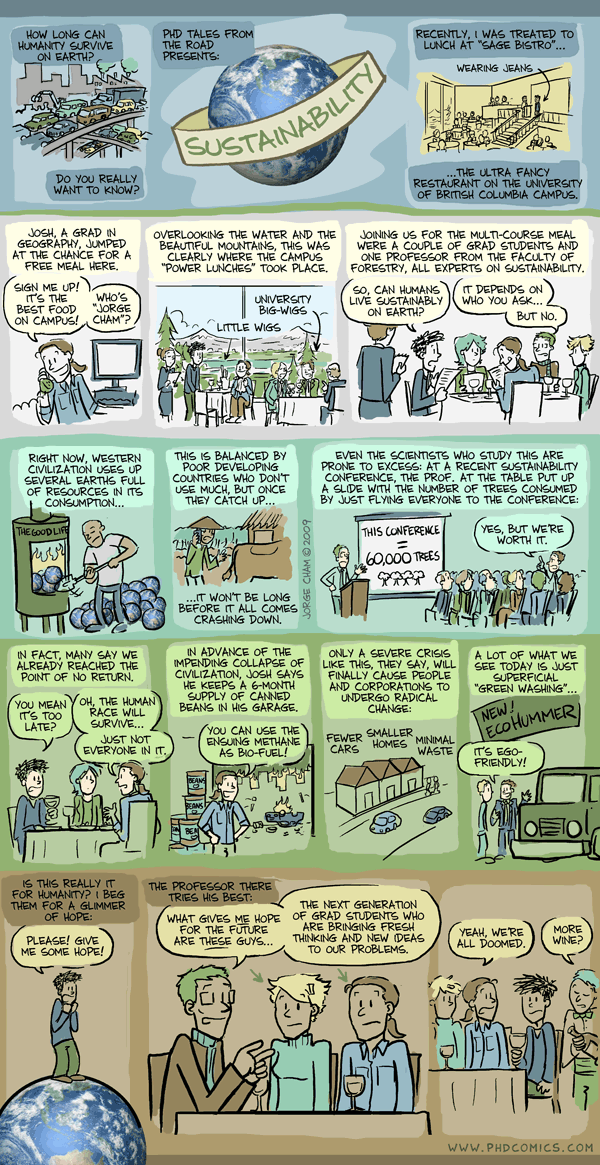
Here's the latest PhD comic, published yesterday:

The author, notably, did not consult an economist on the issue of sustainability, just foresters. And in doing so, we miss half of the evidence of what's going on when it comes to long term economic development. We are told people are just mouths and stomachs: they just consume and more people or development means more consumption. End of story. But people are also hands and heads: we produce and (most critically) we invent.

Which is the bigger factor? The evidence suggests that, certainly, in the short run consumption matters more. More consumption raises the price of goods (meaning they are more scarce). But the long run results (the sustainability concern) favors production. Goods (adjusted for inflation) keep getting cheaper. That short run boast in prices generates the incentive to ration, find substitutes, and ultimately develop new technology. People say it's different now, especially with energy (one of our most fundamental inputs). We've reached some peak that we can never return from. Armageddon is always just around the corner.

Humanity faced an energy shortage since our conception as a species. We sought it in plants, rivers, wind, fire, and a menagerie of animals. We built waterwheels, windmills, stoves, ships, sails, yokes, collars, carts, and harnesses in pursuit of of more efficient sources of energy. We dug mines all over the planet. Wood begot peat begot coal begot oil begot gas begot uranium. Now we seek it from the inner depths of out planet (geothermal) to the distant reaches of space (solar) and one theme permeates this unending quest of one of our most precious of resources: energy is cheaper. What new trend could have possibly emerged that makes them think it's suddenly different now?

Next time, Mr. Cham, I suggest you ask someone versed in both consumption and production. Next time, ask an economist.

Tuesday, June 03, 2008

When To Recycle and When To Not

There are four plastic bags near the front door of my parents' house each stuffed with a few weeks worth of newspaper bags. This is my mom's latest attempt to save the world. In her infinite foresight she's gathering these bags to "keep them out of the landfill." She plans to send them back to the newspaper company so they can reuse them. I somehow doubt they will.

Plastic bags are tremendously cheap, evidence in that are giving them away to customers. They still cost the company something but I doubt it'll be worth sorting through the bags to reuse them. Recycling's expensive and often not worth the time and effort. Though in some cases, like recycling cans, it is. People are willing to pay for the savings it brings. Note soda cans are one of the few places you are paid to recycle.

Recycling reduces space used in a landfill but so what? Is landfill space really so scarce that this is worth it? If it is, why aren't we charged per bag or per pound thrown out? Part of this is due to the city-run industry but the a bigger factor is that landfills aren't hurting for space, particularly out here in Iowa.

If you're not being charged to throw it out and if no one's willing to compensate you for your time it's not worth recycling. See a past post on this subject here.

Sunday, April 27, 2008

Worlds Within Worlds

Bill Maher fretted to Jeffery Sachs Friday that if all people of the world consumed like Americans we would need five Earths to supply the resources. Yet a hundred years ago, we could tell a similar story using Europe as a baseline instead of the States. How can I make this claim?

What Maher and Sachs are ignoring (as too many people do) is that if the people of the world used more resources, they would be able to produce more of them. More creativity, more inventions, more ideas, more productivity, more investment, more hands at work, more active minds. The history of the world is replete with scares of shortages and the panics never hold out to the adaptive world of free markets.

Tuesday, April 22, 2008

Earth Day Is Capitalism Day

On this Earth Day, George Mason University's Don Boudreaux celebrates what he calls Capitalism Day:
...far more than any other, has made human lives clean, safe, dignified, and culturally rich. Capitalism is also responsible for giving people the wealth and leisure to permit them to mis-perceive nature as loving and bountiful, and to enjoy nature in a way that few of our pre-industrial ancestors could ever have enjoyed it.
It is this latter point that is often ignored. A wealthier society is a gateway to all other things we value. Wealthier societies not only have more stuff (from Wiis to advanced medicine) and more options (for jobs, living areas, places to travel) they also give us the gift of time.

Time is our most precious resource. Our ability to save time (though greater productivity) is critical to our happiness. We spend time to enjoy the company of others, find love, seek enlightenment, discover our purpose in the world, and enjoy nature. In a lot ways, nature is a really nasty thing. It's a little strange we leave the safety of modern society to visit it. Nature is filled with bugs, dirt, and disease. The sun spews radiation. Some hiking trails are small and uneven, making it easy to get lost and then sprain an ankle. There is no plumbing, no Internet, and no one to gut and cook a fish for you. Poison ivy crops up in unexpected places. Water needs purification tablets and food needs to be hoisted in the air out of the reach of wild animals. Birds scream all the time. And this assumes it doesn't rain.

Few would ever want to live permanently in such a place and most that try don't last long. But all this "roughing it" can be fun if it's temporary; nature is best left as a tourist attraction. But only with the time capitalism awards us can we afford to "get away from it all" for days at a time. Visitors cut themselves off from the world that they rely on for everything they brought out to the wilderness to make sure they don't die. If there was no capitalism, if people were too busy to see how beautiful nature can be, we likely wouldn't have an Earth Day which celebrates the wilderness. Or, worse yet, we'd be out there all the time.

Thursday, April 17, 2008

The Secret Safety Record of Nuclear Power

When it comes to the environment and electricity there are two basic schools of thought for clean energy: nuclear power versus wind/solar (and occasionally hydroelectric). Nuclear power has the advantage of being reliable (the weather doesn't effect it so it's great for base-line power) and cost effective. Its main problem is that it's scary.

There's only been two major accidents in nuclear power history--Chernobyl and Three Mile Island. Lots of other accidents involving isolated radiation leakage occur, but it's the disaster scenarios that people are scared of. It's very strange, much like how people are afraid of flying because there's been a few big accidents yet don't bat an eye at the thousands of car wrecks a year. If we want to truly judge the safety of nuclear power versus other sources, let's examine how many people die per terawatt-hour. Note these deaths can occur in many ways, such as accidents, pollution, construction and maintenance.

Coal: 32.6
Solar: 0.83
Wind: 0.4
Nuclear: 0.052

The solar rate are based largely on rooftop solar and most of it comes from the danger of installing it (roofing is one of the most dangerous occupations in the States). See this article for more information. I picked up the coal and nuclear numbers from this article.

Granted, it's difficult to tell how dangerous nuclear power is given the long-term effects of radiation and issues regarding nuclear waste. At the same time since nuclear power is so much cheaper its customers could afford other things that they couldn't otherwise such as healthier food or better medical care. The net effect is far from obvious but it seems unlikely to overcome the ten-fold increase in the death rate compared to its clean alternatives. Nuclear power is a lot safer than you think.

Tuesday, January 15, 2008

Green Greed

In our own way, we are all environmentalists. Rare is the person who desires to see animals go extinct or bulldozes old growth forests for kicks. The question is not should we embolden the natural environment but how.

Enter such phrases as "free market environmentalism." Economic development and environmental protection are not mutually exclusive, though pundits often paint them as such. Polluting less can save a company money; all pollution is something the company bought, reformed, and then throws away. A power plant in my hometown sells its excess heat to an adjacent Alcoa plant instead of the Mississippi River. The plant is happy, Alcoa's happy, and the fish are happy.

Economic growth comes from fulfilling people's desires and that includes environmental concerns. Harry Smith at CBS writes to inform us of a car that runs on batteries instead of the internal combustion engine. Ok, it may not get rid of pollution if the homes are powered by coal plants or the supply chain to make the battery yields a net loss. But it does demonstrate that firms are willing to invest millions in these new technologies because they know it will attract paying customers. To paraphrase a great economist, it is not from the benevolence of the builder, the banker, and the boss that we expect a cleaner environment, but from their regard to their own self interest.

Saturday, September 15, 2007

You Shouldn't Take It With You

An anti-trash activist (I didn't catch her name) spoke on NPR yesterday encouraging people to try her experiment. Instead of throwing things away, she said, people should carry everything that doesn't go into their compost in a trash bag with them to raise awareness about how much people throw away. There's too much waste, she said. People are just too selfish.

True, waste is expensive which is why people are always trying to reduce it. But only up to a point. Disposing garbage is still quite cheap: evidence this activist is more single-minded than revolutionary. While she tries to guilt us into paying more for effectively nothing, we have to smell her garbage. Talk about selfish.

Tuesday, July 31, 2007

Don't Panic

Yesterday on NPR I heard an interview with an author (I didn't hear the name) about his new book (I didn't hear the title, either). What caught my attention was that the author implored listeners and readers to reduce the amount of resources people use. That grocery stores give away plastic bags for free should be a crime, he said. Most economists have a different view: don't panic.

For example, one should ask why do stores give away plastic bags? They certainly didn't get them for free--why give them away? The answer is pretty obvious (customers demand it) but the lesson is not. Plastic bags are clearly cheap (if they costed a dollar each, I'm sure most stores wouldn't give them away) and because they are so inexpensive the resources that made them are relatively abundent. (Plastics take very little oil to make and tend to be made out of the part of crude oil that's low quality.) If some component of plastic bags becomes more scarce, the price of bags rises and people adapt. Stores might charge people for bags, creating an incentive for customers to bring in their own cloth one (something this author suggested everyone do even though this scarcity is not yet occuring).

People have a very hard time understanding that as long as people have an incentive to innovate, we will always be able to solve new resource problems that come our way. That has been the great trend of human history. Every time doomsayers claim we've reached a limit to technology, they've always been proven wrong. The author noted that all animals when they've used up their resources start dying out. He proposed that since humans are no different more countries should start exploring a one child policy to reduce "overpopulation." But people are fundamentally different than animals. We have the capacity to create (farm, invent, etc) the resources we need for our survival. This fundamental difference insures us against ourselves. Mandating we all conserve now takes away from that capacity and diminishes the incentive (fewer inventors and less profit opportunity). The best thing you can do for the environment and the future of humanity is, in the words of a great book, Don't Panic.

Thursday, July 26, 2007

US Government Sends Sheep to Death

The U.S. Fish and Wildlife Service might be setting aside 400,000 acres of habitat for the endangered Sierra Nevada bighorn sheep. The land will be a de facto commons--officially protected but in practice much too hard to enforce. I'd wager that this graceful animal is in for a rough time: with only a handful of rangers protecting it and legions of men with guns wanting to kill it before their competition does, it appears the US government is setting up a classic tragedy of the commons.

But this historically disastrous set up is not the only problem the sheep faces. One of the reasons it's numbers fell was because the herds would intermingle with domestic sheep and disease would pass from the farm animals to the wild ones, causing mass deaths. With nobody owning the bighorns, nobody was there to care what the sheep did to them (though there was certainly those that were watching their domesticated herd for signs of problems). In this case, the sheep farmers were externalizing a cost onto the wild. But nobody owned the wild so nobody noticed. Not until it was too late.

Instead of preventing the average person from wanting to protect these animals, the US government should look into allowing to own, kill, and profit from them. That way there will be legions of those making sure the bighorn stays around for a long time, instead of legions trying to beat each other to the last one.

Socially Optimal

Ever since the green revolution there's been a great deal of talk about the need for firms to be "socially responsible." I'm honestly not sure what that means and I'd venture most people don't, either. Perhaps it means that companies should not pursue only profits but also, say, protect the environment even if it's very costly. That might make conventional environmentalists feel good inside but not the rest of society, who has to shoulder those costs. What people often don't recognize is that pursuing profits can protect the environment; one just needs to adjust the incentives.

The Star Online, for example, applauds the growing trend that electronic companies are adding recycling programs to reduce waste. But what is strangely missing from the article is the fact that firms have reasons to recycle beyond making their customers feel good or in the pursuit of some good feelings/PR. The real issue is that often people (and this usually extends to firms, at least in my experience) are charged a flat rate (or no rate) every month or year to throw all their garbage away. Sending three tons a month to the dumpster costs exactly the same as sending one ton (my students would recognize this as a fixed cost). It costs essentially nothing for a firm to send those two tons to the landfill. But recycling those two tons is expensive--sorting, cleaning, and special trips is costly. Is it any wonder that widespread corporate recycling is newsworthy?

Instead of municipal dumps charging a flat rate for throwing things away, why not charge per ton? This landfill in Salinas Valley does (though it notably charges nothing for electronics, what the article in the Star focuses on). That way when a landfill becomes crowded, the price will go up and people will recycle more. But when a landfill is mostly empty, the price will be low and we can avoid those costly activities recycling demands (such as the second or third truck that has to drive around the city). But no matter what, we can depend on firms being socially responsible.

Thursday, June 28, 2007

A Clean Environment is a Luxury Good

Despite the blame on America for massive pollution, the 10 Cities with the Worst Air Pollution are all in developing countries. The richer people are, they can demand more that their environment be cleaner.

Cairo, Egypt: 11.1 million
Delhi, India: 15 million
Kolkata, India: 14.3 million
Tianjin, China: 7 million
Chongqing, China: 6.4 million
Kanpur, India: 3 million
Lucknow, India: 2.6 million
Jakarta, Indonesia: 13.2 million
Shenyang, China: 4.7 million
Zhengzhou, China: 2.6 million

Saturday, June 16, 2007

No Green, No Green.

Libby Rosenthal at the NYT noted with disgust that "going green" seems to be solely focused on making money. Instead, we should focus on taking care of the environment because "it is the right thing to do." In fact, the economic benefits may be exaggerated.

The strange thing about the article is that the author just gave every reader a reason to not go green. Good feeling and a guilty conscience only gets one so far. But the pursuit of wealth, as Julian Simon pointed out, is the most reliable motivator to ensure humanity does not strip it down to nothing.

Thursday, June 07, 2007

Well Meaning Environmental Effort from the 1970s

In the 1970s there was a well intended project that put about two million tires off the coast of Florida to create an artificial reef. The result? They didn’t support sea life and have been destroying coral. Now the state is spending $2 million to remove 700,000 of the tires to fix the problem.

The law of unintended consequences is something to keep in mind for any legislation, especially with something as complicated and intricate as the environment.

Wednesday, May 02, 2007

My Love for Bags

Last week Jason sent me an article in the Chicago Tribune by Beloit College (my alma mater) professor Ted Rueter. Prof. Rueter, who joined the political science department last year, writes that plastic bags are becoming the great scourge of the environment. Americans discard one hundred billion bags each year. They don't biodegrade (anytime soon anyway) and they are rarely recycled.

Let's set aside that recycling is rarely better for the environment. Let's even set aside the related notion that since people aren't being paid to recycle, it's probably not a good idea to. Instead, I'd like to challenge Prof. Rueter's take on preferences.

Prof. Rueter writes "...plastic bags are four times cheaper than paper bags and are lightweight and water resistant. However, the virtues of plastic are overriden by its vices." In other words, these very real benefits are completely and utterly cancelled out by pollution. I don't know if he actually believes this (perhaps he hasn't yet had to get groceries during one of the Midwest's many nasty storms) but even if it's true he's just one guy. For him plastic bags are not worth the harm they do to the environment (which is actually quite small since they just sit in lined landfills). But everyone else clearly doesn't share his priorities since most of them don't recycle bags.

What it means to be happy or wealthy is always different for anyone you meet. For some it's all about a clean environment. Others care mainly for large paychecks. Still others see fast computers as their Nirvana. These are all nice things, but if we want a happier or wealthier society we have to understand what's good for one person isn't always worth the sacrifice for another. If Prof. Rueter doesn't like plastic bags so much, then he should start collecting them from others instead of telling them to live like him.