There are very few wide ranging Rules of Economics, especially when you compare it to the hard sciences. Easily one of the most basic is "incentives matter." We see it everywhere: when prices increase, supply responds as fast as it can; when a grocery line is shorter, people are more likely to gravitate towards it; when wages for a job increase, more people are willing to do the work. Incentives play as vital role in economics as gravity does in physics.
So imagine my surprise when one of my first conversations with an AU econ grad student involved him saying "incentives aren't that important." I was stunned.
He stated that many people do things without monetary gain. In a way, it's true. Most of human history existed in a cooperative structure where people--in small family units--did favors for each other. But that doesn't mean incentives aren't important. Sometimes people do things for moral or social reasons. Sometimes it's as basic as simple survival. Sometimes you do something nice because it gives you a warm fuzzy feeling. All organisms are creatures of purpose and humans are no expection.
Ok, my colleague said, so why can't we use moral or social incentives do get things done? Why the emphasis of material incentives? He cited collective farms as a prime example where people pitch in out of sense of community. I have no doubt these communities exist because they emulate the social structure of hunter-gatherer societies. Large scale societies (and by "large" I talk of a hundred or more) tend not to be able to function in this way.
There are many reasons why this is but I would say enforcement is a main one. Allow me to digress into a personal example. I went to a very small school--my graduating class was ten and that was a big class. There were roughly thirty students in the high school in total. Thus we pretty much hung out with each other even if we had little in common. (In fact, of these thirty-odd people I only consider a few to be friends and I talk regularly to an even smaller number.)
Contrast this with most high schools, which are much larger. Clicks are not just common, they are a staple of growing up (and being an adult come to think of it). People gravitate towards those that are like them. In small societies, if you piss off others, you're alone. In large ones, if you piss off others, you just hang out with your friends. Typical strategies of guilt and ostracism don't work between strangers.
Not all kinds of incentives matter all the time. Social incentives work better in small groups; material incentives work better in large groups. But I'm not willing to say incentives aren't that important no more than I'm willing to point to a hot air balloon and question the significance of gravity.
Sunday, February 12, 2006
Saturday, February 11, 2006
Through the Looking Glass


Last night I had a date with this girl I met online. It turned out we were both first year PhD economics students (me at Mason, she at American) and we've been talking via e-mail comparing classes.
During this date, I discovered that American University's economic department leaned left. So after dinner, we decided to go to meet up with some of her friends from the program in a bar. It was here I discovered AU's program was Very Leftist.
It's hard to overstate how different I learned our departments and student body were. When I mentioned I was from Mason, there were cringes and looks of horror. When I noted I had friends at Cato and IHS, they were visibly shaken. They talked of the Soviet Union just not having the right people in charge, of incentives not mattering that much and an "implict collusion" between car makers.
I had never fathomed an economics department could seriously embrace these ideas in this day in age, especially at a world-renown school like American. But there it was, Ying to Mason's Yang; stir to Mason's shake; Bizarro to Mason's Superman (or perhaps more appropriately, Superman to Mason's Bizarro because Superman is a socialist).
Over the next few blog posts, I plan to retell--to the best of my ability--some of the discussions I engaged in with AU's econ students. I think it's worthy to engage in such dialogues; its helpful and neccessary to do so if you want to continue to claim to be a scientist. Hopefully my retellings will demonstrate that.
During this date, I discovered that American University's economic department leaned left. So after dinner, we decided to go to meet up with some of her friends from the program in a bar. It was here I discovered AU's program was Very Leftist.
It's hard to overstate how different I learned our departments and student body were. When I mentioned I was from Mason, there were cringes and looks of horror. When I noted I had friends at Cato and IHS, they were visibly shaken. They talked of the Soviet Union just not having the right people in charge, of incentives not mattering that much and an "implict collusion" between car makers.
I had never fathomed an economics department could seriously embrace these ideas in this day in age, especially at a world-renown school like American. But there it was, Ying to Mason's Yang; stir to Mason's shake; Bizarro to Mason's Superman (or perhaps more appropriately, Superman to Mason's Bizarro because Superman is a socialist).
Over the next few blog posts, I plan to retell--to the best of my ability--some of the discussions I engaged in with AU's econ students. I think it's worthy to engage in such dialogues; its helpful and neccessary to do so if you want to continue to claim to be a scientist. Hopefully my retellings will demonstrate that.
The Return of Mike
My old blogging partner (and co-founder of L3) Mike will be back for a guest post. Let us all wish him the best of luck and hope he decides to stay. His articles are always insightful and thought-provoking and I'm looking forward to reading his economic commentary once again.
Friday, February 10, 2006
Quick! Someone Give Us Something To Honor!
Here's a sampling of what the House did on Legislative Day of February 8, 2006:
-H.RES.670: Congratulations to the Pittsburgh Steelers for winning the Super Bowl.
-H.R.4456: Renaming a post office in Arkansas the "Hattie W. Caraway Station."
-H.R.389: Saying how great museums are in this, the "Year of the Museum."
-H.R.660: And let's not forget this month is National Mentoring Month which stands for some pretty awesome ideas.
-H.R. 657: Catholic schools are pretty cool, too.
Each of these required 40 minutes of debate (I'm thinking debate is a requirement for all resolutions). Don't get me wrong: I'm all in favor of lawmakers wasting time; it gives them less time to do something damaging. But as long as they are not doing anything really important, they might as well be occupied doing something productive like picking up trash. Crimminals do it so it's got to be good enough for politicians, right?
-H.RES.670: Congratulations to the Pittsburgh Steelers for winning the Super Bowl.
-H.R.4456: Renaming a post office in Arkansas the "Hattie W. Caraway Station."
-H.R.389: Saying how great museums are in this, the "Year of the Museum."
-H.R.660: And let's not forget this month is National Mentoring Month which stands for some pretty awesome ideas.
-H.R. 657: Catholic schools are pretty cool, too.
Each of these required 40 minutes of debate (I'm thinking debate is a requirement for all resolutions). Don't get me wrong: I'm all in favor of lawmakers wasting time; it gives them less time to do something damaging. But as long as they are not doing anything really important, they might as well be occupied doing something productive like picking up trash. Crimminals do it so it's got to be good enough for politicians, right?
Hippies Get High (But In A Way That Makes It News Worthy)
Mike sent me an e-mail containing this link with the exclamatory subject, "Malthus!"
The link led me to a page describing "Z-Axis Urban Agriculture," otherwise known as putting a bunch of plants in a skyscraper. The article warns of the growing population growth of the planet and even with improved technology, humanity may have trouble finding the land to feed itself (which may or may not be true as we don't know what this new technology will look like).
The article trumps the buildings as a way to reduce a community's "ecological footprint" and other nonsense about needing to increase the quality of urban settings. The artist's conception even sports tiny wind power plants at the top.
The strangest bit about all of this is Julian Simon had a similar idea except he was more ambitious. Using hydroponic bays, we could grow all the food for the whole world in a giant 100-story building the size of a small state (I think it was New Jersey).
Simon, however, was using it only as a hypothetical point to illustrate how humanity was in no danger of "running out of farm land" as these cranks claim we are. It's true that ideas like Z-axis farming are what ensure we don't have to worry about a food shortage and in doing so, these neo-Malthusians are proving their own scares false.
The thing I can't get past (besides the staggering but so far uncited panic number that 80% of the arable land is farmed) is the effort to make a test farm in New York from an abandoned building as part of the general strategy. If land is becoming so scarce, how come there are all these abandoned buildings in urban areas (where land is generally more valuable than its counterparts in rural areas).
If and when this becomes an important tool to feed humanity, it will happen because the rising food prices will make such an endeavor profitable. If not, then not. Either way, we don't need neo-Malthusians making test farms, spreading panic in their wake.
The link led me to a page describing "Z-Axis Urban Agriculture," otherwise known as putting a bunch of plants in a skyscraper. The article warns of the growing population growth of the planet and even with improved technology, humanity may have trouble finding the land to feed itself (which may or may not be true as we don't know what this new technology will look like).
The article trumps the buildings as a way to reduce a community's "ecological footprint" and other nonsense about needing to increase the quality of urban settings. The artist's conception even sports tiny wind power plants at the top.
The strangest bit about all of this is Julian Simon had a similar idea except he was more ambitious. Using hydroponic bays, we could grow all the food for the whole world in a giant 100-story building the size of a small state (I think it was New Jersey).
Simon, however, was using it only as a hypothetical point to illustrate how humanity was in no danger of "running out of farm land" as these cranks claim we are. It's true that ideas like Z-axis farming are what ensure we don't have to worry about a food shortage and in doing so, these neo-Malthusians are proving their own scares false.
The thing I can't get past (besides the staggering but so far uncited panic number that 80% of the arable land is farmed) is the effort to make a test farm in New York from an abandoned building as part of the general strategy. If land is becoming so scarce, how come there are all these abandoned buildings in urban areas (where land is generally more valuable than its counterparts in rural areas).
If and when this becomes an important tool to feed humanity, it will happen because the rising food prices will make such an endeavor profitable. If not, then not. Either way, we don't need neo-Malthusians making test farms, spreading panic in their wake.
Wednesday, February 08, 2006
40 Acres and an iPod
Mike sent me this link. Watch it; apparently Lincoln and Washington knew the power of electronics.
Tuesday, February 07, 2006
Mixed Feelings From the House
I never thought I'd say this, but reading the daily proceedings from the House floor has actually made me more optimistic about government (though I wasn't very optimistic in the first place).
Consider their activities on the first of February, 2006. The House debated for forty minutes on H. Res. 648. An intense debate it must have been because HR 648 "eliminate floor privileges and access to Member exercise facilities for registered lobbyists who are former Members or officers of the House." (They passed it, by the way.)
At the same time, I get more concerned. They spent the same amount of time debating H.R.4659, which extends the Patriot Act (it also passed by the way and was signed by the President four days ago).
And then I get confused. For example, at 5:07 the "House agreed to Senate amendment to House amendment pursuant to H. Res. 653." which relates "to consideration of the bill (S. 1932) to provide for reconciliation pursuant to section 202(a) of the concurrent resolution on the budget for fiscal year 2006 (H. Con. Res. 95)."
But the most damning thing of all is they took a week off, due to reconvene today at 2 PM. God only knows what they did in the meantime.
Consider their activities on the first of February, 2006. The House debated for forty minutes on H. Res. 648. An intense debate it must have been because HR 648 "eliminate floor privileges and access to Member exercise facilities for registered lobbyists who are former Members or officers of the House." (They passed it, by the way.)
At the same time, I get more concerned. They spent the same amount of time debating H.R.4659, which extends the Patriot Act (it also passed by the way and was signed by the President four days ago).
And then I get confused. For example, at 5:07 the "House agreed to Senate amendment to House amendment pursuant to H. Res. 653." which relates "to consideration of the bill (S. 1932) to provide for reconciliation pursuant to section 202(a) of the concurrent resolution on the budget for fiscal year 2006 (H. Con. Res. 95)."
But the most damning thing of all is they took a week off, due to reconvene today at 2 PM. God only knows what they did in the meantime.
Channel 101 101
Last week I posted an article about Channel 101, praising it as an improved institution over conventional television.
My colleague, Jason Briggeman, disagrees passionately as he notes that voting in the conventional sense (the prime mechanism for which 101 uses to determine which shows to keep) is not the same as watching a show every week and "voting" that way. The former is simply "talk," putting your stamp of approval, that really doesn't bear a cost to you, on a show of which you shrug your shoulders and say, "why not?" The latter requires the voter to bear a very real cost, such as spending the time to watch the show in question. The former does not. Jeremy made a similar agrument commenting on the difference between American Idol voters and the Billboard rankings.
These are very good points, but let me take a moment to defend 101's methods. I acknowledge that imposing costs for voting is a much more accurate way to discover what people want, ceteris paribus. But it isn't completely divorced from preferences; it still has its uses. More fundamentally, expressing choice for media is not easy because one must consume the product before determining if it was a good idea to do so.
Media companies have developed a few ways of getting around this problem (creating previews, measuring returning audiences, creating advertising campaigns) but these strategies are hardly appropriate for five-minute shows that are to be judged on a episode-by-episode basis (for example, measuring returning audiences would require making two episdoes of a potentially bad concept, meaning one new show wouldn't have as much of a chance to be shown, thanks to opportunity costs). I've toyed with the idea of spliting up each episode and then measuring how many people download the second half, but downloading 2.5 minutes of video nowadays hardly imposes a cost on the consumer. Perhaps there is a good idea out there to solve the problem, but I haven't heard it yet.
It is not that voting (which by the way is approval voting) on 101 is ideal. But given the turnover, 101 does what is sets out to do; the voting system is certainly sufficent and (I'd argue) Channel 101 much more dynamic than conventional television as a result. (Jason and I did come to the agreement that if 101 became mainstream, it could just start turning out crap, depending how it was organized.)
My colleague, Jason Briggeman, disagrees passionately as he notes that voting in the conventional sense (the prime mechanism for which 101 uses to determine which shows to keep) is not the same as watching a show every week and "voting" that way. The former is simply "talk," putting your stamp of approval, that really doesn't bear a cost to you, on a show of which you shrug your shoulders and say, "why not?" The latter requires the voter to bear a very real cost, such as spending the time to watch the show in question. The former does not. Jeremy made a similar agrument commenting on the difference between American Idol voters and the Billboard rankings.
These are very good points, but let me take a moment to defend 101's methods. I acknowledge that imposing costs for voting is a much more accurate way to discover what people want, ceteris paribus. But it isn't completely divorced from preferences; it still has its uses. More fundamentally, expressing choice for media is not easy because one must consume the product before determining if it was a good idea to do so.
Media companies have developed a few ways of getting around this problem (creating previews, measuring returning audiences, creating advertising campaigns) but these strategies are hardly appropriate for five-minute shows that are to be judged on a episode-by-episode basis (for example, measuring returning audiences would require making two episdoes of a potentially bad concept, meaning one new show wouldn't have as much of a chance to be shown, thanks to opportunity costs). I've toyed with the idea of spliting up each episode and then measuring how many people download the second half, but downloading 2.5 minutes of video nowadays hardly imposes a cost on the consumer. Perhaps there is a good idea out there to solve the problem, but I haven't heard it yet.
It is not that voting (which by the way is approval voting) on 101 is ideal. But given the turnover, 101 does what is sets out to do; the voting system is certainly sufficent and (I'd argue) Channel 101 much more dynamic than conventional television as a result. (Jason and I did come to the agreement that if 101 became mainstream, it could just start turning out crap, depending how it was organized.)
Saturday, February 04, 2006
Welcome To the 21st Century
Today on MSNBC, a guy (the Secretary, I believe) from Veterans Affairs pronounced a revolutionary development that change everything for providing veteran's health care. After building up the advancement to suggest a medical breakthrough, he smugly announced they've switched to electronic health records.
Excuse me? Dozens of sectors started using computers decades ago to coordinate and store data. American Airlines completed an automated reservation network as early as 1964. VA finally making it to the punch isn't revolutionary; it's meeting minimal standards. You want it to be revolutionary? Try jumping back half a century.
Excuse me? Dozens of sectors started using computers decades ago to coordinate and store data. American Airlines completed an automated reservation network as early as 1964. VA finally making it to the punch isn't revolutionary; it's meeting minimal standards. You want it to be revolutionary? Try jumping back half a century.
Tuesday, January 31, 2006
What Would Hayek Watch?
Imagine a channel where anyone can submit shows and the audience votes on which to keep every month. Where creativity is your greatest asset. Where new ideas are constantly being churned in, and then out. That's Channel 101; almost a standard television station, but completely different at the same time.
The premise is based on peer production. Anyone, from artistes to epigones, can submit a five minute show to the site. People vote on which shows they like and the winners are picked up for another episode. The losers go back to the drawing board. (Nifty diagram here.)
The best part about it is that there's no resting on your laurels. Even if you get picked up, you get picked up for just one show; the second, third or even twelveth episode is treated like a pilot for voting purposes.
Sadly the show is not as rooted in peer production as I'd like to see. Submitted pilots have to go through a screening process by the "Prime Timers" and one cannot take a failed idea and try to improved on it (well, one might be able to, but Channel 101 gives all legal rights of the episode to the submitter, so it might get messy). Moreover, only five ideas are allowed to be kept, even if there are six good ideas.
A lot of this is meant to simulate the corporate world so (I'm guessing) promising filmmakers can get a harsh dose of reality. According to the site, "Channel 101 is where you learn three things: How to fail, how to succeed, and finally, how there is no difference between the two....You surrender to the audience as life-giving God and acquire total creative freedom through that surrender."
The consumer is king!
The premise is based on peer production. Anyone, from artistes to epigones, can submit a five minute show to the site. People vote on which shows they like and the winners are picked up for another episode. The losers go back to the drawing board. (Nifty diagram here.)
The best part about it is that there's no resting on your laurels. Even if you get picked up, you get picked up for just one show; the second, third or even twelveth episode is treated like a pilot for voting purposes.
Sadly the show is not as rooted in peer production as I'd like to see. Submitted pilots have to go through a screening process by the "Prime Timers" and one cannot take a failed idea and try to improved on it (well, one might be able to, but Channel 101 gives all legal rights of the episode to the submitter, so it might get messy). Moreover, only five ideas are allowed to be kept, even if there are six good ideas.
A lot of this is meant to simulate the corporate world so (I'm guessing) promising filmmakers can get a harsh dose of reality. According to the site, "Channel 101 is where you learn three things: How to fail, how to succeed, and finally, how there is no difference between the two....You surrender to the audience as life-giving God and acquire total creative freedom through that surrender."
The consumer is king!
The Boys Are Back In Town
Today at noon, the House will reconvene for a new legislative day, returning from a vacation lasting since the 3rd of January.
I have no problem with Representatives taking some time off. However, one of my New Year's resolutions is to blog more about what the House passes but the media doesn't cover. Few people actually look at what the House passes. Perhaps that's for a good reason. Perhaps not. Looks like I'm going to find out either way.
I have no problem with Representatives taking some time off. However, one of my New Year's resolutions is to blog more about what the House passes but the media doesn't cover. Few people actually look at what the House passes. Perhaps that's for a good reason. Perhaps not. Looks like I'm going to find out either way.
Friday, January 27, 2006
Learn to Market "Market"
Tonight, Larry Kudlow ran an online poll for his show asking, "Which is the more reliable economic indicator? Markets or GDP?" The episode concluded with the results; 54/46, favoring of markets.
Larry seemed quite pleased with this result, but I'm just confused. Market for what? Everything? That's just a tautology. Gold? Too ambiguous. Copper? Aluminum? Sodium nitrate? Some combination? Is it a reference to the DOW or Nasdaq?
He's right to look down on GDP, and there are alternatives (copper is my favorite check, at least for short term changes), but don't load the question with the nice-sounding--but ultimately meaningless--description, "market."
Larry seemed quite pleased with this result, but I'm just confused. Market for what? Everything? That's just a tautology. Gold? Too ambiguous. Copper? Aluminum? Sodium nitrate? Some combination? Is it a reference to the DOW or Nasdaq?
He's right to look down on GDP, and there are alternatives (copper is my favorite check, at least for short term changes), but don't load the question with the nice-sounding--but ultimately meaningless--description, "market."
WikiDistraction
Wikipedia is organized in such a way, it's very easy to get lost in it. For example, pick any date (such as your birthday) and look it up to see shared birthdays and important events (and deaths, but that's not as fun).
On my birthday, Kellogg patented corn flakes, the 17th Amendment was added to the Constitution, the Ford made the last Model T, Seinfeld premired, Union (and later Republic) of South Africa was founded and Mark Felt admited to being Deepthroat. (Not to mention the Tulsa Race Riots, the Battle of Seven Pines, the Johnstown Flood and the Ancash earthquake.)
Shared birthdays include two kings, four Nobel Prize laureates (including economist Maurice Allais), Walt Whitman and Pope Pius XI. As a juxtaposition to the last two, I also share it with Colin Farrel and Clint Eastwood. The question then becomes who do I mention first at parties?
On my birthday, Kellogg patented corn flakes, the 17th Amendment was added to the Constitution, the Ford made the last Model T, Seinfeld premired, Union (and later Republic) of South Africa was founded and Mark Felt admited to being Deepthroat. (Not to mention the Tulsa Race Riots, the Battle of Seven Pines, the Johnstown Flood and the Ancash earthquake.)
Shared birthdays include two kings, four Nobel Prize laureates (including economist Maurice Allais), Walt Whitman and Pope Pius XI. As a juxtaposition to the last two, I also share it with Colin Farrel and Clint Eastwood. The question then becomes who do I mention first at parties?
NASA Wises Up...Sort Of
Twenty years after the Challenger explosion, NASA finally announced the space shuttle will be scraped and they will undertake a new generation of design.
The shuttle has never worked the way it was supposed to, and by that I mean be cheaper to operate than a rocket and capasule. Thus, NASA will design a new rocket and capsule.
It took two disasters, five space-worthy (relative term) shuttles and a good four decades of development to finally admit what was demonstrated with every launch; it's just not worth it.
But the most puzzling thing is the use of old capsule design for the new phase of NASA space exploration in an age when the Ansari X-Prize generated 26 teams, each with their own method of getting to space. The most notable example being the winner of the Prize: SpaceShipOne. Hell, the craft's hanging in the National Air and Space Museum. It's not like NASA officials have to go far to see it. Perhaps they don't just want to admit the private sector has a leading role in their domain.
The shuttle has never worked the way it was supposed to, and by that I mean be cheaper to operate than a rocket and capasule. Thus, NASA will design a new rocket and capsule.
It took two disasters, five space-worthy (relative term) shuttles and a good four decades of development to finally admit what was demonstrated with every launch; it's just not worth it.
But the most puzzling thing is the use of old capsule design for the new phase of NASA space exploration in an age when the Ansari X-Prize generated 26 teams, each with their own method of getting to space. The most notable example being the winner of the Prize: SpaceShipOne. Hell, the craft's hanging in the National Air and Space Museum. It's not like NASA officials have to go far to see it. Perhaps they don't just want to admit the private sector has a leading role in their domain.
Thursday, January 26, 2006
Paradise Still Lost
There are few events in the human imagination that are as world-changing as first contact with extra terrestrial intelligence. Its draw is so powerful we often loose perspective.
So is the case with astronomers yesterday when they announced the discovery of OGLE-2005-BLG-390Lb, to date the most Earthlike exoplanet yet discovered.
"Earthlike," however, is a relative term; there is no alien Eden here. The rock's more than five times larger than ours with an average temperature of a chilly -364 degrees F. Clearly, no life (as we know it) could exist here yet still it's lauded as progress for the search for intelligence beyond our solar system.
But even if life as we know it could exist there, I say so what? What would we do, say "Hi?" It would only take 21,000 years for the message to get there (give or take a few millennia). Normally I wouldn't be so cynical about such things but the National Science Foundation is the one that funded the research, an aimless institution that seems to spend taxpayer money finding empty planets we can't get to.
Only the government could find a pointless little planet they claim is important, but fail to name it anything remotely memorable. Must not have been in the budget.
So is the case with astronomers yesterday when they announced the discovery of OGLE-2005-BLG-390Lb, to date the most Earthlike exoplanet yet discovered.
"Earthlike," however, is a relative term; there is no alien Eden here. The rock's more than five times larger than ours with an average temperature of a chilly -364 degrees F. Clearly, no life (as we know it) could exist here yet still it's lauded as progress for the search for intelligence beyond our solar system.
But even if life as we know it could exist there, I say so what? What would we do, say "Hi?" It would only take 21,000 years for the message to get there (give or take a few millennia). Normally I wouldn't be so cynical about such things but the National Science Foundation is the one that funded the research, an aimless institution that seems to spend taxpayer money finding empty planets we can't get to.
Only the government could find a pointless little planet they claim is important, but fail to name it anything remotely memorable. Must not have been in the budget.
Tuesday, January 24, 2006
Nu-Clear Perspective
"Take a nuclear chain reaction 20 times more powerful than Hiroshima. Run it through a power plant every day near families. What management would negate the risk?"
These angry words came from President Bartlet during last Sunday's episode of the West Wing. In the show, a nuclear power plant nearly exploded and one person died from radiation poisoning in preventing the meltdown. For the record, if this event was true it would constitute the highest casuality total for any nuclear accident in the US, ever.
But still, people are wary of nuclear power. Very wary of it. Critics still cite Three-Mile-Island as a reason not to use this technology even though no one died. Imagine, for a moment, that there was a nuclear disaster with a relativity new technology that killed, say, 300 people. Not just any people, but men and women and children. I would be amazed if there would be a working reactor anywhere in the US within five years of the incident.
Well, it really did happen, but it wasn't radiation or plutonium or Manhattan Project technology that caused it. It was natural gas and the incident is better known as the New London School explosion of 1937. Three hundred students and teachers died from a leaking gas line and the spark from a newly started electric sander.
Natural gas is poisonous, explosive and pumped into millions of homes--most with families--every day. Shitty stuff happens, and it's very sad when it does, but you can't negate risk, especially at large scales. It's dangerous to assume you can.
After the New London explosion, industry started adding minute amounts of odorant to aid in the detection of leaks. When disasters happen, we shouldn't run and hide, throwing the new and unknown away in the process. We learn, adapt and move forward, building a better world for the future.
These angry words came from President Bartlet during last Sunday's episode of the West Wing. In the show, a nuclear power plant nearly exploded and one person died from radiation poisoning in preventing the meltdown. For the record, if this event was true it would constitute the highest casuality total for any nuclear accident in the US, ever.
But still, people are wary of nuclear power. Very wary of it. Critics still cite Three-Mile-Island as a reason not to use this technology even though no one died. Imagine, for a moment, that there was a nuclear disaster with a relativity new technology that killed, say, 300 people. Not just any people, but men and women and children. I would be amazed if there would be a working reactor anywhere in the US within five years of the incident.
Well, it really did happen, but it wasn't radiation or plutonium or Manhattan Project technology that caused it. It was natural gas and the incident is better known as the New London School explosion of 1937. Three hundred students and teachers died from a leaking gas line and the spark from a newly started electric sander.
Natural gas is poisonous, explosive and pumped into millions of homes--most with families--every day. Shitty stuff happens, and it's very sad when it does, but you can't negate risk, especially at large scales. It's dangerous to assume you can.
After the New London explosion, industry started adding minute amounts of odorant to aid in the detection of leaks. When disasters happen, we shouldn't run and hide, throwing the new and unknown away in the process. We learn, adapt and move forward, building a better world for the future.
Approving the Vote
Last week I encouraged the adoption of approval voting in some part of the US system because I think it's a step in the right direction and because the system is culturally connected to everyday life, thus improving its chances to become the norm.
This apparently had a strange effect on Jason Briggeman, who was apparently apathetic enough not to comment on the article but upset enough to make his first words to me since mid-December--and I'm paraphrasing here--"What the hell is wrong with you David? Voting systems don't matter." I had a wonderful break, Jason; thank you for asking.
Voting systems do matter for the simple fact that they affect the political landscape. There are no hard fast rules on this matter but safe to say that plurality systems such as the US encourage a two party system while IRV or approval voting encourage a multi-party system.
So why should libertarians (small "l") care how many parties have a shot at office(s)? Because the more parties there are, the less percentage points any one party has, thus they have to engage in more time and energy playing politics and less time passing crazy laws. Libertarians like deadlock; deadlock is our ally. Approval voting is an easy to understand and rhetorically sympathetic way to slow government down.
This apparently had a strange effect on Jason Briggeman, who was apparently apathetic enough not to comment on the article but upset enough to make his first words to me since mid-December--and I'm paraphrasing here--"What the hell is wrong with you David? Voting systems don't matter." I had a wonderful break, Jason; thank you for asking.
Voting systems do matter for the simple fact that they affect the political landscape. There are no hard fast rules on this matter but safe to say that plurality systems such as the US encourage a two party system while IRV or approval voting encourage a multi-party system.
So why should libertarians (small "l") care how many parties have a shot at office(s)? Because the more parties there are, the less percentage points any one party has, thus they have to engage in more time and energy playing politics and less time passing crazy laws. Libertarians like deadlock; deadlock is our ally. Approval voting is an easy to understand and rhetorically sympathetic way to slow government down.
Monday, January 23, 2006
Soaps and Suds All Night Long
After the Liberty Fund/IHS conference this weekend, I heard the strangest ad on the radio. A local carwash is now open 24 hours a day, 7 days a week. The dialogue went a something like, "You can get food when you need it, you can get perscriptions when you want, but why can't you wash your car at your convience?"
I can understand food and drugs because there's a strong time preference (I'm hungry now, I need to take X now) but washing your car? Maybe the queue for car washing is so long, the firm thought this would be a good way to handle it. But it is yet another example of how freakishly wonderful the free market is because it allows this choice.
I can understand food and drugs because there's a strong time preference (I'm hungry now, I need to take X now) but washing your car? Maybe the queue for car washing is so long, the firm thought this would be a good way to handle it. But it is yet another example of how freakishly wonderful the free market is because it allows this choice.
Thursday, January 19, 2006
We Should Vote Like We Pick Pizza Toppings
While reading about voting systems, I wondered if we could use casual election systems to aid us in establishing a new way of voting in our political system (our current way encourages a two party system which doesn't offer as much deadlock as most libertarians would like).
For those of you that don't know, there are dozens (perhaps hundreds) of different institutional rules for voting, each yielding a different result. One of these is approval voting. Given a list of options, votes vote for which ever they approve of. They can vote for all or none or three or one. This simple method may seem strange to us who are used to one-person, one-vote but in reality, it's a method we use all the time.
Consider three friends picking pizza toppings. If two want pineapple but three want sausage, then they get sausage. Even if one really wants pineapple and is only slightly in favor of sausage, they get sausage because the third person hates pineapple. (Though they might get pineapple if the other two don't like this hypothetical third person very much.) The same sort of informal voting pops up when people choose movies, televison shows, video games, restaurants and so on. It is only when there is a tie does level of preference become an issue.
While I institutionally prefer instant runoff voting (because it includes approval and level of preference), convincing the general public of approval voting is much easier given we do it so often as it is.
Sadly, the pizza topping analogy is quickly becoming obselete as Pizza Hut and its competitors offer up solutions to choosing toppings, such as mini pizzas or Domino's bulk pizza deals. The slogan may have to be reworked.
For those of you that don't know, there are dozens (perhaps hundreds) of different institutional rules for voting, each yielding a different result. One of these is approval voting. Given a list of options, votes vote for which ever they approve of. They can vote for all or none or three or one. This simple method may seem strange to us who are used to one-person, one-vote but in reality, it's a method we use all the time.
Consider three friends picking pizza toppings. If two want pineapple but three want sausage, then they get sausage. Even if one really wants pineapple and is only slightly in favor of sausage, they get sausage because the third person hates pineapple. (Though they might get pineapple if the other two don't like this hypothetical third person very much.) The same sort of informal voting pops up when people choose movies, televison shows, video games, restaurants and so on. It is only when there is a tie does level of preference become an issue.
While I institutionally prefer instant runoff voting (because it includes approval and level of preference), convincing the general public of approval voting is much easier given we do it so often as it is.
Sadly, the pizza topping analogy is quickly becoming obselete as Pizza Hut and its competitors offer up solutions to choosing toppings, such as mini pizzas or Domino's bulk pizza deals. The slogan may have to be reworked.
Monday, January 16, 2006
A Pricing Lesson
Last week my brother commented about prices saying,
It makes me very concerned because it implies that suppliers set prices and we, as consumers, have to take them. The reality is much more tricky. First, there is wiggle room when it comes to prices. If you think a price is too high, you can a) wait for a sale or b) get it somewhere else. True, traditional bargaining is very rare (particularly in the US) but we negotiate--in a sense--when we refuse to pay for something we feel is priced too high. Our actions put downward pressure on prices.
It is true that any random individual has very little control over what the tag says. But that goes for both demand AND supply. No one person sets the price from on high. It is the result of the wants and needs of millions of other people. Compromise is not only possible, it is really the everyday reality prices experience.
Hayek reminds us that prices are determined by billions of seemingly disconnected circumstances from all over the economy. They draw in knowledge that's unique to time and place, knowledge that's important but difficult to convey and, most astonishing of all, only the knowledge that's important (granted the "important" part is imperfect but it's still quite the impressive filter). "Prices" forged in the government sector (such as union wages, speed limits and sugar cane) stop being useful amalgams; they don't merge demand and supply, they ignore millions of tiny adjustments, and sidestep countless and qualifiable volumes of knowledge.
My brother quoted an old adage--"an item is worth whatever the purchaser will pay for it"--but we all know it's not quite that simple. If you think it is, try buying a yatch for the same price as your microwave.
Prices, however, often give you no wiggle room. "An item is worth whatever the purchaser will pay for it." they say. I can't go into a Musicland and try to negotiate the price of a CD. I may think it's worth $5 but they want $20. No comprimise is possible.
It makes me very concerned because it implies that suppliers set prices and we, as consumers, have to take them. The reality is much more tricky. First, there is wiggle room when it comes to prices. If you think a price is too high, you can a) wait for a sale or b) get it somewhere else. True, traditional bargaining is very rare (particularly in the US) but we negotiate--in a sense--when we refuse to pay for something we feel is priced too high. Our actions put downward pressure on prices.
It is true that any random individual has very little control over what the tag says. But that goes for both demand AND supply. No one person sets the price from on high. It is the result of the wants and needs of millions of other people. Compromise is not only possible, it is really the everyday reality prices experience.
Hayek reminds us that prices are determined by billions of seemingly disconnected circumstances from all over the economy. They draw in knowledge that's unique to time and place, knowledge that's important but difficult to convey and, most astonishing of all, only the knowledge that's important (granted the "important" part is imperfect but it's still quite the impressive filter). "Prices" forged in the government sector (such as union wages, speed limits and sugar cane) stop being useful amalgams; they don't merge demand and supply, they ignore millions of tiny adjustments, and sidestep countless and qualifiable volumes of knowledge.
My brother quoted an old adage--"an item is worth whatever the purchaser will pay for it"--but we all know it's not quite that simple. If you think it is, try buying a yatch for the same price as your microwave.
Friday, January 13, 2006
Start Selling the Lobby
Mike sent me this link yesterday about the relator's association as they attempt to create barriers to entry in their area of expertise. Thankfully, they are having trouble.
This is all great stuff. Belated, but great. My only problem is that people don't seem to be getting an good overarching message from the trend. The biggest message people seem to be getting is "The industry could be more competitive" or "Finally, someone is standing up to that nasty lobby." A better lesson would be, "This is what happens when we let lobbies get out of hand. Let's try to create some overarching rules to diminish capacity." In other words, it's not just the lobby. More generally, it's whom the lobbies are lobbying. You focus so much on hamstringing one faction, another will just take it's place.
I'd like to see more talk about how to limit faction influence, like denying Congress from creating certain laws (such as those that restrict entry), but until the public grasps this big picture lesson, such a limitation is little more than a pipe dream.
The Justice Department sued the association last year, asserting that the group's rules for online property listings discriminate against Internet-based brokers. Battles have also raged in the states as realtor organizations pursued policies that opponents say would hurt discount brokers. The Consumer Federation of America is revving up to fight any such industry-sponsored legislation state by state in coming months.
This is all great stuff. Belated, but great. My only problem is that people don't seem to be getting an good overarching message from the trend. The biggest message people seem to be getting is "The industry could be more competitive" or "Finally, someone is standing up to that nasty lobby." A better lesson would be, "This is what happens when we let lobbies get out of hand. Let's try to create some overarching rules to diminish capacity." In other words, it's not just the lobby. More generally, it's whom the lobbies are lobbying. You focus so much on hamstringing one faction, another will just take it's place.
I'd like to see more talk about how to limit faction influence, like denying Congress from creating certain laws (such as those that restrict entry), but until the public grasps this big picture lesson, such a limitation is little more than a pipe dream.
Monday, January 09, 2006
Price Discrimination Lesson In Sports
I'm not a sports fan, but I overhead some of my colleagues discussing last Saturday's game between the Washington Redskins and the Tampa Bay Buccaneers. I'm told this was a very important game, thus many Redskins fans traveled all the way to Florida to see it.
Naturally, Buc fans didn't want the other guys sitting in their stadium, cheering the enemy so the ticket agents claimed to anyone with a Virginia, DC or Maryland license that they were sold out. This is where it gets funny. Less enthusiatic natives who could buy tickets did so and re-sold them to Redskins fans at a tidy profit.
While not typical price discrimination, the attempt still counts because the price to buy was deliberately increased for a certain group. But no economist should be surprised it didn't work because these tickets can be easily resold; the stadium merely created an arbitrage opportunity. A friend who was at the game tells me about half the stadium were Redskins fans (I think she's exaggerating but even half that would be impressive). Price discrimination only works with items that are hard to resell, such as education, plane tickets or the physical entering of a stadium, but not a resellable ticket that allows the ticketholder in. Economics be a harsh mistress to those that don't respect or understand her.
For the record the Redskins won 17-10.
Naturally, Buc fans didn't want the other guys sitting in their stadium, cheering the enemy so the ticket agents claimed to anyone with a Virginia, DC or Maryland license that they were sold out. This is where it gets funny. Less enthusiatic natives who could buy tickets did so and re-sold them to Redskins fans at a tidy profit.
While not typical price discrimination, the attempt still counts because the price to buy was deliberately increased for a certain group. But no economist should be surprised it didn't work because these tickets can be easily resold; the stadium merely created an arbitrage opportunity. A friend who was at the game tells me about half the stadium were Redskins fans (I think she's exaggerating but even half that would be impressive). Price discrimination only works with items that are hard to resell, such as education, plane tickets or the physical entering of a stadium, but not a resellable ticket that allows the ticketholder in. Economics be a harsh mistress to those that don't respect or understand her.
For the record the Redskins won 17-10.
Friday, January 06, 2006
The Roddenberry Economy
If you're a Star Trek fan, or even a person with a passing familiarity but like economics, you've probably asked yourself, how does the economy of the future work? This is a question I've taken upon myself to answer at Memory-Alpha wiki (article here).
I've already gotten flak because I've speculated and made educated guesses but only because there is so little evidence. Still, I felt that pointing out the problems with this economy would get removed rather quickly because we don't know of any critisms in the Star Trek world. So I post here.
The New World Economy, from what I can gather, is a sorts of voluntary socialism. Consider Roddenberry's comments: "Money is a terrible thing. Why do people work at jobs in Star Trek? Why does someone become a baker? Because the family is going to starve to death? No. People become bakers because certain people love the smell of things baking and certain people take pride--we all have a little pride--in something. 'Let me give this to you because it's delicious and you will love it, and I made it, and this is my recipe'. All things will be taken care of."
It would be wishful thinking to believe all things would be taken care of. Even in a world of replicators and transporters, there are thousands of needed jobs few people would do for fun. At the least, the demand would exceed the supply even in the rare case where it's known that demand exceeds supply. Building ships, fixing replicators, scrubbing plasma conduits, mining dilithium, construction, surveying, ferrying goods and people between planets, operating transporters for intraplanetary travel, maintaining the power infrastructure, etc.
Roddenberry is wrong; prices are a wonderful thing. In one stroke they provide the knowledge and incentive to get done what needs to get done. But people don't consider prices to choose a career; they do what they simply feel like doing, even if they're bad at it, even if there are brownouts. Sculptors, paintings, playwrights and actors must be a dime a dozen on Terra Prime. In this economy, Earth must be a place with lots of bad art in lots of bad lighting. But I guess that's why they call it a paradise.
I've already gotten flak because I've speculated and made educated guesses but only because there is so little evidence. Still, I felt that pointing out the problems with this economy would get removed rather quickly because we don't know of any critisms in the Star Trek world. So I post here.
The New World Economy, from what I can gather, is a sorts of voluntary socialism. Consider Roddenberry's comments: "Money is a terrible thing. Why do people work at jobs in Star Trek? Why does someone become a baker? Because the family is going to starve to death? No. People become bakers because certain people love the smell of things baking and certain people take pride--we all have a little pride--in something. 'Let me give this to you because it's delicious and you will love it, and I made it, and this is my recipe'. All things will be taken care of."
It would be wishful thinking to believe all things would be taken care of. Even in a world of replicators and transporters, there are thousands of needed jobs few people would do for fun. At the least, the demand would exceed the supply even in the rare case where it's known that demand exceeds supply. Building ships, fixing replicators, scrubbing plasma conduits, mining dilithium, construction, surveying, ferrying goods and people between planets, operating transporters for intraplanetary travel, maintaining the power infrastructure, etc.
Roddenberry is wrong; prices are a wonderful thing. In one stroke they provide the knowledge and incentive to get done what needs to get done. But people don't consider prices to choose a career; they do what they simply feel like doing, even if they're bad at it, even if there are brownouts. Sculptors, paintings, playwrights and actors must be a dime a dozen on Terra Prime. In this economy, Earth must be a place with lots of bad art in lots of bad lighting. But I guess that's why they call it a paradise.
Sunday, January 01, 2006
Government: Unsafe At Any Speed
Happy New Year!
Sorry it's been so long since I posted; blame the holidays. I did want to have a thematic post today, but when I was in Iowa I saw something worth mentioning.
They raised the speed limit to 70.
Considering the rhetoric surrounding speed limits, the move surprised and pleased me. Especially after being in Virginia where the top speed is a mere 55. It got me thinking, is there any way I can make the claim speed limits are unconstitutional?
Granted I am no legal scholar by any measure of the word but I know enough to know that the overarching laws and ideas trump the smaller ones. So I asked myself, is there anything in the Constitution that could be interpreted as forbidding speed limits? I think there is.
Suppose I'm driving home one night and it's rapidly approaching Southpark time. In an effort to get there in time for the opening scenes (because face it, you're lost for the whole episode without them), I exceed the speed limit by several miles per hour. In doing so, I have hurt no one but I still get pulled over for breaking the law which causes me to miss a show that gives me joy. They have denied me my pursuit of happiness.
All attempts to restrict velocity deny in fact deny the pursuit of happiness because people want to go fast for a reason. Even if that reason is work because they will surely be sad if they get fired (unless they want to get fired for some unknown reason, in which case the question becomes "Why do they want to get there on time?").
Opponents would argue that speed limits reduces crashes and deaths and that certainly makes people happier than watching TV shows. This is a sloppy argument because first, they don't know that. Second, it is dangerous because the line between acceptable and unacceptable becomes arbitary. Outlawing cars would also reduce crashes and it would do so more completely than speed limits. So why not outlaw cars? It would be smarter to advise for greater punishment if accidents occur. That way we can discourage what we don't want without denying the opportunity of satisfaction.
It's appropriate that when I was home, I discovered a friend of mine might loose his license because he got three speeding tickets in the course of a year. Two of them occured while he was working his delivery job. If his license is revoked, he will loose his job and possibly have to drop out of college. So much for his pursuit of happiness.
Sorry it's been so long since I posted; blame the holidays. I did want to have a thematic post today, but when I was in Iowa I saw something worth mentioning.
They raised the speed limit to 70.
Considering the rhetoric surrounding speed limits, the move surprised and pleased me. Especially after being in Virginia where the top speed is a mere 55. It got me thinking, is there any way I can make the claim speed limits are unconstitutional?
Granted I am no legal scholar by any measure of the word but I know enough to know that the overarching laws and ideas trump the smaller ones. So I asked myself, is there anything in the Constitution that could be interpreted as forbidding speed limits? I think there is.
Suppose I'm driving home one night and it's rapidly approaching Southpark time. In an effort to get there in time for the opening scenes (because face it, you're lost for the whole episode without them), I exceed the speed limit by several miles per hour. In doing so, I have hurt no one but I still get pulled over for breaking the law which causes me to miss a show that gives me joy. They have denied me my pursuit of happiness.
All attempts to restrict velocity deny in fact deny the pursuit of happiness because people want to go fast for a reason. Even if that reason is work because they will surely be sad if they get fired (unless they want to get fired for some unknown reason, in which case the question becomes "Why do they want to get there on time?").
Opponents would argue that speed limits reduces crashes and deaths and that certainly makes people happier than watching TV shows. This is a sloppy argument because first, they don't know that. Second, it is dangerous because the line between acceptable and unacceptable becomes arbitary. Outlawing cars would also reduce crashes and it would do so more completely than speed limits. So why not outlaw cars? It would be smarter to advise for greater punishment if accidents occur. That way we can discourage what we don't want without denying the opportunity of satisfaction.
It's appropriate that when I was home, I discovered a friend of mine might loose his license because he got three speeding tickets in the course of a year. Two of them occured while he was working his delivery job. If his license is revoked, he will loose his job and possibly have to drop out of college. So much for his pursuit of happiness.
Thursday, December 22, 2005
Global Design and Intelligent Warming
Regular vistors of L3 would probably have noticed my reservations when it comes to accepting the theory of global warming, or more specifically, that humans are the cause. With the recent decision about intelligent design, it might seem odd that I side with the scientists on this one.
Consider the similarities. Both theories are nearly universally accepted in scientific circles. Both ideas are seeped in politics. Both relate to dynamic systems. Both have huge bodies of evidence but neither can be "proven" in the lab.
But there are solid differences.
1) Politics played against evolution when the theory first appeared. Global warming scares are modern tools of politicians. The consistency lies in disbelieving what the government tells you.
2) Evolution describes a dynamic system. GW makes causal claims of a dynamic system.
3) Evolutionary theory became more sophisticated as technology developed (using DNA to demonstrate how species are connected, for example). GW theory has certainly become more complicated as computer technology improved, but its reliance on modeling the unknown does not make it more sophisticated in any useful sense.
4) The most important difference is that evolution is the best scientific theory we have that explains the origin of life. But there are far better origins of causation for changing climate (ie that it's natural and the virtue of this theory is, like evolution, it has historic evidence).
The judge was absolutely correct when he said ID is nothing more than creationism with a scientific-sounding name. When opponents perversly argued that evolution is its own dogma, they were equally, absolutely wrong. By definition science cannot be dogma. But that doesn't mean scientists are never dogmatic.
Consider the similarities. Both theories are nearly universally accepted in scientific circles. Both ideas are seeped in politics. Both relate to dynamic systems. Both have huge bodies of evidence but neither can be "proven" in the lab.
But there are solid differences.
1) Politics played against evolution when the theory first appeared. Global warming scares are modern tools of politicians. The consistency lies in disbelieving what the government tells you.
2) Evolution describes a dynamic system. GW makes causal claims of a dynamic system.
3) Evolutionary theory became more sophisticated as technology developed (using DNA to demonstrate how species are connected, for example). GW theory has certainly become more complicated as computer technology improved, but its reliance on modeling the unknown does not make it more sophisticated in any useful sense.
4) The most important difference is that evolution is the best scientific theory we have that explains the origin of life. But there are far better origins of causation for changing climate (ie that it's natural and the virtue of this theory is, like evolution, it has historic evidence).
The judge was absolutely correct when he said ID is nothing more than creationism with a scientific-sounding name. When opponents perversly argued that evolution is its own dogma, they were equally, absolutely wrong. By definition science cannot be dogma. But that doesn't mean scientists are never dogmatic.
Saturday, December 17, 2005
Thinkin' About Your Deficit
I've often mentioned that the only times I trackback to CF is when I disagree with her and today is no expection. She wrote yesterday that there's no such thing as a "trade deficit." This is wrong. The trade deficit exists; it's just a dumb name.
I'll agree that when people talk of the trade deficit, they're speaking of a vacuous concept. The trade deficit is an arbitary distinction between net exports and capital flow. It exists, however, because people make that very real distinction.
It would be (slightly) more accurate to say that there is no trade "deficit" because a deficit implies we have to pay it back. We aren't running up a debt because we import more than we export. CF is correct that we should ignore the media scares. At the same time, remember the English language is clunkly and silly and people call things stuff that doesn't make sense. I drive in a parkway but I park in a driveway and so on. Sementics. Technically true, but there are bigger battles to fight.
While the trade deficit exists, the real lesson is that it doesn't matter. Two reasons for this: CF's point (we can afford these imports; isn't that a good sign?) and the accounting identity. Dollars that go abroad have to end up in the US (okay they could end up in Palau or East Timor or whatever but they're too small to really mean anything). Now you could say that net exporters (like China) are putting those dollars back in the US buy purchasing government bonds, thus funding inefficient spending. That's true; that's a problem. But that's really a problem with the budget deficit, not the trade deficit, because that's something we really do have to pay back.
I'll agree that when people talk of the trade deficit, they're speaking of a vacuous concept. The trade deficit is an arbitary distinction between net exports and capital flow. It exists, however, because people make that very real distinction.
It would be (slightly) more accurate to say that there is no trade "deficit" because a deficit implies we have to pay it back. We aren't running up a debt because we import more than we export. CF is correct that we should ignore the media scares. At the same time, remember the English language is clunkly and silly and people call things stuff that doesn't make sense. I drive in a parkway but I park in a driveway and so on. Sementics. Technically true, but there are bigger battles to fight.
While the trade deficit exists, the real lesson is that it doesn't matter. Two reasons for this: CF's point (we can afford these imports; isn't that a good sign?) and the accounting identity. Dollars that go abroad have to end up in the US (okay they could end up in Palau or East Timor or whatever but they're too small to really mean anything). Now you could say that net exporters (like China) are putting those dollars back in the US buy purchasing government bonds, thus funding inefficient spending. That's true; that's a problem. But that's really a problem with the budget deficit, not the trade deficit, because that's something we really do have to pay back.
Wednesday, December 07, 2005
Smoke Freely
The Broadside had an opinion piece this week that advocated more non-smoking zones on campus. I sent the editor a reply:
Making rules about how people should live their lives a free society does not make.
Dear Editor,
I do not smoke. Like Lindsay Wolcott who wrote to you on December 5th, I find it disgusting. There is also no doubt that cigarettes are harmful to your health. Everyone knows this; most anti-smoking ads are pointless because they merely repeat this well-known fact.
Yet teens continue to smoke. Why? Imagine James Dean, the ultimate cool guy. He’s a rebel and when you’re young, being a rebel is cool. Dean smoked because authoritarian figures didn’t want him to just as such figures don’t want teenagers to smoke today. That makes smoking cool.
Not enough people understand this concept so pro-banners cite passive smoking health risks to push their cause. It would surprise few that second-hand smoking is dangerous, but there is a real difference between a child living with a pack-a-day mom and a person passing a few smokers on the street. The first could do real harm, the second likely wouldn’t do anything.
It is already shameful that we treat smokers as second-class citizens by telling them to leave large open spaces (like the JC dining area) and stand out in the cold. Pushing that boundary further so you don’t have to walk through “clouds of smoke” is inconsiderate laziness. If Ms. Wolcott is truly so concerned about her health, she can hold her breathe for the few seconds it takes to pass smokers. If, as she implies, this is truly not an option then I strongly recommend she gets her lungs checked.
Sincerely,
David Youngberg
First Year Graduate Student, Economics
Making rules about how people should live their lives a free society does not make.
The Wealth of Christmas
Economics is hard, so we shouldn't be surprised if even CF gets it wrong every once in a while.
Yesterday she posted about how Buy Nothing Day is silly and that eliminating Christmas would be irrelevant. I agree with her that BND is absurd but for a fundamentally different reason. She says that buying nothing for a day is very common. I said in an earlier post that it's actually impossible. Clearly CF does not read my blog as often as I read hers. Shame on her.
I also disagree with her on Christmas though her logic is at first sound. People have X amount of money to spend every year: eliminating Christmas won't cause people to have less money or want fewer things. But it assumes there are no benefits to crowding production. Schleifer argues that the role of implementation theory (sectors of the economy work best when they are all working together) means Christmas makes the economy more efficient. In other words by lumping our consumption and production, our efficiency is higher on average for the year than if both were smooth over the seasons.
This idea should come as no surprise to either CF or myself because we practice implementation theory as students all the time. Finals are coming up and to prepare for math, we are going through about a chapter a day. We did not study so intensely a week ago. We are crowding our production just as most students do.
If we think about it more, we can complicate it more. There are problems with Christmas. There's inefficiency with buying stuff for other people, but there's also utility asscoiated with giving and receiving. People get utility from the holiday itself while others get disutility. My gut tells me that the benefits outweigh the costs, which I think says a lot because I'm not a fan of Christmas.
But to call the holiday irrelevant based solely on an accounting identity is very incomplete.
Yesterday she posted about how Buy Nothing Day is silly and that eliminating Christmas would be irrelevant. I agree with her that BND is absurd but for a fundamentally different reason. She says that buying nothing for a day is very common. I said in an earlier post that it's actually impossible. Clearly CF does not read my blog as often as I read hers. Shame on her.
I also disagree with her on Christmas though her logic is at first sound. People have X amount of money to spend every year: eliminating Christmas won't cause people to have less money or want fewer things. But it assumes there are no benefits to crowding production. Schleifer argues that the role of implementation theory (sectors of the economy work best when they are all working together) means Christmas makes the economy more efficient. In other words by lumping our consumption and production, our efficiency is higher on average for the year than if both were smooth over the seasons.
This idea should come as no surprise to either CF or myself because we practice implementation theory as students all the time. Finals are coming up and to prepare for math, we are going through about a chapter a day. We did not study so intensely a week ago. We are crowding our production just as most students do.
If we think about it more, we can complicate it more. There are problems with Christmas. There's inefficiency with buying stuff for other people, but there's also utility asscoiated with giving and receiving. People get utility from the holiday itself while others get disutility. My gut tells me that the benefits outweigh the costs, which I think says a lot because I'm not a fan of Christmas.
But to call the holiday irrelevant based solely on an accounting identity is very incomplete.
Have A Merry Holiday
People get upset about the stupidest things. Consider the annual uproar from conservatives because Bush sends out a "holiday" card instead of a Christmas one. There is no Jesus in this card, odd for a self-proclaimed born again.
The White House reasonably responds that they send out cards to all faiths, hence they aim for a wide-appeal. That makes sense but frankly, it doesn't matter. They could send out Happy Kwanzaa cards and it wouldn't matter (but it would be funny).
This is where it gets really absurd because some find the card to be a crime against humanity. "This clearly demonstrates that the Bush administration has suffered a loss of will and that they have capitulated to the worst elements in our culture," said William Donohue, president of the Catholic League for Religious and Civil Rights.
The worst elements of our culture? That's pretty impressive for one card. One card which apparently cancels out all of Bush's references to Jesus and God, all his trips to church and all quotes from the Bible. I know if I could undo an entire culture with a folded piece of paper, I'd do it just for the thrill.
The White House reasonably responds that they send out cards to all faiths, hence they aim for a wide-appeal. That makes sense but frankly, it doesn't matter. They could send out Happy Kwanzaa cards and it wouldn't matter (but it would be funny).
This is where it gets really absurd because some find the card to be a crime against humanity. "This clearly demonstrates that the Bush administration has suffered a loss of will and that they have capitulated to the worst elements in our culture," said William Donohue, president of the Catholic League for Religious and Civil Rights.
The worst elements of our culture? That's pretty impressive for one card. One card which apparently cancels out all of Bush's references to Jesus and God, all his trips to church and all quotes from the Bible. I know if I could undo an entire culture with a folded piece of paper, I'd do it just for the thrill.
Tuesday, December 06, 2005
Cato the Unbounded
Cato recently launched its online monthly, Cato Unbound. There's some smart people at Cato and I promised Steve Slivinski my legions of....fan will check it out. Don't make a liar out of me!
Thursday, December 01, 2005
Pondering Walter Williams: The Art of the Deal
The other day in class WW tried to convince us that the phrase "bargaining power" (especially as it pertains to wages and labor) is a vacuous statement. The argument is reminiscent of economic thought's early days, when a great debate raged over if it was supply or demand that determined price.
It's both, of course, and Williams used a similar argument. While one could demand a low wage, the other could respond with a low quantity of working hours. Price and quantity go hand in hand, just like supply and demand. Thus claims of having superior bargaining power is the same as claiming superior demand. It's meaningless.
I disagree. The bargaining process is not a one-time negotiation where a wage is presented, a quantity of labor is responded with and there's nothing beyond that except agreement or rejection. Bargaining is a process of give and take where new offers are made for a single unit. It is a process that describes how supply and demand discover price and quantity.
Bargaining power is really a comment about elasticity. As different wages are offered, different hours (explicitly or implicitly) are offered to match with it. Each negotiator has a range of prices and a range of quantities they would be willing to put on the table but without the other party giving up and walking away. The wider those ranges, the greater the bargaining power.
Suppose I seek out employment at the Cato Institute. Being a first year grad student, I know I have a small range of p's and q's to offer them because my human capital is relatively low (but still pretty good). Now fast forward about five years. I've publish a few papers and got my PhD; my ranges of p's and q's has increased. I have more bargaining power. Bargaining power describes how sensitive the size of sets of p's and q's are to changes in human capital (just as elasticity describes how sensitive Q is to changes in P). Like elasticity, bargaining power is influenced by similar determinants, most notably the number of substitutes.
It's difficult to measure human capital so it's difficult to come up with an absolute value of bargaining power. We can estimate the ranks of such power, if someone has more or less or roughly equal ranges of offers. Thus we can say if someone has superior (greater) bargaining power, just as we can say if some goods are more or less elastic than others. (We can use the word "superior" because more bargaining power is always preferred by any agent while more elasticity may be preferred or not depending on if one is on the demand or supply side.)
It's both, of course, and Williams used a similar argument. While one could demand a low wage, the other could respond with a low quantity of working hours. Price and quantity go hand in hand, just like supply and demand. Thus claims of having superior bargaining power is the same as claiming superior demand. It's meaningless.
I disagree. The bargaining process is not a one-time negotiation where a wage is presented, a quantity of labor is responded with and there's nothing beyond that except agreement or rejection. Bargaining is a process of give and take where new offers are made for a single unit. It is a process that describes how supply and demand discover price and quantity.
Bargaining power is really a comment about elasticity. As different wages are offered, different hours (explicitly or implicitly) are offered to match with it. Each negotiator has a range of prices and a range of quantities they would be willing to put on the table but without the other party giving up and walking away. The wider those ranges, the greater the bargaining power.
Suppose I seek out employment at the Cato Institute. Being a first year grad student, I know I have a small range of p's and q's to offer them because my human capital is relatively low (but still pretty good). Now fast forward about five years. I've publish a few papers and got my PhD; my ranges of p's and q's has increased. I have more bargaining power. Bargaining power describes how sensitive the size of sets of p's and q's are to changes in human capital (just as elasticity describes how sensitive Q is to changes in P). Like elasticity, bargaining power is influenced by similar determinants, most notably the number of substitutes.
It's difficult to measure human capital so it's difficult to come up with an absolute value of bargaining power. We can estimate the ranks of such power, if someone has more or less or roughly equal ranges of offers. Thus we can say if someone has superior (greater) bargaining power, just as we can say if some goods are more or less elastic than others. (We can use the word "superior" because more bargaining power is always preferred by any agent while more elasticity may be preferred or not depending on if one is on the demand or supply side.)
Tuesday, November 29, 2005
Pondering Walter Williams: God's Priorities
Today I again refer to Walter Williams' list of questions for us to ponder.
Question 92. d) Why do you think that the commandments: "Thou shalt have no other Gods before me" and "Thou shalt not make unto thee any graven image...." are the two more important amoung the Ten Commandments, in the eyes of God?
There are really two different but related ways to answer this: for monopoly and for legitimacy. Monopoly power is probably the one WW is thinking of so let's start with that.
The first cited commandment is a way to clear out all existing competition. "Dump all your other objects of worship." The second is to establish a lasting monopoly, a barrier to entry. "Not only can you not keep your objects of worship, you can't make any more." Remember, "thy God am a jealous God."
Without competition, God gets final say on everything. Pretty sweet deal.
But it is also possible that God's pursuit of monopoly power wasn't power for its own sake but for legitimancy. It's hard to get everyone to follow the rules if some people think the rule-maker could be wrong. Thus we see God not only as the one true deity but as the ultimate moral authority (even though he gets jealous at times). Weird.
Question 92. d) Why do you think that the commandments: "Thou shalt have no other Gods before me" and "Thou shalt not make unto thee any graven image...." are the two more important amoung the Ten Commandments, in the eyes of God?
There are really two different but related ways to answer this: for monopoly and for legitimacy. Monopoly power is probably the one WW is thinking of so let's start with that.
The first cited commandment is a way to clear out all existing competition. "Dump all your other objects of worship." The second is to establish a lasting monopoly, a barrier to entry. "Not only can you not keep your objects of worship, you can't make any more." Remember, "thy God am a jealous God."
Without competition, God gets final say on everything. Pretty sweet deal.
But it is also possible that God's pursuit of monopoly power wasn't power for its own sake but for legitimancy. It's hard to get everyone to follow the rules if some people think the rule-maker could be wrong. Thus we see God not only as the one true deity but as the ultimate moral authority (even though he gets jealous at times). Weird.
Monday, November 28, 2005
Clarification On MR
Tyler Cowen is having us, his students, write up our own questions for our final to post in the comments section of his blog. After contributing my question, I later scanned the other ones until I came across this one by Brad DeLong:
I thought this question was funny, not because it's a bad question (it's a good one in fact) but because a) Brad DeLong is not a student in our class and b) the nature of the question is very different from the topics we've been covering and from the other questions that were asked.
A couple of lines down I noticed the comment, "Brad DeLong is one of your students? Weird."
Naturally I thought this was very funny because I was thinking the exact same thing so I replied, "Yeah and given his question I can tell you he's been skipping class." The point of the comment was to establish what I found to be an hilarious juxtaposition between what he thought we were focusing on (projected growth calculations) and what we were doing (pretty much everything besides that).
It would appear not everyone thought this way. Robert Schwartz commented "Say something snarky about Brad Delong and your post will be taken down on this blog and his." To be sure, Prof. Schwartz, I don't mean it as "snarky," merely good humored.
The whole episode speaks to the immense confusion I feel when I think about the hierarchial nature of academia--a place where ideas are supposed to flow freely. There are things to say about that, but it's a post for another time.
The United States, with a GDP of some $12 trillion a year, currently has a current-account deficit of $750 billion a year composed of a $750 billion trade deficit and a balanced flow of factor incomes. Making your own rough back-of-the-envelope projections of U.S. GDP growth and of real interest and profit rates over the next twenty years, answer the following question: If the trade deficit stays constant as a share of GDP over the next twenty years, how large--both in 2005 real dollars and as a share of U.S. 2025 GDP--will the current-account deficit be in 2025? Why might one argue that this trade deficit is "unsustainable"?
I thought this question was funny, not because it's a bad question (it's a good one in fact) but because a) Brad DeLong is not a student in our class and b) the nature of the question is very different from the topics we've been covering and from the other questions that were asked.
A couple of lines down I noticed the comment, "Brad DeLong is one of your students? Weird."
Naturally I thought this was very funny because I was thinking the exact same thing so I replied, "Yeah and given his question I can tell you he's been skipping class." The point of the comment was to establish what I found to be an hilarious juxtaposition between what he thought we were focusing on (projected growth calculations) and what we were doing (pretty much everything besides that).
It would appear not everyone thought this way. Robert Schwartz commented "Say something snarky about Brad Delong and your post will be taken down on this blog and his." To be sure, Prof. Schwartz, I don't mean it as "snarky," merely good humored.
The whole episode speaks to the immense confusion I feel when I think about the hierarchial nature of academia--a place where ideas are supposed to flow freely. There are things to say about that, but it's a post for another time.
Sunday, November 27, 2005
Sticking It To Stigler
George Stigler wrote a piece on the economics of information sometime back inwhich he described reasons that determine the scale of cost of search (as in for the best price of a product). He listed several relevant factors: the number of buyers and sellers, the ratio of price of good to income and the geographical size of the market.
It annoys me, though, that he paid no attention to technological development as a factor, which can increase the size of the market but at the same time can increase the amount of search. Lo and behold while I was reviewing old micro final exams I stumble onto this sentence we're asked to comment on:
"According to the search model of George Stigler, the rise of the Internet should increase the amount of time that consumers spend searching for good prices."
The move is technically ambiguous because while sellers and buyers have increased (more search), the geographic area has also increased (less search). The second part isn't important, though, because the whole point of considering the geographic size is to include the cost of moving from place to place, which has actually decreased. But the author only talks about geographic change, not effective geographic change.
Seeing this question, I found myself shaking my fist at the paper loudly saying, "Damn you Stigler for not including technological change in your determining criteria for the cost and amount of search a consumer endures for the pursuit of the best price of a particular good or service."
I wonder how long I've been such a big economics dork?
It annoys me, though, that he paid no attention to technological development as a factor, which can increase the size of the market but at the same time can increase the amount of search. Lo and behold while I was reviewing old micro final exams I stumble onto this sentence we're asked to comment on:
"According to the search model of George Stigler, the rise of the Internet should increase the amount of time that consumers spend searching for good prices."
The move is technically ambiguous because while sellers and buyers have increased (more search), the geographic area has also increased (less search). The second part isn't important, though, because the whole point of considering the geographic size is to include the cost of moving from place to place, which has actually decreased. But the author only talks about geographic change, not effective geographic change.
Seeing this question, I found myself shaking my fist at the paper loudly saying, "Damn you Stigler for not including technological change in your determining criteria for the cost and amount of search a consumer endures for the pursuit of the best price of a particular good or service."
I wonder how long I've been such a big economics dork?
Thursday, November 24, 2005
Try Buying Nothing For a Day. I Dare You.
With Thanksgiving winding down there's growing anticipation in the streets and homes of DC. I'm surrounded by an edgy silence. It's like a simmering Jamaican soup, calmly sitting on the stove but possessing enough fire and passion to melt the coldest of hearts. I can feel the energy in the air; it's absolutely palpable.
Tomorrow is one of the biggest shopping days of the year: Black Friday, so named as it tends to bring retailers into the fiscal black. It is an exciting day and while I prefer to avoid the crowds I do like to stop by the malls and breathe in the wonderful ordered chaos. It's a holy pilgrimage for economists.
And now that I live in a real city, I might get lucky and spot some "Buy Nothing Day" protesters. I doubt I'll actually see any because the Adbusters group doesn't seem to protest consumerism in the US (but they seem to be very popular in Europe in Canada). Their rather ambitious goal is to buy nothing on Black Friday to protest the evils of people purchasing gifts for their friends and family. The horror, the horror.
I really hope to see them so I could tell them they are hypocrites. They didn't “buy nothing” that day. Virtually nobody "buys nothing." Here's a list of things at least one protestor will buy tomorrow.
-Gas
-Car maintenance (depreciation)
-Electricity
-Food
-Drink/Water
-Cigarettes
-Lighters (for the cigarettes)
-Butane (for the lighters)
-Markers (they carry big signs)
-Posters (again, the signs)
-Clothes/Shoes (depreciation)
-Bus/cab/subway fares
-Cell phone minutes
-Pay toilets
No doubt people will say that they didn't buy those things today, but I argue they did otherwise their entire protest is meaningless. If we define "buying" as merely the exchange of money between hands then buying doesn't happen nearly as much. You don't buy something if you paid with a credit card (you write the check much later). Since I doubt the make the distinction between credit cards and cash, they must mean "buying" to be "engaging in an activity that promises payment." Consumption. Because of the protesters activities tomorrow, they will or did buy certain goods and services. In every relevant way, they are buying things. Ironically, you are less of a consumer if you stay at home and watch TV.
Say what you will about the mall-shoppers tomorrow. At least they are being honest.
Tomorrow is one of the biggest shopping days of the year: Black Friday, so named as it tends to bring retailers into the fiscal black. It is an exciting day and while I prefer to avoid the crowds I do like to stop by the malls and breathe in the wonderful ordered chaos. It's a holy pilgrimage for economists.
And now that I live in a real city, I might get lucky and spot some "Buy Nothing Day" protesters. I doubt I'll actually see any because the Adbusters group doesn't seem to protest consumerism in the US (but they seem to be very popular in Europe in Canada). Their rather ambitious goal is to buy nothing on Black Friday to protest the evils of people purchasing gifts for their friends and family. The horror, the horror.
I really hope to see them so I could tell them they are hypocrites. They didn't “buy nothing” that day. Virtually nobody "buys nothing." Here's a list of things at least one protestor will buy tomorrow.
-Gas
-Car maintenance (depreciation)
-Electricity
-Food
-Drink/Water
-Cigarettes
-Lighters (for the cigarettes)
-Butane (for the lighters)
-Markers (they carry big signs)
-Posters (again, the signs)
-Clothes/Shoes (depreciation)
-Bus/cab/subway fares
-Cell phone minutes
-Pay toilets
No doubt people will say that they didn't buy those things today, but I argue they did otherwise their entire protest is meaningless. If we define "buying" as merely the exchange of money between hands then buying doesn't happen nearly as much. You don't buy something if you paid with a credit card (you write the check much later). Since I doubt the make the distinction between credit cards and cash, they must mean "buying" to be "engaging in an activity that promises payment." Consumption. Because of the protesters activities tomorrow, they will or did buy certain goods and services. In every relevant way, they are buying things. Ironically, you are less of a consumer if you stay at home and watch TV.
Say what you will about the mall-shoppers tomorrow. At least they are being honest.
Wednesday, November 23, 2005
A World Without Patents
This past weekend I went to the SEA conference in DC and had a wonderful discussion with economist Howard Baetjer of Towson University.
Howie wrote a wonderful article in the Review of Austrian Economics called "Capital As Embodied Knowledge" (pfd here). Capital, he says, get its value because it's infused with knowledge, thus other people can use it even if they don't understand the technology. I can use my car even though I can't even change my oil. If I had no knowledge of how computers work, I could still use one just fine.
We got to talking about patents and how screwy they are. For a long time I always figured patents as a necessary evil. Yes, they are subject to terrible abuse but I couldn't think of an alternative to protecting intellectual property. He suggested re-enginneering, say software, to encrypt it better so its patent is protected.
This is where it gets really interesting. I realized that what he's proposing is the seperation of service (what the technology does) and technology (how it works). This is what patents basically do: seperate service from technology. Patents allow people to enjoy what a technology does but disallow the replication of that technology. Firms cannot "reverse-engineer" a patented item (usually). But if there were no patents, they could (and do).
In a world without patents, the costs of reverse engineering is their grace period (not the length of the patent). Thus, I propose firms will adjust their behavior to get the most out of the technology they developed.
First, they will attempt to make it as hard as possible to reverse-engineer the product by doing extra work to seperate service from implementation. I call this practice "black-boxing" because you want to turn your product into a "black box;" all the people know is what comes from it (the service), not how it works (implementation). We can imagine firms hiding circuts, creating false relays, adding "self-destruct" programs (overheat the circuts if the case is broken) and maybe even coating the inner-casing with a tough structure that's physically hard to remove.
Second, firms will engage in multi-incremental technology growth. With patents, marketing the absolute latest makes sense because no one else can make that technology. Without patents, firms will not release a product the moment they perfect the slightest improvement because that will be easy to reverse-engineer. Instead we'll likely see new products that not only contain generations of a particular improvement, but several of them at once. With all these leaps in one product, it becomes exponentially more complex to figure out how it works. (Think of the difference of giving a six-shooter to the founding fathers and giving them a machine gun.)
Third, firms will reduce their prices faster for new technology because they want to get a bigger foot in the door. With patents, they have greater monopoly power (because they know when their power ends). Without patents, their length of their monopoly power becomes uncertain; it would be as if they are competing with a company even before they replicate the technology.
Fourth, all of these things will encourage corporate espionage, and that's just cool.
Fifth, there will be more focus on technology with greater originality and novel approaches. Reverse-engineering such technology is harder because you're less certain where to start.
All of these things would, of course, increase the costs for firms, (just like removing a licensing law increases the costs). I do not think firms will embrace this change in law. However, it is possible it could work in their favor if they black-box and spy well enough.
Howie wrote a wonderful article in the Review of Austrian Economics called "Capital As Embodied Knowledge" (pfd here). Capital, he says, get its value because it's infused with knowledge, thus other people can use it even if they don't understand the technology. I can use my car even though I can't even change my oil. If I had no knowledge of how computers work, I could still use one just fine.
We got to talking about patents and how screwy they are. For a long time I always figured patents as a necessary evil. Yes, they are subject to terrible abuse but I couldn't think of an alternative to protecting intellectual property. He suggested re-enginneering, say software, to encrypt it better so its patent is protected.
This is where it gets really interesting. I realized that what he's proposing is the seperation of service (what the technology does) and technology (how it works). This is what patents basically do: seperate service from technology. Patents allow people to enjoy what a technology does but disallow the replication of that technology. Firms cannot "reverse-engineer" a patented item (usually). But if there were no patents, they could (and do).
In a world without patents, the costs of reverse engineering is their grace period (not the length of the patent). Thus, I propose firms will adjust their behavior to get the most out of the technology they developed.
First, they will attempt to make it as hard as possible to reverse-engineer the product by doing extra work to seperate service from implementation. I call this practice "black-boxing" because you want to turn your product into a "black box;" all the people know is what comes from it (the service), not how it works (implementation). We can imagine firms hiding circuts, creating false relays, adding "self-destruct" programs (overheat the circuts if the case is broken) and maybe even coating the inner-casing with a tough structure that's physically hard to remove.
Second, firms will engage in multi-incremental technology growth. With patents, marketing the absolute latest makes sense because no one else can make that technology. Without patents, firms will not release a product the moment they perfect the slightest improvement because that will be easy to reverse-engineer. Instead we'll likely see new products that not only contain generations of a particular improvement, but several of them at once. With all these leaps in one product, it becomes exponentially more complex to figure out how it works. (Think of the difference of giving a six-shooter to the founding fathers and giving them a machine gun.)
Third, firms will reduce their prices faster for new technology because they want to get a bigger foot in the door. With patents, they have greater monopoly power (because they know when their power ends). Without patents, their length of their monopoly power becomes uncertain; it would be as if they are competing with a company even before they replicate the technology.
Fourth, all of these things will encourage corporate espionage, and that's just cool.
Fifth, there will be more focus on technology with greater originality and novel approaches. Reverse-engineering such technology is harder because you're less certain where to start.
All of these things would, of course, increase the costs for firms, (just like removing a licensing law increases the costs). I do not think firms will embrace this change in law. However, it is possible it could work in their favor if they black-box and spy well enough.
If You Ever Thought Your State Was Sad
At least you're not from Idaho. Earlier this month, Maddox gave a nice rant about his potato-farming neighbor. The most telling bit of evidence is the recent resolution the Idaho house passed to commend the movie, Napolean Dynamite, which was filmed in the state.
Here are some of the things they cite as why they honor the film.
"tater tots figure prominently in this film thus promoting Idaho's most famous export"
"Uncle Rico's football skills are a testament to Idaho athletics"
"Napoleon's bicycle and Kip's skateboard promote better air quality and carpooling as alternatives to fuel-dependent methods of transportation"
"Pedro's efforts to bake a cake for Summer illustrate the positive connection between culinary skills to lifelong relationships"
"Kip and LaFawnduh's wedding shows Idaho's commitment to healthy marriages"
"Napoleon's tetherball dexterity emphasizes the importance of physical education in Idaho public schools"
There are many more but the best part of the list concludes with
This is where your tax dollars are going.
Here are some of the things they cite as why they honor the film.
"tater tots figure prominently in this film thus promoting Idaho's most famous export"
"Uncle Rico's football skills are a testament to Idaho athletics"
"Napoleon's bicycle and Kip's skateboard promote better air quality and carpooling as alternatives to fuel-dependent methods of transportation"
"Pedro's efforts to bake a cake for Summer illustrate the positive connection between culinary skills to lifelong relationships"
"Kip and LaFawnduh's wedding shows Idaho's commitment to healthy marriages"
"Napoleon's tetherball dexterity emphasizes the importance of physical education in Idaho public schools"
There are many more but the best part of the list concludes with
any members of the House of Representatives or the Senate of the Legislature of the State of Idaho who choose to vote "Nay" on this concurrent resolution are "FREAKIN' IDIOTS!" and run the risk of having the "Worst Day of Their Lives!"
This is where your tax dollars are going.
Monday, November 21, 2005
Seeing the Light
Have you ever heard of Rattenberg, Austria? Yeah, neither have I. Not until today at least.
With a population of 440, it's the smallest town in Austria and exists in perpetual darkness during the winter months. With the looming shadow of the romantically named Rat Mountain blocking their sun, the people are naturally upset.
Founded in the 1300s, the town's dismal placement made sense because it helped defend them against marauders. (Though I thought the best defense would be on the mountain, not behind it, but what do I know?) Marauders aren't common anymore so naturally adjacent towns sprang up when the region stablized.
Instead of taking the cue and moving, the people of Rattenberg have decided to build an array of thirty mirrors to redirect sunlight to their town. Keep in mind, this won't be the whole town; only certain areas will be bathed in light.
Granted, that would look really cool from a distance but then you look at the $2.4 million dollar price tag. It's about $5500 per person, and that doesn't include maintainence.
The EU plans to foot half the bill meaning people smart enough to live in cities with sun are paying to bring the sun to those too cheap/lazy/stupid to move one town over.
In the US we have these things called ghost towns. Austria should remember some communities deserve to wither and die.
With a population of 440, it's the smallest town in Austria and exists in perpetual darkness during the winter months. With the looming shadow of the romantically named Rat Mountain blocking their sun, the people are naturally upset.
Founded in the 1300s, the town's dismal placement made sense because it helped defend them against marauders. (Though I thought the best defense would be on the mountain, not behind it, but what do I know?) Marauders aren't common anymore so naturally adjacent towns sprang up when the region stablized.
Instead of taking the cue and moving, the people of Rattenberg have decided to build an array of thirty mirrors to redirect sunlight to their town. Keep in mind, this won't be the whole town; only certain areas will be bathed in light.
Granted, that would look really cool from a distance but then you look at the $2.4 million dollar price tag. It's about $5500 per person, and that doesn't include maintainence.
The EU plans to foot half the bill meaning people smart enough to live in cities with sun are paying to bring the sun to those too cheap/lazy/stupid to move one town over.
In the US we have these things called ghost towns. Austria should remember some communities deserve to wither and die.
Friday, November 18, 2005
Delaying The Action
For reasons I don't quite remember (I think it had something to do with how old great writers were when wrote their great works), Chris Nelson, someone else and myself were wondering how old Adam Smith was when he wrote The Wealth of Nations. This was several months ago.
I saw Chris this evening at the SEA conference during an IHS gathering and he reminded me of my task. Belated, here are the results.
Adam Smith was baptized June 5, 1723 (exact birthday unknown).
He published The Theory of Moral Sentiments in 1759 when he was about 36.
He published The Wealth of Nations in 1776 when he was about 53.
I guess that gives hope to the procrastinators.
I saw Chris this evening at the SEA conference during an IHS gathering and he reminded me of my task. Belated, here are the results.
Adam Smith was baptized June 5, 1723 (exact birthday unknown).
He published The Theory of Moral Sentiments in 1759 when he was about 36.
He published The Wealth of Nations in 1776 when he was about 53.
I guess that gives hope to the procrastinators.
Thursday, November 17, 2005
Miracle Whipped
There may be fairies at the bottom of the garden. There is no evidence for it, but you can't prove that there aren't any, so shouldn't we be agnostic with respect to fairies?
--Richard Dawkins
Last night during the Caplan-Iannaccone debate about the rationality of religion, Prof. Iannaccone made a rather amazing argument for a trained mathematician: he told us miracles proved themselves.
A virgin birth is a crazy idea because every other birth at that time was non-virginal. "But that's the whole point," Iannaccone said. "It's a miracle."
Is that all you need, Professor? Someone to tell you something amazing is happening? If I tell you I've seen those fairies Dawkins refers to, will you build altars at your garden? Will I be your new God?
If a miracle is by definition unprovable and supernatural, how can we possibly tell if it's a miracle? We can't, which makes them rationally useless.
Fire At GMU
The Foundation for Individual Rights in Education announced today that it's challenging the recent activity of my new school, George Mason University. In late September, GMU student and Air Force veteran Tariq Khan protested some visiting military with a sign saying "Recruiters Lie."
Even though Khan's sign as forcibly taken by another student, campus police arrested the protester. Khan apparently violated GMU Policy 1110 which "applies to the sale and distribution of products, goods, food, beverages, services, and newspapers by GMU and non-GMU organization and individuals." The school cites the purpose for the rule: "to protect faculty, staff, students, contractors and University guests from commercial and non-commercial exploitation and harassment, preserve the aesthetic atmosphere of the University, avoid disruption of the University’s educational mission and to promote safety and security in University facilities and on University grounds."
I had no idea we needed protection from being told stuff.
FIRE's campus profile of GMU can be found here.
Even though Khan's sign as forcibly taken by another student, campus police arrested the protester. Khan apparently violated GMU Policy 1110 which "applies to the sale and distribution of products, goods, food, beverages, services, and newspapers by GMU and non-GMU organization and individuals." The school cites the purpose for the rule: "to protect faculty, staff, students, contractors and University guests from commercial and non-commercial exploitation and harassment, preserve the aesthetic atmosphere of the University, avoid disruption of the University’s educational mission and to promote safety and security in University facilities and on University grounds."
I had no idea we needed protection from being told stuff.
FIRE's campus profile of GMU can be found here.
Wednesday, November 16, 2005
Captain Progress
I remember Captain Planet, that 90s cartoon about saving the environment. Then I learned economics and I cringe when I read some of their old plots. Consider this gem:
Wait, reducing garbage is bad? Is it because he's making money or because he's not recycling? Talk about missing the industry for the firms.
I would love to make a comic about Captain Progress or maybe Captain Profit and the Profiteers. I'll develop this as the ideas come, but I'll need someone who can draw.
NO SMALL PROBLEM
With landfills overflowing, Sly Sludge is ready to cash in on his new garbage reducing ray. But when the Planeteers threaten to expose his operation, Sludge shrinks them down and buries them in a sea of refuse. In jeopardy from toxic trash, and seagulls the size of jumbo jets, our heroes have to do some serious recycling in an effort to engineer their way out of their new "world of waste!"
Wait, reducing garbage is bad? Is it because he's making money or because he's not recycling? Talk about missing the industry for the firms.
I would love to make a comic about Captain Progress or maybe Captain Profit and the Profiteers. I'll develop this as the ideas come, but I'll need someone who can draw.
Dawkins Wisdom
If you have a few minutes today, I suggest scanning Richard Dawkin's entry at Wikiquote. His kernels of wisdom are near infinite. For example,
"Justifying space exploration because we get non-stick frying pans is like justifying music because it is good exercise for the violinists right arm."
"Justifying space exploration because we get non-stick frying pans is like justifying music because it is good exercise for the violinists right arm."
Tuesday, November 15, 2005
Gas-Tastic
"...perhaps in the absence of hurricanes and other phenomena that shift the demand for oil upward, prices naturally drop," said CF yesterday as she pointed out a trend we are all seeing at the gas pump: prices are falling.
But it would be wrong to claim that this short period is indictive of a larger trend, just as pundits were wrong when they screamed doomsday only a few months earlier as gas prices rose. What is causing oil prices to fall now is the result of a game of catch-up. It takes a good six months for petroleum to go from ground to gas station. Even though oil companies pumped more oil when gas prices started to rise, we are now only seeing those benifits; supply is merging with demand.
It's true that prices naturally drop, but we have to look at a much longer time period. Check out this graph from wtgr economics.

Note that oil prices were falling for about the fifteen years before the creation of OPEC in 1973 and have been stochastic ever since. A non-market organization made prices flucutate, it seems, not the market itself.
Consider now the role of tar sands and oil shales, two sources of oil the industry didn't consider profitable until not too long ago. The former source is pretty evenly split three ways between the Mid-East, Venezuela and Canada and makes up about 2/3 of the oil reserves in the world. The latter is mostly in the US--1.2 trillion barrels worth. Oil companies are extracting or planning to extract oil from these sources, a process that becomes more worthwhile as prices and volatility rises. As this production increases, OPEC will become less significant and prices will then follow the trend we saw in the pre-OPEC days. Imagine a newspaper headline in the year 2025 reading,
"Though NA Net Oil Exports Continue To Rise, Congress Worries About Falling Gas Prices"
Fricking Gas-Tastic.
But it would be wrong to claim that this short period is indictive of a larger trend, just as pundits were wrong when they screamed doomsday only a few months earlier as gas prices rose. What is causing oil prices to fall now is the result of a game of catch-up. It takes a good six months for petroleum to go from ground to gas station. Even though oil companies pumped more oil when gas prices started to rise, we are now only seeing those benifits; supply is merging with demand.
It's true that prices naturally drop, but we have to look at a much longer time period. Check out this graph from wtgr economics.
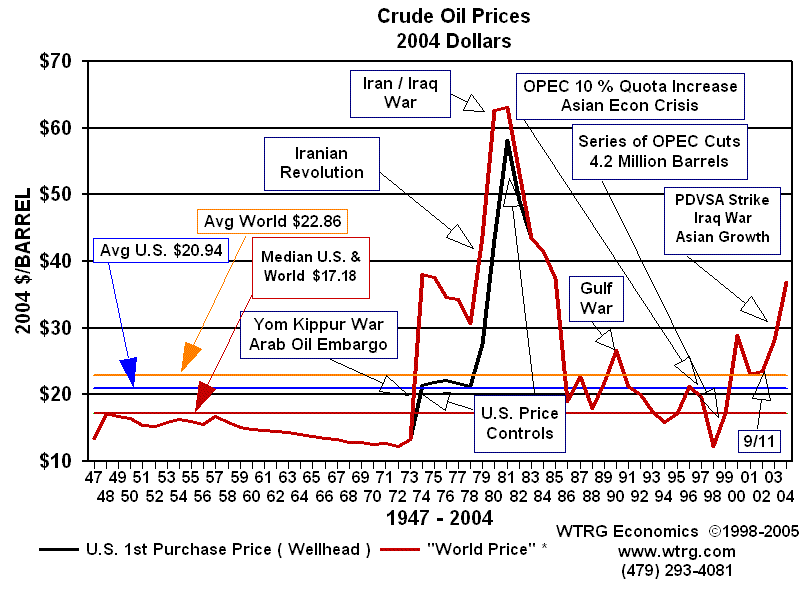
Note that oil prices were falling for about the fifteen years before the creation of OPEC in 1973 and have been stochastic ever since. A non-market organization made prices flucutate, it seems, not the market itself.
Consider now the role of tar sands and oil shales, two sources of oil the industry didn't consider profitable until not too long ago. The former source is pretty evenly split three ways between the Mid-East, Venezuela and Canada and makes up about 2/3 of the oil reserves in the world. The latter is mostly in the US--1.2 trillion barrels worth. Oil companies are extracting or planning to extract oil from these sources, a process that becomes more worthwhile as prices and volatility rises. As this production increases, OPEC will become less significant and prices will then follow the trend we saw in the pre-OPEC days. Imagine a newspaper headline in the year 2025 reading,
"Though NA Net Oil Exports Continue To Rise, Congress Worries About Falling Gas Prices"
Fricking Gas-Tastic.
Sunday, November 13, 2005
Windfall Tax Nothing But Hot Air
The Tax Foundation has a lovely graph describing the 1980s establishment of a windfall tax.
This is of course the statist's argument against the tax, which I think misses the point. The goal of government shouldn't be to make money but to create a framework within which others can make money.
This is of course the statist's argument against the tax, which I think misses the point. The goal of government shouldn't be to make money but to create a framework within which others can make money.
Fandom of the Opera
Today I made the transition from Firefox to Opera web browser. Firefox was incredible when it was released. Tabs. Google search in the browser itself. Quick links. But now those revolutionary additions are the standard and imitation pushes the web browser product forward.
Enter Opera, which recently became free. I wasn't too keen on switching browsers but after the 100th time of not being able to view media because I lacked the right plug in, I though I'd give it a serious shot. I'm now hooked. Opera has the following advantages.
1. It comes with all the plugins you'll need to view web movies, etc. This was a main reason why I switched as FF doesn't come with any.
2. I like to multitask when I'm online and to keep all the webpages straight, I want to group similar tabs together. FF puts the tabs in the order you've created them and won't let you switch. Opera does; it's very nice.
3. Adding bookmarks is less awkward in Opera than in FF; where you are putting a link is much more clear.
4. It might be my imagination but I think Opera runs faster.
There might be other things Opera has; I'm still exploring it. Not yet sure what the "rewind" and "magic wand" does yet. You can download Opera for free here.
NOTE: Mike just told me I've been using an old version of FF; the new one lets you move tabs. Didn't solve the other problems I have with it, though.
Enter Opera, which recently became free. I wasn't too keen on switching browsers but after the 100th time of not being able to view media because I lacked the right plug in, I though I'd give it a serious shot. I'm now hooked. Opera has the following advantages.
1. It comes with all the plugins you'll need to view web movies, etc. This was a main reason why I switched as FF doesn't come with any.
2. I like to multitask when I'm online and to keep all the webpages straight, I want to group similar tabs together. FF puts the tabs in the order you've created them and won't let you switch. Opera does; it's very nice.
3. Adding bookmarks is less awkward in Opera than in FF; where you are putting a link is much more clear.
4. It might be my imagination but I think Opera runs faster.
There might be other things Opera has; I'm still exploring it. Not yet sure what the "rewind" and "magic wand" does yet. You can download Opera for free here.
NOTE: Mike just told me I've been using an old version of FF; the new one lets you move tabs. Didn't solve the other problems I have with it, though.
Saturday, November 12, 2005
I Completely Missed It
Walter Williams was on 20/20 on Friday. 20/20's been doing a weekly series about the seven sins and last night's was greed. Naturally they talked to my micro professor.
I was able to watch a segment of the episode on the 20/20 website which had him in it. I don't know if this was the extent of his participation or not but here's his quote:
It reminds me of a book I'd like to write someday: The Ethics of Greed because greed generates the incentive that makes our economy work so well. And because it works so well, people can have greater freedom and choices, they live longer, they can do more with their lives, they are safer and they are happier (yes, happiness is hard to measure but I bet if you stuck one of those unhappy people in a third world country for a month, they'll stop complaining so much about rush hour). All of these things are what the great philosophers have been trying to accomplish for thousands of years (Plato's Republic comes to mind) and greed, the least likely of candidates, makes it possible (as well as the right institutions). How amazing is that?
I was able to watch a segment of the episode on the 20/20 website which had him in it. I don't know if this was the extent of his participation or not but here's his quote:
Normally in our country those areas where people are motivated the most by greed are the areas we are most satisfied with. Supermarkets. Computers. FedEx. Those areas where people say we're motivated by caring are the areas of disaster in our country. Such as education. The post office. City garbage collection. Police services.
It reminds me of a book I'd like to write someday: The Ethics of Greed because greed generates the incentive that makes our economy work so well. And because it works so well, people can have greater freedom and choices, they live longer, they can do more with their lives, they are safer and they are happier (yes, happiness is hard to measure but I bet if you stuck one of those unhappy people in a third world country for a month, they'll stop complaining so much about rush hour). All of these things are what the great philosophers have been trying to accomplish for thousands of years (Plato's Republic comes to mind) and greed, the least likely of candidates, makes it possible (as well as the right institutions). How amazing is that?
Wednesday, November 09, 2005
Other People's Money
Was surfing Wikiquote and found these great words by Milton Friedman.
There are four ways in which you can spend money. You can spend your own money on yourself. When you do that, why then you really watch out what you’re doing, and you try to get the most for your money. Then you can spend your own money on somebody else. For example, I buy a birthday present for someone. Well, then I’m not so careful about the content of the present, but I’m very careful about the cost. Then, I can spend somebody else’s money on myself. And if I spend somebody else’s money on myself, then I’m sure going to have a good lunch! Finally, I can spend somebody else’s money on somebody else. And if I spend somebody else’s money on somebody else, I’m not concerned about how much it is, and I’m not concerned about what I get. And that’s government. And that’s close to 40% of our national income.
-Fox News interview 2004
Monday, November 07, 2005
Bullets Aren't Economic-Proof
Last night on the West Wing, the live debate strayed to the topic restricting bullet sales the same way we restrict gun sales. It reminded of me of a Chris Rock bit where he proposed a high tax on bullets so people couln't afford to kill each other.
These sound like nice ideas, but they lack an anchor in reality. Bullets are little more than hunks of metal. If the state makes it hard to buy them, you can bet a black market will arise overnight. Mafias and gangs will sell bullets to fund their activities in the same way they sell drugs or they sold alcohol during prohibition. Artifically kicking up the price of bullets will move money away from the accountable law-abiding firms and into the hands of crimminals.
That's only the beginning. When it's worth it to learn how to make bullet and it's profitable to buy the equipment, it's a very short jump to making the bullets we really don't want people to have such as those that pierce armor. (Yes these bullets are circulated anyway but they will become much more common and easy to get.)
Alcohol, drugs, prostitution, guns; these are all things where there was some kind of government control on them and every single one of them got their very own black market. Why should we think bullets are any different?
These sound like nice ideas, but they lack an anchor in reality. Bullets are little more than hunks of metal. If the state makes it hard to buy them, you can bet a black market will arise overnight. Mafias and gangs will sell bullets to fund their activities in the same way they sell drugs or they sold alcohol during prohibition. Artifically kicking up the price of bullets will move money away from the accountable law-abiding firms and into the hands of crimminals.
That's only the beginning. When it's worth it to learn how to make bullet and it's profitable to buy the equipment, it's a very short jump to making the bullets we really don't want people to have such as those that pierce armor. (Yes these bullets are circulated anyway but they will become much more common and easy to get.)
Alcohol, drugs, prostitution, guns; these are all things where there was some kind of government control on them and every single one of them got their very own black market. Why should we think bullets are any different?
Sunday, November 06, 2005
Vinick For President
I just watched the debates on NBC and Vinick is now my guy for President. His closing speech was a classic argument for libertarian values.
There was a lot of great ideas touched on the debate; my head is still swimming. One thing I did want to comment on was Vinick's take on the worldest poorest countries. He was right in the sense that a major hurdle for these downtrodden are the oppressive taxes they bear. And they bear them because the local governments have loan payments.
I would not doubt that, but there are even more core issues, most notably is that the governments themselves suck. They are not only havens for corruption, they deny the basic economic infrastructure needed for a successful economy. Creating a legal business is like pulling teeth so entrepreneurs are forced to establish costly illegal businesses. Thus, they can't secure loans. They can't advertise. They have to bribe countless people just to stay open, nevermind making a profit.
This speaks to an earlier part of the debate when Santos reminded us that the key to limiting illegal immigration was for the government to improve economic conditions. Of course since he's not running for President of Mexico, that was a worthless promise. Didn't even say how this would be accomplished. Now if he would listen to his opponent (or me for that matter) he'd have something to tell President Fox.
For those of you who didn't see the debate, I strongly recommend you find a copy and watch it. There was some great libertarian themes in it.
There was a lot of great ideas touched on the debate; my head is still swimming. One thing I did want to comment on was Vinick's take on the worldest poorest countries. He was right in the sense that a major hurdle for these downtrodden are the oppressive taxes they bear. And they bear them because the local governments have loan payments.
I would not doubt that, but there are even more core issues, most notably is that the governments themselves suck. They are not only havens for corruption, they deny the basic economic infrastructure needed for a successful economy. Creating a legal business is like pulling teeth so entrepreneurs are forced to establish costly illegal businesses. Thus, they can't secure loans. They can't advertise. They have to bribe countless people just to stay open, nevermind making a profit.
This speaks to an earlier part of the debate when Santos reminded us that the key to limiting illegal immigration was for the government to improve economic conditions. Of course since he's not running for President of Mexico, that was a worthless promise. Didn't even say how this would be accomplished. Now if he would listen to his opponent (or me for that matter) he'd have something to tell President Fox.
For those of you who didn't see the debate, I strongly recommend you find a copy and watch it. There was some great libertarian themes in it.
Saturday, November 05, 2005
Million Dollar Idea #906
I was reminded the other day about a conversation I had with an old undergraduate professor of mine. He insisted that greeting cards were Giffen goods--you buy more as the price increases. He reasoned that because the price is printed on the back of the card, people fearing being called cheap by a loved one go for the higher price.
What he's missing, of course, is that such reasoning is not holding all things equal. The value of the card went up because the price went up, thus they are completely different goods. The same could be said of shopping at buying designer jeans rather than Old Navy--the price has inherent value; it sends a signal.
Pushing the point even more yields a wonderful business opportunity (assuming my prof's greeting card purchasing concerns are common). Make very cheap greeting cards with a fake price on the back: say five dollars. Then, at the factory, put a sticker over the fake price with the real price on it: say fifty cents. Add instructions on the sticker: "Peel To Impress."
The only problem is success will be the mark of failure as brand name trumps all. But you could always come up with fake brand names and then put the real brand name on a sticker, too. It's genius!
Want more? Send me fifty dollars.
What he's missing, of course, is that such reasoning is not holding all things equal. The value of the card went up because the price went up, thus they are completely different goods. The same could be said of shopping at buying designer jeans rather than Old Navy--the price has inherent value; it sends a signal.
Pushing the point even more yields a wonderful business opportunity (assuming my prof's greeting card purchasing concerns are common). Make very cheap greeting cards with a fake price on the back: say five dollars. Then, at the factory, put a sticker over the fake price with the real price on it: say fifty cents. Add instructions on the sticker: "Peel To Impress."
The only problem is success will be the mark of failure as brand name trumps all. But you could always come up with fake brand names and then put the real brand name on a sticker, too. It's genius!
Want more? Send me fifty dollars.
Thursday, November 03, 2005
Pecuniary Printing
Forbes posted this nice piece on Google Print by Nick Schulz from TCS. One of my favorite points:
Google Print is just more of the same. To those that say people shouldn't make money off their work not only forget that's been true long before Google or even Amazon (reviewers have been doing this for a very long time) but they miss the big point. It doesn't matter. It is completely absurd to claim that getting a check for doing a job is morally worse than being compensated solely by the person's own sense of satisfaction.
Pecuniary gains and non-pecuniary gains both make people better off; the distinction is meaningless for this argument.
The way the current copyright law works, I can take a book out from any library, read it and write a review of it for publication on the Web site I edit or in the pages of Forbes.com or anywhere else.
Google Print is just more of the same. To those that say people shouldn't make money off their work not only forget that's been true long before Google or even Amazon (reviewers have been doing this for a very long time) but they miss the big point. It doesn't matter. It is completely absurd to claim that getting a check for doing a job is morally worse than being compensated solely by the person's own sense of satisfaction.
Pecuniary gains and non-pecuniary gains both make people better off; the distinction is meaningless for this argument.
Wednesday, November 02, 2005
Why Dudes Become Ladies
Deirdre McCloskey is a wonderful economist, focusing on rhetoric (something we do need work on). Most interested in economics know that much. Slightly fewer people know that Deirdre was born Donald and underwent a sex change operation in the 1990s.
I was talking about this to a friend of mine yesterday who did not know this fascinating piece of economic trivia and we stumbled upon the question of what factors (besides the obvious) determine if a person engages in this expensive and life-altering surgery.
Donald, I pointed out, used to be a burly Scotish man. The last person you would except to become a woman. (And to my surprise, the transition went very well: pictures here).
But I remember watching TLC once and they had a thing about sex changes--some turn out to be very bad (person looks like a man in a woman's body) while others were so great the girl became a stripper.
I naturally starting thinking about what physical attributes might make the man-to-woman transition easier and see if it's a predictor. Height would be a big factor. Bone structure, too (but that's harder to measure). I'm not really familar enough with the procedure to guess beyond those.
So if we assume that the deep urge/feeling to become a woman is randomly distributed among the population we could check if the average height of transformed women is lower than the average height of men (though there may be a confounding factor there). We could also see if there's a correlation between the average height of a country and the percent of the men that undergo the procedure (though again there are confounding factors).
Hmmmm. Maybe I'll change my dissertation plans.
I was talking about this to a friend of mine yesterday who did not know this fascinating piece of economic trivia and we stumbled upon the question of what factors (besides the obvious) determine if a person engages in this expensive and life-altering surgery.
Donald, I pointed out, used to be a burly Scotish man. The last person you would except to become a woman. (And to my surprise, the transition went very well: pictures here).
But I remember watching TLC once and they had a thing about sex changes--some turn out to be very bad (person looks like a man in a woman's body) while others were so great the girl became a stripper.
I naturally starting thinking about what physical attributes might make the man-to-woman transition easier and see if it's a predictor. Height would be a big factor. Bone structure, too (but that's harder to measure). I'm not really familar enough with the procedure to guess beyond those.
So if we assume that the deep urge/feeling to become a woman is randomly distributed among the population we could check if the average height of transformed women is lower than the average height of men (though there may be a confounding factor there). We could also see if there's a correlation between the average height of a country and the percent of the men that undergo the procedure (though again there are confounding factors).
Hmmmm. Maybe I'll change my dissertation plans.
Tuesday, November 01, 2005
Check Out That Alpenglow
I'm having a dictionary thing lately.
Today's word of the day from dictionary.com is alpenglow. It means:
"A reddish glow seen near sunset or sunrise on the summits of mountains."
Note that's not any glow--only reddish ones--and it's not on the horizon of just any landscape--only mountain summits. The word comes from German words meaning "glowing Alps."
There's something to be said about the economics of language. Spontaneous order. Creative destruction. Technological development. Cultural evolution. Signs of wealth and poverty. If I was a language person, I would use foreign vocabularies to estimate the economic strength of the corresponding regions. But I have trouble with English as it is.
Anyone wanna test Cowen's Second Law (there's a literature on everything)?
Today's word of the day from dictionary.com is alpenglow. It means:
"A reddish glow seen near sunset or sunrise on the summits of mountains."
Note that's not any glow--only reddish ones--and it's not on the horizon of just any landscape--only mountain summits. The word comes from German words meaning "glowing Alps."
There's something to be said about the economics of language. Spontaneous order. Creative destruction. Technological development. Cultural evolution. Signs of wealth and poverty. If I was a language person, I would use foreign vocabularies to estimate the economic strength of the corresponding regions. But I have trouble with English as it is.
Anyone wanna test Cowen's Second Law (there's a literature on everything)?
Wednesday, October 26, 2005
When Black Is White
Today's word of the day from dictionary.com is virago. It has two meanings.
1. A woman of extraordinary stature, strength, and courage.
2. A woman regarded as loud, scolding, ill-tempered, quarrelsome, or overbearing.
"Virago" gets the reward for the most ambiguous word in the world.
1. A woman of extraordinary stature, strength, and courage.
2. A woman regarded as loud, scolding, ill-tempered, quarrelsome, or overbearing.
"Virago" gets the reward for the most ambiguous word in the world.
Wednesday, October 19, 2005
Fads and Fortunes
While re-reading Fischer Black's Noise, I was reminded of his theory of business cycles: economics downturns are due to firms poorly estimating what people want. When this mismatching occurs at a great scale, recession hits.
Tyler Cowen isn't much of a fan of this theory; by the law of large numbers, the successes should cancel out the failures. I've argued this point with him, saying that the LLN only works if the agents are independent. It makes sense that they are not--entreprenuers don't live in vacuums. He reasonably asked, "What sort of connection between all these agents is so strong that it could intitate such a downturn?" To that I had no answer.
I still don't have one per se, but I just thought about the other side of the equation.
The LLN argument only works if both the firms and the consumers are independent. I may not be able to nail down a common link between firms but cultural exchange is something consumers do in abundence. Personally, I've been introduced to (and in some cases became obsessed with) restaurants, televison shows, movies, music, games, books, food, clothes and so forth. I've also shared most of these new wonders with others.
These sort of information linkage mechanisms create crowding around a particular good or service which leaves average or unadvertised alternatives without a market. Because Mike introduced me to Firefly, I spend time and money on it; a void is filled that I might have filled with some other substitute. Ideas that would have been consumed or supported are crowded out by more popular ones. Failure occurs; money is wasted. Fads (fashionable products that are later abandoned) aggrevate the downturn because these once-popular goods fail (thus any resources spent on expanding the line are also wasted).
This could help explain why the business failure rate for fashionable products (clothes, restaurants, television shows) is so much higher than industrial products (to which popularity plays less of a role). As someone who wrote a guide on dining in the DC area, this is an argument I'm sure Prof. Cowen can at least appreciate.
Tyler Cowen isn't much of a fan of this theory; by the law of large numbers, the successes should cancel out the failures. I've argued this point with him, saying that the LLN only works if the agents are independent. It makes sense that they are not--entreprenuers don't live in vacuums. He reasonably asked, "What sort of connection between all these agents is so strong that it could intitate such a downturn?" To that I had no answer.
I still don't have one per se, but I just thought about the other side of the equation.
The LLN argument only works if both the firms and the consumers are independent. I may not be able to nail down a common link between firms but cultural exchange is something consumers do in abundence. Personally, I've been introduced to (and in some cases became obsessed with) restaurants, televison shows, movies, music, games, books, food, clothes and so forth. I've also shared most of these new wonders with others.
These sort of information linkage mechanisms create crowding around a particular good or service which leaves average or unadvertised alternatives without a market. Because Mike introduced me to Firefly, I spend time and money on it; a void is filled that I might have filled with some other substitute. Ideas that would have been consumed or supported are crowded out by more popular ones. Failure occurs; money is wasted. Fads (fashionable products that are later abandoned) aggrevate the downturn because these once-popular goods fail (thus any resources spent on expanding the line are also wasted).
This could help explain why the business failure rate for fashionable products (clothes, restaurants, television shows) is so much higher than industrial products (to which popularity plays less of a role). As someone who wrote a guide on dining in the DC area, this is an argument I'm sure Prof. Cowen can at least appreciate.
Finding Dollar
Tyler Cowen's suggestion that for our upcoming macro test, we study "every waking hour" is proving to be actually kind of fun (thus far). One thing it got me doing is looking up stuff I've always meant to look up.
At the top of that list are non-US countries that use the dollar for their local currency. Whenever I get in a dicussion about why the trade deficit doesn't matter (because countries can't spend our money domestically, thus it ends up back here), these exceptions always enter the conversation. Now I finally have memorized which ones they are.
-East Timor
-Ecuador
-Marshall Islands
-Palau
-Federated States of Micronesia
-Northern Mariana Islands
-El Salvador
-Lebanon (Lebanon also has the Lebanonese pound which is used interchangably with the dollar at a rate currently pegged 1500 to one.)
All countries that have an extremely mild (except Ecuador which I count as "very mild") impact on the global economy.
At the top of that list are non-US countries that use the dollar for their local currency. Whenever I get in a dicussion about why the trade deficit doesn't matter (because countries can't spend our money domestically, thus it ends up back here), these exceptions always enter the conversation. Now I finally have memorized which ones they are.
-East Timor
-Ecuador
-Marshall Islands
-Palau
-Federated States of Micronesia
-Northern Mariana Islands
-El Salvador
-Lebanon (Lebanon also has the Lebanonese pound which is used interchangably with the dollar at a rate currently pegged 1500 to one.)
All countries that have an extremely mild (except Ecuador which I count as "very mild") impact on the global economy.
First Look at RBC
In studying for my macro exam Monday, I've decided to summarize some macroeconomic theories for this next week of blog postings (as well as be active on Wikipedia).
Most of the theories we've encountered pertain to the business cycle. Ideally, a business cycle model exhibits three key ideas: it's persistent over time, sectors of the economy move together and there are changes in the labor supply. Because real business cycle theory does best with these, it is most popular.
Of course that doesn't mean it's very accurate. RBC, developed by Robert Lucas, Finn Kydland and Edward Prescott, is deeply rooted in rational expectations and independent of money supply. Indeed, people do not make mistakes in this economic model; downturns happen with productivity shocks. As people adjust to productivity shocks, the economy recovers. Thus all changes are exogenous.
I think that last point is one of the weakest points of RBC. All changes are exogenous? If all shocks are exogenous, then where does technology come from? Does that mean that people who are working on new technology are not included? Or just those technology-pursuing activities? But shouldn't they be included because it's rational to pursue technology? Technology shocks are both endogenous and exogenous in RBC; it can't be both.
There are other problems, mostly labor related. It also has zero predictive power; what counts as a "productivity shock?" How do you weight shocks against each other? How long does a shock last?
Yet it's still the mainstream theory. Go figure.
Most of the theories we've encountered pertain to the business cycle. Ideally, a business cycle model exhibits three key ideas: it's persistent over time, sectors of the economy move together and there are changes in the labor supply. Because real business cycle theory does best with these, it is most popular.
Of course that doesn't mean it's very accurate. RBC, developed by Robert Lucas, Finn Kydland and Edward Prescott, is deeply rooted in rational expectations and independent of money supply. Indeed, people do not make mistakes in this economic model; downturns happen with productivity shocks. As people adjust to productivity shocks, the economy recovers. Thus all changes are exogenous.
I think that last point is one of the weakest points of RBC. All changes are exogenous? If all shocks are exogenous, then where does technology come from? Does that mean that people who are working on new technology are not included? Or just those technology-pursuing activities? But shouldn't they be included because it's rational to pursue technology? Technology shocks are both endogenous and exogenous in RBC; it can't be both.
There are other problems, mostly labor related. It also has zero predictive power; what counts as a "productivity shock?" How do you weight shocks against each other? How long does a shock last?
Yet it's still the mainstream theory. Go figure.
Tuesday, October 18, 2005
The World Wide Way?
Today I discovered the Global : Ideas : Bank, a website dedicated to posting users' random ideas for the world to see and discuss.
I was almost going to put it aside and sign up later (so I could comment) when I saw this entry (safe to say I signed up soon after):
Very fitting that just minutes before I had re-read The Idea Trap.
I was almost going to put it aside and sign up later (so I could comment) when I saw this entry (safe to say I signed up soon after):
The Problem:
Most of the time when we are surfing internet, we face the problem of find the information we need(What we are looking for).
The Social Invention:
A standard layout for website should be created which enforce the new website development to follow that standard layout. I than way [I think this way (?)] we will alway find the information more quickly and without any sort of hasle of search again and again.
Also some sort of engine can be develop which shows the information on the web site in a consist manner (Embebed with the internet browser). [sic]
Very fitting that just minutes before I had re-read The Idea Trap.
Sunday, October 16, 2005
The End of Serenity?
Tyler Cowen cited briefly why he doesn't expect a Serenity sequel: low box office. Since its release date (September 30, 2005), Serenity's total box office sales are $22.1 million domestic, $3.6 overseas. That's a $25.7 million revenue versus a $39 million production costs.
These numbers, however, are not perfect as they don't include earnings from preview screenings, and there was a lot of them. Too many, in my opinion; Mike, for example, saw the movie twice before it was even released. Combine this with the low rewatching value (thanks to the death of a certain character), I'm sadly not surprised by the numbers.
Presumably, the powers that be are including preview revenues and Joss will point out the (hopefully) strong DVD sales, but I'm not optimistic.
These numbers, however, are not perfect as they don't include earnings from preview screenings, and there was a lot of them. Too many, in my opinion; Mike, for example, saw the movie twice before it was even released. Combine this with the low rewatching value (thanks to the death of a certain character), I'm sadly not surprised by the numbers.
Presumably, the powers that be are including preview revenues and Joss will point out the (hopefully) strong DVD sales, but I'm not optimistic.
Friday, October 14, 2005
The Power of All of Them
North Dakota may be one of the first of a growing pool of states that will require licenses for selling on eBay.
According to this CNN article, "applicants must pay a $35 fee, obtain a $5,000 surety bond and undergo training at one of eight approved auction schools, where the curriculum includes talking really fast."
Thank God most people have at least half a brain; most of the slashdot comments recognized the stupidity of the law in all its forms.
But they overplayed the harm it does to the small businesses that use eBay as a forum for sales. Yes, the auctioneer schools benefit. Yes, the state benefits. But in the long run, the businesses benefit because it will make their competition (non-firms selling on eBay) virutally non-existent. Granted, this plan only works if most other states adopt similar rules.
I'm also constantly puzzled as to if people think some behavior is a good thing, why there needs to be a law that requires people to act certain ways. "Gordon Krance, president of the North Dakota Auctioneers Association, said the group has no position on whether people who are paid to sell others' goods on eBay should have an auctioneer's license. But he said sellers could benefit from attending auctioneering school."
If they'd benifit, then why do you need to force them to go?
Hat tip to Mike for the link.
According to this CNN article, "applicants must pay a $35 fee, obtain a $5,000 surety bond and undergo training at one of eight approved auction schools, where the curriculum includes talking really fast."
Thank God most people have at least half a brain; most of the slashdot comments recognized the stupidity of the law in all its forms.
But they overplayed the harm it does to the small businesses that use eBay as a forum for sales. Yes, the auctioneer schools benefit. Yes, the state benefits. But in the long run, the businesses benefit because it will make their competition (non-firms selling on eBay) virutally non-existent. Granted, this plan only works if most other states adopt similar rules.
I'm also constantly puzzled as to if people think some behavior is a good thing, why there needs to be a law that requires people to act certain ways. "Gordon Krance, president of the North Dakota Auctioneers Association, said the group has no position on whether people who are paid to sell others' goods on eBay should have an auctioneer's license. But he said sellers could benefit from attending auctioneering school."
If they'd benifit, then why do you need to force them to go?
Hat tip to Mike for the link.
Thursday, October 13, 2005
Cost and Costlessness
Not more than a minute ago as I walked up the stairs to the office, a guy clearly from some student organization offered me a free T-Shirt. Barely thinking, I turned him down.
No doubt this was not his first rejection in this matter and I'm sure on several occasions he and his peers mused as to why anyone would refuse anything that's free.
Beyond the fact that I didn't know what organization was or what the shirt said (it was drapped over his sweaty shoulder, which was probably another reason I refused so quickly), I can think of several reasons why people would turn down free things, all of them related to non-pecuniary costs. For your benefit, sweaty guy, here they are.
1. I still have to carry the shirt. Granted shirts don't weigh a lot but space in my bag is limited.
2. I have to store it somewhere. Again, my dresser isn't that full but it's not so empty I won't have to move it out of the way of quality clothing.
3. If the shirt said something I didn't care for ("Fair Trade Now," "Rush X Faternity" or "I did your mom last night"), I get disutility from not only having it but from having touched it or even knowing it exists.
4. This goes double if someone I know saw me accept the tainted item.
5. Often accepting a zero-priced item includes an annoying rant about how great Y organization is and how I should join or otherwise support them. Sort of like telemarketers but harder to hang up on.
6. They weren't operating from one of the school's kiosks, thus making their organization all the more shady.
7. While the length of time is small, I could be doing something else when I'm grabing the shirt and finding a place to put it.
TANSTAAFL.
No doubt this was not his first rejection in this matter and I'm sure on several occasions he and his peers mused as to why anyone would refuse anything that's free.
Beyond the fact that I didn't know what organization was or what the shirt said (it was drapped over his sweaty shoulder, which was probably another reason I refused so quickly), I can think of several reasons why people would turn down free things, all of them related to non-pecuniary costs. For your benefit, sweaty guy, here they are.
1. I still have to carry the shirt. Granted shirts don't weigh a lot but space in my bag is limited.
2. I have to store it somewhere. Again, my dresser isn't that full but it's not so empty I won't have to move it out of the way of quality clothing.
3. If the shirt said something I didn't care for ("Fair Trade Now," "Rush X Faternity" or "I did your mom last night"), I get disutility from not only having it but from having touched it or even knowing it exists.
4. This goes double if someone I know saw me accept the tainted item.
5. Often accepting a zero-priced item includes an annoying rant about how great Y organization is and how I should join or otherwise support them. Sort of like telemarketers but harder to hang up on.
6. They weren't operating from one of the school's kiosks, thus making their organization all the more shady.
7. While the length of time is small, I could be doing something else when I'm grabing the shirt and finding a place to put it.
TANSTAAFL.
Who Hid the Master Plans?
Government can be surprisingly uncoordinated (even for government). In Alaska, they built a road to nowhere. In Arizona, a new school's short a road. Sounds like someone wrote the wrong state abbreviation somewhere...
Wednesday, October 12, 2005
Greatest Wikipedia Page Ever
There are over 450,000 Wikipedians. It only takes two to have a lame war.
Monday, October 10, 2005
Pondering Walter Williams: Price of Life
For our micro class, Prof. Walter Williams created a list of questions for us to ponder over the course of the semester. With our first test looming, I broke out the packet and came across this particularly interesting one:
30. a) Is life priceless? What evidence can you offer to support your contention?
My short answer is "No, because people die."
Granted, this is a little simplistic; sometimes people would pay anything to save someone but they can't because of natural or legal barriers. So my slightly longer answer is "No, because life-sustaining goods cost a finite amount."
Food, for example, costs a measurable number, even the healthy stuff. If life was priceless, then food would cost a great deal more. Indeed, nothing is priceless. When I went to the Natural History Museum and saw the Hope Diamond, I overheard a guard responding to a woman's question of the object's worth. "It's priceless," he said.
But we know the government doesn't think the diamond is priceless because if it did, they wouldn't risk showing it to the public; they would keep it hidden at all times to make it that much harder for thieves and revolutionaries. Similarly, if human life was priceless, we'd never risk leaving our homes and be 100% risk averse. We clearly are not so careful.
30. a) Is life priceless? What evidence can you offer to support your contention?
My short answer is "No, because people die."
Granted, this is a little simplistic; sometimes people would pay anything to save someone but they can't because of natural or legal barriers. So my slightly longer answer is "No, because life-sustaining goods cost a finite amount."
Food, for example, costs a measurable number, even the healthy stuff. If life was priceless, then food would cost a great deal more. Indeed, nothing is priceless. When I went to the Natural History Museum and saw the Hope Diamond, I overheard a guard responding to a woman's question of the object's worth. "It's priceless," he said.
But we know the government doesn't think the diamond is priceless because if it did, they wouldn't risk showing it to the public; they would keep it hidden at all times to make it that much harder for thieves and revolutionaries. Similarly, if human life was priceless, we'd never risk leaving our homes and be 100% risk averse. We clearly are not so careful.
Saturday, October 08, 2005
Crimminally Poor
Tonight, Bill Maher talked to Ann Coulter, author of such conversation-elevating books like How To Talk To a Liberal (If You Must) and Treason: Liberal Treachery from the Cold War to the War on Terrorism. She said a lot of crazy things but the one that really stuck out for me is when she said crime and poverty were unrelated.
Few variables better correlate with crime; the research I've done on this matter suggests that poverty explains about 20% of the crime rate. Poverty was my best predictor (also checked execution laws, unemployment and education).
The two certainly makes sense; poor people have less to lose (for the case of robberies) and more to escape from (for the case of drug "crimes"). Some of them even have loads of free time. You could probably make the case that there's a confounding variable that's causing them both, but such are hard to come by. Both factors are pretty fundamental. Besides, that doesn't mean they are unrelated. A simple regression shows there's some kind of connection between the two, even in the unlikely event that it's an indirect relation.
I guess acknowledging a role of poverty bars Coulter from directly blaming yet another one of societies ills on liberals.
Few variables better correlate with crime; the research I've done on this matter suggests that poverty explains about 20% of the crime rate. Poverty was my best predictor (also checked execution laws, unemployment and education).
The two certainly makes sense; poor people have less to lose (for the case of robberies) and more to escape from (for the case of drug "crimes"). Some of them even have loads of free time. You could probably make the case that there's a confounding variable that's causing them both, but such are hard to come by. Both factors are pretty fundamental. Besides, that doesn't mean they are unrelated. A simple regression shows there's some kind of connection between the two, even in the unlikely event that it's an indirect relation.
I guess acknowledging a role of poverty bars Coulter from directly blaming yet another one of societies ills on liberals.
Friday, October 07, 2005
What's In a Name?
A few weeks ago, Prof. Williams opened our micro class with one of his random economic thoughts: do you own your reputation? Before you say "of course," ask yourself if you own other people's opinions about you as that's all a reputation is.
The concept is a little strange to wrap your head around because your actions strongly influence others' thoughts. When Tom Cruise acted like an arrogant prick with the Today Show's Matt Lauer a few months ago, the vast majority of the population started thinking of him as an arrogant prick. But that does not mean you own your reputation; if you did, no reputation would go bad. You can only influence it; the effects are ultimately determined by the minds of others.
Similarly, I ask "Do you know your name?" Before you shout back, "Of course, it's MY name!" recall that it's also YOUR reputation; if sementics were a determinant of ownership, I would own my parents. Anyone that's ever been to my house would know that is not the case.
A name is nothing more than a way for others to identify you. The only time you use your own name is to signal to people who you are. Just like repuation, you can influence what you are called, but the result isn't up to you. When P. Diddy renamed himself Diddy for the absurd reason that "the P was getting in the way" of his fans, we all went along with it. We chose to call him Diddy. Why should he own what other people choose to call him?
For contrast, suppose Castro wanted everyone to call him "His Holiness." Or if Mr. Bush declared his new name to be "Gandhi." I can't see society going along with it. You name is your name because that's what everyone chooses to call you. They just happen to call you the same thing.
The concept is a little strange to wrap your head around because your actions strongly influence others' thoughts. When Tom Cruise acted like an arrogant prick with the Today Show's Matt Lauer a few months ago, the vast majority of the population started thinking of him as an arrogant prick. But that does not mean you own your reputation; if you did, no reputation would go bad. You can only influence it; the effects are ultimately determined by the minds of others.
Similarly, I ask "Do you know your name?" Before you shout back, "Of course, it's MY name!" recall that it's also YOUR reputation; if sementics were a determinant of ownership, I would own my parents. Anyone that's ever been to my house would know that is not the case.
A name is nothing more than a way for others to identify you. The only time you use your own name is to signal to people who you are. Just like repuation, you can influence what you are called, but the result isn't up to you. When P. Diddy renamed himself Diddy for the absurd reason that "the P was getting in the way" of his fans, we all went along with it. We chose to call him Diddy. Why should he own what other people choose to call him?
For contrast, suppose Castro wanted everyone to call him "His Holiness." Or if Mr. Bush declared his new name to be "Gandhi." I can't see society going along with it. You name is your name because that's what everyone chooses to call you. They just happen to call you the same thing.
Sunday, October 02, 2005
I Speak, You Speak, We All Speak
Stumbled on this page about modern newspeak. My favorite entry:
Jungle - Replaced by Rainforest. A Rainforest is a happy place where Disney characters dance and sing ... a jungle is a scary place with lions, tigers, malaria and natives that want to cut off your head and boil it for dinner... who in their right mind would want to save that!?! (Original Emphasis)
Saturday, October 01, 2005
What Would Julian Simon Say If He Saw Serenity?
He would cry, probably. At least at the beginning. Serenity, based on the cult-hit series Firefly, opens with a teacher telling the history their civilization. The story is Earth runs out of resources and the everyone travels to a new solar system to put down roots.
But Julian Simon points out that we'll never run out of resources. As raw inputs become more expensive, it becomes economical to develop alternatives. This has been the history of human civilization. And why doomsayers have claimed that we will run out of everything from food to flint, they have always been wrong.
But Simon isn't completely right. We won't have to abandon a resource-dry earth no matter what because his theory is contingent on free minds in a free society. If government controls resources (as it did in the USSR and as the US continues to do more of) we really could run out of resources. That is the great craziness of the doomsayers: they become right if we follow their advice.
But Julian Simon points out that we'll never run out of resources. As raw inputs become more expensive, it becomes economical to develop alternatives. This has been the history of human civilization. And why doomsayers have claimed that we will run out of everything from food to flint, they have always been wrong.
But Simon isn't completely right. We won't have to abandon a resource-dry earth no matter what because his theory is contingent on free minds in a free society. If government controls resources (as it did in the USSR and as the US continues to do more of) we really could run out of resources. That is the great craziness of the doomsayers: they become right if we follow their advice.
Watch An Order Emerge
I love organization. I like putting things in their place and creating a framework to work in. But it's a bitch to implement and maintain. There's always exceptions, there's always new places to put more of the same thing. Thank God for wikis.
Wikis are web sites made up of pages than anyone can change, including pages for organization. Wikipedia, the world's largest encyclopedia, is easily the most famous of these sites. But few people know you can make your own wikis for any topic you'd like at wikicities. Currently there are over 500 wikis on wikicities.
After a long trial, I was finally able to launch my own wiki for the World of Darkness. (It's actually very easy to make a wikicity wiki; I ran into some trouble because I wasn't the only one to make a wiki for this.) The World of Darkness is a game series created by White Wolf publishing; my wiki is for fans to published their own ideas genre.
Today is the Wiki's first official day (I posted its existence on various forums early this morning) and already we see order emerge. All I did was advertise it a bit and establish a basic framework (mostly through example). Slowly I'm seeing people fill the holes I left as they contribute. To witness this world evolve, check out its recent changes page. (AtLastAwake is me.)
There is a lesson here that cannot be understated: wikis are economies in their own right. Motivation is generated not by the profit from a job well done, but the prestige from your fellows and the satisfaction of creation. There's no private property, but there's no scarcity either (granted there is some scarcity, but such exceptions have very close substitutes). I think one of the reasons people don't appreciate the beauty of spontaneous is that they can't witness order emerge from on high. Wikis, at least, are a close substitute.
Wikis are web sites made up of pages than anyone can change, including pages for organization. Wikipedia, the world's largest encyclopedia, is easily the most famous of these sites. But few people know you can make your own wikis for any topic you'd like at wikicities. Currently there are over 500 wikis on wikicities.
After a long trial, I was finally able to launch my own wiki for the World of Darkness. (It's actually very easy to make a wikicity wiki; I ran into some trouble because I wasn't the only one to make a wiki for this.) The World of Darkness is a game series created by White Wolf publishing; my wiki is for fans to published their own ideas genre.
Today is the Wiki's first official day (I posted its existence on various forums early this morning) and already we see order emerge. All I did was advertise it a bit and establish a basic framework (mostly through example). Slowly I'm seeing people fill the holes I left as they contribute. To witness this world evolve, check out its recent changes page. (AtLastAwake is me.)
There is a lesson here that cannot be understated: wikis are economies in their own right. Motivation is generated not by the profit from a job well done, but the prestige from your fellows and the satisfaction of creation. There's no private property, but there's no scarcity either (granted there is some scarcity, but such exceptions have very close substitutes). I think one of the reasons people don't appreciate the beauty of spontaneous is that they can't witness order emerge from on high. Wikis, at least, are a close substitute.
Subscribe to:
Posts (Atom)

 Sunk Costs Cannot Be Retrieved.