Google Maps is a great resource for finding your way around the city, especially in an area you've never been to. The only problem is everything looks so unrecognizable from the satellite and it gets time consuming to pin point every needed locale. Google Maps Street View is nice, but only available in some parts of a few cities.
Enter Wikimapia which combines all the great aspects of Wikipedia with all those of Google Maps. Everything on Wikimapia looks like what you would see on any satellite except the screen is covered with a cornucopia of boxes. Hover over a box, and it'll tell you what you're looking at. Click on it and a little window will pop up, giving you a short description. There are ads, done, of course, by Google.
Only a year and a half old, users have tagged over five million sites. Few things are perhaps as good as capturing Hayek's "man on the street" as this.
Friday, January 18, 2008
Tuesday, January 15, 2008
Green Greed


In our own way, we are all environmentalists. Rare is the person who desires to see animals go extinct or bulldozes old growth forests for kicks. The question is not should we embolden the natural environment but how.
Enter such phrases as "free market environmentalism." Economic development and environmental protection are not mutually exclusive, though pundits often paint them as such. Polluting less can save a company money; all pollution is something the company bought, reformed, and then throws away. A power plant in my hometown sells its excess heat to an adjacent Alcoa plant instead of the Mississippi River. The plant is happy, Alcoa's happy, and the fish are happy.
Economic growth comes from fulfilling people's desires and that includes environmental concerns. Harry Smith at CBS writes to inform us of a car that runs on batteries instead of the internal combustion engine. Ok, it may not get rid of pollution if the homes are powered by coal plants or the supply chain to make the battery yields a net loss. But it does demonstrate that firms are willing to invest millions in these new technologies because they know it will attract paying customers. To paraphrase a great economist, it is not from the benevolence of the builder, the banker, and the boss that we expect a cleaner environment, but from their regard to their own self interest.
Friday, January 11, 2008
Safety Regulations Can Be Dangerous
People often scoff when I argue that more laws and standards reduce innovation. Scoffers probably can't think of an example of what wasn't created because of those restrictions. Enter the Tata Nano, a $2,500 unveiled in India yesterday. In a country where the next cheapest car runs about four times as much, the Nano has a lot of potential to give mobility (and opportunity) to a lot of people.
But don't expect the US (or Europe) to benefit from mobility--the Nano won't meet the government's safety standards. We are forced to favor safety over price, or get nothing and the poorest are hurt most of all. In a country where it's hard to go anywhere without a car, those who need the most opportunities find their job choices severely curtailed.
Some might say we don't want less safe (but cheap) cars, but even that is not obvious. Recall that in the wake of Hurricane Katrina, where people lost their lives because they has no way to escape New Orleans, the more expensive car was the more dangerous one.
Monday, January 07, 2008
Demand Curves Still Slope Down
Paul Krugman argues (January 7) that increasing taxes on the wealthy will not hinder the slowing US economy. It's a strange argument considering the wealthy invest much more and this investment is a key input into how economies grow. If you tax people more, especially on investment, they will be less likely to invest. Krugman cites the high growth rates in the Clinton era but it isn't, as he implies, due to high taxes. The plethora of possibilities was due to the dotcom boom. Krugman is mistaking coincidence for logic.
Of course if you do want to play this game, Herbert Hoover sharply raised taxes in 1932 and it didn't fix the problem.
Of course if you do want to play this game, Herbert Hoover sharply raised taxes in 1932 and it didn't fix the problem.
Thursday, January 03, 2008
The Tyranny of Oil?
During his Iowa Caucus victory speech, Barack Obama promised (among many, many other things) an end to the "tyranny of oil." Mr. Obama must be confused--Americans voluntarily buy countless barrels every day. We habitually downplay substitutes, opting to live far from city centers, shunning buses, and using candles primarily for romance. Claiming we are under a tyranny of the very thing we choose to buy is like accusing Google, McDonald's, and Nintendo of being dictators.
Mr. Obama ironically said this in Iowa, where farmers collect taxpayer money to grow corn. This is money taken by force and handed out to a select few, offering no clear benefit to society. Ethanol, not oil, is the closer autocrat.
Mr. Obama ironically said this in Iowa, where farmers collect taxpayer money to grow corn. This is money taken by force and handed out to a select few, offering no clear benefit to society. Ethanol, not oil, is the closer autocrat.
Tuesday, January 01, 2008
The Separation of School and State
Okay, it's getting down to the worse time of year for me. It's that time when every California state university and college student is pressured to register to vote. And those doing the pressuring make no bones about putting in a good word for their own favorites.
Back when Governor Kennedy (aka, the "Governator") was running, I was hounded by campus advocates collecting Social Security numbers - in the form of voting registrations. One rep actually told my friends and me that we needed to register "so that you can vote 'No' on the recall and for Bustamonte for governor"!!! So, I need to be told how to vote? By a campus rep?
A year later, during a grad student orientation, some rep from the Office of the Dean of Graduate Studies actually told the non-California residents that they needed to vote in California to get residency...a blatant lie! She also hinted that their votes were needed to it to avoid a repeat of the 2000 Presidential election. She failed to mention that, regardless of what these students did, California's electoral votes were going to go to the Democratic candidate. All she did was encourage students from borderline states to throw their votes away!
Why pressure college students to vote? Yes, they're underrepresented in the voting population, but isn't that their business? Why have links on the school website? Why the pop-up ads? Why let activists take up precious classroom time to encourage full-grown adults to do something that they obviously would have done if they cared about it? I call for the separation of school and state! Leave the on-campus recruiting to independent groups and their sidewalk booths and rallies. At least, they're expected to be partisan.
Sunday, December 30, 2007
Hillary's Magic Wand
My friend's support for Clinton encouraged me visit her site and poke around. While scanning the endless and all-too-familiar prattle of empty promises, I discovered a rather strange campaign promise of "ensuring our trade laws work for all Americans"
I don't think the former first lady realizes what a tall order that is. Freer trade will harm some farmers, steel workers, and other competitors of foreign imports. Protectionist policies will harm all other Americans. In competition, there must be losers.
Mrs. Clinton's efforts to retrain them does not make the issue disappear. If they wanted to be retrained, they would have quit long ago. If all that was stopping them was the $440 million she wants to send to Trade Adjustment Assistance (TAA) program, then now the taxpayers are the losers.
Granted, it's not impossible for everyone to come out ahead in this match up. But given the uncertainty of finding a new job and constant calls for less trade, I wouldn't place money on this alleged Pareto improvement fulfilling its promise.
Saturday, December 29, 2007
The Exaggerated Cost of Low Prices
My mom hates Wal-Mart, something we inevitably bring up whenever I come home. And because I love driving her crazy, each Christmas I buy at least one of her presents from the discount retailer.
Yesterday morning while saying goodbye to my parents to go through security, I let her know where I got that the orange chocolate she likes so much. "But David!" she said. "They treat their workers so badly." I didn't have time to go through all the reasons why that statement was wrong, so I just reminded her that they are not slaves. People choose to work at Wal-Mart.
Granted, many of them don't have much of a choice. But their situation is not the employer's fault. And when you understand that because they are "treated poorly" (as in no generous health benefits), Wal-Mart can offer more jobs to people who need them the most, it's hard to call them evil. The employer/employee relationship is one of exchange, not serfdom. The only things employers owe to employees is what they promise.
This recent article by the Economist (indirectly) notes how powerful these low wages (and thus low prices) can be to those that need the most help.
Jerry Hausman of the Massachusetts Institute of Technology and Ephraim Leibtag of the United States Department of Agriculture, show that Wal-Mart's move into the grocery business has lowered food prices. Because the poorest spend the largest part of their budget on food, lower prices have benefited them most.It's not just that the costs of low prices are exaggerated; the benefits are often shunned.
A Bet Four Years In the Making
With the Iowa caucuses looming, my visit home was replete with the underlying theme of politics. This particularly came up when I had lunch with Jon, a headstrong Democrat and old friend from high school.
I told Jon that while I think all politicians are slime balls, I support any Republican. No, it's not because I count myself among the GOP, but because the Democrats control both the House and the Senate. Someone needs to watch them (as no one watched the Republican-controlled government from 2000-2006). Jon disagreed. As a Hillary supporter, he thought she would set all things right. Besides, the GOP is evil and the worst Democrat is better than the best Republican. (I might be over-simplifying a bit, but not by much.) I thought a Democratic president (assuming the same party in Congress) would cause spending and deficit to rise. Jon agreed on spending but claimed the deficit would fall. More social spending would be corrected by lowering war spending and, most of all, a higher capital gains tax.
After a few discussions we decided to have a bet. With $20 riding, if a Democrat--any Democrat--is elected president and if both chambers of Congress will stay Democratic until 2012, then I predict that at the end of the next president's first term, the government deficit will increase. Jon figures it'll decrease.
According to the U.S. National Debt Clock, today's debt stands at $9,126,556,172,755.16 ($9.1 trillion). I really hope I'm wrong.
Thursday, December 27, 2007
Barzan
Today for my last excursion in Qatar, I went to Barzan.

It was used as a lookout for pearl divers (which used to be a big thing here), oncoming ships, and as a lunar observatory. There are two towers, and were built in 1910. Here’s the second tower, as seen from the one above.

My mom and I drove through a little town to get there, but by the towers there was no one around at all. When we got to the first tower, there was a door. I hesitated, then let myself in.

They sell picture frames here that have a door such as this over the picture and you open it up to see it. I assumed it was traditional here, but this was the first time I had seen a door like this. The immediate inside was full of trash, and there were stairs to the side. I went up the stairs to the landing and it was small.

I went over to be inside under the tower

and saw a guano covered ladder. I couldn’t not climb up it, so I went up to the top of the fort, knocking down the guano and I went up.

As I was climbing up, I could hear a bunch of birds fly away. The top wasn’t that big, but it did have a bit of guano.

But it did have a great view of the other tower

and of the city of Doha.

My camera batteries died after I took my first picture from the top, and I left my camera bag at the base of the tower since I had to have both hands free to climb up. So I had to climb up twice, since I had to climb down to get new batteries. I then climbed it a third time after I gave my mom the camera so she could take a picture of my at the top. I think the birds were glad that I was gone.

We then walked over to the other tower. I couldn’t go inside, since the door was inside a fenced off area on someone’s land. By this tower there was a little creek and it was green around it. It was the most green that I’ve seen my whole time here. I guess I didn't realize how much of a desert this place is until I was shocked to see something so green.

There was a courtyard by the tower that I could walk around in,

but it had litter everywhere.
This was a fun little place to visit, and it was only about half an hour from my mom’s apartment. It seemed like no one had been there in a long time, even the trash looked old. Even though the towers look desolated, the area around it had built up. The pictures I had seen of it before (on the link at the top and in other places) have just the towers in the desert. But now there were little dwelling places all around, with construction going on as well. Hopefully someone will clean up the place and the towers won’t fall into complete disrepair in the future.
Monday, December 24, 2007
Al Souq
The souq is the traditional shop/market of the Mideast. There is a big souq in Doha built where a fort was.

The souq has many, many little stores inside. There are a lot of pathways, and it’s easy to get lost and turned around. The alley ways go in all directions and feed into the main street on the inside or to the road on the outside.

In the shops there are all sorts of things for sale, like swords, Iraqi money, clothes, and food. There are also various restaurants. Phonographs are quite popular, for some reason.

Fancy decorations are available,

as are pictures and other random things,

not to mention a boat or two.

Instead of shopping carts, there are old men with wheelbarrows who will cart around your stuff for you.

Close to this souq is the old souq, which has the pigeon masque outside of it.

There are a lot of pigeons.

Across the road from this there are the gold souqs. There are at least ten of these all bunched together.

The souqs are fun to walk around and look. It’s good because there are touristy things to buy (like little magic genie lamps, post cards, pictures, etc.) but also real things that natives buy (food, clothes, pots and pans, etc). You get a good mix of enough foreigners so you can get by in English, but also enough natives so not everyone speaks English and you have an authentic feel.
Sunday, December 23, 2007
Where the Money Goes
The other night I attended a dinner party with the folks. Since the caucus is just a few weeks away, politics was on everyone's lips. One guest was particularly angry about outsourcing. While he has no problem with it in general, he disapproves when firms outsource (or employ illegal immigrants) but the price of the good does not fall. This is an interesting concern and one worth exploring. Let us consider some of the possibilities where these savings go to and if/how that improves social welfare.
Quality. If you can spend three dollars to increase the value of a good by four dollars, that's a lot better than dropping the price by three dollars (two ways to spend three bucks). Quality's harder to measure since you actually might never experience it: the product could be offered in more colors, have better consumer service, be more durable, and so on.
Investment. Related to quality but more general, the savings from product A could be used to better or even create product B. This, I imagine, becomes particularly common as firms become bigger since their assets are spread out more.
Dividends. Perhaps the money is instead sent outside the firm to stockholders as a payment for holding their stock (called a dividend). Smart investors know that good dividend payments mean a stable company. Increasing the dividend will attract new investors, encouraging existing holders to buy more stock and discourage them from selling what they have. This is ultimately a form of investment: a way to secure even more funds to finance things like investment and quality. It's just more long term than the direct approach.
Bonuses. This is a lot like dividends--the best way to secure a good CEO is to pay the CEO (and underlings) a good hunk of money. However, this could also be a bad sign in the form of a principal-agent problem: the CEOs don't need the additional incentive to keep working at the firm, or they are not worth the additional payment. However, since--to my knowledge--bigwig bonuses rarely/never equal total savings, the effect is likely ambiguous. Note also, bonuses are one time increases in pay, while outsourcing/immigrant savings accrue every year. And again, it is possible the upper management deserved the payment.
Material costs/Debt. Contrary to popular belief, firms don't like increasing their price. It can ruin a reputation and give the competition a sudden leg up (for most products, people are very sensitive to price). Thus when costs begin to creep up, or sudden expenses appear, the firm tends to foot the bill in hopes it can weather the storm without increasing its price. Thus, in a round-about way, lowering costs through outsourcing can effectively lower the price, not by actually lowering it but by not raising it despite the pressures to.
Setting aside the real, but small, impact of functional embezzlement, there are real social gains to corporations lowering their costs. Even if we assume that the costs mostly translate into profits, those gains generate an incentive for entrants to compete, offering opportunities for more choice, lower prices, better products, and smarter management. And we haven't even touched on the gains to the new workers.
Markets in Everything; Qatari Edition
In Qatar you don't have to worry about mowing your lawn, but it is dusty. Sand blows around all over the place, and cars get covered in the dust and sand quickly. So people here wash vehicles like people mow lawns in America. Once a week a guy comes by and washes my mom's car. It is definitely necessary here.
Saturday, December 22, 2007
"Riding the dunes is like dancing salsa."
Here's my second post on vacation in Qatar (this is the first).
Today my parents and I and some American friends headed south of Doha to the sand dunes and the Inner Sea – a part of the Arabian Gulf (don’t call it the Persian Gulf here) that juts into Qatar. (You can click here and zoom in on the southeast corner of the country right next to Saudi.)
We went in two SUVs and drove until the road ended. There were some camels there,

and I hoped on one for a short ride.

Our drivers/guides deflated the tires a little bit and we drove into the desert, leaving any roads behind us. Unlike the rocky desert in the northern part of Qatar, this was all sand.

I have no idea how they knew where they were going, but they did. We stopped off at a pool of water that is left from high tide of the gulf.

We got back in the SUVs and kept driving. And this was quite the drive. We would go over the dunes, with the driver gunning it, then we would go down big dunes with the car turning sideways. It’s hard to grasp with a picture what it was like or explain it. The closest thing is a roller coaster with a car. My feet would be airborne and my camera would jump off my lap as we went up and down. We would drive on top of a dune a few feet from a 50-100 foot plunge. We went up and down all sorts of dunes like this.

This was about the angle we were at a lot of the time. The dark ground on the left was the flat ground.

They had walkie-talkies in the car. The best was when they started talking in Arabic, then suddenly we would both at the top a huge dune next to each other like a race. Here’s one hill where we went down almost completely sideways.

As we were sliding down the dunes, I asked our driver if he's ever seen cars flip over. He said "plenty of times." It wasn't the most reassuring thing I've ever heard.
The height and slope are hard to picture, but this is what it looks like from the rear view mirror.

In the car we were listening to American hip-hop and Latin music, though when we first started going on the dunes he put on music from Pirates of the Caribbean. As we were driving, our driver told me “riding the dunes is like dancing salsa.” We drove for about 45-60 minutes in the desert jumping over dunes, when suddenly we were at the Arabian Gulf.

The land in the distance is Saudi Arabia. I put on my bathing suit and went for a quick swim.

The water was great. I only wish that we could have spent a few hours there. But after half an hour or so, we piled back in and drove back up to the road, filled the tires with air, and came home.
Al Zubarah
My parents moved to Doha, Qatar and for Christmas I have come to visit. And so channeling my inner King Holler, here's what I did my first full functional day in the country.
I went to the west side of the country with my mom and two other people she knows. We were going west across the country on a highway, and stopped to look at some camels on the side of the road.
They were behind a fence, and were being raised the way Americans raise horses. The desert isn’t sand like I expected, it is mostly hard ground and rock.

We then went to the al Zubarah fort. It was built in 1938 on the ruins of a destroyed castle and used as a defense against Bahrain. The holes in the building were meant for guns to shoot out at intruders. The fort was then used as a jail as late as the 1970s, and as a Coast Guard place until the 1980s. It was then turned into a museum.
When we got there, there was no one there. We just walked on in and went around. After a while some other people arrived.

After going around the fort, we went to the Arabian Gulf. I waded out, it is really shallow and I couldn’t really go swimming.

Then we went to al Zubarah town. It was build in the late 1600s, and most of it has not been unearthed. In its day it was huge – some European maps called all of Qatar Zubarah after the town.

Coins from India, China, and European Africa have been found there. The city is estimated to be 2,000 by 800 meters. It will be much more impressive if it is ever fully excavated. Like the fort, we just walked on in. There wasn’t a place for anything official, it was completely self guided.

On our way home we stopped by the Emir's personal zoo, and could look in through the fence. He had various animals (mostly African) including the oryx - the national animal of Qatar.
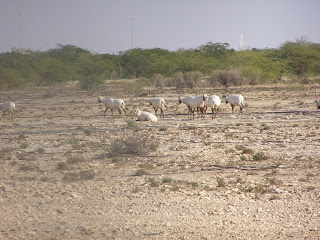
The animals were hunted to extinction in the wild, but the Emir's herd was so successful that some were reintroduced back into the desert.
I went to the west side of the country with my mom and two other people she knows. We were going west across the country on a highway, and stopped to look at some camels on the side of the road.

They were behind a fence, and were being raised the way Americans raise horses. The desert isn’t sand like I expected, it is mostly hard ground and rock.

We then went to the al Zubarah fort. It was built in 1938 on the ruins of a destroyed castle and used as a defense against Bahrain. The holes in the building were meant for guns to shoot out at intruders. The fort was then used as a jail as late as the 1970s, and as a Coast Guard place until the 1980s. It was then turned into a museum.
When we got there, there was no one there. We just walked on in and went around. After a while some other people arrived.

After going around the fort, we went to the Arabian Gulf. I waded out, it is really shallow and I couldn’t really go swimming.

Then we went to al Zubarah town. It was build in the late 1600s, and most of it has not been unearthed. In its day it was huge – some European maps called all of Qatar Zubarah after the town.

Coins from India, China, and European Africa have been found there. The city is estimated to be 2,000 by 800 meters. It will be much more impressive if it is ever fully excavated. Like the fort, we just walked on in. There wasn’t a place for anything official, it was completely self guided.

On our way home we stopped by the Emir's personal zoo, and could look in through the fence. He had various animals (mostly African) including the oryx - the national animal of Qatar.

The animals were hunted to extinction in the wild, but the Emir's herd was so successful that some were reintroduced back into the desert.
Sunday, December 16, 2007
Cramer and Paul Channel Friedman
Jim Cramer talked to presidential hopeful Ron Paul recently concerning adding oversight to the Fed Reserve. Their conversation bears a similar cord Russ Roberts interview (transcript) with the late Milton Friedman last year on EconTalk. The lack of transparency is so severe, the potential for disaster so high, Friedman said
I've always been in favor of abolishing the Federal Reserve and substituting a machine program that would keep the quantity of money going up at a steady rate.
Sunday, December 09, 2007
Speaking of Moral Hazard....
I hope my money and banking students can answer the following:
Was the Federal Reserve justified in its role in preventing the bankruptcy of LTCM? In answering this question, be sure to address issues of moral hazard and the key goal of the central bank.
Saturday, December 08, 2007
No Long Term Fix
President Bush is mistaken if he thinks he--or Congress--can "fix" subprime mortgages. Force banks to give people, even a few people, a lower rate than agreed on and you set a precedent for abuse. While their situation is unfortunate, borrowers are not victims. If you treat them as such, years from now they will gamble as though they cannot lose.
AP paradoxically called Bush's plan a "no quick fix" but it's the long run that could prove more disastrous. Give a man a Pinto and he will drive like a saint. Give him a tank and he'll drive like however he wants.
AP paradoxically called Bush's plan a "no quick fix" but it's the long run that could prove more disastrous. Give a man a Pinto and he will drive like a saint. Give him a tank and he'll drive like however he wants.
Sunday, December 02, 2007
Our Utopian Society
From an article on Salon about the history of cleanliness, I found this quote to be interesting:
Last Christmas I visited a great aunt of mine who lives in an old house in rural Ohio. She still doesn't have indoor plumbing; she has an outhouse and a pump in the kitchen for her sink. It's amazing how far we've come in the past couple hundred years, especially in things we take for granted like the number of bathrooms in our houses.
In the 19th century, Harriet Beecher Stowe, who wrote "Uncle Tom's Cabin," said she dreamed of a time when there would be one bathroom in an American house for every three or four bedrooms. People at the time thought that was just crazy utopian, just so over the top compared to what they were used to. Now a luxury apartment across from the Metropolitan Museum in New York City has more bathrooms than bedrooms.
Last Christmas I visited a great aunt of mine who lives in an old house in rural Ohio. She still doesn't have indoor plumbing; she has an outhouse and a pump in the kitchen for her sink. It's amazing how far we've come in the past couple hundred years, especially in things we take for granted like the number of bathrooms in our houses.
The Cure Is Worse Than The Disease
An FDA report will be discussed tomorrow concerning the agency's poor performance. The agency claims it simply needs more funding which it will use to centralize its work and add management positions.
It would make more sense to return the agency to an advisory status. This would drastically reduce its costs and could accomplish a handful of things really well instead of doing many things poorly.
Throwing money at a problem rarely solves it--the organization must have to have a strong incentive to use resources wisely. Companies have an incentive to make a safe and useful product. Dangerous ones will slip through, but at least the error is self-correcting. When things go bad, the drug is pulled. The FDA, however, is rewarded when it turns out most drugs--even good ones that can save lives. And this error doesn't disappear. People continue to needlessly die.
The question is not if free markets or government is perfect at screening disease. Neither is perfect; it's a useless inquiry. The question is which one is most robust against error: a single government agency or the collective wants and constraints of millions of interacting people.
Subscribe to:
Posts (Atom)

 Sunk Costs Cannot Be Retrieved.