Monday, February 29, 2016

Against Free College

All things being equal, having a college degree is better than not having one. Degree holders make more money and have an easier time finding a job compared to non-degree holders. The difference between just a high school degree and a college degree is over $400 a week (about $20,000/year!). And it's an asset that needs no maintenance and can never be taken away from you. With such large benefits, why shouldn't college be free?

(Of course it's not "free." People on both sides of this argument know it's not "free." But "subsidized so much that the price consumers pay is at or near zero" is too damn long. So I'm calling it "free" for short.)

Free college is not smart policy. For one, it's not entirely clear college debt is a problem. Average debt may be high, but it's driven largely by graduate students. Median balance is just $8,500. And that's only the people who have any debt at all. (To say nothing of subsidization causing the higher tuition in the first place.) Free college is a solution looking for a problem.

But even if this wasn't true, those large internalized benefits make the argument for free college so hard: why shouldn't you pay for something you benefit so much from? Why should other people be forced to shoulder the cost of something that benefits just you? Any externalized benefits to college degrees (slightly lower rates of crimes, for example) are tiny compared to the internalized benefits. With a tertiary enrollment rate of about 90%, any additional incentive would be wasteful. Clearly, further subsidization isn't necessary to encourage people to go to college. If anything, the U.S.'s attendance rate it too high already.

If the benefits are internalized, the costs should be as well. College is the first time in most people's lives where they get to truly customize their education. This isn't merely choosing this or that AP class. This is choosing the most defining aspect of your degree: your major. It determines not only a large share of what classes you'll take, but also the skills you develop and what it says about you as a person. It's no wonder that salaries vary widely by major.

That customization derails another common pro-free college argument: people pay for their own education through the tax system. Higher income means more taxes owed, especially with progressive taxes. It's sort of like a loan. But this is an incredibly sloppy loan system, with cost nonsensically removed from payment.

Many forms of compensation are not taxable. Jobs differ with varying levels of fulfillment, work hours, flexibility, stress, prestige, and so on. Desirable jobs will have many applicants and undesirable jobs will have few. Differences in wages compensate for differences in working conditions and the fun jobs get a modest paycheck. Yet those favorable conditions cannot be taxed (how would one possibly tax the joy of being a musician?). Some simply won't pay for their education through the tax system. They will learn while others work.

College graduates don't have to be starving artists for this play out. You can live a good life and force strangers to pay for your education without having to pay for the education of strangers. It takes a lot of money in the U.S. to enter the realm of net-tax payer. Only the wealthiest Americans pay any net tax at all. Maybe there's a tax plan out there that will ensure proper payment (and that's a big maybe), but it's unlikely to be fairer than simply paying tuition.

There are already many paths in place to address the big advantage of free college: educational mobility. Increase funding for Pell grants and other programs which target low-income students. There will be more schools like Berea College which charges zero tuition and focuses enrollment on the financially strained. Payments could only be due starting the first few years after college, when incomes are lowest and most in flux. Improve secondary education and encourage trade schools so fewer students drop out (dropouts are most likely to default). We are awash in better solutions.

Not only are these alternatives less costly and more just than free college, they're also far smarter.
Monday, January 18, 2016

In Favor of Designer Babies

The ethics of designer babies--humans with an enhanced genome--was a big topic last year; I imagine it will be again this year. And I imagine most of the arguments will, again, be against. This is a problem.

The pro-ban argument hinges on inequality: only the rich could afford giving their kids the genetic advantage. There would be haves and have-not. The gap between the rich and poor would widen.

To be clear: this widening does not come from the poor will be poorer. It would occur because the rich will be richer (or at least more secure in their wealth). And those gains will not come from corruption or favorable tax laws or money from a dead relative. Those gains will come from genetic enhancements. Intelligence is the clearest candidate but other traits such as work ethic, memory, and ambition could theoretically be boosted.

This is where the pro-ban argument falls apart. If there are more people who are smarter, without anyone being stupider, that's a better world. If there are more people who have great memories, without anyone being more forgetful, that's a better world. It means more and better inventors, doctors, entrepreneurs, and all the other occupations we associate with a better world. The designer babies will grow into designer adults who will be wealthy because they made the world a better place.

Designing your baby is no different than the many other things parents do to give their kid an advantage. Smart people tend to mate with other smart people because they don't want to risk having a stupid kid. No one argues that provides an unfair advantage, though the advantage is as fundamental as genetic engineering. Reading to your child gives them a huge advantage. As does raising them in a loving household.

When it's argued that we should do these things less, it's clear how backward a designer baby ban is. Last year, philosophy professor Adam Swift claimed parents shouldn't read to their kids because some kids have parents who don't read to them. It's an unfair advantage, he says. Same with loving your kids: a stable and caring household is an unfair advantage. But, obvious to anyone who thinks about it for a few minutes, the best response isn't to read to or love your kids less. It's that people should do these things more. 

And that's the final nail in the coffin for the pro-banners. All technology starts out as only for the rich but falls in price as production improves. Costs came down for computers, for cars, for air conditioning, for cell phones. Why not for genetic engineering? Imagine a world where a cocktail of genetic improvement is as standard as an ultrasound. Where everyone is cancer-resistant, Einstein-smart, and lives to be 200. That's a strictly better world.

But it can't happen if it can't ever get started.

Wednesday, July 29, 2015

Keep the Olympics in Athens

Boston gave up on its bid to host the 2024 Olympics on Monday, a surprisingly wise move given the city was home to the most expensive highway project in the US: the way over budget Big Dig. Maybe the whole ordeal made Bostonians suspicious of megaprojects. And rightfully so.

Projects that cost a billion dollars or more--whether private or public--tend to take much longer and cost much more than initially estimated. It's not simply corruption. It's also just very hard to estimate these parameters.

Olympic preparation is a particular dumb megaproject. The building big, special-use stadiums is outrageously expensive. And that doesn't include the upgrades to transportation infrastructure, hotel space, and other projects. Brazil faced protests in 2014 over its spending and forced relocation efforts for hosting the World Cup and Rio's experiencing some of those same protests again over its Olympic hosting. It's no wonder economists agree that hosting the Olympics is a bad deal.

Maybe having a new host city every four years made sense in 1896, when the modern Olympics first began. There was no television. Radio was only invented the year before. But in the Information Age, a rotating host city is an anachronism.

Keeping the Olympics in Athens eliminates many of these cost problems. Yes, the infrastructure would have to be maintained but it will be far less costly than recreating it every four years. Countries would loss the ability to gain prestige from hosting the Olympics, but hopefully more cities will realize it's a bad deal and that prestige will morph into embarrassment.

Saturday, July 04, 2015

Happy Fourth!

Every Independence Day, I read the Declaration of Independence. Join me, won't you?

Friday, May 22, 2015

On Foolish Correlations

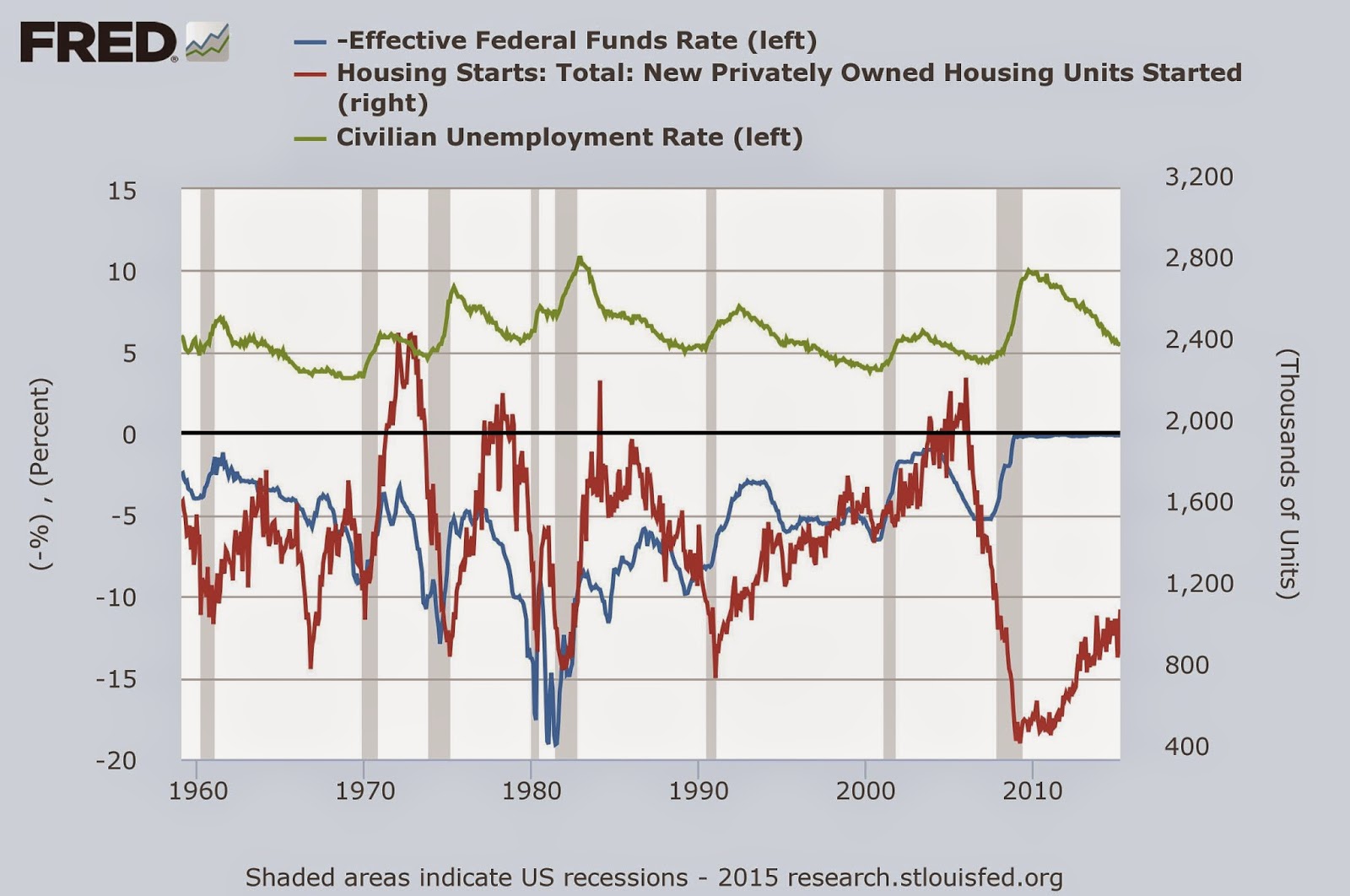
James Montier and Paul Krugman are in a bit of a spat over how much interest rates matter. Krugman put forth data from FRED (Federal Reserve Economic Data) showing a strong correlation between interest rates and housing starts. But, says Cullen Roche, he left out 40% of the data, putting his whole thesis into question. A simple regression of the all the data yields an R-squared of just 0.0453 (in other words, interest rates predict about 4.53% of the variation in housing starts).

But the ultimate problem isn't the missing data but the premise. If monetary policy is effective, we shouldn't see much of a correlation between interest rates and housing starts because, by the nature of the Fed, interest rates should be low during recessions. That's one of the jobs of the Federal Reserve: keep unemployment low.

There's any number of appropriate variables you can pick to factor in market conditions but let's look at the big one: civilian unemployment. Here's the graph with civilian unemployment thrown in:


Unfortunately, it's hard to tell much from this but a regression can help. With change in interest rates AND unemployment predicting housing starts, we get:
  • Unemployment
    • Coefficient: -100.6
    • T-Stat: -11.48 (statistically significant)
  • Interest rate
    • Coefficient: -22.7
    • T-Stat: -5.91 (also statistically significant)
  • R-squared: 0.202 (now we're explaining over 20% of the variation!)
Here's the interesting bit about this regression: Krugman transformed interest rates to be negative. Graphically, this makes it easier to see the relationship: when both lines are increasing, that means a negative correlation. Lower interest rates mean more new construction.

I didn't remove that transformation when I ran the regression. Thus the negative coefficient means positive correlation between interest rates and housing starts. So despite the incomplete approach by his critics, Krugman still appears to be wrong.

But don't throw out the demand curve just yet. New housing starts don't just respond to monetary policy; monetary policy responds to new housing starts. It is the classic causation problem that comes up in statistical analysis, especially regressions.

This is why theory is so important; it just makes too much sense that as interest rates fall, people will want to borrow more. Untangling all the effects to demonstrate that is indeed the case--and to what degree that's the case--cannot be done with something as simple as a correlation coefficient.

Tuesday, May 27, 2014

95.8% of Averages Are Nonsense

Sent to Marketplace today:
Your interview with Jules Pieri on the morning of May 27th concerning Title IX for business missed a crucial point. Pieri assumes that such a large gap in venture capitalist money (only 4% to women) is due to sexism.

But men tend to pursue degrees in the sciences, such as engineering and computer science. These skills more easily translate into start-up ideas compared to the softer sciences women tend to major in. Even a study NPR reported on in March found investors chose businesses proposed by men 68% of the time, not 96%. There's a lot more going on than the raw averages suggest.

Venture capitalists make money by investing in good ideas. But at the heart of Pieri's Title IX proposal is a bizarre notion: these capitalists care more about being sexist than about being profitable.

I am deeply disappointed you didn't question her on this all-too-common over-simplification.

Sincerely,
David Youngberg
Asst. Professor of Economics
Montgomery College

Thursday, May 15, 2014

Poor Prioritization

Sent yesterday to NPR concerning this story.
Dear Ms. Michel Martin,
 I was disappointed when I heard your story today concerning the connection between the career of Barbara Walters and the kidnapped Nigerian girls. Rather than emphasizing the large gap in opportunity that exists between people in different countries, you focused on the tenuous gender income gap within the United States.
 As you briefly acknowledged, the comparison is complex and there are many logical reasons why women earn less. But moments later, you casually ignored that complexity and claimed a woman earns less simply because she's a women. But women earn less because of the choices they tend to make, not simply because of their gender.
 When you control for all the complexities--women tend to take more time off, they tend to pursue low-paying fields, they tend to work less dangerous jobs, etc.--the pay gap all but disappears. These complexities are at the heart of the conversation. To brush them off as you did is disappointing and distracts from more important issues.
 Attention is a scarce resource. Sexism, while terrible and still in place in modern day America, is not the most crucial issue of the day. It is, thankfully, rarer now than it was decades ago when Walters began her career. Equating the pay gap of today to the rampant anti-women terrorism in Nigeria does a great disservice. There are much more important lessons to draw from the tragic story of the kidnapped Nigerian girls.
 Sincerely,
David Youngberg
Asst. Professor of Economics
Montgomery College

Wednesday, January 29, 2014

Efficiency Wages Are Not Free Lunches

President Obama visited a CostCo today to champion the wages they pay their workers and boost support for increasing the minimum wage. Other businesses should follow suit, he said, as a higher wage “helps build a strong workforce and profitability over the long run.” And he's right: the main motivation for CostCo's wages is because it builds employee loyalty. Henry Ford knew this well. One hundred years ago he offered twice as much as other employers which led to boosted productivity and low turnover. But that logic does not translate to the larger economy. To use it as a justification for increasing the minimum wage is completely backwards.

Economists call the strategy an "efficiency wage." It's a wage purposely set above the market wage so they improve the pool of job candidates, retain good workers, and encourage productivity. Because it's above market wage, this high wage will attract the best workers. Because it will be hard to find a comparable wage elsewhere, they are less likely to quit and more likely to work hard.

But if everyone has a higher wage, many of these benefits disappear. It becomes an expectation, not a perk, and because everyone offers it, fewer workers will be particularly motivated by it.

If politicians think companies should embrace raising the minimum wage because it will increase their profits then they should remember that these companies don't need government permission to increase them. If they're not doing it on their own, one can only conclude it's not the free lunch the President is telling us.

Monday, December 09, 2013

Wages Are Not Special Prices

Americans are calling for an increase in the minimum wage and the airwaves and internet are filled with commentators claiming increasing the minimum wage won't have any unemployment effects, or any ill effects at all.

The problem with studies which claim there's no immediate employment effect is that they don't or can't examine other reactions to price controls. Employers could respond by cutting worker hours or hiring less (which would play out over the course of several years). They could raise prices, effectively reducing the wages of their customers. They could cut wages or raises from higher-paid workers which could hurt the underlying functionality of the business as these employees work less hard or quit. Indeed, many studies point to a real and negative unemployment effect to the minimum wage.

We know legally fixing prices make a mess of things. Pegging gas prices artificially low back in the 1970s created huge lines and massive shortages. Capping bread prices caused Washington's army to starve at Valley Forge. FDR and Hoover encouraged high prices during the Depression (on the theory that it would increase wages and employment), which helped transformed the 1930s into America's worst economic crisis in history.

Wages are prices for labor. Proponents of increasing the minimum wage are so willing to overturn over two centuries of economic thought, yet have no explanation why this particular price control won't have well-documented unintended consequences. The demand curve slopes down.

Tuesday, July 09, 2013

Mythbusters: Economics Edition

Robert Atkinson and Michael Lind posted a terribly foolish article on introductory economics yesterday at Salon. They claim economists tell a series of ten myths but fail at every turn. Let's look at each "myth" in turn.

Myth 1: Economics is a science. They claim that since there is disagreement in economics--citing a survey reporting 40% of economists agree increasing the minimum wage would make it harder for people to find jobs and 40% disagree--economics cannot claim to be a science.

Right off the bat, the survey they cite actually ask respondents if raising the minimum wage would make it noticeably harder for people to find work. "Noticeable" means different things to different people (hardly a scientific question) so you're going to get disagreement. Better wording yields 79% agreement.

But fundamentally, economics is a science. You might see economists disagree a lot because we like to talk about things we disagree about. Discussing points of consensus is boring, like two astrophysicists arguing if the earth revolves around the sun or the sun revolves around the earth...no one will take the latter argument. Sure, as a social science economics has more give than the physical sciences. But we still test our hypotheses and make accurate predictions.

Myth 2: The goal of economic policy is maximizing efficiency. They claim the actual goal is to create disruptive innovation which, in turn, causes inefficiency. The right allocation isn't the goal.

This is really just a misunderstanding between the short and the long run. In the short run, R&D spending might seem inefficient (and it is at some level; too much on R&D means you don't have income coming in to fund it). It's a payment without a benefit. But in the long run, it's worth it. It's an investment and smart investments result in greater efficiency.

Myth 3: The economy is a market. They claim that a great deal of economic activity takes place in governments, households, and nonprofits.

Let's be clear: a "market" is a gathering of people who engage in exchange. Conventional markets are an excellent (clean) way to illustrate how the economy works, but governments, nonprofits, and even households illustrate market activity, too. Government actors swap favors and votes. Bureaus and nonprofits compete for funds. Even households engage in specialization and exchange ("Who's turn is it to do the dishes?)

But all of this is really a minor point because the purpose of this "myth" in econ 101 is to discuss how this sort of activity plays out. Buying and selling (and producing!) in a conventional sense is clean world for students to discuss and understand. We set aside complexities for much the same reason you ignore air pressure when calculating how long it takes something to fall 30 meters in physics.

Myth 4: Prices reflect value. They point out sometimes prices don't reflect value, such as in stock markets bubbles.

This is why every econ 101 class covers externalities (when prices don't reflect value). The flaws of the Efficient Market Hypothesis is good to discuss in finance (I sometimes cover it in introductory but ultimately decided other things were more important). But the EMH is useful: most of the time, prices really do reflect value. If they didn't economists could play the stock market and be billionaires overnight. But, as any investor will tell you, beating the stock market is really, really, really hard. The EMH explains why.

Myth 5:  All profitable activities are good for the economy. They claim some profitable activities, like crony-capitalism (profits that come from political connections) and stock market manipulation, aren't good for the economy.

Again, this is why we cover externalities and monopolies and taxes and subsidies. No econ 101 course would claim all profitable activities are good for the economy.

Myth 6:  Monopolies and oligopolies are always bad because they distort prices. They claim that having a few producers can be good because of economies of scale and innovation creation.

Beyond the obvious contradiction between this myth and the previous two, most monopolies really are bad. But econ 101 covers the idea of economies of scale and it's connection to monopoly (called a natural monopoly). The value of monopolies (incentive to invent) is something I cover in my class and admittedly, I think it should be a larger part of the conversation.

Myth 7: Low wages are good for the economy. They claim high wages are good because you get workers with high productivity.

And they would be right, but ultimately wrong, because no economist claims wages should be high or low. Economists just want wages (like all prices) to be correct. See item #4.

Myth 8: “Industrial policy” is bad. They argue industrial policy can be good because governments can encourage firms to shift money to R&D and other activities with a high rate of return.

It's not that industrial policy is "bad" (again, economists argue subsidies and tariffs are useful policy tools) but that it's dangerous (because, again, crony-capitalism/corruption can get in the way of good policy). A handful of people (government agents) guiding the economy will be more corruptible and less informed than a hundreds or thousands of firms being paid for being right.

Myth 9: The best tax code is one that doesn't pick winners. An ideal tax code would encourage efficient innovation (e.g. R&D tax credit).

But most tax codes distortions are really undesirable and it is just as dangerous to invest too much in R&D than it is to invest too little. There is good reason to start with the idea of zero favoritism. To claim 101 students should consider all the nuances to slight modifications along this line is a waste of time; if students are in a position to influence policy, they can call an expert for advice and ask him/her about the devil which lives in the details. Besides, this general idea is covered in 101 anyway: in externalities.

Myth 10: Trade is always win-win. Industrial policy is the ultimate driver of what determines what a country is best at producing, not comparative advantage. "Koreans and Japanese are not good at making flat panel displays because they have a lot of sand"

I quoted that last bit because it is particularly unbelievable. The source of a country's comparative advantage isn't limited to natural resource but labor force skills and size, location, compatible industries, trade port quality, natural of government, etc. Governments and firms can foster comparative advantage in one direction or another (risky, for reasons mentioned above) but it really is all about comparative advantage.

What all this has to do with trade nor always being win-win is unclear but it's worth noting (in a nod to item #1) that economists really do have wide consensus on the virtues of free trade.

Much like any discipline, economics is a complex subject; the important stuff doesn't stop at the introductory level. If the authors feel econ 101 could use more nuance, they should remember a sizable portion of classroom time is taken up correcting the nonsense students enter the course with, nonsense reinforced by articles foolish journalists write.

Thursday, July 04, 2013

In Praise of Unpaid Internships

Companies, of course, want cheap labor. It's hard to get cheaper than free so some firms will let people work for nothing. Why would anyone take this deal? Seems bizarre to be willing to work well, well, below minimum wage.

But millions take these jobs, better known as unpaid internships. In fact, more than half of all college-level interns weren't paid. And that doesn't include post-college internships.

Why so much interest? Being in an internship--paid or not--demonstrates a level of legitimacy to future employers, signals responsibility and professionalism, unlocks networking opportunities, opens the door to one or more professional references, and may even lead to a full time position. Of course, many of these things may not happen but you can say the same thing of going to graduate school (another way to stand out in a crowded job market). And graduate school takes a lot longer and is a lot more expensive.

So here we have a system of mutually benefiting participants. Interns get experience and networking. Companies get free labor. They would be willing to pay more if they knew the interns were worth the extra cost, but they don't...that's why interns are willing to work for free. It's their chance to prove themselves. Why would anyone have a problem with this?

Enter Eric Glatt, the Black Swan intern-turned-law-student who sued for wages. To be clear, he knew the position was unpaid. He knew it could lead nowhere (or was foolishly optimistic). But he sued for something that was never ethically owed him anyway. (Granted, he was probably right on the law but as a matter of justice and fairness, the company owed him nothing.) Last month, the court ruled in his favor.

Glatt recently appeared on Q on NPR advocating and end to minimum wage internships. Virtually none of what he said made sense. Most of what he says isn't worth repeating as it's ignoring the logic of why people eagerly take unpaid internships.

But of note he claims "interns who do get paid...get better paying jobs when they finish their degree than those who did unpaid internships. Some studies even show that people who did unpaid internships have a lower starting salary than people who did no internships at all."

Great workers are hard to come by so companies are willing to pay them more to make sure those workers work for them. Interns who do get paid are probably very talented compared to those who don't and thus will naturally go on to higher paying jobs. But internships aren't the only way to stand out in a competitive job market: those who do no internship at all might not because they have particularly impressive grades, extracurricular activities, or recommendations. Causation is not as clear-cut as Glatt implies.

There is nothing immoral about offering an unpaid internship and nothing foolish about taking one.

Thursday, June 27, 2013

The Economics of Bigotry

Conventionally, profit-seeking and bigotry are contradictions in terms. A company that constrains who can be an employee interferes with the ability to get the best employee and thus interferes with profits. A company which limits its customer base affects its bottom line. The same logic can be applied to personal relationships: if you refuse to make friends with people of different ethnicity, genders, religions, sexual orientations, etc, then you limit the pool of potential friends. Since people are so diverse in their interests, bigotry can make you very lonely. Incentives discourage bigotry.

If it was that simple, the Supreme Court ruling on the Voting Rights Act would be inconsequential and we could safely say anti-discrimination laws have no place in a libertarian government. Economic incentives (which we know are very powerful) would discourage bigotry so much, such laws would serve no purpose. But it is not so simple.

The person who hires is not always the same as the person who profits from that hiring. In fact, it is very common that the manager is not the owner of the store she manages. While a manager's salary and job security are tied to the division he manages, it's an indirect tie. The likelihood he'll get full credit for good performance diminishes the farther the manager is removed from the owner(s). Knowing this, a manager (particularly a low-level manager) faces a very low cost to be a bigot. She gives up little (a small, small chance to get credit for good sales) compared to the owner so she indulges in bigotry more than the owner would. The demand curve slopes down.

This is a real concern for owners who naturally want the very best performers, but it is virtually impossible to get around. Refusing to hire the best person due to bigotry is hard to detect; there is no obvious error the owner can point to (unlike hiring a stupid or lazy person, where there is a record of complaints and poor performance).

What makes matters worse is that sometimes the best performers (or customers) are bigots themselves. Even if a manager isn't a bigot, he may be encouraged to avoid certain traits others  unjustly find offensive. This concern, real or imagined, might be more prominent than we may be willing to admit: the desire to be around people who look like you is a strong one, one probably hard-wired into our DNA.

This instinct increases the benefits of bigotry. In the FX series Justified, the main character is a deputy U.S. Marshal in eastern Kentucky. While not a racist himself, he's found it advantageous to his job to feign some racist attitudes. More people are willing to talk to him if they feel like he's "one of them." It's an extreme example, but it highlights an important point. We not only like to be around people who look like us, we like being around people who think like us. The more people who have foolish views of those who are not like them, the greater incentive to engage in those views (or least, not challenge your primitive instincts). Bigotry becomes self-sustaining.

This is what makes the ruling on the VRA so disturbing. Even though the South had issues with racism "a long ago" (half a century ago), that certainly doesn't mean many of those attitudes are gone. As the recent decision by students to resegregate a South African school demonstrates, old habits die hard.

Wednesday, May 29, 2013

Consumer Surplus Is Everywhere

People tend to complain that goods are really expensive or even over-priced. Such good are actually very few; most goods come at great deals. They are just so common, we tend not to notice them.

Consider my bed. Less than two years ago, I paid Ikea $400 for a mattress and box spring. It's incredibly comfortable and still in great shape. Since I'm moving in a couple of days, I'm giving it away (I need to get rid of it quickly). Did I get my money's worth?

Over the past 21 months, I've spent about 16 months sleeping in my apartment (the rest visiting my fiancee during breaks). That means that bed cost me $25 per month, or less than a dollar a night (about 83 cents). On any night, I would have easily spent ten times that amount to avoid sleeping on the floor. I would probably go as high as 15 times (or $12.50). Thus I received $6,000 (or, 15 times $400) - $400 = $5,600 in "consumer surplus." I don't really think of this bed as costing $400. I think of it as giving me a net of over $5,000.

I assume most of you have never calculated your consumer surplus (the most you are willing to pay minus how much you actually paid) for your bed. I bet you haven't done it for your electricity, Internet access, gasoline, or toilet paper. Anything you buy without thinking too much about if you should buy it are items you get a lot of surplus from. Take a moment and estimate your consumer surplus from one of these items. You'll find a lot of stuff is really cheap.

Monday, April 29, 2013

It's All Costs and Benefits

The way economists approach consumer choice theory (why do people buy what they buy at the prices and quantities they do) is really simple. Economic Man (or Woman) goes to a store or website. "What is the most I am willing to pay for this?" thinks Economic Man. "What is the price?" he asks himself. If the value exceeds the price, he buys it. If it doesn't, he doesn't. Simple. Rational.

Nobel Laureate in Economics Daniel McFadden recently argued that economists need to rethink how economists approach consumer choice. Psychology, neurobiology, and other disciplines find a host of things which put our stable, simple world into chaos.
To take one example, the “people” in economic models have fixed preferences, which are taken as given. Yet a large body of research from cognitive psychology shows that preferences are in fact rather fluid. People value mundane things much more highly when they think of them as somehow “their own”: they insist on a much higher price for a coffee cup they think of as theirs, for instance, than for an identical one that isn’t. This “endowment effect” means that people hold on to shares well past the point where it makes sense to sell them.
There are others as well: your loss of happiness is greater if you lose X than your gain of happiness if you acquire X. People prefer a free $10 gift card than to pay $1 for a $15 gift card. There is such as thing as too many choices. It's enough to make economists think people are irrational.

No doubt that people care for other things beyond what you see in our simple model, just like air resistances affects how fast a ball falls but it's so hard to incorporate that at the basic level, you assume it away in intro physics. It's a simplifying assumption. It doesn't require that we redo all of economics or change our fundamental approach.

And this is where these economists get it wrong because most stop there but they shouldn't. None of this demonstrates that people are actually irrational. Rationality is a very low bar in economics: do something when benefits exceed costs. That gets us very, very far. These studies that other disciplines tout are important, not because they undo what we know but because they add to what we know people care about. People derive inherent satisfaction from owning things or getting things for free, just as they value food, sex, and shelter.

Nothing really changes. I guarantee that if you change that $15 gift certificate to $20, $30, or $50, you'll see fewer people willing to indulge in their preference for "free" things. Demand slopes down.

This extends to all areas. Advertising works but it can never brainwash someone into buying something they don't want on some level. Advertising has limits and the fact that you don't buy everything you see advertised to you is a testament to that. I don't like tomatoes and I don't wear makeup. I know this about myself and no matter how many ads I see for either will not change my purchasing patterns. (I've seen thousands of ads for bras; I've never bought one.)

Ads work because they help us economize on other things we find valuable such as time and mental energy. On occasion, I find myself at the store wanting a general thing, like a cracker, but no strong preference on brand name. Then I remember a jingle or a funny commercial and so I buy Wheat Thins or Ritz. This is not irrational; I didn't have a strong preference and making a choice is costly both in time and mind. Costs exceed benefits to make up my own mind so I'll do what's easiest: I'll follow the ad.

That I am describing this everyday purchase in this way does not make me unusual. Quite the contrary, as an economist I'm trained to think like a typical strangers. Time is a real resource people care about. Thinking hurts. So we avoid it if it's cheap to do so. We are rational.

Thursday, April 25, 2013

Unsustainable Pricing

A series of clicks today led me to this YouTube video of Senator Warren's March 2013 congressional hearings on the minimum wage.

At 2:53 she notes as a result of an increase in the minimum wage to $10.10/hour over three years, the price of a fast food meal would rise by four cents.
So instead of it being $7.19 it would be $7.23. Are you telling me that's unsustainable?
Given the context, "unsustainable" probably refers to the restaurant business itself. As in, "if you raise your price by four cents, are you really going to have issues?"

The answer is yes.

There is a nasty consumer habit to believe that the prices we see are given, as if they were determined randomly or granted to us from a deity. But they are the careful, careful decision of business owners and analysts with the sole aim at maximizing revenue. The $7.19 price came from a conversation like this (all prices are post tax):

"How about $7 for the meal?"
"$7 is a bit low; I bet we can up our revenue if we increase by two quarters."
"Our market research tells us our consumers are particular price sensitive, especially given the state of the economy. I wouldn't go higher than $7.05."
"Really? We can definitely go higher than $7.05. I was thinking $7.40."
"No way! Our competitors' are pricing lower than that. We gotta go much lower."
"Our competitors price there for a reason."
"A TV dinner only cost $5. This is our competition."
"It isn't nearly as easy, nearly as good. When we offered a coupon last year, people barely used it. We can afford to go higher. We have investments to pay off."
"How about $7.35?"
"Burger King's $7.25."
"It also's been hitting the airwaves harder than us. Let's drop a little below them and get our customers through price."
"$7.24?"
"A little bit more; something big enough that they just can't respond."
"$7.17? Has a nice ring to it"
"Maybe...or $7.20"
[Market research]
"$7.19 seems to be the sweet spot."

This is an abstraction, (void of uncertainty which is another factor they consider but I need to go to bed) but it's meant to remind us that firms do not grab numbers from nowhere, especially for firms who tend to sell very cheap food and where customers are very sensitive to price. Warren's thought process seems to be "Well, I'd pay 4 cents more while on my campaign trail" but she is a wealthy individual with very little time and not many alternatives: it's hard to get more insensitive than that.

Many customers, especially when times are tough (and thus when  increasing the minimum wage is most popular), are very price sensitive. This goes double after a lot of time has passed and they can adapt to the 4 extra cents (which, for a family of four and a biweekly meal out totals to $16.64 over the course of a year) in ways such as going to restaurants with fewer minimum wage workers (and thus less of a price increase so at least you get more for your money) to eating at home more to eating less when you do eat out.

At the heart of Warren's question is a puzzle: if an extra four cents is so sustainable, why isn't it already four cents more expensive?

It's because it is. That's the revenue maximizing price.

Tuesday, February 26, 2013

The Government Isn't a Household

I was recently told that the balancing the U.S. budget is like balancing a family budget. If you're spending too much, cutting out a lot of little things can make a big difference. In the conversation, cutting back on the EPA was a theme.

The EPA budget in 2011 was about $8.5 billion. The Federal government spent $3,630 billion that year and brought in $2,314 billion. This is a deficit of $1,316 billion. So if we to eliminate--not merely scale back but completely remove--the EPA, we are shaving off a little more than 0.6% of the deficit.

Let's put that in perspective. Suppose your household make $50,000 a year (after taxes) but you spend about $78,435 a year (this keeps our household income and expenses in proportion to the Federal government: here our deficit is $28,435). Our EPA equivalent is an expense of $170.61. You're spending more than $28,000 a year than you earn and some people are arguing you can solve your problem by three fewer video games.

Yes, yes, I know. The argument is that if we do enough of these little cuts (and keep in mind, I'm eliminating the EPA, not just cutting it back), it adds up into a significant effect. Forget the fact that there aren't enough little cuts to use until you run into the politically tough stuff (Medicare, Social Security, defense). The household analogy is fundamentally flawed beyond that.

Imagine you attempted the same strategy but you needed everyone's approval before you made changes. You can't cut your cellphone budget unless your talkative daughter approves. The video game budget adjustments need approval from your kids. Hell, even your dog has to approve adjustments to how many new toys he gets.

Now spending your time and effort taking away a few video games seems really dumb. In fact, it might be better to spend more on video games just so the kids won't complain when you dip into their college fund (which is a really big expense and can solve the problem by itself).

Like a household budget, our budget needs to be balanced. But there's where the analogy stops because to change the Federal budget, you have to get approval from folks who are about as forward thinking as teenagers and as thoughtful as a family dog.

Thursday, February 21, 2013

The Scarce Resource of Political Capital

A couple of days ago I participated in a round table discussion on the state of the economy. It was organized by the office of Representative David McKinley and included local business leaders and political actors. Two of Bethany's best students were there as well, about 12 overall.

While the main purpose of the meeting was sequestration, the businessmen wanted to express concerns about the EPA, making sure the congressman was aware of the barriers it sets up. The EPA's smothering them and, by extension, job creation. I emphasized regime uncertainty: the only way we're going to get the investment needed to bring job growth back up is for Congress to strike some kind of deal. There's too much uncertainty in the market. Everyone agreed, but I don't think people really got it.

Everyone seemed to believe that McKinley could do both: help strike a budget deal and weaken the EPA (and do other things, too). But he can't. He only has so much political capital to spend and making these things happen requires getting a lot of people on board. McKinely's a Republican so reigning in the EPA will upset some Democrats which will make it harder to strike a deal. And since he's a member of the Tea Party Caucus, increasing taxes is politically tricky, too. A common Sophie's choice in politics: what the country wants or what the constituents want. (Oh wait, that's not a good analogy; they will side with their constituents almost every time.)

This is why I like pork. If you think of it solely as a project (e.g. a bridge to no where), then yes, it's wasteful. No one seemed to like pork at the round table discussion and I regret I didn't defend it because pork makes things easier. If EPA deregulation and politically stable is what you buy with political capital, pork is a way to earn it.

Pork is cheap. Giving every Representative a $5 million pet project would cost a little less than $2.2 billion dollars. If that gives us a budget deal, we get stability and economic growth: that's worth hundreds of billions of dollars. Yes, it might take more than $5 million to get cooperation from some, but others won't require any pork. It's a good deal.

Political capital's a scarce resource. Like the money Congress is fighting over, you can't have everything. But if you sleep with the pigs, you might get enough to make everyone satisfied.

Friday, January 11, 2013

James Buchanan (1919-2013)

Nobel laureate and Father of Public of Choice James Buchanan passed away at the age of 93. He was a titan of a thinker and a tireless defender of liberty. He will be missed.

Here is Tyler Cowen, Alex Tabarrok, Robert Higgs, Arnold Kling, Don Bordeaux, Russ Roberts, David Henderson, and additional remembrances compiled by Don Bordeaux.

Pete Boettke posts a video of a panel discussion with Buchanan from a conference held in his honor, Don Bordeaux discusses Buchanan's thoughts on public debt (in two parts), and here is Buchanan's Nobel lecture.

Monday, December 03, 2012

Two Krugmans Enter, One Krugman Leaves

Paul Krugman likes to contradict himself but never have I seen it happen within a single column. Writing on health care costs, he states:
But even as Republicans demand “entitlement reform”, they are dead set against anything like that. Bargaining over drug prices? Horrors!
I agree, being able to bargain over drug prices is a good thing. Makes sense: being able to bargain and not blindly accept forced prices is a hallmark of free-markets. But later he writes:
If they were serious about deficits, they’d be willing to consider policies that might actually work; instead, they cling to free-market fantasies that have failed repeatedly in practice.
Ah, but you might say that the goal is to allow the government more bargaining power and since the government increasingly has monopsony power (like a monopoly but there're few buyers rather than few sellers), it's not a free-market. In other words, Krugman tells us that monopsonies are actually desirable, which is endorsing a law which states only Microsoft gets to hire engineers. Even non-economists should understand why that's a bad idea.

That's not the only issue with today's column--the claim that private firms apparently have no incentive to reduce costs is equally strange and the point that an underfunded voucher system won't work is equally obvious (since it's underfunded!)--but those are for another post.

Thursday, November 29, 2012

I'm Not a Grinch; I Just Don't Like Negative Externalities

I don't remember how it came up, but I couldn't help myself. And when it started, I couldn't stop. Today I told my managerial class that I don't like Christmas. Or, more accurately, the Christmas season. They were surprised, and so of course I had to tell them why. But my hatred for the season really stems for a hatred of any negative externality people blissfully ignore, things people don't think are externalities.

A negative externality is when something imposes a cost onto others. We are familiar with examples: pollution, cigarette smoke, screaming/crying babies, traffic. Basically anything someone does which makes people who had nothing to do with the transaction worse off. I buy power from the power company, but neither of us pay the cost of the pollution which poisons the water downstream from the power plant.

We're all well aware of these problems and there are attempts to correct for them. But what I find endless annoying are those negative externalties which so many refuse to acknowledge. And that brings me to the  Christmas season.

Christmas Season. For one month, everything becomes about Christmas. I must endure the decorations, the constant Christmas references in all media, the music on the radio, the Christmas theme in virtually every article, the extra traffic, and, most of all, the cheeriness of everyone who assumes you are as excited about the season as they are. Don't get me wrong: there are things I've found enjoyable. I like time with the family, I like my neighbor's Christmas cookies she bakes every year, I like the time off from work. But if we were to at least diversify the season for a month, I would welcome the change.

Sports. If you like sports, that's fine, but shut up about it. Don't be surprised when other people think slaying dragons is more interesting than watching football. Don't think me a fool because I don't know if the Raiders and the Cubs play the same game. Don't run around screaming and honking horns when the team you like wins. Or loses. (I really don't understand what motivates you.)

Dogs. Again, I don't hate dogs as much as the externalities they create. And really, I don't like how dog-lovers don't understand how inconsiderate they can be when they assume no one cares about these externalities. Dogs are not angels: they bark, they smell, their "kisses" are slobber. Dog poop, even when I see it to avoid it (which isn't always) stinks. Not to mention, they bite (and yes, they do bite; they of course don't bite you because you're the one who feeds them).

I am well aware that all of these things are better existing than not; the total annoyance they create is probably outweighed by the total joy they create. Benefits probably exceed costs, including the external, and in my book that's the thumbs up even if I'm not a fan.

But, for the love of all that is good and holy (religion: that's another one; not everyone's religious you know) stop assuming everyone's like you. I'm not excited that Christmas is coming, I don't want to pet your dog, and no, I didn't watch the #%$%^ game last night.